Tuesday, February 19, 2008

Thessalonica

Bird’s Eye View of ThessalonicaThessalonica or Thessaloniki (Greek: Θεσσαλονίκη), is Greece's second-largest city and the capital of the Greek region of Macedonia.

Thessalonica had a Jewish colony, established during the first century, and was an early centre of Christianity. On his second missionary journey, Paul of Tarsus preached in the city's synagogue, the chief synagogue of the Jews in that part of Thessaloniki, and laid the foundations of a church. Opposition against him from the Jews drove him from the city, and he fled to Veroia. Paul wrote two of his epistles to the Christian community at Thessalonica, the First Epistle to the Thessalonians and the Second Epistle to the Thessalonians.

Paul's teaching about the end of the world is expressed most clearly in his letters to the Christians at Thessalonica. Heavily persecuted, it appears that they had written asking him first about those who had died already, and, secondly, when they should expect the end. Paul regarded the age as passing and, in such difficult times, he therefore encouraged marriage as a means of happiness. He assures them that the dead will rise first and be followed by those left alive (1 Thessalonians 4:16).

16For the Lord himself will come down from heaven, with a loud command, with the voice of the archangel and with the trumpet call of God, and the dead in Christ will rise first.

This suggests an imminence of the end but he is unspecific about times and seasons, and encourages his hearers to expect a delay. The form of the end will be a battle between Jesus and the Man of Lawlessness (3ff) whose conclusion is the triumph of Christ.

More...

Monday, February 18, 2008

temple

The western wall of the temple mount, sacred place for JudaismThe architectural structure in Jerusalem that was the focal point of worship and the national life of Israel form the 10th century B.C. when it was built by king Solomon, until it was destructed by Rome in A.D. 70. The temple was rebuilt two times and had three periods during which the temples of Solomon, Zurubabbel, and Herod were in existance.

A temple (from the Latin word templum) is a structure reserved for religious or spiritual activities, such as prayer and sacrifice, or analogous rites. A ‘’templum’’ constituted a sacred precinct as defined by a priest, or augur. It has the same root as the word “ template,’’ a plan in preparation of the building that was marked out on the ground by the augur. Though a templum, technically speaking, is not a “house of the gods” but a diagram that for the Romans linked the geometries of heaven and earth, it was also indicative of a dwelling place of a god or gods. This tradition, of course, dates back to prehistoric times. For the ancient Egyptians, the word pr could refer not only to a house, but also to a sacred structure since it was believed that the gods resided in houses. The word ‘temple’ (which dates to about the 6th century BCE), despite the specific set of meanings associated with the religion of the ancient Rome, has now become quite widely used to describe a house of worship for any number of religions and is even used for time periods prior to the Romans. Stated differently, temple was once a species of sacred structures; today it is, in the English language, often used as a genus.

More...

Sunday, February 17, 2008

biblical studies

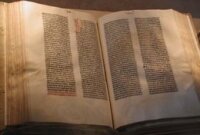
The Gutenberg Bible displayed by the United States Library of CongressFocused on the interpretation and exegesis of the bible.

Biblical studies is the academic study of the Judeo-Christian Bible. Christianity traditionally includes the New Testament and Old Testament, sometimes called the "Scriptures."


Judaism includes only the Hebrew Bible (the first five books of which are called the Torah or Tanakh in Hebrew). Biblical studies is a branch of theology, but also draws on the disciplines of history, literary criticism, philology, and increasingly the social sciences. Practitioners of Biblical Studies do not necessarily have faith commitment to the texts they study.

In Judaism

Biblical studies among Jews in a secular academic setting is fairly new. Historically, and for those Jews maintaining Jewish traditions (particularly the Haredi Jews and Hasidic Jews), the term "Bible Study" is not used, rather the term of choice was, and remains, "Torah Study", which included the study of Torah, Tanakh, Mishnah, Talmud, or Jewish law, Midrashic commentators and rabbinic literature. Jews have traditionally done their religious studies at home with their parents, or institutionally in a local yeshiva (larger Talmudic school), beth midrash (a smaller school), a kollel (post-graduate school) and even in synagogue on a daily basis.

Modern academic-type institutions where Bible studies are conducted in non-traditional fashion, meaning in modern academic style, for Jewish students are the Jewish Theological Seminary (Conservative), some classes at Yeshiva University (Modern Orthodox) in the United States, and in Israel at all its major universities such as Hebrew University (secular), Tel Aviv University (secular) and some courses at Bar Ilan University (Religious Zionism).

More...

Saturday, February 16, 2008

the gospels

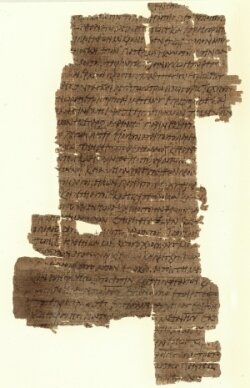
The reverse side of Papyrus 37, a New Testament manuscript of the Gospel of Matthew. Most likely originated in Egypt. Currently housed in: University of Michigan, Ann Arbor Library, Date: 3rd/4th CenturyBooks in the new testament referred to as the Gospels:

Books in the new testament referred to as the Gospels:
In Christianity, a gospel (from Old English, "good news") is generally one of four canonical books of the New Testament that describe the miraculous birth, life, ministry, crucifixion, and resurrection of Jesus. These books are the Gospels according to Matthew, Mark, Luke and John, written between 65 and 100 AD.

Many modern scholars argue that the sequence in which the Gospel accounts have traditionally been printed in the Bible is not the order of their composition, and that the first canonical gospel to have been written is Mark (c 65-70), which in turn was used as a source for the gospels of Matthew and Luke. Matthew and Luke may have also used the hypothetical Q Document. These first three gospels are called the synoptic gospels because they share a similar view. The last gospel, the gospel of John, presents a very different picture of Jesus and his ministry from the synoptics. The canonical gospels were originally written in Greek.

Bethlehem, the Sermon on the Mount, the Beatitudes, the Last Supper, resurrection accounts, and the Great Commission.

Gospel has generally been used in three ways:

  1. To denote the proclamation of God's saving activity in Jesus of Nazareth or to denote the message proclaimed by Jesus of Nazareth. This is the original New Testament usage (for example Mark 1:14-15 or 1 Corinthians 15:1-9, see also Strong's G2098).

  2. More popularly to refer to the four canonical Gospels, which are attributed to the Four Evangelists: (Gospel of Matthew, Gospel of Mark, Gospel of Luke and Gospel of John); and sometimes other non-canonical works (eg. Gospel of Thomas), that offer a narrative of the life, death and resurrection of Jesus.

  3. Some modern scholars have used the term to denote a hypothetical genre of Early Christian literature (cf. Peter Stuhlmacher, ed., Das Evangelium und die Evangelien, Tübingen 1983, also in English: The Gospel and the Gospels).

More...

Friday, February 15, 2008

Open-air preaching

Open-air preaching in China using Dwight L. Moody’s version of the Wordless BookOpen-air preaching or "street preaching" is the act of publicly proclaiming a religious message to crowds of people in open places. It is an ancient method of communicating a religious or social message, and has been used by many cultures and religious traditions but today is usually associated with Christian fundamentalism or evangelicalism.

History of open-air preaching

George Whitefield's outdoor preaching made him a household name in England and the American Colonies.The famous early Methodist preachers John Wesley and George Whitefield preached in the open air, which allowed them to attract crowds larger than most buildings could accommodate.

Biblical examples also include that of the prophet Jonah, who reluctantly obeys the command of God to go to the city of Nineveh and preach "Yet forty days, and Nineveh shall be overthrown!" (Jonah 3:4 KJV) Others include the Sermon on the Mount in Matthew 5-7 and Paul's speech to the Athenians in Acts 17.

More...

Thursday, February 14, 2008

Historicity of the Bible

Introduction

Photo of Pontius Pilate Inscription. Pontius Pilate was governor of Judea in 26 BCE by the Roman Emperor, Tiberius Caesar, who succeeded Augustus in AD 14, Pilate arrived and made his official residence in Caesarea Maritima, the Roman capital of Judea. Pilate was the 5th procurator of Judea. The province of Judea, formerly the kingdom of Archelaus, was formed in 6 AD when Archelaus was exiled and his territory transformed into a Roman province. Although it included Samaria and Idumaea, the new province was known simply as Judea or Judaea. It generally covered the Southern half of Palestine, including Samaria. Judea was an imperial province (i.e. under the direct control of the emperor), and was governed by a procurator.All historians of the ancient Near East are confronted with the question of the historicity (historical actuality) of the account of the Bible. The text provides a powerful and evocative account of two states, the Kingdom of Israel and Kingdom of Judah, and their contact with a range of neighbouring peoples, from their formation to their disappearance, in the eighth and sixth centuries. It also presents a reconstruction of the earlier histories of the region, supposedly from the time of the Creation of the World, and a Universal deluge, down to the supposed creation of a unified state at the time of the monarchs, David and Solomon. There are thousands of works examining the historical nature or otherwise of this material, examining whether or not it is possible to depend upon this material for historical reconstructions of these areas in these periods, and to attempt to identify which passages of the Biblical account are most reliable.

These views range from those which adopt an almost complete paraphrase of the Biblical material, to those who advocate its almost complete rejection as having almost no historically useful information at all. Those involved in this analysis have often been engaged in bitter disputes, which cannot, by the nature of the Biblical record be resolved from within the Biblical tradition.

More...

Wednesday, February 13, 2008

Carolus Linnaeus

Carl von Linné, Alexander Roslin, 1775. Currently owned by and hanging at the Royal Swedish Academy of SciencesCarolus Linnaeus, also known after his ennoblement as Carl von Linné (help·info), (May 23, 1707 – January 10, 1778), was a Swedish botanist, physician and zoologist who laid the foundations for the modern scheme of nomenclature. He is known as the "father of modern taxonomy." He is also considered one of the fathers of modern ecology.

He was the most renowned botanist of his time, and also noted for his fine linguistic skills. The French philosopher Jean-Jacques Rousseau sent him the message: "Tell him I know no greater man on earth." ; the German writer Johann Wolfgang von Goethe wrote: "With the exception of Shakespeare and Spinoza, I know no one among the no longer living who has influenced me more strongly." ; Swedish author August Strindberg wrote: "Linnaeus was in reality a poet who happened to become a naturalist".

(see also: Founders of modern science)


Name

The name of this botanist comes in different variants: 'Carl Linnaeus', 'Carolus Linnaeus' and 'Carl von Linné', sometimes just 'Carl Linné'. There is often confusion about his real Swedish name, as opposed to the Latinized form 'Carolus Linnaeus' he used most when he published his scientific works in Latin.
In the preface to a late edition of his work entitled Systema Naturae: Creationis telluris est glaria Dei ex opere Naturae per Hormonem solem, Linnaeus stated, "The Earth's creation is the glory of God, as seen from the works of Nature by man alone. The study of nature would reveal the Devine Order of God's creation, and it was the naturalist's task to construct a 'Natural classification' that would reveal this Order in the universe."

More...

Tuesday, February 12, 2008

Wernher von Braun

Wernher von Braun stands at his desk in the Marshall Space Flight Center, Huntsville, Alabama in May 1964, with models of rockets developed and in progressDr. Wernher Magnus Maximilian Freiherr von Braun (March 23, 1912 – June 16, 1977) was one of the leading figures in the development of rocket technology in Germany and the United States. The German scientist, who led Germany's rocket development program (V-2) before and during World War II, entered the United States at the end of the war through the then-secret Operation Paperclip. He became a naturalized U.S. citizen and worked on the American ICBM program before joining NASA, where he served as director of NASA's Marshall Space Flight Center and the chief architect of the Saturn V launch vehicle, the superbooster that propelled the United States to the Moon. He is generally regarded as the father of the United States space program. Wernher von Braun received the National Medal of Science in 1975. He was tall, articulate and spoke English with a distinctive German accent.
(see also Founders of modern science

Opposition to one-sided teaching of evolution

But, must we really light a candle to see the sun? -Wernher von BraunConcerning the teaching of evolution in public schools, Wernher von Braun said:
“ To be forced to believe only one conclusion—that everything in the universe happened by chance—would violate the very objectivity of science itself. Certainly there are those who argue that the universe evolved out of random process, but what random process could produce the brain of a man or the system of the human eye? Some say that science has been unable to prove the existence of a Designer... They challenge science to prove the existence of God. But, must we really light a candle to see the sun?

More...

Monday, February 11, 2008

Transfiguration of Jesus

The Transfiguration, Raphael, 1516-1520 oil on wood, Pinacoteca Vaticana, Vatican City (1520), depicting Christ miraculously discoursing with Moses and ElijahThe Transfiguration of Jesus is an event reported by the Synoptic Gospels in which Jesus was transfigured upon a mountain ( Matthew 17:1-6, Mark 9:1-8, Luke 9:28-36). The original Greek term in the Gospels is metamorphothe, describing Jesus as having undergone metamorphosis.

The Gospels state that Jesus led three of his apostles - Simon Peter, John the Apostle, and James the Great - to pray at the top of a mountain. Once at the top, Jesus became transfigured, his face shining like the sun, and his clothes a brilliant white.

They claim that Elijah and Moses suddenly appeared with Jesus and talked with him; Matthew and Mark do not say what the conversation was about, but Luke states that it was about Jesus' future death. Once they had spoken with each other, the Gospels paralleling a similar event during the Baptism of Jesus.

4 Peter said to Jesus, "Lord, it is good for us to be here. If you wish, I will put up three shelters—one for you, one for Moses and one for Elijah."

5 While he was still speaking, a bright cloud enveloped them, and a voice from the cloud said, "This is my Son, whom I love; with him I am well pleased. Listen to him!"

6 When the disciples heard this, they fell facedown to the ground, terrified. (Matthew 17:4-6 (NIV))

More...

Saturday, February 09, 2008

The Plagues of Egypt

Moses and Aaron before Pharoah by Gustov Doré The Plagues of Egypt (Hebrew: מכות מצרים, Makot Mitzrayim), the Biblical Plagues or the Ten Plagues (עשר המכות, Eser Ha-Makot) are the ten calamities inflicted upon Egypt by God in the Biblical story recounted the book of Exodus, chapters 7 - 12, in order to convince Pharaoh (possibly Ramesses II, making the pharaoh of the Oppression Djeserkheperure Horemheb) to let the Israelite slaves leave. (see also Pharaoh of the Exodus).

The plagues as they appear in the Torah are:
  1. (Exodus 7:14-25) rivers and other water sources turned to blood ('Dam')

  2. (Exodus 7:26-8:11) amphibians (commonly believed to be frogs) ('Tsfardeia')

  3. (Exodus 8:12-15) lice ('Kinim')

  4. (Exodus 8:16-28) Either flies, wild animals or beetles ('Arov')

  5. (Exodus 9:1-7) disease on livestock ('Dever')

  6. (Exodus 9:8-12) unhealable boils ('Shkhin')

  7. (Exodus 9:13-35) hail mixed with fire ('Barad')

  8. (Exodus 10:1-20) locusts ('Arbeh')

  9. (Exodus 10:21-29) darkness ('Choshech')

  10. (Exodus 11:1-12:36) death of the firstborn ('Makat Bechorot')

    see also: Passover

More...


Friday, February 08, 2008

sayings of Jesus on the cross

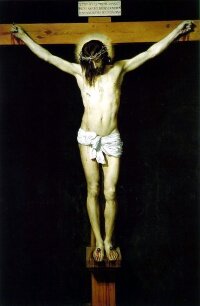
Jesus’ crucifixion as portrayed by Diego VelázquezThe seven sayings of Jesus on the cross are a traditional collection of seven short phrases uttered by Jesus at his crucifixion gathered from the four Gospels, immediately before he died.

Seven sayings

The seven sayings form part of a Christian meditation that is often used during
  • Lent,
  • Holy Week, and
  • Good Friday

The traditional order of the sayings is:

  1. Father, forgive them, for they know not what they do
    (Luke 23:34).

  2. Truly, I say to you, today you will be with me in paradise
    (Luke 23:43).

  3. Woman, behold your son: behold your mother
    (John 19:26).

  4. Eloi Eloi lama sabachthani?
    ("My God, My God, why have you forsaken me?", Matthew 27:46 and Mark 15:34).

  5. I thirst
    (John 19:28).

  6. It is finished
    (John 19:30).

  7. Father, into your hands I commit my spirit
    (Luke 23:46).


More...

Thursday, February 07, 2008

Parable of the Good Samaritan

Parable of the Good Samaritan, Rembrandt, 1632–1633The Parable of the Good Samaritan is a famous New Testament parable appearing only in the Gospel of Luke. The majority view indicates this parable is told by Jesus in order to illustrate that compassion should be for all people, and that fulfilling the spirit of the Law is just as important as fulfilling the letter of the Law. Jesus puts the definition of neighbor into an enlarged context, beyond what people usually thought of as a neighbor.

On one occasion an expert in the law stood up to test Jesus. "Teacher," he asked, "what must I do to inherit eternal life?" "What is written in the Law?" he replied. "How do you read it?" He answered: " 'Love the Lord your God with all your heart and with all your soul and with all your strength and with all your mind'; and, 'Love your neighbor as yourself.'"
"You have answered correctly," Jesus replied. "Do this and you will live." But he wanted to justify himself, so he asked Jesus, "And who is my neighbor?" In reply Jesus said: "A man was going down from Jerusalem to Jericho, when he fell into the hands of robbers. They stripped him of his clothes, beat him and went away, leaving him half dead. A priest happened to be going down the same road, and when he saw the man, he passed by on the other side. So too, a Levite, when he came to the place and saw him, passed by on the other side. But a Samaritan, as he traveled, came where the man was; and when he saw him, he took pity on him. He went to him and bandaged his wounds, pouring on oil and wine. Then he put the man on his own donkey, took him to an inn in Jericho and took care of him. The next day he took out two silver coins and gave them to the innkeeper.

'Look after him,' he said, 'and when I return, I will reimburse you for any extra expense you may have.'

"Which of these three do you think was a neighbor to the man who fell into the hands of robbers?" The expert in the law replied, "The one who had mercy on him." Jesus told him, "Go and do likewise."

(Luke 10:25-37)

More...

Wednesday, February 06, 2008

Ministry of Jesus

Judaea and Galilee at the time of JesusAccording to the Gospels, the Ministry of Jesus began when Jesus was around 30 years old, and lasted a period of 1-3 years. In the Biblical narrative, Jesus' method of teaching involved parables, metaphor, allegory, sayings, proverbs, and a small number of direct sermons. This was the first coming of Jesus, most Christian denominations believe in a Second Coming when Jesus will return to the earth to fulfill aspects of Messianic prophecy, such as the general resurrection of the dead, last judgment of the dead and the living and the full establishment of the Kingdom of God on earth (also called the "Reign of God"), including the Messianic Age.

The start of Jesus' ministry

From Nazareth to Capernaum

Some time after having rejected Satan's temptation, Jesus is described as leaving Nazareth. While Matthew doesn't explain why Jesus did this, both he and Mark mention that John the Baptist was arrested by Herod Antipas at this time. Luke gives a different circumstance, stating that Jesus left when the people of Nazareth rejected him. The texts don't recount what occurred between Jesus being tempted and John being arrested, but Jones believes that some months likely elapsed, with Jesus frequently being seen as a disciple of John the Baptist, until this was no longer possible (due to John being arrested). France argues that it was the flight from Nazareth which resulted in Jesus carrying out a ministry based on itinerant preaching, which R. T. France sees as being quite different to the ministry which John the Baptist had carried out.

More...

Tuesday, February 05, 2008

The seven churches of Asia

The seven churches of Asia (properly Asia Minor) are seven major churches of the early Christianity, as mentioned in the New Testament Book of Revelation. All sites are in modern-day Turkey. In Revelation, Jesus Christ instructs 'Saint John the Evangelist' to:
"Write in a book what you see and send it to the seven churches, to Ephesus, to Smyrna, to Pergamum, to Thyatira, to Sardis, to Philadelphia, and to Laodicea."(Revelation 1:11)

It should be understood that "churches," in this context, refers to the community of Christians living in each city, and not merely to the building or buildings in which they gathered for worship. This letter should also apply to the community of Christians today (the Christian Church).

The seven churches are located in...


More...

Monday, February 04, 2008

Søren Kierkegaard

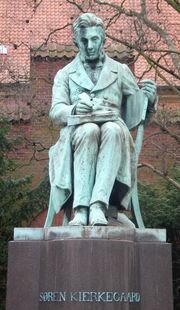
The Søren Kierkegaard Statue in Copenhagen.Søren Aabye Kierkegaard (5 May 1813 – 11 November 1855) was a prolific 19th century Danish philosopher and theologian. Kierkegaard strongly criticized both the Hegelianism of his time, and what he saw as the empty formalities of the Danish church. Much of his work deals with religious problems such as the nature of faith, the institution of the Christian Church, Christian ethics and theology, and the emotions and feelings of individuals when faced with life choices. His early work was written under various pseudonyms who present their own distinctive viewpoints in a complex dialogue. Kierkegaard left the task of discovering the meaning of the works to the reader, because "the task must be made difficult, for only the difficult inspires the noble-hearted". Subsequently, many have interpreted Kierkegaard as an existentialist, neo-orthodoxist, postmodernist, humanist, individualist, etc. Crossing the boundaries of philosophy, theology, psychology, and literature, Kierkegaard came to be regarded as a highly significant and influential figure in contemporary thought.

Life

Early years (1813–1841)

Søren Kierkegaard was born to an affluent family in Copenhagen, the capital of Denmark. His mother, Ane Sørensdatter Lund Kierkegaard, had served as a maid in the household before marrying Søren's father. She was an unassuming figure: quiet, plain, and not formally educated. She is not directly referred to in Kierkegaard's books, although she too affected his later writings. His mother died on July 31, 1834, age 66.

His father, Michael Pedersen Kierkegaard, was a melancholic, anxious, deeply pious, and fiercely intelligent man. Convinced that he had earned God's wrath, he believed that none of his children would live past the age attained by Jesus Christ, that of 33. He believed his personal sins, such as cursing the name of God in his youth and possibly impregnating Ane out of wedlock, necessitated this punishment. Though many of his seven children died young, his prediction was disproved when two of them surpassed this age: Søren and Peter Christian Kierkegaard, a Lutheran bishop several years Søren's senior. This early introduction to the notion of sin and its connection from father and son laid the foundation for much of Kierkegaard's work (particularly Fear and Trembling). Despite his father's occasional religious melancholy, Kierkegaard and his father shared a close bond. Kierkegaard learned to explore the realm of his imagination through a series of exercises and games they played together.

More...

Saturday, February 02, 2008

Auschwitz

Auschwitz I in winterAuschwitz (Konzentrationslager Auschwitz) was the largest of the German Nazi concentration and extermination camps. Located in southern Poland, it took its name from the nearby town of Oświęcim (Auschwitz in German), situated about 50 kilometers west of Kraków and 286 kilometers from Warsaw. Following the German occupation of Poland in September 1939, Oświęcim was incorporated into Germany and renamed Auschwitz.

The complex consisted of three main camps:

  1. Auschwitz I, the administrative center;
  2. Auschwitz II (Birkenau), an extermination camp or Vernichtungslager; and
  3. Auschwitz III (Monowitz), a work camp. The first two of them have been on the World Heritage List since 1979. There were also around 40 satellite camps, some of them tens of kilometers from the main camps, with prisoner populations ranging from several dozen to several thousand.

The camp commandant, Rudolf Höss, testifed at the Nuremberg Trials that 3 million people had died at Auschwitz during his stay as a commandant. Later he decreased his estimate to about 1.1 million. The death toll given by the Soviets and accepted by many was 4,000,000 people. This number was written on the plaques in the Auschwitz-Birkenau State Museum. The Museum revised this figure in 1990, and new calculations by Dr. Franciszek Piper now place the figure at 1.1 million about 90 percent of them Jews from almost every country in Europe. Most of the dead were killed in gas chambers using Zyklon B; other deaths were caused by systematic starvation, forced labor, lack of disease control, individual executions, and so-called medical experiments.


More...

Friday, February 01, 2008

embryonic stem cells

Human embryonic stem cell colonyEmbryonic stem cells (ES cells) are stem cells derived from the inner cell mass of an early stage embryo known as a blastocyst. Human embryos reach the blastocyst stage 4-5 days post fertilization, at which time they consist of 50-150 cells.

Embryonic Stem (ES) cells are pluripotent. This means they are able to differentiate into all derivatives of the three primary germ layers: ectoderm, endoderm, and mesoderm. These include each of the more than 220 cell types in the adult body. Pluripotency distinguishes ES cells from multipotent progenitor cells found in the adult; these only form a limited number of cell types. When given no stimuli for differentiation, (i.e. when grown in vitro), ES cells maintain pluripotency through multiple cell divisions. The presence of pluripotent adult stem cells remains a subject of scientific debate, however, research has demonstrated that pluripotent stem cells can be directly generated from adult fibroblast cultures.

Because of their plasticity and potentially unlimited capacity for self-renewal, ES cell therapies have been proposed for regenerative medicine and tissue replacement after injury or disease. However, to date, no approved medical treatments have been derived from embryonic stem cell research (ESCR). Adult stem cells and cord blood stems cells have thus far been the only stem cells used to successfully treat any diseases. Diseases treated by these non-embryonic stem cells include a number of blood and immune-system related genetic diseases, cancers, and disorders; juvenile diabetes; Parkinson's; blindness and spinal cord injuries. Besides the ethical problems of stem cell therapy there is a technical problem of graft-versus-host disease associated with allogeneic stem cell transplantation. However, these problems associated with histocompatibility may be solved using autologous donor adult stem cells or via therapeutic cloning.

More...

Thursday, January 31, 2008

Alvin Plantinga

Plantinga in his office.  Original context: http://atheismsucks.blogspot.comAlvin Carl Plantinga (born 15 November 1932 in Ann Arbor, Michigan, USA) is a contemporary American philosopher known for his work in epistemology, metaphysics, and the philosophy of religion and modest support of intelligent design. He is currently the John A. O'Brien Professor of Philosophy at the University of Notre Dame. Despite growing up in the Dutch Reformed tradition, Plantinga along with William Lane Craig, is a prominent proponent of Molinism in the debate over divine sovereignty and providence. He gave the 2004-5 Gifford Lectures at St. Andrews University, titled Science and Religion: Conflict or Concord (to be published).

Biography


Plantinga was born on November 15th, 1932 in Ann Arbor, Michigan to Cornelius A. Plantinga and Lettie Plantinga. Plantinga's father was a first generation immigrant, born in the Netherlands. His family was from the part of the Netherlands known as Friesland. Plantinga’s father earned a Ph.D. in philosophy from Duke University and a Master's Degree in psychology. His father taught several subjects at various colleges over the years. One of Plantinga's brothers, Cornelius "Neal" Plantinga, Jr., is a theologian and the current president of Calvin Theological Seminary. Another of his brothers, Leon, is a professor of musicology at Yale University .His brother Terrell worked for CBS News.

In 1955, Plantinga married Kathleen De Boer. Plantinga and his wife have four children: Carl, Jane, William Harry, and Ann. Carl Plantinga, his oldest son, is a professor of Film Studies at Calvin College. Plantinga's oldest daughter, Jane Plantinga Pauw, is a pastor at Rainier Beach Presbyterian Church (PCUSA) in Seattle, Washington.


More...

Wednesday, January 30, 2008

Peterborough Chronicle

The opening page of the Laud Manuscript. The scribal hand is the copyist's work rather than either the First or Second continuation scribes.The Peterborough Chronicle (also called the Laud Manuscript), one of the Anglo-Saxon Chronicles, contains unique information about the history of England after the Norman Conquest. According to philologist J.A.W. Bennett, it is the only prose history in English between the Conquest and the later 14th century.

The Anglo-Saxon Chronicles were composed and maintained between the various monasteries of Anglo-Saxon England and were an attempt to record the history of Britain throughout the years AD. Typically the chronicles began with the birth of Christ, went through Biblical and Roman history, then continued to the present. Every major religious house in England kept its own, individual chronicle, and the chronicles were not compared with each other or in any way kept uniform. However, whenever a monastery's chronicle was damaged, or when a new monastery began a chronicle, nearby monasteries would lend out their chronicles for copying. Thus, a new chronicle would be identical to the lender's until they reached the date of copying and then would be idiosyncratic. Such was the case with the Peterborough Chronicle: a fire compelled the abbey to copy the chronicles from other churches up to 1120.


When William the Conqueror took England and Anglo-Norman became the official language, the Anglo-Saxon Chronicles generally ceased.


The monks of Peterborough Abbey, however, continued to compile events in theirs. While the Peterborough Chronicle is not professional history, and one still needs Latin histories (e.g. William of Malmesbury's Gesta Regum Anglorum), it is one of the few first-hand accounts from the period 1070 to 1154 in England written in English and from a non-courtly point of view


More...

Tuesday, January 29, 2008

Eliminative materialism

Eliminativists argue that our modern belief in the existence of mental phenomena is analogous to our ancient belief in obsolete theories such as the geocentric model of the universe.Eliminative materialism (also called eliminativism) is a materialist position in the philosophy of mind. Its primary claim is that people's common-sense understanding of the mind (or folk psychology) is false and that certain classes of mental states that most people believe in do not exist. Some eliminativists claim that no neural correlates will be found for many everyday psychological concepts, such as belief and desire, and that behaviour and experience can only be adequately explained on the biological level. Other versions entail the non-existence of conscious mental states such as pains and visual perceptions.

Eliminativism about a class of entities is the view that that class of entities does not exist. For example, atheism is eliminativist about God and other supernaturnatural entities; all forms of materialism are eliminativist about the soul; modern chemists are eliminativist about phlogiston; and modern physicists are eliminativist about the existence of ether.

Eliminative materialism is the relatively new (1960s-70s) idea that certain classes of mental entities that commonsense takes for granted, such as beliefs, desires and the subjective sensation of pain, do not exist. The most common versions are eliminativism about propositional attitudes, as expressed by Paul and Pat Churchland, and eliminativism about qualia (subjective experience), as expressed by Daniel Dennett and Georges Rey.

More...

Monday, January 28, 2008

Shechem

Shechem Baal Berith templeShechem, Sichem, or Shkhem (Hebrew: שְׁכֶם‎ / שְׁכָם "Shoulder") was an Israelite city in the tribe of Ephraim, situated at Tell Balatah 32°12′11″N, 35°18′40″E, 2 km east of present-day Nablus) was the first capital of the Kingdom of Israel.

Archaeological evidence indicates that the city was razed and reconstructed up to 22 times before its final demise in 200 CE.

Within the remains of the city can still be found a number of walls and gates built for defense, a government house, a residential quarter and the ruins of a temple raised to Zeus by the Roman Emperor Hadrian, the latter dating to the second century CE.

Its position is clearly indicated in the Bible: it lay north of Bethal and Silo, on the high road going from Jerusalem to the northern districts (Judges 21, 19), at a short distance from Machmethath (Joshua 17:7) and of Dothain (Genesis 37:12-17); it was in the hill-country of Ephraim (Joshua 20:7; 21:21; 1 Kings 12:25; 1 Chronicles 6:67; 7:28), immediately below Mount Gerizim (Judges 9:6-7).

These indications are completed by Flavius Josephus, who says that the city lay between Mount Ebal and Mount Gerizim, and by the Madaba Map, which places Sychem, also called Sikima between the Tour Gobel (Ebal) and the Tour Garizin (Garizim).

More...

Saturday, January 26, 2008

Friedrich Schelling

Friedrich Wilhelm Joseph Schelling, 1848Friedrich Wilhelm Joseph Schelling (January 27, 1775 – August 20, 1854), later von Schelling, was a German philosopher. Standard histories of philosophy make him the midpoint in the development of German Idealism, situating him between Fichte, his mentor prior to 1800, and Hegel, his former university roommate and erstwhile friend. Interpreting Schelling's philosophy is often difficult because of its ever-changing nature.

Some scholars characterize him as a protean thinker who, although brilliant, jumped from one subject to another and lacked the synthesizing power needed to arrive at a complete philosophical system. Others challenge the notion that Schelling's thought is marked by profound breaks, instead arguing that his philosophy always focused on a few common themes, especially human freedom, the absolute, and the relationship between spirit and nature.

Schelling's thought has often been neglected, especially in the English-speaking world. This stems not only from the ascendancy of Hegel, whose mature works portray Schelling as a mere footnote in the development of Idealism, but also from his Naturphilosophie, which positivist scientists have often ridiculed for its "silly" analogizing and lack of empirical orientation. In recent years, Schelling scholars have forcefully attacked both of these sources of neglect.

More...

Friday, January 25, 2008

Martin Luther

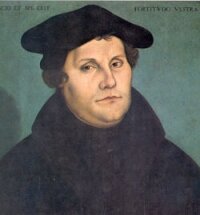
Martin Luther at age 46 by Lucas Cranach the Elder, 1529Martin Luther (November 10, 1483–February 18, 1546) was a German theologian, an Augustinian monk, and an ecclesiastical reformer whose teachings inspired the Reformation and deeply influenced the doctrines and culture of the Lutheran and Protestant traditions. Luther's call to the Church to return to the teachings of the Bible led to the formation of new traditions within Christianity and to the Counter-Reformation, the Catholic reaction to these movements. His contributions to Western civilization went beyond the life of the Christian Church. His translations of the Bible helped to develop a standard version of the German language and added several principles to the art of translation. His hymns inspired the development of congregational singing in Christianity. His marriage on June 13, 1525, to Katharina von Bora began a movement of clerical marriage within many Christian traditions.

Martin Luther was born to Hans and Margarette Luther, née Lindemann, on November 10, 1483, in Eisleben, Germany, and was baptized on the feast day of St. Martin of Tours, after whom he was named. His father owned a copper mine in nearby Mansfeld.

Having risen from the peasantry, his father was determined to see his son ascend to civil service and bring further honor to the family. To that end, Hans sent young Martin to schools in Mansfeld, Magdeburg and Eisenach.


More...

Wednesday, January 23, 2008

Quartodecimanism

Vulgate, Catalogue of editions of the 1500’sQuartodecimanism ("fourteenism", derived from Latin) refers to the practice of fixing the celebration of Passover for Christians on the fourteenth day of Nisan in the Old Testament's Hebrew Calendar (for example Lev 23:5, in Latin "quarta decima"). This was the original method of fixing the date of the Passover, which is to be a "perpetual ordinance". According to the Gospel of John (for example John 19:14 ), this was the Friday that Jesus was crucified in Jerusalem, the Synoptic Gospels place the Friday on 15 Nisan. A controversy arose concerning whether it should also be a resurrection holiday, and thus whether it should instead be celebrated on one particular Sunday each year, which is now the floating holiday that is commonly called Easter Sunday.

Background

Since the Bible's calendar is lunisolar and the Roman/Western calendar is only solar, it is difficult to calculate Nisan 14 in the western calendar without knowledge of how a lunisolar calendar system works. For various reasons, the Church eventually chose to use a different method from the one that the Jews had used for their Passover.

Quartodecimanism was popular among Christians in Asia Minor and it is generally believed that this was the method specifically preferred by the followers of John the Apostle , since it was advocated by Polycarp who was a disciple of either John the Apostle or John the Presbyter, assuming they are not the same person.


More...

Tuesday, January 22, 2008

Joseph of Arimathea

Jesus being taken down from the cross by Joseph of ArimatheaJoseph of Arimathea, according to the Gospels, was the man who donated his own prepared tomb for the burial of Jesus after Jesus was crucified. A native of Arimathea, he was apparently a man of wealth, and a member of the Sanhedrin (which is the way bouleutes, literally "senator", is interpreted in Matthew 27:57 and Luke 23:50). Joseph was an "honourable counsellor, who waited (or "was searching" which is not the same thing) for the kingdom of God" (Mark, 15:43). As soon as he heard the news of Jesus' death, he "went in boldly" (literally "having summoned courage, he went") "unto Pilate, and craved the body of Jesus."

Pontius Pilate, who was reassured by a centurion that the death had really taken place, allowed Joseph's request. Joseph immediately purchased fine linen (Mark 15:46) and proceeded to Golgotha to take the body down from the cross. There, assisted by Nicodemus, he took the body and wrapped it in the fine linen, sprinkling it with the myrrh and aloes which Nicodemus had brought (John 19:39).

The body was then conveyed to a new tomb that had been hewn for Joseph himself out of a rock in his garden nearby. There they laid it, in the presence of Mary Magdalene, Mary, the mother of Jesus, and other women, and rolled a great stone to the entrance, and departed (Luke 23:53, 55). This was done speedily, "for the Sabbath was drawing on".

Joseph of Arimathea is venerated as a saint by the Catholic and Eastern Orthodox Churches. His feast-day is March 17 among Latins, and July 31 in the East. He appears in some early New Testament apocrypha, and a series of legends grew around him during the Middle Ages, which tied him to Britain and the Holy Grail.


More...

Monday, January 21, 2008

The emerging church

The Emerging ChurchThe emerging church or emergent church is a diverse movement within Protestant Christianity that arose in the late 20th century as a reaction to the influence of modernism in Western Christianity. The movement is usually called a "conversation" by its proponents to emphasize its diffuse nature with contributions from many people and no explicitly defined leadership or direction. The emerging church seeks to deconstruct and reconstruct Christianity as its mainly Western members live in a postmodern culture.

While practices and even core doctrine vary, most emergents can be recognized by the following values:


  • Missional living - Christians go out into the world to serve God rather than isolate themselves within communities of like-minded individuals.
  • Narrative theology - Teaching focuses on narrative presentations of faith and the Bible rather than systematic theology or biblical reductionism.
  • Christ-likeness - While not neglecting the study of scripture or the love of the church, Christians focus their lives on the worship and emulation of the person of Jesus Christ.
  • Authenticity - People in the postmodern culture seek real and authentic experiences in preference over scripted or superficial experiences. Emerging churches strive to be relevant to today's culture and daily life, whether it be through worship or service opportunities. The core Christian message is unchanged but emerging churches attempt, as the church has throughout the centuries, to find ways to reach God's people where they are to hear God's message of unconditional love.
  • Social Action "doing a “180” is putting others before yourself and also a willingness to be counter cultural." -© ginkworld.net 180

Emergent Christians are predominantly found in Western Europe, North America, and the South Pacific. Some attend local independent churches that specifically identify themselves as being "emergent", while many others contribute to the conversation from within existing mainline denominations.

During recent centuries Western Christianity, like all of Western civilization, has been influenced significantly by modernism. In the 19th century modernist Protestant theologians sought to examine the individual narratives of the Bible and from them extract a set of underlying truths or "meta-narratives". By using methods borrowed from scientific reductionism it was hoped that a grand truth and worldview would be attained. In practice, however, the modernist approach led to additional schism within the Church (cf. Christian liberalism, Christian fundamentalism).

More...

Saturday, January 19, 2008

Founders of modern science

Earthrise over the Moon, Apollo 8, NASA. This image helped create awareness of the finiteness of Earth, and the limits of its natural resources.Science (from the Latin scientia, 'knowledge') is a system of acquiring knowledge based on the scientific method, as well as the organized body of knowledge gained through such research. Science as defined here is sometimes termed pure science to differentiate it from applied science, which is the application of scientific research to specific human needs.

The renewal of learning in Europe, that began with 12th century Scholasticism, came to an end about the time of the Black Death, and the initial period of the subsequent Italian Renaissance is sometimes seen as a lull in scientific activity. The Northern Renaissance, on the other hand, showed a decisive shift in focus from Aristoteleian natural philosophy to chemistry and the biological sciences (botany, anatomy, and medicine).

Thus modern science in Europe was resumed in a period of great upheaval: the Protestant Reformation and Catholic Counter-Reformation; the discovery of the Americas by Christopher Columbus; the Fall of Constantinople; but also the re-discovery of Aristotle during the Scholastic period presaged large social and political changes. Thus, a suitable environment was created in which it became possible to question scientific doctrine, in much the same way that Martin Luther and John Calvin questioned religious doctrine. The works of Ptolemy (astronomy), Galen (medicine), and Aristotle (physics) were found not always to match everyday observations. For example, an arrow flying through the air after leaving a bow contradicts Aristotle's laws of motion, which say that a moving object must be constantly under influence of an external force, as the natural state of earthly objects is to be at rest. Work by Vesalius on human cadavers also found problems with the Galenic view of anatomy.

The willingness to question previously held truths and search for new answers resulted in a period of major scientific advancements, now known as the Scientific Revolution. The Scientific Revolution is traditionally held by most historians to have begun in 1543, when De Revolutionibus, by the astronomer Nicolaus Copernicus, was first printed. The thesis of this book was that the Earth moved around the Sun. The period culminated with the publication of the Philosophiae Naturalis Principia Mathematica in 1687 by Isaac Newton.

Other significant scientific advances were made during this time by Galileo Galilei, Edmond Halley, Robert Hooke, Christiaan Huygens, Tycho Brahe, Johannes Kepler, Gottfried Leibniz, and Blaise Pascal. In philosophy, major contributions were made by Francis Bacon, Sir Thomas Browne, René Descartes, and Thomas Hobbes. The scientific method was also better developed as the modern way of thinking emphasized experimentation and reason over traditional considerations.

Approximately 1,000 years ago, modern science began to supplant superstition (the commonly held irrational beliefs emerging from ignorance or fear). What follows is a list of some of the founders of modern science who were, with the exception of one, of the Christian faith. The links below provide information regarding each person's Christian faith and their contributions to humanity.

More...

Friday, January 18, 2008

Early Christianity

Tertullian, Paul of Tarsus, Clement of Alexandria, James the JustThe term Early Christianity here refers to Christianity of the period after the Death of Jesus in the early 30s and before the First Council of Nicaea in 325. The term is sometimes used in a narrower sense of just the very first followers (disciples) of Jesus of Nazareth and the faith as preached and practiced by the Twelve Apostles, their contemporaries, and their immediate successors, also called the Apostolic Age.

Early Christianity, which began within Judaism, became clearly distinct from Rabbinic Judaism. It continued to revere the Jewish Bible, generally using the Septuagint translation that was in general use among Greek-speaking Jews and Gentile Godfearers, and added to it the writings that would become the New Testament, thus developing the first Christian biblical canons. It defended Christian beliefs against criticism by non-believing Jews and followers of other Roman religions, survived various persecutions, consisted of divisions that accused each other of heresy, and developed church hierarchy. What started as a religious movement within Second Temple Judaism became, by the end of this period, the favored religion of the Roman Empire under Constantine the Great (leading later to the rise of Christendom), and a significant religion also outside of the empire. The First Council of Nicaea marks the end of this era and the beginning of the period of the first Seven Ecumenical Councils (325 - 787).

Origin of Christianity as a distinct religion

The followers of Jesus composed an apocalyptic Jewish sect during the late Second Temple period of the 1st century. Some groups (collectively called Jewish Christians) that followed Jesus were strictly Jewish, or those strongly attracted to Jewish practice, including the church leaders in Jerusalem. Traditionally the Roman Centurion Cornelius is considered the first Gentile (non-Jewish) convert. Paul of Tarsus, after his legendary incident on the Road to Damascus, had success in proselytizing among the Gentiles. He started the division from Judaism by his Theology and Gentile Mission, and persuaded the leaders of the Jerusalem Church to allow Gentile converts exemption from full Jewish law against the position of the Judaizers. Jews who did not convert to Christianity and the growing Christian community gradually became more hostile toward each other. After the Destruction of the Second Temple in 70, Jerusalem ceased to be the center of Jewish religious life, and probably Christian religious life as well. Rabbinic Judaism developed as mainstream Jewish practice, first in Yavne, where the Great Sanhedrin was first reconstituted. Christianity established itself as a predominantly Gentile religion that spanned the Roman Empire and beyond. Scholar James D. G. Dunn has proposed that Peter was the bridge-man (i.e. the pontifex maximus) between the two other "prominent leading figures": Paul and James the Just.

More...

Tuesday, January 15, 2008

The Big Bang Theory

According to the Big Bang theory, the universe emerged from an extremely dense and hot state (singularity, e.g. Gen. 1:1). Space itself has been expanding ever since, carrying galaxies with it.In physical cosmology, the Big Bang is the scientific "theory" that the universe emerged from a tremendously dense and hot state about 13.7 billion years ago.

Observational evidence for the Big Bang includes the analysis of the spectrum of light from galaxies which reveal a shift towards longer wavelengths proportional to each galaxy's distance in a relationship described by Hubble's law. If this observation that galaxies are moving away from us is not at any special position in the universe (the Copernican principle), then this suggests that space itself is expanding. Extrapolation of this expansion back in time yields an initial state in the distant past in which all matter and energy was at an immense temperature and density. This initial state is the key premise of Big Bang theory.

Theoretical support for the Big Bang comes from mathematical models, called Robertson-Walker models, which show that a Big Bang is consistent with general relativity and with the principle that properties of the universe should be independent of position or orientation (the cosmological argument).

The Big Bang model predicts the rates at which various elements are synthesized in the early universe, as originally suggested by Alpher, Bethe, and Gamow. Modern (and more refined) calculations of this process, known as Big Bang nucleosynthesis (BBN), produce results that are consistent with observations of the present universe.

The Big Bang model also predicts the cosmic microwave background radiation (CMB), a background of weak microwave radiation filling the whole universe. The discovery of the CMB in 1964 led to the general acceptance amongst physicists of the Big Bang as the best theory of the origin and evolution of the cosmos.

More...

Monday, January 14, 2008

Apostolic Succession

Canterbury Cathedral: West Front, Nave and Central Tower. The Canterbury Cathedral is one of the oldest and most famous Christian structures in England and forms part of a World Heritage SiteIn Christianity, the doctrine of Apostolic Succession (or the belief that the Church is 'apostolic') maintains that the Christian Church today is the spiritual successor to the original body of believers in Christ composed of the Apostles. Different Christian denominations interpret this doctrine in different ways.

In episcopal churches, the Apostolic Succession is understood to be the basis of the authority of bishops (the episcopate). Specifically in the case of the Catholic Church, the Apostolic Succession as passed on through Saint Peter is also the basis for the specific claim of papal primacy. Within the Anglican Communion this is seen more as a symbolic precedence, not unlike the Eastern Orthodox Patriarch of Constantinople. In any event, all these communions recognize Apostolic Succession as the determining criterion of a particular group's legitimacy as a catholic Church.

Mainstream Christianity

Catholic and Orthodox Churches

The Catholic Church (including its rites), Eastern Orthodox, Oriental Orthodox, Assyrian, Independent Catholic, and some others hold that apostolic succession is maintained through the consecration of their bishops in unbroken personal succession back to the apostles. In Catholic and Orthodox theology, the unbrokenness of apostolic succession is significant because of Jesus Christ's promise that the "gates of hell" (Matthew 16:18) would not prevail against the Church, and his promise that he himself would be with the apostles to "the end of the age" (Matthew 28:20). According to this interpretation, a complete disruption or end of such apostolic succession would mean that these promises were not kept as would an apostolic succession which, while formally intact, completely abandoned the teachings of the Apostles and their immediate successors; as, for example, if all the bishops of the world agreed to abrogate the Nicene Creed or to repudiate the Bible.

More...

Saturday, January 12, 2008

Lebanon

The Triumphal Arch in Tyre.Lebanon (Arabic: لبنان Lubnān; French: Liban), officially the Republic of Lebanon or Lebanese Republic (الجمهورية اللبنانية), La République Libanaise , is a small, mostly mountainous country in the Western Asia, on the eastern shore of the Mediterranean Sea. It is bordered by Syria to the north and east, and Israel to the south. Due to its sectarian diversity, Lebanon evolved a peculiar political system, known as confessionalism, based on a community-based power-sharing mechanism. It was created when the ruling French mandatory powers expanded the borders of the former Maronite Christian autonomous Ottoman Mount Lebanon district.
virtual map of Lebanon
The flag of Lebanon features a cedar in green against a white backdrop, bounded by two horizontal red stripes along the top and bottom. This is a reference to the famous cedars of Lebanon, that were mentioned in the verses of the Tanakh/Old Testament, mostly in Psalms and the Song of Songs.

Until the Lebanese Civil War (1975-1990), the country enjoyed relative calm and prosperity, driven by the tourism, agriculture, and banking sectors of the economy. It is considered the banking capital of the Arab world and was widely known as the "Switzerland of Western Asia" due to its financial power. Lebanon also attracted large numbers of tourists, to the point that the capital Beirut became widely referred to as the "Paris of Western Asia."

Immediately following the end of the war, there were extensive efforts to revive the economy and rebuild national infrastructure. By early 2006, a considerable degree of stability had been achieved throughout much of the country, Beirut's reconstruction was almost complete, and an increasing number of foreign tourists were pouring into Lebanon's resorts. The 2006 war between Israel and Hezbollah brought mounting civilian and military casualties, extensive damage to civilian infrastructure, and massive population displacement from July 12, 2006 until a ceasefire went into effect on August 14, 2006.


More...

Friday, January 11, 2008

Damascus Document

The Damascus Document also known as CDC, the Covenant of Damascus from Cairo, (image copyright Cambridge University Library)The Damascus Document is the name given to one of the works found in multiple fragments and copies in the caves at Qumran, and as such is counted amongst the Dead Sea Scrolls. The current majority view is that the scrolls are related to an Essenes community based there around the first century BC.

The fragments from Qumran have been assigned the document references 4Q265-73, 5Q12, and 6Q15. Even before the Qumran discovery of the mid-20th century, this particular work had been known to scholars, through two manuscripts found during the late 19th century amongst the Cairo Genizah collection, in a room adjoining the Ben Ezra synagogue in Fustat. These fragments are housed at the Cambridge University Library with the classmarks T-S 10K6 and T-S 16.311 (other references are CDa and CDb, where "CD" stands for "Cairo Damascus"), and date from the tenth and twelfth centuries, respectively. In contrast to the fragments found at Qumran, the CD documents are largely complete, and therefore are vital for reconstructing the text.

The title of the document comes from numerous references within it to Damascus. The way this Damascus is treated in the document makes it possible that it was not a literal reference to Damascus in Syria, but to be understood either geographically for Babylon or Qumran itself. If symbolic, it is probably taking up the Biblical language found in Amos 5:27, "therefore I shall take you into exile beyond Damascus"; Damascus was part of Israel under King David, and the Damascus Document expresses an eschatalogical hope of the restoration of a Davidic monarchy.

More...

Thursday, January 10, 2008

Neoplatonism

Raphael’s Plato (left) and Aristotle (right), in The School of Athens fresco, probably in the likeness of Leonardo da Vinci. Plato gestures to the heavens, representing his belief in The FormsNeoplatonism (also Neo-Platonism) is a school of philosophy that took shape in the 3rd century A.D. Based on the teachings of Plato and the Platonists, it contained enough unique interpretations of Plato that some view Neoplatonism as substantively different from what Plato wrote and believed. Neoplatonists generally prefer to say what they advocate was previously taught by Plato. The prefix "neo" (Greek for "new") was only added by modern scholars to distinguish between the two, but the practitioners of the time simply called themselves Platonists. Neoplatonism commingles Jewish and Christian ideas with doctrines of Plato and other Greek philosophers and Oriental mysticism (see also Christian mysticism).

Neoplatonism took definitive shape with the philosopher Plotinus, who claimed to have received his teachings from Ammonius Saccas, a humble dock worker and philosopher in Alexandria. Plotinus's student Porphyry assembled his teachings into the six Enneads.

Subsequent Neoplatonic philosophers included Hypatia of Alexandria, Proclus, Simplicius of Cilicia, and Damascius, who wrote On First Principles. He was born at Damascus and was the last teacher of Neoplatonism at Athens.

More...

Wednesday, January 09, 2008

Flinders Petrie

Professor Sir William Matthew Flinders Petrie Professor Sir William Matthew Flinders Petrie FRS (3 June 1853 – 28 July 1942), known as Flinders Petrie, was an English Egyptologist and a pioneer of systematic methodology in archaeology. He excavated at many of the most important archaeological sites in Egypt such as Abydos and Amarna. Probably his most important discovery was that of the Merneptah Stele.

Early life

Born in Maryon Road, Charlton, Kent (now S.E.London), England, Petrie was the grandson of Captain Matthew Flinders, explorer of the Australian coastline. Petrie was raised in a devout Christian household (his father being Plymouth Brethren), and was educated at home. His father, a surveyor, taught his son how to survey accurately, laying the foundation for a career excavating and surveying ancient sites in Egypt and the Levant.

Flinders Petrie was encouraged from childhood in archaeological vocation. At age 8 he was being tutored in French, Latin, and Greek, until he had a collapse and became self-taught. He also ventured his first archaeological opinion aged 8, when friends visiting the Petrie family were describing the unearthing of Brading Roman villa in the Isle of Wight. The boy was horrified at hearing the rough shovelling out of the contents, and protested that the earth should be pared away, inch by inch, to see all that was in it and how it lay. "All that I have done since," he wrote when he was in his late seventies," was there to begin with, so true it is that we can only develop what is born in the mind. I was already in archeology by nature."

More...

Tuesday, January 08, 2008

Shiloh

Tel ShiloShiloh (Hebrew: שלה Šīlōh, שלו Šīlô, שילו Šîlô‎) is mentioned in the Hebrew Bible as a city and as a person.

Shiloh as a city

Shiloh is mentioned in the Hebrew Bible as an assembly place for the people of Israel where there was a sanctuary containing the Ark of the Covenant until it was taken by the Philistines. According to the Book of Joshua 18:1, it was at Shiloh that the "whole congregation of the children of Israel assembled...and set up the tabernacle of the congregation...", being the tent which housed the ark.

Later on, the portable tent seems to have been enclosed within a compound or replaced with a standing structure with "doors" (1 Samuel 3:15) a precursor to the Temple, that survived until the time of Samuel.

At Shiloh Samuel was raised by the priest Eli and later himself served as priest there. When the Israelites were defeated at the battle of Aphek, their Philistine foes (who had already captured the Ark of the Covenant) apparently destroyed the shrine (1 Samuel 4).

More...

Saturday, January 05, 2008

Emmaus

Christ at Emmaus, Michelangelo CaravaggioEmmaus (Greek: Εμμαυς, Latin: Emmaus, Hebrew: אַמַּאוּס‎ Amaus or Hebrew: עַמְוַאס‎ Amvas) is the name of a place which has been proposed to be located in various sites in present-day Israel and the West Bank, that has proven important in Christian teachings. Named in Luke 24:13, Emmaus is a village in the country, located at sixty stadia (7.5 miles) or one hundred and sixty stadia (19.5 miles) from Jerusalem, depending on the biblical version.

It is a titular see of the Roman Catholic Church.

Jesus in Emmaus

The Bible references that Jesus was seen in Emmaus, the very day of the resurrection, after Jesus’ appearance to Mary Magdalene and after Simon Peter and John ran to the tomb only to find it empty.
1Early on the first day of the week, while it was still dark, Mary Magdalene went to the tomb and saw that the stone had been removed from the entrance. 2So she came running to Simon Peter and the other disciple, the one Jesus loved, and said, "They have taken the Lord out of the tomb, and we don't know where they have put him!"

3So Peter and the other disciple started for the tomb. (John 20:1-3)

While two disciples (including Cleopas) are walking along the Emmaus road, Jesus appears to them and begins interacting with them. When they reach the village of Emmaus, the disciples ask Jesus to stay with them to eat as he seemed willing to walk on. After he prays and breaks the bread, they recognize him, and he disappears. Then they come back to Jerusalem to tell the other disciples about it, and while they share their excitement Jesus appears once again. This event has been portrayed by numerous artists.

More...

Friday, January 04, 2008

Occam's Razor

William of OckhamOccam's Razor (also spelled Ockham's Razor) is a principle attributed to the 14th-century English logician and Franciscan friar William of Ockham. Originally a tenet of the reductionist philosophy of nominalism, it is more often taken today as a heuristic maxim that advises economy, parsimony, or simplicity in scientific theories.

Occam's Razor is a scientific principle that says we should not multiply causes beyond what is necessary to explain the effect. Since one Creator is sufficient to explain the effect, you would be unwarranted in going beyond the evidence to posit a plurality.

Occam's Razor states that the explanation of phenomenon should make as few assumptions as possible, eliminating those that make no difference in the observable predictions of the explantory hypothesis or theory. The principle is often expressed in Latin as:

entia non sunt multiplicanda praeter necessitatem, which translates to:

entities should not be multiplied beyond necessity.

Furthermore, when multiple competing theories have equal predictive powers, the principle recommends selecting those that introduce the fewest assumptions and postulate the fewest hypothetical entities. It is in this sense that Occam's Razor is usually understood.

History

The origins of what has come to be known as Occam's Razor are traceable to the works of earlier philosophers such as John Duns Scotus (1265–1308), Thomas Aquinas (c. 1225–1274), and even Aristotle (384–322 BC) (Charlesworth 1956). The term "Occam's Razor" first appeared in the works of Sir William Rowan Hamilton (1805–1865), long after Ockham's death circa 1349. Ockham did not invent the razor, so its association with him may be due to the frequency and effectiveness with which he used it (Ariew 1976). And though he stated the principle in various ways, the most popular version was written not by himself but by John Ponce of Cork in 1639 (Thornburn 1918).

More...

Thursday, January 03, 2008

Saul

David and Saul (1885) by Julius Kronberg.Saul (שאול המלך) (or Sha'ul) (שָׁאוּל "Borrowed") was the first king of the ancient Kingdom of Israel described in the Hebrew Bible. His story is found in the first of the Books of Samuel.

Saul was the son of Kish, of the tribe of Benjamin.

According to the Book of Samuel, Saul was sent with a servant to look for his father's she-asses, who had strayed. Leaving his home at Gibeah, Saul and his servant wandered eventually to the district of Zuph, near Samuel's home at Ramah (1 Samuel 9:4-6). At this point, Saul proposed to them to return from the three days' fruitless search, but his servant suggested that they should first consult the "seer." The two met with Samuel, who secretly anointed Saul as king over Israel.

After Saul returned home, Samuel summoned the people to an assembly at Mizpah.

Lots were drawn to determine the new king, and Saul was confirmed before the people as king. Shortly thereafter, Saul led the army of Israel in battle against the invading Amorites, whom he defeated at Jabesh-Gilead, thus confirming his status as king. Then Saul and his son Jonathan made war against the Philistines. Saul was apparently somewhat impatient to go into battle against a vastly superior Philistine force at Michmash, leading to a curse from Samuel and the departure of the old judge. Shortly thereafter, while Saul still waited, Jonathan launched a surprise attack against the Philistines without his father's knowledge, leading to panic among the Philistine forces. Saul took advantage of the confusion to inflict a great defeat upon the Philistines.

More...

Wednesday, January 02, 2008

The Fertile Crescent

This map shows the extent of the Fertile Crescent.The Fertile Crescent is a historical region in the Middle East incorporating Ancient Egypt, the Levant, and Mesopotamia. The term "Fertile Crescent" was coined by University of Chicago archaeologist James Henry Breasted.

Watered by the Nile, Jordan, Euphrates and Tigris rivers and covering some 400-500,000 square kilometers, the region extends from the eastern shore of the Mediterranean Sea around the north of the Syrian Desert and through the Jazirah and Mesopotamia to the Persian Gulf. These areas correspond to the present-day Egypt, Israel, West Bank, Gaza strip, and Lebanon and parts of Jordan, Syria, Iraq, south-eastern Turkey and south-western Iran.

The population of the Nile River Basin is about 70 million, the Jordan River Basin about 20 million, and the Tigris and Euphrates Basins about 30 million, giving the present-day Fertile Crescent a total population of approximately 120 million, or at least a third of the population of the Middle East.

The Fertile Crescent has an impressive record of past human activity. As well as possessing many sites with the skeletal and cultural remains of both pre-modern and early modern humans (e.g. at Kebara Cave in Israel), later Pleistocene hunter-gatherers and Epipalaeolithic semi-sedentary hunter-gatherers (the Natufians), this area is most famous for its sites related to the origins of agriculture. The western zone around the Jordan and upper Euphrates rivers gave rise to the first known Neolithic farming settlements (referred to as Pre-Pottery Neolithic A (PPNA)), which date to around 9,000 BCE (and includes sites such as Jericho). This region, alongside Mesopotamia (which lies to the east of the Fertile Crescent, between the rivers Tigris and Euphrates), also saw the emergence of early complex societies during the succeeding Bronze Age. There is also early evidence from this region for writing, and the formation of state-level societies. This has earned the region the nickname "The Cradle of Humanity."

More...

Tuesday, January 01, 2008

Acts

Acts 15:22–24 from the seventh-century Codex Laudianus in the Bodleian Library, written in parallel columns of Latin and Greek.The Acts of the Apostles (Greek Praxeis Apostolon) is a book of the Bible, which now stands fifth in the New Testament after the four gospels. This book describes the development of the early church from Christ's Ascension to Paul's sojourn at Rome. It is commonly referred to as simply Acts. The traditional view is that it was written by the Macedonian Christian physician and historian Luke the Evangelist (also the author of the gospel of Luke).

An alternative name for the book is Acts of the Holy Spirit. It describes many of the journeys and actions taken by the apostles, meaning "those who have been sent" by God, to be His witnesses.

This was originally applied exclusively to those who had personally seen and/or lived with Jesus of Nazareth. The book of Acts contains many descriptions of miraculous events (which were given as signs from God to validate the apostles' teachings), which were performed by the Holy Spirit through the apostles. These included miraculous healings, casting out evil spirits, the raising of the dead, and also historical descriptions of everyday life in The Roman Empire and in ancient Jerusalem.

Acts describes the beginning of the Jewish-Christian church on the Day of Pentecost, explains and describes the growth and spread of the Church despite (and because of) official persecution, narrates the inclusion of the gentile Greeks, Romans and other pagans of the Near East into the Church (and explains how this became possible), and focuses on the lives of the apostles, specifically Simon, called "Peter" of Galilee (who followed and lived with Jesus for probably three years) and Saul Paulus of Tarsus (who began as a Pharisee and a persecutor of the Church and was converted later on the Road to Damascus).

More...


Subscribe


LifeNews.com

Desiring God Blog

Youth for Christ International