Showing posts with label Wernher von Braun. Show all posts

Wednesday, December 08, 2010

Founders of modern science

Science (from the Latin scientia, 'knowledge') is a system of acquiring knowledge based on the scientific method, as well as the organized body of knowledge gained through such research. Science as defined here is sometimes termed pure science to differentiate it from applied science, which is the application of scientific research to specific human needs.

The renewal of learning in Europe, that began with 12th century Scholasticism, came to an end about the time of the Black Death, and the initial period of the subsequent Italian Renaissance is sometimes seen as a lull in scientific activity. The Northern Renaissance, on the other hand, showed a decisive shift in focus from Aristoteleian natural philosophy to chemistry and the biological sciences (botany, anatomy, and medicine). Thus modern science in Europe was resumed in a period of great upheaval: the Protestant Reformation and Catholic Counter-Reformation; the discovery of the Americas by Christopher Columbus; the Fall of Constantinople; but also the re-discovery of Aristotle during the Scholastic period presaged large social and political changes (see the Renaissance).

Thus, a suitable environment was created in which it became possible to question scientific doctrine, in much the same way that Martin Luther and John Calvin questioned religious doctrine. The works of Claudius Ptolemaeus (astronomy) and Galen (medicine) were found not always to match everyday observations. Work by Vesalius on human cadavers found problems with the Galenic view of anatomy.

The willingness to question previously held truths and search for new answers resulted in a period of major scientific advancements, now known as the Scientific Revolution. The Scientific Revolution is traditionally held by most historians to have begun in 1543, when De Revolutionibus, by the astronomer Nicolaus Copernicus, was first printed. The thesis of this book was that the Earth moved around the Sun. The period culminated with the publication of the PhilosophiƦ Naturalis Principia Mathematica in 1687 by Isaac Newton.

More...


 Galileo and the Church, Part 1 of 4

Wednesday, July 21, 2010

Wernher von Braun

Dr. Wernher Magnus Maximilian Freiherr von Braun (March 23, 1912 – June 16, 1977) was one of the leading figures in the development of rocket technology in Germany and the United States. The German scientist, who led Germany's rocket development program (V-2) before and during World War II, entered the United States at the end of the war through the then-secret Operation Paperclip. He became a naturalized U.S. citizen and worked on the American ICBM program before joining NASA, where he served as director of NASA's Marshall Space Flight Center and the chief architect of the Saturn V launch vehicle, the superbooster that propelled the United States to the Moon. He is generally regarded as the father of the United States space program. Wernher von Braun received the National Medal of Science in 1975. He was tall, articulate and spoke English with a distinctive German accent.

(see also Founders of modern science)

After von Braun's death, Major General John Medaris commented,
“ His imagination strolled easily among the stars, yet the farther out into the unknown and unknowable vastness of Creation his thoughts went, the more he was certain that the universe, and this small garden spot within it, came from no cosmic accident, but from the thought and purpose of an all-knowing God. ”
Concerning the teaching of evolution in public schools, Wernher von Braun said:
“ To be forced to believe only one conclusion—that everything in the universe happened by chance—would violate the very objectivity of science itself. Certainly there are those who argue that the universe evolved out of random process, but what random process could produce the brain of a man or the system of the human eye? Some say that science has been unable to prove the existence of a Designer.. They challenge science to prove the existence of God. But, must we really light a candle to see the sun?  ”

More...

Thursday, June 04, 2009

Wernher von Braun

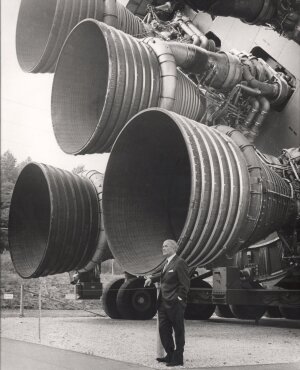
Wernher von Braun, with the F-1 engines of the Saturn V first stage at the US Space and Rocket Center.Dr. Wernher Magnus Maximilian Freiherr von Braun (March 23, 1912 – June 16, 1977) was one of the leading figures in the development of rocket technology in Germany and the United States. The German scientist, who led Germany's rocket development program (V-2) before and during World War II, entered the United States at the end of the war through the then-secret Operation Paperclip. He became a naturalized U.S. citizen and worked on the American ICBM program before joining NASA, where he served as director of NASA's Marshall Space Flight Center and the chief architect of the Saturn V launch vehicle, the superbooster that propelled the United States to the Moon. He is generally regarded as the father of the United States space program. Wernher von Braun received the National Medal of Science in 1975. He was tall, articulate and spoke English with a distinctive German accent.

After von Braun's death, Major General John Medaris commented,

"His imagination strolled easily among the stars, yet the farther out into the unknown and unknowable vastness of Creation his thoughts went, the more he was certain that the universe, and this small garden spot within it, came from no cosmic accident, but from the thought and purpose of an all-knowing God."
More...

Tuesday, February 12, 2008

Wernher von Braun

Wernher von Braun stands at his desk in the Marshall Space Flight Center, Huntsville, Alabama in May 1964, with models of rockets developed and in progressDr. Wernher Magnus Maximilian Freiherr von Braun (March 23, 1912 – June 16, 1977) was one of the leading figures in the development of rocket technology in Germany and the United States. The German scientist, who led Germany's rocket development program (V-2) before and during World War II, entered the United States at the end of the war through the then-secret Operation Paperclip. He became a naturalized U.S. citizen and worked on the American ICBM program before joining NASA, where he served as director of NASA's Marshall Space Flight Center and the chief architect of the Saturn V launch vehicle, the superbooster that propelled the United States to the Moon. He is generally regarded as the father of the United States space program. Wernher von Braun received the National Medal of Science in 1975. He was tall, articulate and spoke English with a distinctive German accent.
(see also Founders of modern science

Opposition to one-sided teaching of evolution

But, must we really light a candle to see the sun? -Wernher von BraunConcerning the teaching of evolution in public schools, Wernher von Braun said:
“ To be forced to believe only one conclusion—that everything in the universe happened by chance—would violate the very objectivity of science itself. Certainly there are those who argue that the universe evolved out of random process, but what random process could produce the brain of a man or the system of the human eye? Some say that science has been unable to prove the existence of a Designer... They challenge science to prove the existence of God. But, must we really light a candle to see the sun?

More...
 

Subscribe


LifeNews.com

Desiring God Blog

Youth for Christ International