Showing posts with label Founders of modern science. Show all posts

Thursday, December 08, 2011

Founders of Modern Science

 Earthrise over the Moon,
Apollo 8, NASA. 
Science (from the Latin scientia, 'knowledge, skill') is a system of acquiring knowledge based on the scientific method, as well as the organized body of knowledge gained through such research. Science, as defined here, is sometimes termed pure science to differentiate it from applied science, which is the application of scientific research to specific human needs.

The renewal of learning in Europe, that began with 12th century Scholasticism, came to an end about the time of the Black Death, and the initial period of the subsequent Italian Renaissance is sometimes seen as a lull in scientific activity. The Northern Renaissance, on the other hand, showed a decisive shift in focus from Aristoteleian natural philosophy to chemistry and the biological sciences (botany, anatomy, and medicine). Thus modern science in Europe was resumed in a period of great upheaval: the Protestant Reformation and Catholic Counter-Reformation; the discovery of the Americas by Christopher Columbus; the Fall of Constantinople; but also the re-discovery of Aristotle's during the Scholastic period presaged large social and political changes.

Thus, a suitable environment was created in which it became possible to question scientific doctrine, in much the same way that Martin Luther and John Calvin questioned religious doctrine. The works of Claudius Ptolemaeus (astronomy) and Galen (medicine) were found not always to match everyday observations. Work by Vesalius on human cadavers found problems with the Galenic view of anatomy.

The willingness to question previously held truths and search for new answers resulted in a period of major scientific advancements, now known as the Scientific Revolution. The Scientific Revolution is traditionally held by most historians to have begun in 1543, when De Revolutionibus, by the astronomer Nicolaus Copernicus, was first printed. The thesis of this book was that the Earth moved around the Sun. The period culminated with the publication of the Philosophiæ Naturalis Principia Mathematica in 1687 by Isaac Newton.
More...


Galileo and the Church
Creation As Science by Dr. Hugh Ross
Wednesday, December 08, 2010

Founders of modern science

Science (from the Latin scientia, 'knowledge') is a system of acquiring knowledge based on the scientific method, as well as the organized body of knowledge gained through such research. Science as defined here is sometimes termed pure science to differentiate it from applied science, which is the application of scientific research to specific human needs.

The renewal of learning in Europe, that began with 12th century Scholasticism, came to an end about the time of the Black Death, and the initial period of the subsequent Italian Renaissance is sometimes seen as a lull in scientific activity. The Northern Renaissance, on the other hand, showed a decisive shift in focus from Aristoteleian natural philosophy to chemistry and the biological sciences (botany, anatomy, and medicine). Thus modern science in Europe was resumed in a period of great upheaval: the Protestant Reformation and Catholic Counter-Reformation; the discovery of the Americas by Christopher Columbus; the Fall of Constantinople; but also the re-discovery of Aristotle during the Scholastic period presaged large social and political changes (see the Renaissance).

Thus, a suitable environment was created in which it became possible to question scientific doctrine, in much the same way that Martin Luther and John Calvin questioned religious doctrine. The works of Claudius Ptolemaeus (astronomy) and Galen (medicine) were found not always to match everyday observations. Work by Vesalius on human cadavers found problems with the Galenic view of anatomy.

The willingness to question previously held truths and search for new answers resulted in a period of major scientific advancements, now known as the Scientific Revolution. The Scientific Revolution is traditionally held by most historians to have begun in 1543, when De Revolutionibus, by the astronomer Nicolaus Copernicus, was first printed. The thesis of this book was that the Earth moved around the Sun. The period culminated with the publication of the Philosophiæ Naturalis Principia Mathematica in 1687 by Isaac Newton.

More...


 Galileo and the Church, Part 1 of 4

Monday, January 04, 2010

Founders of Modern Science

Science (from the Latin scientia, 'knowledge') is a system of acquiring knowledge based on the scientific method, as well as the organized body of knowledge gained through such research. Science as defined here is sometimes termed pure science to differentiate it from applied science, which is the application of scientific research to specific human needs.

Scholasticism, came to an end about the time of the Black Death, and the initial period of the subsequent Italian Renaissance is sometimes seen as a lull in scientific activity. The Northern Renaissance, on the other hand, showed a decisive shift in focus from Aristoteleian natural philosophy to chemistry and the biological sciences (botany, anatomy, and medicine). Thus modern science in Europe was resumed in a period of great upheaval: the Protestant Reformation and Catholic Counter-Reformation; the discovery of the Americas by Christopher Columbus; the Fall of Constantinople; but also the re-discovery of Aristotle during the Scholastic period presaged large social and political changes.

More...

Wednesday, July 08, 2009

Joseph Lister

Joseph Lister, 1st Baron Lister, OM , FRS (5 April 1827 – 10 February 1912) was an English surgeon who promoted the idea of sterile surgery while working at the Glasgow Royal Infirmary.Joseph Lister, 1st Baron Lister, OM , FRS (5 April 1827 – 10 February 1912) was an English surgeon who promoted the idea of sterile surgery while working at the Glasgow Royal Infirmary. He successfully introduced carbolic acid (phenol) to sterilize surgical instruments and to clean wounds.

Joseph Lister came from a prosperous Quaker home in Upton, Essex, a son of Joseph Jackson Lister, the pioneer of the compound microscope, and Isabella Harris.

He attended the University of London, one of only a few institutions which was open to Quakers at that time. He initially studied the Arts but at the age of 25 became a Bachelor of Medicine and entered the Royal College of Surgeons.

In 1854, Lister became first assistant surgeon to James Syme, at the University of Edinburgh in Scotland. The two became close friends and Lister ended up marrying Syme's daughter Agnes, a member of the Scottish Episcopal Church, leaving the Quakers, perhaps because his religion did not permit marriages with non-members. He once stated,

“I am a believer in the fundamental doctrines of Christianity.”

More...

Sunday, February 01, 2009

Founders of Modern Science

Earthrise over the Moon, Apollo 8, NASA. This image helped create awareness of the finiteness of Earth, and the limits of its natural resources.Science (from the Latin scientia, 'knowledge') is a system of acquiring knowledge based on the scientific method, as well as the organized body of knowledge gained through such research. Science as defined here is sometimes termed pure science to differentiate it from applied science, which is the application of scientific research to specific human needs.

The renewal of learning in Europe, that began with 12th century Scholasticism, came to an end about the time of the Black Death, and the initial period of the subsequent Italian Renaissance is sometimes seen as a lull in scientific activity. The Northern Renaissance, on the other hand, showed a decisive shift in focus from Aristoteleian natural philosophy to chemistry and the biological sciences (botany, anatomy, and medicine). Thus modern science in Europe was resumed in a period of great upheaval: the Protestant Reformation and Catholic Counter-Reformation; the discovery of the Americas by Christopher Columbus; the Fall of Constantinople; but also the re-discovery of Aristotle during the Scholastic period presaged large social and political changes.

Thus, a suitable environment was created in which it became possible to question scientific doctrine, in much the same way that Martin Luther and John Calvin questioned religious doctrine. The works of Claudius Ptolemaeus (astronomy) and Galen (medicine) were found not always to match everyday observations. Work by Vesalius on human cadavers found problems with the Galenic view of anatomy.

Approximately 1,000 years ago, modern science began to supplant superstition (the commonly held irrational beliefs emerging from ignorance or fear). What follows is a list of some of the "Founders of Modern Science" who were, with the exception of one, of the Christian faith. The links below provide information regarding each person's faith and contributions to humanity.

More...

Thursday, August 07, 2008

Joseph Lister

Joseph Lister, 1st Baron Lister, OM , FRS (5 April 1827 – 10 February 1912) was an English surgeon who promoted the idea of sterile surgery while working at the Glasgow Royal Infirmary.Joseph Lister, 1st Baron Lister, OM , FRS (5 April 1827 – 10 February 1912) was an English surgeon who promoted the idea of sterile surgery while working at the Glasgow Royal Infirmary. He successfully introduced carbolic acid (phenol) to sterilize surgical instruments and to clean wounds.

Early Life and College

Joseph Lister came from a prosperous Quaker home in Upton, Essex, a son of Joseph Jackson Lister, the pioneer of the compound microscope, and Isabella Harris.

He attended the University of London, one of only a few institutions which was open to Quakers at that time. He initially studied the Arts but at the age of 25 became a Bachelor of Medicine and entered the Royal College of Surgeons.

In 1854, Lister became first assistant surgeon to James Syme, at the University of Edinburgh in Scotland. The two became close friends and Lister ended up marrying Syme's daughter Agnes, a member of the Scottish Episcopal Church, leaving the Quakers, perhaps because his religion did not permit marriages with non-members. He once stated,

“I am a believer in the fundamental doctrines of Christianity.”

Discovery of Antiseptic Treatment of Wounds


After six years he got a professorship of surgery at the University of Glasgow. At the time the usual explanation for wound infection was that the exposed tissues were damaged by chemicals in the air or via a stinking "miasma" in the air. The sick wards actually smelled bad, not due to a "miasma" but due to the rotting of wounds. Hospital wards were occasionally aired out at midday, but Florence Nightingale's doctrine of fresh air was still seen as science fiction. Facilities for washing hands or the patient's wounds did not exist and it was even considered unnecessary for the surgeon to wash his hands before he saw a patient. The work of Ignaz Philipp Semmelweis and Oliver Wendell Holmes were not heeded.

More...

Monday, March 24, 2008

William Thomson

A photograph of William Thomson, likely from the late-19th century William Thomson (1st Baron Kelvin, Lord Kelvin), OM, GCVO, PC, PRS, FRSE, (26 June 1824 – 17 December 1907) was a mathematical physicist, engineer, and outstanding leader in the physical sciences of the 19th century. He did important work in the mathematical analysis of electricity and thermodynamics, and did much to unify the emerging discipline of physics in its modern form. He is widely known for developing the Kelvin scale of absolute temperature measurement. The title Baron Kelvin was given in honour of his achievements, and named after the River Kelvin, which flowed past his university in Glasgow, Scotland.

He also enjoyed a second career as a telegraph engineer and inventor, a career that propelled him into the public eye and ensured his wealth, fame and honour (see also Founders of modern science).

Thomson was a defender of Christian education, and he studied the Bible, its history, and the geography of the ancient world.

More...

Wednesday, February 13, 2008

Carolus Linnaeus

Carl von Linné, Alexander Roslin, 1775. Currently owned by and hanging at the Royal Swedish Academy of SciencesCarolus Linnaeus, also known after his ennoblement as Carl von Linné (help·info), (May 23, 1707 – January 10, 1778), was a Swedish botanist, physician and zoologist who laid the foundations for the modern scheme of nomenclature. He is known as the "father of modern taxonomy." He is also considered one of the fathers of modern ecology.

He was the most renowned botanist of his time, and also noted for his fine linguistic skills. The French philosopher Jean-Jacques Rousseau sent him the message: "Tell him I know no greater man on earth." ; the German writer Johann Wolfgang von Goethe wrote: "With the exception of Shakespeare and Spinoza, I know no one among the no longer living who has influenced me more strongly." ; Swedish author August Strindberg wrote: "Linnaeus was in reality a poet who happened to become a naturalist".

(see also: Founders of modern science)


Name

The name of this botanist comes in different variants: 'Carl Linnaeus', 'Carolus Linnaeus' and 'Carl von Linné', sometimes just 'Carl Linné'. There is often confusion about his real Swedish name, as opposed to the Latinized form 'Carolus Linnaeus' he used most when he published his scientific works in Latin.
In the preface to a late edition of his work entitled Systema Naturae: Creationis telluris est glaria Dei ex opere Naturae per Hormonem solem, Linnaeus stated, "The Earth's creation is the glory of God, as seen from the works of Nature by man alone. The study of nature would reveal the Devine Order of God's creation, and it was the naturalist's task to construct a 'Natural classification' that would reveal this Order in the universe."

More...

Tuesday, February 12, 2008

Wernher von Braun

Wernher von Braun stands at his desk in the Marshall Space Flight Center, Huntsville, Alabama in May 1964, with models of rockets developed and in progressDr. Wernher Magnus Maximilian Freiherr von Braun (March 23, 1912 – June 16, 1977) was one of the leading figures in the development of rocket technology in Germany and the United States. The German scientist, who led Germany's rocket development program (V-2) before and during World War II, entered the United States at the end of the war through the then-secret Operation Paperclip. He became a naturalized U.S. citizen and worked on the American ICBM program before joining NASA, where he served as director of NASA's Marshall Space Flight Center and the chief architect of the Saturn V launch vehicle, the superbooster that propelled the United States to the Moon. He is generally regarded as the father of the United States space program. Wernher von Braun received the National Medal of Science in 1975. He was tall, articulate and spoke English with a distinctive German accent.
(see also Founders of modern science

Opposition to one-sided teaching of evolution

But, must we really light a candle to see the sun? -Wernher von BraunConcerning the teaching of evolution in public schools, Wernher von Braun said:
“ To be forced to believe only one conclusion—that everything in the universe happened by chance—would violate the very objectivity of science itself. Certainly there are those who argue that the universe evolved out of random process, but what random process could produce the brain of a man or the system of the human eye? Some say that science has been unable to prove the existence of a Designer... They challenge science to prove the existence of God. But, must we really light a candle to see the sun? ”

More...

Saturday, January 19, 2008

Founders of modern science

Earthrise over the Moon, Apollo 8, NASA. This image helped create awareness of the finiteness of Earth, and the limits of its natural resources.Science (from the Latin scientia, 'knowledge') is a system of acquiring knowledge based on the scientific method, as well as the organized body of knowledge gained through such research. Science as defined here is sometimes termed pure science to differentiate it from applied science, which is the application of scientific research to specific human needs.

The renewal of learning in Europe, that began with 12th century Scholasticism, came to an end about the time of the Black Death, and the initial period of the subsequent Italian Renaissance is sometimes seen as a lull in scientific activity. The Northern Renaissance, on the other hand, showed a decisive shift in focus from Aristoteleian natural philosophy to chemistry and the biological sciences (botany, anatomy, and medicine).

Thus modern science in Europe was resumed in a period of great upheaval: the Protestant Reformation and Catholic Counter-Reformation; the discovery of the Americas by Christopher Columbus; the Fall of Constantinople; but also the re-discovery of Aristotle during the Scholastic period presaged large social and political changes. Thus, a suitable environment was created in which it became possible to question scientific doctrine, in much the same way that Martin Luther and John Calvin questioned religious doctrine. The works of Ptolemy (astronomy), Galen (medicine), and Aristotle (physics) were found not always to match everyday observations. For example, an arrow flying through the air after leaving a bow contradicts Aristotle's laws of motion, which say that a moving object must be constantly under influence of an external force, as the natural state of earthly objects is to be at rest. Work by Vesalius on human cadavers also found problems with the Galenic view of anatomy.

The willingness to question previously held truths and search for new answers resulted in a period of major scientific advancements, now known as the Scientific Revolution. The Scientific Revolution is traditionally held by most historians to have begun in 1543, when De Revolutionibus, by the astronomer Nicolaus Copernicus, was first printed. The thesis of this book was that the Earth moved around the Sun. The period culminated with the publication of the Philosophiae Naturalis Principia Mathematica in 1687 by Isaac Newton.

Other significant scientific advances were made during this time by Galileo Galilei, Edmond Halley, Robert Hooke, Christiaan Huygens, Tycho Brahe, Johannes Kepler, Gottfried Leibniz, and Blaise Pascal. In philosophy, major contributions were made by Francis Bacon, Sir Thomas Browne, René Descartes, and Thomas Hobbes. The scientific method was also better developed as the modern way of thinking emphasized experimentation and reason over traditional considerations.

Approximately 1,000 years ago, modern science began to supplant superstition (the commonly held irrational beliefs emerging from ignorance or fear). What follows is a list of some of the founders of modern science who were, with the exception of one, of the Christian faith. The links below provide information regarding each person's Christian faith and their contributions to humanity.

More...

Thursday, October 18, 2007

Founders of modern science

Earthrise over the Moon, Apollo 8, NASA. This image helped create awareness of the finiteness of Earth, and the limits of its natural resources.Science (from the Latin scientia, 'knowledge') is a system of acquiring knowledge based on the scientific method, as well as the organized body of knowledge gained through such research. Science as defined here is sometimes termed pure science to differentiate it from applied science, which is the application of scientific research to specific human needs.

The renewal of learning in Europe, that began with 12th century Scholasticism, came to an end about the time of the Black Death, and the initial period of the subsequent Italian Renaissance is sometimes seen as a lull in scientific activity. The Northern Renaissance, on the other hand, showed a decisive shift in focus from Aristoteleian natural philosophy to chemistry and the biological sciences (botany, anatomy, and medicine).

Thus modern science in Europe was resumed in a period of great upheaval: the Protestant Reformation and Catholic Counter-Reformation; the discovery of the Americas by Christopher Columbus; the Fall of Constantinople; but also the re-discovery of Aristotle during the Scholastic period presaged large social and political changes. Thus, a suitable environment was created in which it became possible to question scientific doctrine, in much the same way that Martin Luther and John Calvin questioned religious doctrine. The works of Ptolemy (astronomy), Galen (medicine), and Aristotle (physics) were found not always to match everyday observations. For example, an arrow flying through the air after leaving a bow contradicts Aristotle's laws of motion, which say that a moving object must be constantly under influence of an external force, as the natural state of earthly objects is to be at rest. Work by Vesalius on human cadavers also found problems with the Galenic view of anatomy.

More...

Saturday, August 18, 2007

Louis Pasteur

Louis PasteurLouis Pasteur (December 27, 1822 – September 28, 1895) was a French chemist best known for his remarkable breakthroughs in microbiology. His experiments confirmed the germ theory of disease, also reducing mortality from puerperal fever (childbed), and he created the first vaccine for rabies. He is best known to the general public for showing how to stop milk and wine from going sour - this process came to be called pasteurization. He is regarded as one of the three main founders of bacteriology, together with Ferdinand Cohn and Robert Koch. He also made many discoveries in the field of chemistry, most notably the asymmetry of crystals.

“He believed that the Genesis account that created life reproduces its own kind. He worked to deomonstrate the fallacy of spontaneous generation, which many continued to believe despite the work of Leeuwenhoek in the previous century”

Louis Jean Pasteur was born on December 27, 1822 in Dole in the Jura region of France and grew up in the town of Arbois. There he later had his house and laboratory, which is a Pasteur museum today. His father, Jean Pasteur, was a tanner and a veteran of the Napoleonic wars. Louis's aptitude was recognized by his college headmaster, who recommended that the young man apply for the École Normale Supérieure, which accepted him. After serving briefly as professor of physics at Dijon Lycée in 1848, he became professor of chemistry at Strasbourg University, where he met and courted Marie Laurent, daughter of the university's rector in 1849. They were married on May 29, 1849 and together they had five children, only two of whom survived to adulthood. Throughout his whole life, Louis Pasteur remained an ardent Catholic. A well-known quotation illustrating this is attributed to him: "I have the faith of a Breton peasant, and by the time I die I hope to have the faith of a Breton peasant's wife."

More...

Friday, August 17, 2007

Gregor Mendel

Gregor Johann MendelGregor Johann Mendel (July 20, 1822 – January 6, 1884) was a German-Czech Augustinian priest and scientist often called the "father of modern genetics" for his study of the inheritance of traits in pea plants. Mendel showed that the inheritance of traits follows particular laws, which were later named after him. The significance of Mendel's work was not recognized until the turn of the 20th century. Its rediscovery prompted the foundation of genetics.

As an Augustinian monk, Gregor Mendel was a Christian who belived in creationism.

Mendel was born into a German-speaking family in Heinzendorf, Silesia, then part of the Austrian Empire (now Hynčice in the Czech Republic), and was baptized two days later. During his childhood Mendel worked as a gardener, and as a young man attended the Philosophical Institute in Olomouc (Olmütz). In 1843 he entered the Augustinian Abbey of St. Thomas in Brno, (Brünn). Born Johann Mendel, he took the name Gregor upon entering monastic life. In 1851 he was sent to the University of Vienna to study, returning to his abbey in 1853 as a teacher, principally of physics.

Gregor Mendel, who is known as the "father of modern genetics", was inspired by both his professors at university and his colleagues at the monastery to study variation in plants. He commenced his study his monastery's experimental garden. Between 1856 and 1863 Mendel cultivated and tested some 29,000 pea plants. His experiments brought forth two generalizations which later became known as Mendel's Laws of Inheritance.


More...

Thursday, August 16, 2007

James Clerk Maxwell

James Clerk MaxwellJames Clerk Maxwell (13 June 1831 – 5 November 1879) was a Scottish mathematician and theoretical physicist. His most significant achievement was formulating a set of equations — eponymically named Maxwell's equations — that for the first time expressed the basic laws of electricity and magnetism in a unified fashion. He also developed the Maxwell distribution, a statistical means to describe aspects of the kinetic theory of gases. These two discoveries helped usher in the era of modern physics, laying the foundation for future work in such fields as special relativity and quantum mechanics. He is also known for creating the first true colour photograph in 1861.

“(The work of Maxwell) ... the most profound and the most fruitful that physics has experienced since the time of Newton.” —Albert Einstein, The Sunday Post

The majority of Maxwell's illustrious career took place at the University of Cambridge, where his investigations often made use of his mathematical aptitude, drawing on elements of geometry and algebra. With these skills, Maxwell was able to demonstrate that electric and magnetic fields travel through space, in the form of waves, and at the constant speed of light. Finally, in 1861 Maxwell wrote a four-part publication in the Philosophical Magazine called On Physical Lines of Force where he first proposed that light was in fact undulations in the same medium that is the cause of electric and magnetic phenomena.


More...

Wednesday, August 15, 2007

William Thompson

A photograph of William Thomson, likely from the late-19th century William Thomson, 1st Baron Kelvin, OM, GCVO, PC, PRS, FRSE, (26 June 1824 – 17 December 1907) was a mathematical physicist, engineer, and outstanding leader in the physical sciences of the 19th century. He did important work in the mathematical analysis of electricity and thermodynamics, and did much to unify the emerging discipline of physics in its modern form. He is widely known for developing the Kelvin scale of absolute temperature measurement. The title Baron Kelvin was given in honour of his achievements, and named after the River Kelvin, which flowed past his university in Glasgow, Scotland.

He also enjoyed a second career as a telegraph engineer and inventor, a career that propelled him into the public eye and ensured his wealth, fame and honour.

Thomson was a defender of Christian education, and he studied the Bible, its history, and the geography of the ancient world.

Thomson remained a devout believer in Christianity throughout his life: attendance at chapel was part of his daily routine, though he might not identify with fundamentalism if he were alive today. He saw his Christian faith as supporting and informing his scientific work, as is evident from his address to the annual meeting of the Christian Evidence Society, 23 May 1889.

More...

Tuesday, August 14, 2007

James Prescott Joule

James Joule - English physicist James Prescott Joule, FRS (December 24, 1818 – October 11, 1889) was an English physicist, born in Sale, near Manchester. Joule studied the nature of heat, and discovered its relationship to mechanical work (see energy). This led to the theory of conservation of energy, which led to the development of the first law of thermodynamics. The SI unit of work, the joule, is named after him. He worked with Lord Kelvin to develop the absolute scale of temperature, made observations on magnetostriction, and found the relationship between the flow of current through a resistance and the heat dissipated, now called Joule's law.

"I shall lose no time in repeating and extending these experiments, being satisfied that the grand agents of nature are by the Creator's fiat, indestructible; and that wherever mechanical force is expended, and exact equivalent of heat is always obtained."

"After knowledge of, and obedience to, the will of God, the next aim must be
to know something of His attributes of wisdom power and goodness as evidenced by His handiwork. It is evident that an acquaintance with natural laws means no
less than an acquaintance with the mind of God therein expressed."
-James Prescott Joule

More...

Monday, August 13, 2007

Michael Faraday

Michael Faraday holding a glass bar of the type he used in 1845 to show that magnetism can affect light. Detail of an engraving by Henry Adlard, based on an earlier photograph by Maull and Polyblank c 1857Michael Faraday, FRS (September 22, 1791 – August 25, 1867) was an English chemist and physicist (or natural philosopher, in the terminology of that time) who contributed significantly to the fields of electromagnetism and electrochemistry.

Faraday studied the magnetic field around a conductor carrying a DC electric current, and established the basis for the magnetic field concept in physics. He discovered electromagnetic induction, diamagnetism and electrolysis. He established that magnetism could affect rays of light and that there was an underlying relationship between the two phenomena.

His inventions of electromagnetic rotary devices formed the foundation of electric motor technology.

As a chemist, Faraday discovered chemical substances such as benzene, invented an early form of the bunsen burner and the system of oxidation numbers, and popularized terminology such as anode, cathode, electrode, and ion.

More...

Saturday, August 11, 2007

William Herschel

Sir Frederick William Herschel Sir Frederick William Herschel, FRS KH (15 November 1738-25 August 1822) was a German-born British astronomer and composer who became famous for discovering the planet Uranus. He also discovered infrared radiation and made many other discoveries in astronomy.

Biography
He was born Friedrich Wilhelm Herschel in Hanover, Germany, as one of ten children (of whom four died very young), of Isaac Herschel (1707-1767) a member of the Hanover Military Band. Although Isaac was of Jewish birth, his wife was Christian and the children were raised as Christians. In 1755 the Hanoverian Guards regiment, in whose band William and his brother Jacob were engaged, was ordered to England. At the time, the crowns of England and Hanover were united under George II. He learned English quickly and, at age nineteen, he changed his name to Frederick William Herschel.


"Herschel's pioneering work in astronomy was motivated by his belief in God as the Creator and the author of all natural laws." -Jeffrey Donley, Ph.D.

More...

Friday, August 10, 2007

Antony van Leeuwenhoek

Antony van LeeuwenhoekAntony (October 24, 1632 - August 30, 1723), full name Thonius Philips van Leeuwenhoek (pronounced 'vahn Laywenhook') was a Dutch tradesman and scientist from Delft, Netherlands. He is commonly known as "the Father of Microbiology". Born the son of a basket maker, at age 16 he secured an apprenticeship with a Scottish cloth merchant in Amsterdam. He is best known for his work on the improvement of the microscope and for his contributions towards the establishment of microbiology. Using his handcrafted microscopes he was the first to observe and describe single celled organisms, which he originally referred to as animalcules, and which we now refer to as microorganisms. He was also the first to record microscopic observations of muscle fibers, bacteria, spermatozoa and blood flow in capillaries (small blood vessels).
His faith in God and love for His creation undergirded his science. Along with others, he exposed the fallacy of spontaneous generation (abiogenesis), the superstitious belief that life sprung from material objects, such as raw meat "birthing" maggots.

During his lifetime van Leeuwenhoek ground over 500 optical lenses. He also created over 400 different types of microscopes, only nine of which still exist today. His microscopes were made of silver or copper metal frames holding hand-ground lenses. Those that have survived the years are able to magnify up to 275 times. It is suspected, though, that van Leeuwenhoek possessed some microscopes that could magnify up to 500 times. Although he has been widely regarded as a dilettante or amateur, his scientific research was of remarkably high quality.


More...

Thursday, August 09, 2007

Blaise Pascal

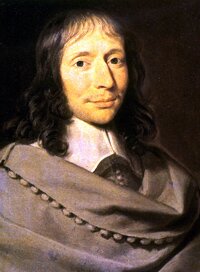
Blaise PascalBlaise Pascal (June 19, 1623–August 19, 1662) was a French mathematician, physicist, and religious philosopher. He was a child prodigy who was educated by his father. Pascal's earliest work was in the natural and applied sciences where he made important contributions to the construction of mechanical calculators, the study of fluids, and clarified the concepts of pressure and vacuum by generalizing the work of Evangelista Torricelli. Pascal also wrote powerfully in defense of the scientific method.

He was a mathematician of the first order. Pascal helped create two major new areas of research. He wrote a significant treatise on the subject of projective geometry at the age of sixteen and corresponded with Pierre de Fermat from 1654 and later on probability theory, strongly influencing the development of modern economics and social science.

Following a mystical experience in late 1654, he abandoned his scientific work and devoted himself to philosophy and theology. His two most famous works date from this period: the Lettres provinciales and the Pensées. However, he had suffered from ill-health throughout his life and his new interests were ended by his early death two months after his 39th birthday.


More...


Subscribe


LifeNews.com

Desiring God Blog

Youth for Christ International