Showing posts with label Martin Luther. Show all posts

Wednesday, July 27, 2011

Reformation

The Protestant Reformation was a movement that emerged in the 16th century as a series of attempts to reform the Roman Catholic Church in Western Europe. The main front of the reformation was started by Martin Luther and his 95 Theses. The Reformation ended in division and the establishment of new institutions, most importantly Lutheranism, the Reformed churches, and Anabaptists, a branch whose name means "those who baptize again".

Martin Luther's spiritual predecessors included men such as John Wycliffe and Jan Hus, who had attempted to reform the church along similar lines, though their efforts had been largely unsuccessful. The Reformation can be said to have begun in earnest on October 31, 1517, in Wittenberg, Saxony (in present-day Germany). There, Luther nailed his Ninety-Five Theses to the door of the All Saints' Church, which served as a notice board for university-related announcements. These were points for debate that criticized the Church and the Pope. The most controversial points centered on the practice of selling indulgences and the Church's policy on purgatory. Other reformers, such as Huldrych Zwingli, soon followed Luther's lead. Church beliefs and practices under attack by Protestant reformers included purgatory, particular judgment, devotion to Mary (Mariology), the intercession of and devotion to the saints, most of the sacraments, the mandatory celibacy requirement of its clergy (including monasticism), and the authority of the Pope.

More

Info about Luther's Von den Jüden und jren Lügen

Sunday, January 16, 2011

Huldrych Zwingli

Huldrych (or Ulrich) Zwingli (1 January 1484 – 11 October 1531) was a leader of the Reformation in Switzerland. He attended the University of Vienna and the University of Basel. He continued his studies while he served as a pastor in Glarus and later in Einsiedeln where he was influenced by the writings of Erasmus, a humanist scholar and theologian.

In 1519, Zwingli became the pastor of the Grossmünster in Zürich where he began to preach ideas on reforming the church. In his first public controversy in 1522, he attacked the custom of fasting during Lent. In his publications, he noted problems in the corruption of the ecclesiastical hierarchy, promoted clerical marriage, and attacked the use of images. In 1525, Zwingli introduced a new communion liturgy to replace the mass. Zwingli also clashed with the radical wing of the Reformation, the Anabaptists, which resulted in their persecution.

The Reformation spread to other parts of the Swiss Confederation, but several cantons resisted preferring to remain Catholic. Zwingli formed an alliance of Reformed cantons which divided the Confederation along religious lines. In 1529, a war between the two sides was averted at the last moment. Meanwhile, Zwingli ’s ideas came to the attention of Martin Luther and other reformers.

More

Sunday, February 21, 2010

History of Protestantism

The History of Protestantism begins with the Reformation movement, which began as an attempt to reform the Catholic Church and led to the fracturing of Christendom. Many western Christians were troubled by what they saw as false doctrines and malpractices within the Church, particularly involving the teaching and sale of indulgences. Another major contention was the rampant Simony and the tremendous corruption found at the time within the Church's hierarchy. At the time, this systemic corruption often reached all the way up to the Bishop of Rome himself, the Pope.

On 31 October 1517, Martin Luther nailed his Ninety-Five Theses On the Power of Indulgences to the door of the Wittenberg Castle Church, which served as a pin board for university-related announcements. This document outlined Luther's criticisms of the Church and the Pope. The most controversial points centered on the practice of selling indulgences and the Church's policy on purgatory.

Among Luther's spiritual predecessors were men such as John Wycliffe and Jan Hus. Other reformers, such as Huldrych Zwingli and John Calvin, soon followed Luther's lead. Church beliefs and practices under attack by Protestant reformers included purgatory, particular judgment, devotion to Mary, the intercession of the saints, most of the sacraments, and the authority of the Pope.

More...

Wednesday, July 15, 2009

Reformation

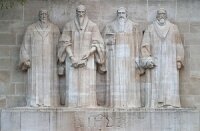
The Reformation Wall in Geneva. From left: William Farel, John Calvin, Theodore Beza, and John KnoxThe Protestant Reformation was a movement that emerged in the 16th century as a series of attempts to reform the Roman Catholic Church in Western Europe. The main front of the reformation was started by Martin Luther and his 95 Theses. The reformation ended in division and the establishment of new institutions, most importantly Lutheranism, the Reformed churches, and Anabaptists, a radical branch whose name means "those who baptize again".

Martin Luther's spiritual predecessors included men such as John Wycliffe and Jan Hus, who had attempted to reform the church along similar lines, though their efforts had been largely unsuccessful. The Reformation can be said to have begun in earnest on October 31, 1517, in Wittenberg, Saxony (in present-day Germany). There, Luther nailed his Ninety-Five Theses to the door of the All Saints' Church, which served as a notice board for university-related announcements. These were points for debate that criticized the Church and the Pope. The most controversial points centered on the practice of selling indulgences and the Church's policy on purgatory. Other reformers, such as Huldrych Zwingli, soon followed Luther's lead. Church beliefs and practices under attack by Protestant reformers included purgatory, particular judgment, devotion to Mary (Mariology), the intercession of and devotion to the saints, most of the sacraments, the mandatory celibacy requirement of its clergy (including monasticism), and the authority of the Pope.

More...

Tuesday, July 29, 2008

the 95 theses

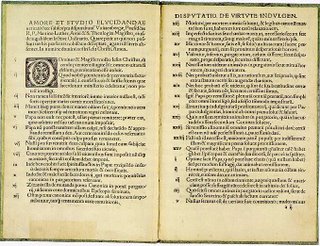
A replica of the 95 Theses in Schlosskirche, WittenbergThe Disputation of Martin Luther on the Power and Efficacy of Indulgences, known as the 95 Theses, (from 31 October 1517) challenged the teachings of the Church on the nature of penance, the authority of the pope and the usefulness of indulgences. They sparked a theological debate that would result in the Reformation and the birth of the Lutheran, Reformed, and Anabaptist traditions within Christianity.

The background for Luther's Theses centers on particular disputes with the Church dealing with the offering of indulgences—the granting of penance for sin. In short, the practice of giving indulgences became somewhat commoditized (with relics) and then commercialized, contributing to what Luther felt was an offense to Holy salvation among Catholics who felt they could find absolution through purchase rather than merit or grace.

The Castle Church in Wittenberg in the Roman Empire held one of Europe's largest collections of religious artifacts, accumulated by Frederick III.

At that time viewing relics was purported to allow the viewer to receive relief from temporal punishment for sins in purgatory. By 1509 Frederick had over 5,000 relics, "including vials of the milk of the Virgin Mary, straw from the manger [of Jesus], and the body of one of the innocents massacred by King Herod."

More...

Monday, June 02, 2008

Philipp Melanchthon

Philipp Melanchthon, engraving by Albrecht Dürer 1526Philipp Melanchthon (born Philipp Schwartzerd) (February 16, 1497 - April 19, 1560) was a German theologian and writer of the Protestant Reformation and an associate of Martin Luther.

Melanchthon was born at Bretten, near Karlsruhe, where his father, Georg Schwarzerd, was armorer to Count Palatine Philip.

In 1507 he was sent to the Latin school at Pforzheim, the rector of which, Georg Simler of Wimpfen, introduced him to the study of the Latin and Greek poets and of the philosophy of Aristotle. But he was chiefly influenced by his great-uncle, Johann Reuchlin, the great representative of humanism, who advised him to change his family name, Schwarzerd (literally Black-earth), into the Greek equivalent Melanchthon.

Not yet thirteen years old, he entered in 1509 the University of Heidelberg where he studied philosophy, rhetoric, and astronomy/astrology, and was known as a good Greek scholar. Being refused the degree of master in 1512 on account of his youth, he went to Tübingen, where he pursued humanistic and philosophical studies, but devoted himself also to the study of jurisprudence, mathematics, astronomy/astrology, and even of medicine.

More...

Tuesday, April 22, 2008

transubstantiation

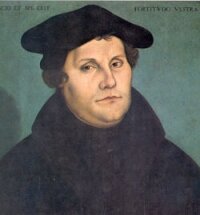
This work, which features Martin Luther’s portrait, first appeared in Latin and was directed against Catholic sacramental teaching. Of the seven sacraments, Luther considered only baptism and communion, and to some degree, confession, sacraments of Christ. In the case of communion, he rejected the notions that it was a sacrifice to God and that the elements are transformed (transubstantiation).Transubstantiation (in Latin, transsubstantiatio) is the change of the substance of bread and wine into the Body and Blood of Christ occurring in the Eucharist according to the teaching of some Christian Churches, including the Roman Catholic Church. In Greek it is called μετουσίωσις.

Theology of transubstantiation

"Substance" here means what something is in itself. (For more on the philosophical concept, see Substance theory.) A hat's shape is not the hat itself, nor is its colour the hat, nor is its size, nor its softness to the touch, nor anything else about it perceptible to the senses. The hat itself (the "substance") has the shape, the colour, the size, the softness and the other appearances, but is distinct from them. While the appearances, which are referred to by the philosophical term accidents, are perceptible to the senses, the substance is not.

More...

Wednesday, February 27, 2008

Protestant Reformation

The Reformation Wall in Geneva. From left: William Farel, John Calvin, Theodore Beza, and John Knox The Protestant Reformation was a movement that emerged in the 16th century as a series of attempts to reform the Roman Catholic Church in Western Europe. The main front of the reformation was started by Martin Luther and his 95 Theses. The reformation ended in division and the establishment of new institutions, most importantly Lutheranism, the Reformed churches, and Anabaptists, a radical branch whose name means "those who baptize again".

It also led to the Counter-Reformation within the Roman Catholic Church, which theological draft and background were drawn up with the Council of Trent (1548–1563), when Rome struck back against the fundamental ideas defended by the Reformers, like Luther. The rift between Catholics and Protestants would lead to the break up of large European empires into the modern nation-state system.

Unrest in the Western Church and Empire culminating in the Avignon Papacy (1308–1378), and the papal schism (1378–1416), excited wars between princes, uprisings among the peasants, and widespread concern over corruption in the monastic system. A new nationalism also challenged the relatively internationalist medieval world.

One of the most disruptive and radical of the new perspectives came first from John Wycliffe at Oxford University, then from John Huss at the University of Prague. The Roman Catholic Church officially concluded this debate at the Council of Constance (1414–1418). The conclave condemned Jan Hus, who was executed (he had come under a promise of safe-conduct) and posthumously burned Wycliffe as a heretic.

More...

Friday, February 22, 2008

Huldrych Zwingli

Huldrych Zwingli in an oil portrait from 1531 by Hans Asper; Kunstmuseum Winterthur.Huldrych (or Ulrich) Zwingli (1 January 1484 – 11 October 1531) was a leader of the Reformation in Switzerland. He attended the University of Vienna and the University of Basel. He continued his studies while he served as a pastor in Glarus and later in Einsiedeln where he was influenced by the writings of Erasmus, a humanist scholar and theologian.

In 1519, Zwingli became the pastor of the Grossmünster in Zürich where he began to preach ideas on reforming the church. In his first public controversy in 1522, he attacked the custom of fasting during Lent. In his publications, he noted problems in the corruption of the ecclesiastical hierarchy, promoted clerical marriage, and attacked the use of images. In 1525, Zwingli introduced a new communion liturgy to replace the mass. Zwingli also clashed with the radical wing of the Reformation, the Anabaptists, which resulted in their persecution.

The Reformation spread to other parts of the Swiss Confederation, but several cantons resisted preferring to remain Catholic. Zwingli formed an alliance of Reformed cantons which divided the Confederation along religious lines. In 1529, a war between the two sides was averted at the last moment. Meanwhile, Zwingli’s ideas came to the attention of Martin Luther and other reformers. The Reformation spread to other parts of the Swiss Confederation, but several cantons resisted preferring to remain Catholic. Zwingli formed an alliance of Reformed cantons which divided the Confederation along religious lines. In 1529, a war between the two sides was averted at the last moment. Meanwhile, Zwingli’s ideas came to the attention of Martin Luther and other reformers.

More...

Friday, January 25, 2008

Martin Luther

Martin Luther at age 46 by Lucas Cranach the Elder, 1529Martin Luther (November 10, 1483–February 18, 1546) was a German theologian, an Augustinian monk, and an ecclesiastical reformer whose teachings inspired the Reformation and deeply influenced the doctrines and culture of the Lutheran and Protestant traditions. Luther's call to the Church to return to the teachings of the Bible led to the formation of new traditions within Christianity and to the Counter-Reformation, the Catholic reaction to these movements. His contributions to Western civilization went beyond the life of the Christian Church. His translations of the Bible helped to develop a standard version of the German language and added several principles to the art of translation. His hymns inspired the development of congregational singing in Christianity. His marriage on June 13, 1525, to Katharina von Bora began a movement of clerical marriage within many Christian traditions.

Martin Luther was born to Hans and Margarette Luther, née Lindemann, on November 10, 1483, in Eisleben, Germany, and was baptized on the feast day of St. Martin of Tours, after whom he was named. His father owned a copper mine in nearby Mansfeld.

Having risen from the peasantry, his father was determined to see his son ascend to civil service and bring further honor to the family. To that end, Hans sent young Martin to schools in Mansfeld, Magdeburg and Eisenach.


More...

Saturday, January 19, 2008

Founders of modern science

Earthrise over the Moon, Apollo 8, NASA. This image helped create awareness of the finiteness of Earth, and the limits of its natural resources.Science (from the Latin scientia, 'knowledge') is a system of acquiring knowledge based on the scientific method, as well as the organized body of knowledge gained through such research. Science as defined here is sometimes termed pure science to differentiate it from applied science, which is the application of scientific research to specific human needs.

The renewal of learning in Europe, that began with 12th century Scholasticism, came to an end about the time of the Black Death, and the initial period of the subsequent Italian Renaissance is sometimes seen as a lull in scientific activity. The Northern Renaissance, on the other hand, showed a decisive shift in focus from Aristoteleian natural philosophy to chemistry and the biological sciences (botany, anatomy, and medicine).

Thus modern science in Europe was resumed in a period of great upheaval: the Protestant Reformation and Catholic Counter-Reformation; the discovery of the Americas by Christopher Columbus; the Fall of Constantinople; but also the re-discovery of Aristotle during the Scholastic period presaged large social and political changes. Thus, a suitable environment was created in which it became possible to question scientific doctrine, in much the same way that Martin Luther and John Calvin questioned religious doctrine. The works of Ptolemy (astronomy), Galen (medicine), and Aristotle (physics) were found not always to match everyday observations. For example, an arrow flying through the air after leaving a bow contradicts Aristotle's laws of motion, which say that a moving object must be constantly under influence of an external force, as the natural state of earthly objects is to be at rest. Work by Vesalius on human cadavers also found problems with the Galenic view of anatomy.

The willingness to question previously held truths and search for new answers resulted in a period of major scientific advancements, now known as the Scientific Revolution. The Scientific Revolution is traditionally held by most historians to have begun in 1543, when De Revolutionibus, by the astronomer Nicolaus Copernicus, was first printed. The thesis of this book was that the Earth moved around the Sun. The period culminated with the publication of the Philosophiae Naturalis Principia Mathematica in 1687 by Isaac Newton.

Other significant scientific advances were made during this time by Galileo Galilei, Edmond Halley, Robert Hooke, Christiaan Huygens, Tycho Brahe, Johannes Kepler, Gottfried Leibniz, and Blaise Pascal. In philosophy, major contributions were made by Francis Bacon, Sir Thomas Browne, René Descartes, and Thomas Hobbes. The scientific method was also better developed as the modern way of thinking emphasized experimentation and reason over traditional considerations.

Approximately 1,000 years ago, modern science began to supplant superstition (the commonly held irrational beliefs emerging from ignorance or fear). What follows is a list of some of the founders of modern science who were, with the exception of one, of the Christian faith. The links below provide information regarding each person's Christian faith and their contributions to humanity.

More...

Monday, November 19, 2007

Council of Trent

Paolo Farinatis: meeting of the council of Trient, 1563The Council of Trent is reckoned by the Roman Catholic Church to be the Nineteenth Ecumenical Council of the universal church. It was held from December 13, 1545, to December 4, 1563 in the Italian city of Trent. Although called an Ecumenical Council, only Roman Catholics attended. Indeed it was called as a riposte to the growth of Protestantism.

It is considered one of the most important councils in the history of the Roman Catholic Church, establishing church doctrine in response to the Reformation and condemning Protestantism. It clearly specified Catholic doctrines on salvation, the sacraments and the Biblical canon, and standardized the Mass throughout the church, largely abolishing local variations. This became called the "Tridentine Mass", from the city's Latin name Tridentum.

Occasion, sessions, and attendance

In reply to the Papal bull Exsurge Domine of Pope Leo X (1520), Martin Luther had burned the document and appealed to a general council. In 1522, German diets joined in the appeal, and Charles V seconded and pressed it as a means of reunifying the Church and settling the controversy started by the Reformation. Pope Clement VII (1523-1534) was vehemently against the idea of a council, agreeing with Francis I of France. After the deliverances of Pope Pius II in his bull Execrabilis (1460) and his reply to the University of Cologne (1463), setting aside the theory of the supremacy of general councils laid down by the Council of Constance, it was the papal policy to avoid councils.

More...

Thursday, October 18, 2007

Founders of modern science

Earthrise over the Moon, Apollo 8, NASA. This image helped create awareness of the finiteness of Earth, and the limits of its natural resources.Science (from the Latin scientia, 'knowledge') is a system of acquiring knowledge based on the scientific method, as well as the organized body of knowledge gained through such research. Science as defined here is sometimes termed pure science to differentiate it from applied science, which is the application of scientific research to specific human needs.

The renewal of learning in Europe, that began with 12th century Scholasticism, came to an end about the time of the Black Death, and the initial period of the subsequent Italian Renaissance is sometimes seen as a lull in scientific activity. The Northern Renaissance, on the other hand, showed a decisive shift in focus from Aristoteleian natural philosophy to chemistry and the biological sciences (botany, anatomy, and medicine).

Thus modern science in Europe was resumed in a period of great upheaval: the Protestant Reformation and Catholic Counter-Reformation; the discovery of the Americas by Christopher Columbus; the Fall of Constantinople; but also the re-discovery of Aristotle during the Scholastic period presaged large social and political changes. Thus, a suitable environment was created in which it became possible to question scientific doctrine, in much the same way that Martin Luther and John Calvin questioned religious doctrine. The works of Ptolemy (astronomy), Galen (medicine), and Aristotle (physics) were found not always to match everyday observations. For example, an arrow flying through the air after leaving a bow contradicts Aristotle's laws of motion, which say that a moving object must be constantly under influence of an external force, as the natural state of earthly objects is to be at rest. Work by Vesalius on human cadavers also found problems with the Galenic view of anatomy.

More...

Monday, October 23, 2006

justification

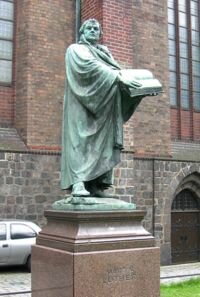
Statue of Martin Luther outside the Marienkirche in central BerlinIn Christian theology, justification is God's act making a sinner righteous before Him by His grace, received through the faith given to the person by God, for Christ's sake, because of his life, death, and resurrection. Because the meaning of the term is subject to dispute among Christians, simple definitions should be taken with a grain of salt.
Night and day I pondered until I saw the connection between the justice of God and the statement that 'the just shall live by his faith.' Then I grasped that the justice of God is that righteousness by which through grace and sheer mercy God justifies us through faith. Thereupon I felt myself to be reborn and to have gone through open doors into paradise. -Martin Luther

Considerable sectarian controversy exists as to its nature and definition.

More...

Wednesday, June 28, 2006

Reformation

Martin Luther's 95 ThesesThe Protestant Reformation was a movement that emerged in the 16th century as a series of attempts to reform the Roman Catholic Church in Western Europe. The main front of the reformation was started by Martin Luther and his 95 Theses. The reformation ended in division and the establishment of new institutions, most importantly Lutheranism, the Reformed churches, and Anabaptists, a radical branch whose name means "those who baptize again".


It also led to the Counter-Reformation within the Roman Catholic Church, which theological draft and background were drawn up with the Council of Trent (1548–1563), when Rome struck back against the fundamental ideas defended by the Reformers, like Luther. The rift between Catholics and Protestants would lead to the break up of large European empires into the modern nation-state system.

More...

Monday, June 19, 2006

Martin Luther

Martin Luther (November 10, 1483–February 18, 1546) was a German theologian, an Augustinian monk, and an ecclesiastical reformer whose teachings inspired the Reformation and deeply influenced the doctrines and culture of the Lutheran and Protestant traditions. Luther's call to the Church to return to the teachings of the Bible led to the formation of new traditions within Christianity and to the Counter-Reformation, the Catholic reaction to these movements. His contributions to Western civilization went beyond the life of the Christian Church. His translations of the Bible helped to develop a standard version of the German language and added several principles to the art of translation. His hymns inspired the development of congregational singing in Christianity. His marriage on June 13, 1525, to Katharina von Bora began a movement of clerical marriage within many Christian traditions.

More...


Subscribe


LifeNews.com

Desiring God Blog

Youth for Christ International