Showing posts with label Protestant Reformation. Show all posts

Sunday, January 17, 2010

Huldrych Zwingli

Huldrych (or Ulrich) Zwingli (1 January 1484 – 11 October 1531) was a leader of the Reformation in Switzerland. He attended the University of Vienna and the University of Basel. He continued his studies while he served as a pastor in Glarus and later in Einsiedeln where he was influenced by the writings of Erasmus, a humanist scholar and theologian.

In 1519, Zwingli became the pastor of the Grossmünster in Zürich where he began to preach ideas on reforming the church. In his first public controversy in 1522, he attacked the custom of fasting during Lent. In his publications, he noted problems in the corruption of the ecclesiastical hierarchy, promoted clerical marriage, and attacked the use of images. In 1525, Zwingli introduced a new communion liturgy to replace the mass. Zwingli also clashed with the radical wing of the Reformation, the Anabaptists, which resulted in their persecution.

More...
Wednesday, July 15, 2009

Reformation

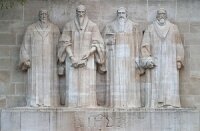
The Reformation Wall in Geneva. From left: William Farel, John Calvin, Theodore Beza, and John KnoxThe Protestant Reformation was a movement that emerged in the 16th century as a series of attempts to reform the Roman Catholic Church in Western Europe. The main front of the reformation was started by Martin Luther and his 95 Theses. The reformation ended in division and the establishment of new institutions, most importantly Lutheranism, the Reformed churches, and Anabaptists, a radical branch whose name means "those who baptize again".

Martin Luther's spiritual predecessors included men such as John Wycliffe and Jan Hus, who had attempted to reform the church along similar lines, though their efforts had been largely unsuccessful. The Reformation can be said to have begun in earnest on October 31, 1517, in Wittenberg, Saxony (in present-day Germany). There, Luther nailed his Ninety-Five Theses to the door of the All Saints' Church, which served as a notice board for university-related announcements. These were points for debate that criticized the Church and the Pope. The most controversial points centered on the practice of selling indulgences and the Church's policy on purgatory. Other reformers, such as Huldrych Zwingli, soon followed Luther's lead. Church beliefs and practices under attack by Protestant reformers included purgatory, particular judgment, devotion to Mary (Mariology), the intercession of and devotion to the saints, most of the sacraments, the mandatory celibacy requirement of its clergy (including monasticism), and the authority of the Pope.

More...

Friday, January 30, 2009

Huldrych Zwingli

Huldrych Zwingli in an oil portrait from 1531 by Hans Asper, Kunstmuseum Winterthur.Huldrych (or Ulrich) Zwingli (1 January 1484 – 11 October 1531) was a leader of the Reformation in Switzerland. He attended the University of Vienna and the University of Basel. He continued his studies while he served as a pastor in Glarus and later in Einsiedeln where he was influenced by the writings of Erasmus, a humanist scholar and theologian.

In 1519, Zwingli became the pastor of the Grossmünster in Zürich where he began to preach ideas on reforming the church. In his first public controversy in 1522, he attacked the custom of fasting during Lent. In his publications, he noted problems in the corruption of the ecclesiastical hierarchy, promoted clerical marriage, and attacked the use of images. In 1525, Zwingli introduced a new communion liturgy to replace the mass. Zwingli also clashed with the radical wing of the Reformation, the Anabaptists, which resulted in their persecution.

The Reformation spread to other parts of the Swiss Confederation, but several cantons resisted preferring to remain Catholic. Zwingli formed an alliance of Reformed cantons which divided the Confederation along religious lines. In 1529, a war between the two sides was averted at the last moment. Meanwhile, Zwingli’s ideas came to the attention of Martin Luther and other reformers.

They met at the Marburg Colloquy and although they agreed on many points of doctrine, they could not reach an accord on the doctrine of the presence of Christ in the Eucharist.

Monday, June 02, 2008

Philipp Melanchthon

Philipp Melanchthon, engraving by Albrecht Dürer 1526Philipp Melanchthon (born Philipp Schwartzerd) (February 16, 1497 - April 19, 1560) was a German theologian and writer of the Protestant Reformation and an associate of Martin Luther.

Melanchthon was born at Bretten, near Karlsruhe, where his father, Georg Schwarzerd, was armorer to Count Palatine Philip.

In 1507 he was sent to the Latin school at Pforzheim, the rector of which, Georg Simler of Wimpfen, introduced him to the study of the Latin and Greek poets and of the philosophy of Aristotle. But he was chiefly influenced by his great-uncle, Johann Reuchlin, the great representative of humanism, who advised him to change his family name, Schwarzerd (literally Black-earth), into the Greek equivalent Melanchthon.

Not yet thirteen years old, he entered in 1509 the University of Heidelberg where he studied philosophy, rhetoric, and astronomy/astrology, and was known as a good Greek scholar. Being refused the degree of master in 1512 on account of his youth, he went to Tübingen, where he pursued humanistic and philosophical studies, but devoted himself also to the study of jurisprudence, mathematics, astronomy/astrology, and even of medicine.

More...

Wednesday, February 27, 2008

Protestant Reformation

The Reformation Wall in Geneva. From left: William Farel, John Calvin, Theodore Beza, and John Knox The Protestant Reformation was a movement that emerged in the 16th century as a series of attempts to reform the Roman Catholic Church in Western Europe. The main front of the reformation was started by Martin Luther and his 95 Theses. The reformation ended in division and the establishment of new institutions, most importantly Lutheranism, the Reformed churches, and Anabaptists, a radical branch whose name means "those who baptize again".

It also led to the Counter-Reformation within the Roman Catholic Church, which theological draft and background were drawn up with the Council of Trent (1548–1563), when Rome struck back against the fundamental ideas defended by the Reformers, like Luther. The rift between Catholics and Protestants would lead to the break up of large European empires into the modern nation-state system.

Unrest in the Western Church and Empire culminating in the Avignon Papacy (1308–1378), and the papal schism (1378–1416), excited wars between princes, uprisings among the peasants, and widespread concern over corruption in the monastic system. A new nationalism also challenged the relatively internationalist medieval world.

One of the most disruptive and radical of the new perspectives came first from John Wycliffe at Oxford University, then from John Huss at the University of Prague. The Roman Catholic Church officially concluded this debate at the Council of Constance (1414–1418). The conclave condemned Jan Hus, who was executed (he had come under a promise of safe-conduct) and posthumously burned Wycliffe as a heretic.

More...


Subscribe


LifeNews.com

Desiring God Blog

Youth for Christ International