Showing posts with label Catholicism. Show all posts

Sunday, February 21, 2010

History of Protestantism

The History of Protestantism begins with the Reformation movement, which began as an attempt to reform the Catholic Church and led to the fracturing of Christendom. Many western Christians were troubled by what they saw as false doctrines and malpractices within the Church, particularly involving the teaching and sale of indulgences. Another major contention was the rampant Simony and the tremendous corruption found at the time within the Church's hierarchy. At the time, this systemic corruption often reached all the way up to the Bishop of Rome himself, the Pope.

On 31 October 1517, Martin Luther nailed his Ninety-Five Theses On the Power of Indulgences to the door of the Wittenberg Castle Church, which served as a pin board for university-related announcements. This document outlined Luther's criticisms of the Church and the Pope. The most controversial points centered on the practice of selling indulgences and the Church's policy on purgatory.

Among Luther's spiritual predecessors were men such as John Wycliffe and Jan Hus. Other reformers, such as Huldrych Zwingli and John Calvin, soon followed Luther's lead. Church beliefs and practices under attack by Protestant reformers included purgatory, particular judgment, devotion to Mary, the intercession of the saints, most of the sacraments, and the authority of the Pope.

More...
Wednesday, July 15, 2009

Reformation

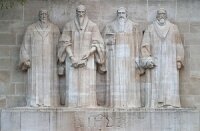
The Reformation Wall in Geneva. From left: William Farel, John Calvin, Theodore Beza, and John KnoxThe Protestant Reformation was a movement that emerged in the 16th century as a series of attempts to reform the Roman Catholic Church in Western Europe. The main front of the reformation was started by Martin Luther and his 95 Theses. The reformation ended in division and the establishment of new institutions, most importantly Lutheranism, the Reformed churches, and Anabaptists, a radical branch whose name means "those who baptize again".

Martin Luther's spiritual predecessors included men such as John Wycliffe and Jan Hus, who had attempted to reform the church along similar lines, though their efforts had been largely unsuccessful. The Reformation can be said to have begun in earnest on October 31, 1517, in Wittenberg, Saxony (in present-day Germany). There, Luther nailed his Ninety-Five Theses to the door of the All Saints' Church, which served as a notice board for university-related announcements. These were points for debate that criticized the Church and the Pope. The most controversial points centered on the practice of selling indulgences and the Church's policy on purgatory. Other reformers, such as Huldrych Zwingli, soon followed Luther's lead. Church beliefs and practices under attack by Protestant reformers included purgatory, particular judgment, devotion to Mary (Mariology), the intercession of and devotion to the saints, most of the sacraments, the mandatory celibacy requirement of its clergy (including monasticism), and the authority of the Pope.

More...

Tuesday, April 22, 2008

transubstantiation

This work, which features Martin Luther’s portrait, first appeared in Latin and was directed against Catholic sacramental teaching. Of the seven sacraments, Luther considered only baptism and communion, and to some degree, confession, sacraments of Christ. In the case of communion, he rejected the notions that it was a sacrifice to God and that the elements are transformed (transubstantiation).Transubstantiation (in Latin, transsubstantiatio) is the change of the substance of bread and wine into the Body and Blood of Christ occurring in the Eucharist according to the teaching of some Christian Churches, including the Roman Catholic Church. In Greek it is called μετουσίωσις.

Theology of transubstantiation

"Substance" here means what something is in itself. (For more on the philosophical concept, see Substance theory.) A hat's shape is not the hat itself, nor is its colour the hat, nor is its size, nor its softness to the touch, nor anything else about it perceptible to the senses. The hat itself (the "substance") has the shape, the colour, the size, the softness and the other appearances, but is distinct from them. While the appearances, which are referred to by the philosophical term accidents, are perceptible to the senses, the substance is not.

More...

Friday, March 30, 2007

Catholicism

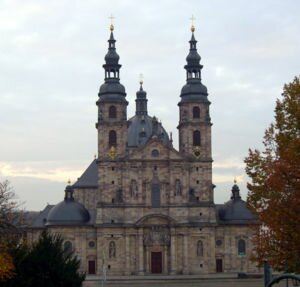
Fulda a stronghold of Catholicism in GermanyCatholicism has two main ecclesiastical meanings, described in Webster's Dictionary as: a) "the whole orthodox Christian church, or adherence thereto"; and b) "the doctrines or faith of the Roman Catholic church, or adherence thereto."

The term Catholicism, derived from the Greek adjective καθολικός (katholikos), meaning "general" or "universal", is widely understood to refer to the Church, governed by the Bishop of Rome and the bishops in communion with him. However, other Churches that trace their historic episcopate to the apostolic succession — such as the Oriental Orthodox Churches, the Eastern Orthodox Churches, the Assyrian Church of the East, the Churches of the Anglican Communion, and the Old-Catholics — consider themselves to be branches of the Catholic Church. Neo-Lutheranism argues that Lutheran Churches are simply a Protestant reform movement that remains within the greater Church catholic.

More...
 

Subscribe


LifeNews.com

Desiring God Blog

Youth for Christ International