Showing posts with label Christian Theology. Show all posts

Monday, February 14, 2011

Paul Tillich


Albert Einstein (left, standing behind girl) and Paul Tillich (right, standing in front wearing glasses) at a conference in Davos, Switzerland on March 18, 1928. (Courtesy of Image Archive ETH-Bibliothek, Zurich).
Paul Johannes Tillich (August 20, 1886 – October 22, 1965) was a German-American theologian and Christian existentialist philosopher. Tillich was one of the most influential Protestant theologians of the twentieth century.

Biography
Paul Tillich was born on August 20, 1886, in the province of Brandenburg in eastern Germany in the small village of Starzeddel. Tillich's Prussian father was a Lutheran pastor and his mother was from the Rhineland and more liberal, influenced heavily by Calvinist thinking. At an early age Tillich held an appreciation for nature and the countryside into which he had been born. Among the general populace, he is best known for his works The Courage to Be (1952) and Dynamics of Faith (1957), which introduced issues of theology and modern culture to a general readership. Theologically, he is best known for his major three-volume work Systematic Theology (1951–63), in which he developed his "method of correlation": an approach of exploring the symbols of Christian revelation as answers to the problems of human existence raised by contemporary existential philosophical analysis.

Paul Tillich’s life has been chronicled in a biography, a partially biographical book (Hopper, 1968), an autobiographical sketch (in On the Boundary), and two autobiographical essays (in Kegley and My Search for Absolutes).

More...

Friday, July 16, 2010

Dispensationalism

Dispensationalism is a branch of Christian theology that
  1. teaches Biblical history as best understood in light of a number of successive economies or administrations under God, which it calls "dispensations," and
  2. emphasizes prophecy of the end-times and the pre-tribulation rapture view of Christ's second coming.
Dispensation is an English term excogitated from the Latin dispensatio, frequently used to translate the Greek oikonomia, the management of a household or of household affairs
  • specifically, the management, oversight, administration, of other's property
  • the office of a manager or overseer, stewardship
  • administration, dispensation.
Some consider Dispensationalism to be a nineteenth century distortion of Biblical history. Dispensationalists teach that there are seven distinct "dispensations" within biblical history. The seventh being the 1000 year reign of Christ or the millennium. According to some, the primary error is the "two covenant" teaching. Dispensationalists believe that God's covenant with Israel continues even through the present "church age." Some Protestants believe that the new covenant in Christ replaces the old covenant with Israel.

More...

Saturday, March 27, 2010

Dietrich Bonhoeffer

Dietrich Bonhoeffer (February 4, 1906 – April 9, 1945) was a German Lutheran pastor and theologian. He was also a participant in the German Resistance movement against Nazism, a founding member of the Confessing Church. His involvement in plans by members of the Abwehr (the German Military Intelligence Office) to assassinate Adolf Hitler resulted in his arrest in April 1943 and his subsequent execution by hanging in April 1945, shortly before the war's end. His view of Christianity's role in the secular world has become very influential.

Academic Training

Bonhoeffer attended Tübingen University for a year and visited Rome, where he became conscious of the universality of the church, before he matriculated at the University of Berlin in 1924, then a centre of liberal theology under theologians such as Adolf von Harnack. Around this time, he discovered the writings of Karl Barth, an eminent Swiss theologian whose pioneering work in neo-orthodoxy was a reaction against liberal theology. Barth believed that "liberal theology" (understood as emphasizing personal experience and societal development) minimized scripture, reducing it to a mere textbook of metaphysics while sanctioning the deification of human culture. Harnack cautioned Bonhoeffer against dangers posed by Barth's "contempt for scientific theology", but young Bonhoeffer, becoming increasingly critical of liberal theology as too constraining and responsible for the lack of relevance in the church, was won over to Barth's dialectical theology. Bonhoeffer was nevertheless not beyond criticizing Barth, and the confluence of Barth's Christocentrism and Harnack's concern to show the relevance of Christianity to the modern world had indelible effect on Bonhoeffer's approach to theology.

More...

Monday, November 23, 2009

Paul Tillich

Bust of Paul Johannes Tillich by James Rosati in New Harmony, Indiana, U.S.A.Paul Johannes Tillich (August 20, 1886 – October 22, 1965) was a German-American theologian and Christian existentialist philosopher. Tillich was one of the most influential Protestant theologians of the twentieth century.

Biography
Paul Tillich was born on August 20, 1886, in the province of Brandenburg in eastern Germany in the small village of Starzeddel. Tillich's Prussian father was a Lutheran pastor and his mother was from the Rhineland and more liberal, influenced heavily by Calvinist thinking. At an early age Tillich held an appreciation for nature and the countryside into which he had been born.

When Tillich was 17 his mother died of cancer. Tillich studied at a number of German universities including Berlin, Tübingen (sister city of Ann Arbor, Michigan, USA), and Halle, and joined the Christian fraternity Wingolf, finally obtaining his Ph.D. at Breslau in 1911. Shortly thereafter, in 1912, he was ordained minister in the Lutheran Church, and soon took up a career as professor. Except for an interlude as chaplain in the German army during World War I, he taught at a number of universities throughout Germany over the next two decades. Tillich taught theology at the universities of Berlin, Marburg, Dresden, and Leipzig, and philosophy at Frankfurt. However, his opposition to the Nazis cost him his job: he was fired in 1933 and replaced by philosopher Arnold Gehlen, who had joined the Nazi Party that year. Finding himself thus barred from German universities, Tillich accepted an invitation from Reinhold Niebuhr to teach at the Union Theological Seminary in the United States, where he emigrated later that year. Tillich became a US citizen in 1940.

More...

Wednesday, April 15, 2009

Dispensationalism

The Horsemen of the Apocalypse, the entities that bring false peace, War, famine, pestilence, and death. The Horsemen of the Apocalypse, the entities that bring false peace, War, famine, pestilence, and death.Dispensationalism is a branch of Christian theology that:
  1. teaches Biblical history as best understood in light of a number of successive economies or administrations under God, which it calls "dispensations," and
  2. emphasizes prophecy of the end-times and the pre-tribulation rapture view of Christ's second coming.
Dispensation is an English term excogitated from the Latin dispensatio, frequently used to translate the Greek oikonomia. The Greek word denotes the law or management of a household (to manage, administer, regulate, or plan).

Some consider Dispensationalism to be a nineteenth century distortion of Biblical history. Dispensationalists teach that there are seven distinct "dispensations" within biblical history. The seventh being the 1000 year reign of Christ or the millennium. According to some, the primary error is the "two covenant" teaching. Dispensationalists believe that God's covenant with Israel continues even through the present "church age." Many Protestants believe that the new covenant in Christ replaces the old covenant with Israel.

More...

Thursday, September 25, 2008

Calvinism

Calvinism is a system of Christian theology and an approach to Christian life and thought, articulated by John Calvin, a Protestant Reformer in the 16th century, and subsequently by successors, associates, followers and admirers of Calvin and his interpretation of Scripture. The Reformed tradition is referred to by the roughly equivalent term Calvinism.

The Reformed tradition was originally advanced by stalwarts such as Martin Bucer, Heinrich Bullinger and Pietro Martire Vermigli, and also influenced English reformers such as Thomas Cranmer and John Jewel. However, because of Calvin's great influence and role in the confessional and ecclesiastical debates throughout the seventeenth century, this Reformed movement generally became known as Calvinism. Today, this term also refers to the doctrines and practices of the Reformed churches, of which Calvin was an early leader. Though it is often over-emphasized by its detractors, Calvinism is perhaps best known for its doctrines of predestination and election.

John Calvin's international influence on the development of the doctrine of the Protestant Reformation began at the age of 25, when he started work on his first edition of the Institutes of the Christian Religion in 1534 (published 1536). This work underwent a number of revisions in his lifetime, including an impressive French vernacular translation. Through it and together with his polemical and pastoral works, his contributions to confessional documents for use in churches, and a massive collection of commentaries on the Bible, Calvin had a direct personal influence on Protestantism. But he is only one of many, although eventually the most prominent influence, on the doctrine of the Reformed churches.

More...

Tuesday, May 27, 2008

William Lane Craig

William Lane CraigWilliam Lane Craig (born August 23, 1949) is an American philosopher, theologian, and Christian apologist. He is a prolific author and lecturer on a wide range of issues related to the philosophy of religion, the historical Jesus, the coherence of the Christian worldview, and Intelligent Design. He is married and lives in Atlanta, Georgia, and is currently a Research Professor of Philosophy at Talbot School of Theology, Biola University in La Mirada, California. Craig is a fellow of the Discovery Institute's Center for Science and Culture, which is the hub of the Intelligent Design movement.

Craig has been critical of philosophical naturalism, logical positivism, moral relativism, liberal theology, and the Jesus Seminar. He has defended the middle knowledge view of divine providence and is also notable for his work in the philosophy of time. He is a founding member and has served as president of the Philosophy of Time Society.

Craig became a Christian believer in high school at the age of 16. His vocation and academic studies reflect his religious commitment to Christian beliefs within the Protestant Evangelical tradition.

More...

Wednesday, May 07, 2008

missional living

Village Children, Eastern Cape of South Africa, taken by Larry and Susan Correll.  This file is licensed under Creative Commons Attribution 2.0 LicenseThe Oxford English Dictionary defines "missional" as "Relating to or connected with a religious mission; missionary." In contemporary usage "missional" is an adjectival alternative to "missionary." Although both words are related to "missio" (Latin: sending), some scholars, including Darrell Guder et. al. in The Missional Church believe "missional" focuses on the the Church's indigenous, rather than cross-cultural context, with the church contextualizing its methods, morality, and message to fit this indigenous culture.

In this usage "missional" has rapidly entered the lexicon of the growing emerging church movement whose participants have popularized the term, enabling participants in this movement to recognize each other across denominational lines.

As the term has come to be closely associated with the emerging church movement, it has come to represent the belief that the Spirit of God is alive and active in the people of God, namely the church as a whole. This approach tends to emphasize the importance of the involvement of "laymembers" and "lay-leaders" in churches.

Mark A. Driscoll (PastorMark), for example, helped start theresurgence.com, a repository of missional theology resources, and has contributed to the "Faith and Values" section of the Seattle Times.

More...

Saturday, April 19, 2008

Presuppositional apologetics

Image of Gordon Haddon Clark, © John W. RobbinsPresuppositional apologetics is a school of Christian apologetics, a field of Christian theology that attempts to present a rational basis for the Christian faith, defend the faith against objections, and attack the alleged flaws of other worldviews. Presuppositional apologetics is especially concerned with the third aspect of this discipline, though it generally sees the trifold distinction as a difference in emphasis rather than as delineating three separate endeavors. Presuppositional apologetics developed in and is most commonly advocated within Reformed circles of Christianity.

The key discriminator of this school is that it maintains that the Christian apologist must assume the truth of the supernatural revelation contained in the Bible (that is, the Christian worldview) because there can be no set of neutral assumptions from which to reason with a non-Christian. In other words, presuppositionalists say that a Christian cannot consistently declare his belief in the necessary existence of the God of the Bible and simultaneously argue on the basis of a different set of assumptions (presumably those of the non-Christian) in which God may or may not exist.

Comparison with other schools of apologetics

Presuppositionalists contrast their approach with the other schools of Christian apologetics by describing them as assuming that the world is intelligible apart from belief in the existence of God and then arguing on purportedly neutral grounds to support trusting the Christian Scriptures and the existence of God. Thomas Aquinas himself insists that many crucial truths can only be known through scripture, and none of his arguments are intended to show the entire Christian picture. Specifically, presuppositionalists describe Thomistic (also "Traditional" or "Classical") apologetics as concentrating on the first aspect of apologetics with its logical proofs for the existence of God, simply assuming common ground with the non-Christian and utilizing a piece-by-piece methodology. In this scheme, the common foundation of neutral brute facts leads to a generic concept of deity, then to the various characteristics of the Christian God as revealed in Scripture, and so forth. Piece-by-piece, Christian theology is built up from a neutral common ground.

More...

Tuesday, February 26, 2008

Christian worldview

Christian Worldview, According to USA Today...click for details...Christian worldview refers to a collection of distinctively Christian philosophical and religious beliefs. The term is typically used in one of three ways:
  1. A set of worldviews voiced by those identifying themselves as Christian;

  2. Common elements of worldviews predominant among those identifying themselves as Christian;
  3. The concept of a single "Christian worldview" on a range of issues.
There are some rather startling statistics, based upon the following definition of "worldview," including a firm belief in six specific religious views.
  1. Jesus Christ lived a sinless life;

  2. God is the all-powerful and all-knowing Creator of the universe and He stills rules it today;

  3. salvation is a gift from God and cannot be earned;

  4. Satan is real;

  5. a Christian has a responsibility to share their faith in Christ with otherpeople; and

  6. the Bible is accurate in all of its teachings.

Based upon the above definition, Barna and other polling organizations have observered a decline in Christian beliefs. A recent study indicates that only 4% of American adults have a biblical worldview as the basis of their decision-making -- while at the same time "spirituality" has been on the rise.

More...

Friday, February 22, 2008

Huldrych Zwingli

Huldrych Zwingli in an oil portrait from 1531 by Hans Asper; Kunstmuseum Winterthur.Huldrych (or Ulrich) Zwingli (1 January 1484 – 11 October 1531) was a leader of the Reformation in Switzerland. He attended the University of Vienna and the University of Basel. He continued his studies while he served as a pastor in Glarus and later in Einsiedeln where he was influenced by the writings of Erasmus, a humanist scholar and theologian.

In 1519, Zwingli became the pastor of the Grossmünster in Zürich where he began to preach ideas on reforming the church. In his first public controversy in 1522, he attacked the custom of fasting during Lent. In his publications, he noted problems in the corruption of the ecclesiastical hierarchy, promoted clerical marriage, and attacked the use of images. In 1525, Zwingli introduced a new communion liturgy to replace the mass. Zwingli also clashed with the radical wing of the Reformation, the Anabaptists, which resulted in their persecution.

The Reformation spread to other parts of the Swiss Confederation, but several cantons resisted preferring to remain Catholic. Zwingli formed an alliance of Reformed cantons which divided the Confederation along religious lines. In 1529, a war between the two sides was averted at the last moment. Meanwhile, Zwingli’s ideas came to the attention of Martin Luther and other reformers. The Reformation spread to other parts of the Swiss Confederation, but several cantons resisted preferring to remain Catholic. Zwingli formed an alliance of Reformed cantons which divided the Confederation along religious lines. In 1529, a war between the two sides was averted at the last moment. Meanwhile, Zwingli’s ideas came to the attention of Martin Luther and other reformers.

More...

Thursday, February 14, 2008

Historicity of the Bible

Introduction

Photo of Pontius Pilate Inscription. Pontius Pilate was governor of Judea in 26 BCE by the Roman Emperor, Tiberius Caesar, who succeeded Augustus in AD 14, Pilate arrived and made his official residence in Caesarea Maritima, the Roman capital of Judea. Pilate was the 5th procurator of Judea. The province of Judea, formerly the kingdom of Archelaus, was formed in 6 AD when Archelaus was exiled and his territory transformed into a Roman province. Although it included Samaria and Idumaea, the new province was known simply as Judea or Judaea. It generally covered the Southern half of Palestine, including Samaria. Judea was an imperial province (i.e. under the direct control of the emperor), and was governed by a procurator.All historians of the ancient Near East are confronted with the question of the historicity (historical actuality) of the account of the Bible. The text provides a powerful and evocative account of two states, the Kingdom of Israel and Kingdom of Judah, and their contact with a range of neighbouring peoples, from their formation to their disappearance, in the eighth and sixth centuries. It also presents a reconstruction of the earlier histories of the region, supposedly from the time of the Creation of the World, and a Universal deluge, down to the supposed creation of a unified state at the time of the monarchs, David and Solomon. There are thousands of works examining the historical nature or otherwise of this material, examining whether or not it is possible to depend upon this material for historical reconstructions of these areas in these periods, and to attempt to identify which passages of the Biblical account are most reliable.

These views range from those which adopt an almost complete paraphrase of the Biblical material, to those who advocate its almost complete rejection as having almost no historically useful information at all. Those involved in this analysis have often been engaged in bitter disputes, which cannot, by the nature of the Biblical record be resolved from within the Biblical tradition.

More...

Monday, February 11, 2008

Transfiguration of Jesus

The Transfiguration, Raphael, 1516-1520 oil on wood, Pinacoteca Vaticana, Vatican City (1520), depicting Christ miraculously discoursing with Moses and ElijahThe Transfiguration of Jesus is an event reported by the Synoptic Gospels in which Jesus was transfigured upon a mountain ( Matthew 17:1-6, Mark 9:1-8, Luke 9:28-36). The original Greek term in the Gospels is metamorphothe, describing Jesus as having undergone metamorphosis.

The Gospels state that Jesus led three of his apostles - Simon Peter, John the Apostle, and James the Great - to pray at the top of a mountain. Once at the top, Jesus became transfigured, his face shining like the sun, and his clothes a brilliant white.

They claim that Elijah and Moses suddenly appeared with Jesus and talked with him; Matthew and Mark do not say what the conversation was about, but Luke states that it was about Jesus' future death. Once they had spoken with each other, the Gospels paralleling a similar event during the Baptism of Jesus.

4 Peter said to Jesus, "Lord, it is good for us to be here. If you wish, I will put up three shelters—one for you, one for Moses and one for Elijah."

5 While he was still speaking, a bright cloud enveloped them, and a voice from the cloud said, "This is my Son, whom I love; with him I am well pleased. Listen to him!"

6 When the disciples heard this, they fell facedown to the ground, terrified. (Matthew 17:4-6 (NIV))

More...

Saturday, February 09, 2008

The Plagues of Egypt

Moses and Aaron before Pharoah by Gustov Doré The Plagues of Egypt (Hebrew: מכות מצרים, Makot Mitzrayim), the Biblical Plagues or the Ten Plagues (עשר המכות, Eser Ha-Makot) are the ten calamities inflicted upon Egypt by God in the Biblical story recounted the book of Exodus, chapters 7 - 12, in order to convince Pharaoh (possibly Ramesses II, making the pharaoh of the Oppression Djeserkheperure Horemheb) to let the Israelite slaves leave. (see also Pharaoh of the Exodus).

The plagues as they appear in the Torah are:
  1. (Exodus 7:14-25) rivers and other water sources turned to blood ('Dam')

  2. (Exodus 7:26-8:11) amphibians (commonly believed to be frogs) ('Tsfardeia')

  3. (Exodus 8:12-15) lice ('Kinim')

  4. (Exodus 8:16-28) Either flies, wild animals or beetles ('Arov')

  5. (Exodus 9:1-7) disease on livestock ('Dever')

  6. (Exodus 9:8-12) unhealable boils ('Shkhin')

  7. (Exodus 9:13-35) hail mixed with fire ('Barad')

  8. (Exodus 10:1-20) locusts ('Arbeh')

  9. (Exodus 10:21-29) darkness ('Choshech')

  10. (Exodus 11:1-12:36) death of the firstborn ('Makat Bechorot')

    see also: Passover

More...


Friday, February 08, 2008

sayings of Jesus on the cross

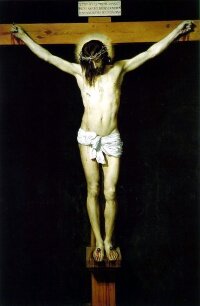
Jesus’ crucifixion as portrayed by Diego VelázquezThe seven sayings of Jesus on the cross are a traditional collection of seven short phrases uttered by Jesus at his crucifixion gathered from the four Gospels, immediately before he died.

Seven sayings

The seven sayings form part of a Christian meditation that is often used during
  • Lent,
  • Holy Week, and
  • Good Friday

The traditional order of the sayings is:

  1. Father, forgive them, for they know not what they do
    (Luke 23:34).

  2. Truly, I say to you, today you will be with me in paradise
    (Luke 23:43).

  3. Woman, behold your son: behold your mother
    (John 19:26).

  4. Eloi Eloi lama sabachthani?
    ("My God, My God, why have you forsaken me?", Matthew 27:46 and Mark 15:34).

  5. I thirst
    (John 19:28).

  6. It is finished
    (John 19:30).

  7. Father, into your hands I commit my spirit
    (Luke 23:46).


More...

Thursday, February 07, 2008

Parable of the Good Samaritan

Parable of the Good Samaritan, Rembrandt, 1632–1633The Parable of the Good Samaritan is a famous New Testament parable appearing only in the Gospel of Luke. The majority view indicates this parable is told by Jesus in order to illustrate that compassion should be for all people, and that fulfilling the spirit of the Law is just as important as fulfilling the letter of the Law. Jesus puts the definition of neighbor into an enlarged context, beyond what people usually thought of as a neighbor.

On one occasion an expert in the law stood up to test Jesus. "Teacher," he asked, "what must I do to inherit eternal life?" "What is written in the Law?" he replied. "How do you read it?" He answered: " 'Love the Lord your God with all your heart and with all your soul and with all your strength and with all your mind'; and, 'Love your neighbor as yourself.'"
"You have answered correctly," Jesus replied. "Do this and you will live." But he wanted to justify himself, so he asked Jesus, "And who is my neighbor?" In reply Jesus said: "A man was going down from Jerusalem to Jericho, when he fell into the hands of robbers. They stripped him of his clothes, beat him and went away, leaving him half dead. A priest happened to be going down the same road, and when he saw the man, he passed by on the other side. So too, a Levite, when he came to the place and saw him, passed by on the other side. But a Samaritan, as he traveled, came where the man was; and when he saw him, he took pity on him. He went to him and bandaged his wounds, pouring on oil and wine. Then he put the man on his own donkey, took him to an inn in Jericho and took care of him. The next day he took out two silver coins and gave them to the innkeeper.

'Look after him,' he said, 'and when I return, I will reimburse you for any extra expense you may have.'

"Which of these three do you think was a neighbor to the man who fell into the hands of robbers?" The expert in the law replied, "The one who had mercy on him." Jesus told him, "Go and do likewise."

(Luke 10:25-37)

More...

Wednesday, February 06, 2008

Ministry of Jesus

Judaea and Galilee at the time of JesusAccording to the Gospels, the Ministry of Jesus began when Jesus was around 30 years old, and lasted a period of 1-3 years. In the Biblical narrative, Jesus' method of teaching involved parables, metaphor, allegory, sayings, proverbs, and a small number of direct sermons. This was the first coming of Jesus, most Christian denominations believe in a Second Coming when Jesus will return to the earth to fulfill aspects of Messianic prophecy, such as the general resurrection of the dead, last judgment of the dead and the living and the full establishment of the Kingdom of God on earth (also called the "Reign of God"), including the Messianic Age.

The start of Jesus' ministry

From Nazareth to Capernaum

Some time after having rejected Satan's temptation, Jesus is described as leaving Nazareth. While Matthew doesn't explain why Jesus did this, both he and Mark mention that John the Baptist was arrested by Herod Antipas at this time. Luke gives a different circumstance, stating that Jesus left when the people of Nazareth rejected him. The texts don't recount what occurred between Jesus being tempted and John being arrested, but Jones believes that some months likely elapsed, with Jesus frequently being seen as a disciple of John the Baptist, until this was no longer possible (due to John being arrested). France argues that it was the flight from Nazareth which resulted in Jesus carrying out a ministry based on itinerant preaching, which R. T. France sees as being quite different to the ministry which John the Baptist had carried out.

More...

Tuesday, February 05, 2008

The seven churches of Asia

The seven churches of Asia (properly Asia Minor) are seven major churches of the early Christianity, as mentioned in the New Testament Book of Revelation. All sites are in modern-day Turkey. In Revelation, Jesus Christ instructs 'Saint John the Evangelist' to:
"Write in a book what you see and send it to the seven churches, to Ephesus, to Smyrna, to Pergamum, to Thyatira, to Sardis, to Philadelphia, and to Laodicea."(Revelation 1:11)

It should be understood that "churches," in this context, refers to the community of Christians living in each city, and not merely to the building or buildings in which they gathered for worship. This letter should also apply to the community of Christians today (the Christian Church).

The seven churches are located in...


More...

Monday, February 04, 2008

Søren Kierkegaard

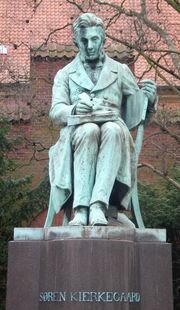
The Søren Kierkegaard Statue in Copenhagen.Søren Aabye Kierkegaard (5 May 1813 – 11 November 1855) was a prolific 19th century Danish philosopher and theologian. Kierkegaard strongly criticized both the Hegelianism of his time, and what he saw as the empty formalities of the Danish church. Much of his work deals with religious problems such as the nature of faith, the institution of the Christian Church, Christian ethics and theology, and the emotions and feelings of individuals when faced with life choices. His early work was written under various pseudonyms who present their own distinctive viewpoints in a complex dialogue. Kierkegaard left the task of discovering the meaning of the works to the reader, because "the task must be made difficult, for only the difficult inspires the noble-hearted". Subsequently, many have interpreted Kierkegaard as an existentialist, neo-orthodoxist, postmodernist, humanist, individualist, etc. Crossing the boundaries of philosophy, theology, psychology, and literature, Kierkegaard came to be regarded as a highly significant and influential figure in contemporary thought.

Life

Early years (1813–1841)

Søren Kierkegaard was born to an affluent family in Copenhagen, the capital of Denmark. His mother, Ane Sørensdatter Lund Kierkegaard, had served as a maid in the household before marrying Søren's father. She was an unassuming figure: quiet, plain, and not formally educated. She is not directly referred to in Kierkegaard's books, although she too affected his later writings. His mother died on July 31, 1834, age 66.

His father, Michael Pedersen Kierkegaard, was a melancholic, anxious, deeply pious, and fiercely intelligent man. Convinced that he had earned God's wrath, he believed that none of his children would live past the age attained by Jesus Christ, that of 33. He believed his personal sins, such as cursing the name of God in his youth and possibly impregnating Ane out of wedlock, necessitated this punishment. Though many of his seven children died young, his prediction was disproved when two of them surpassed this age: Søren and Peter Christian Kierkegaard, a Lutheran bishop several years Søren's senior. This early introduction to the notion of sin and its connection from father and son laid the foundation for much of Kierkegaard's work (particularly Fear and Trembling). Despite his father's occasional religious melancholy, Kierkegaard and his father shared a close bond. Kierkegaard learned to explore the realm of his imagination through a series of exercises and games they played together.

More...

Saturday, February 02, 2008

Auschwitz

Auschwitz I in winterAuschwitz (Konzentrationslager Auschwitz) was the largest of the German Nazi concentration and extermination camps. Located in southern Poland, it took its name from the nearby town of Oświęcim (Auschwitz in German), situated about 50 kilometers west of Kraków and 286 kilometers from Warsaw. Following the German occupation of Poland in September 1939, Oświęcim was incorporated into Germany and renamed Auschwitz.

The complex consisted of three main camps:

  1. Auschwitz I, the administrative center;
  2. Auschwitz II (Birkenau), an extermination camp or Vernichtungslager; and
  3. Auschwitz III (Monowitz), a work camp. The first two of them have been on the World Heritage List since 1979. There were also around 40 satellite camps, some of them tens of kilometers from the main camps, with prisoner populations ranging from several dozen to several thousand.

The camp commandant, Rudolf Höss, testifed at the Nuremberg Trials that 3 million people had died at Auschwitz during his stay as a commandant. Later he decreased his estimate to about 1.1 million. The death toll given by the Soviets and accepted by many was 4,000,000 people. This number was written on the plaques in the Auschwitz-Birkenau State Museum. The Museum revised this figure in 1990, and new calculations by Dr. Franciszek Piper now place the figure at 1.1 million about 90 percent of them Jews from almost every country in Europe. Most of the dead were killed in gas chambers using Zyklon B; other deaths were caused by systematic starvation, forced labor, lack of disease control, individual executions, and so-called medical experiments.


More...


Subscribe


LifeNews.com

Desiring God Blog

Youth for Christ International