Showing posts with label The Gospels. Show all posts

Sunday, December 18, 2011

Jesus of Nazareth

Flagellation of Christ,
Artist: CARAVAGGIO,
Date: c. 1607
Born in Bethlehem and active in Nazareth; His life and sermons form the basis for Christianity (circa 4 bc - ad 29).
The Gospels were all composed during the latter part of the first century, and there is distinct historical evidence to show that they were used and accepted as authentic before the end of the second century.

The principal sources of information regarding Jesus' life and teachings are the four canonical gospels though some scholars argue that other texts (such as the Gospel of Thomas) are as relevant as the canonical gospels to the historical Jesus. Most critical scholars in the fields of history and biblical studies believe that ancient texts on Jesus' life are at least partially accurate, agreeing that Jesus was a Galilean Jew who was regarded as a teacher and healer. They also generally accept that he was baptized by John the Baptist, and was crucified in Jerusalem on orders of the Roman Prefect of Judaea Pontius Pilate, on the charge of sedition against the Roman Empire.



Jesus De Nazareth
Edmar Castaneda Live At Jazz Standard

Christian views of Jesus (see also Christology) center on the belief that Jesus is divine, is the Messiah whose coming was prophesied in the Old Testament (e.g. Deut. 18:15;Judges 13:5;Amos 2:11;Lam. 4:7;Isaiah:53;Isaiah 7:14, etc.), and that he was resurrected after his crucifixion. Christians predominantly believe that Jesus is the "Son of God" (generally meaning that he is the son of God, the second person in the Trinity), who came to provide salvation and reconciliation with God by his death for their sins.

Other Christian beliefs include Jesus' virgin birth, performance of miracles, ascension into Heaven, and future Second Coming. While the doctrine of the Trinity is widely accepted by Christians, a small minority instead hold various nontrinitarian beliefs concerning the divinity of Jesus.

More...

Friday, August 05, 2011

Money, A Biblical Perspective

The bible has quite a lot to say about money and finances, which is evidence that these principles are something God considers important for us to be aware of.

Money
10 For the love of money is a root of all kinds of evil. Some people, eager for money, have wandered from the faith and pierced themselves with many griefs. (1 Timothy 6:10 NIV)

The money changers
The narrative of Jesus and the Money Changers occurs in both the Synoptic Gospels and in the Gospel of John, although it occurs close to the end of the Synoptic Gospels at:

Mark 11:15–19, 11:27–33,
Matthew 21:12–17, 21:23–27 and
Luke 19:45–48, 20:1–8

The story of Jesus overturning the tables of the money changers in the Temple is related. Jesus goes to Jerusalem for the Passover, the first of three in John, the others being John 7, where he goes to the Feast of Tabernacles, and the final Passover during which he is crucified. He enters the Temple courts and sees people selling livestock and exchanging money.


More

Tuesday, February 01, 2011

The Gospels

Books in the new testament referred to as the Gospels:

In Christianity, a gospel (from Old English, "good news") is generally one of four canonical books of the New Testament that describe the miraculous birth, life, ministry, crucifixion, and resurrection of Jesus. These books are the Gospels according to Matthew, Mark, Luke and John, written between 65 and 100 AD.

Many modern scholars argue that the sequence in which the Gospel accounts have traditionally been printed in the Bible is not the order of their composition, and that the first canonical gospel to have been written is Mark (c 65-70), which in turn was used as a source for the gospels of Matthew and Luke. Matthew and Luke may have also used the hypothetical Q Document. These first three gospels are called the synoptic gospels because they share a similar view. The last gospel, the gospel of John, presents a very different picture of Jesus and his ministry from the synoptics.

The vast majority of biblical scholars believe the canonical gospels were originally written in Greek, although some believe the gospel of Matthew was originally written in Aramaic or Hebrew and later translated to Greek. However, Eusebius wrote that Matthew composed the Gospel According to the Hebrews and his Church Catalog suggests that it was the only Jewish Gospel. Yet, some have accused Eusebius of falsification.

Originally, the "gospel" meant the proclamation of God's saving activity in Jesus of Nazareth, or the agape (love) message proclaimed by Jesus of Nazareth. This is the original New Testament usage (for example Mark 1:14-15 or 1 Corinthians 15:1-9; see also Strong's G2098). The word is still used in this sense. Ancient, non-canonical works that purport to quote Jesus (e.g., Gospel of Thomas) are also called gospels, and the term refers, in general, to works of a genre of Early Christian literature (cf. Peter Stuhlmacher, ed., Das Evangelium und die Evangelien, Tübingen 1983, also in English: The Gospel and the Gospels).

More

Saturday, August 14, 2010

Augustinian hypothesis

the evangelist Matthew
inspired by an angel
The Augustinian hypothesis is a solution to the synoptic problem, which concerns the origin of the Gospels of the New Testament. The hypothesis holds that Matthew was written first, by Matthew the Evangelist, a disciple of Jesus of Nazareth. Mark the Evangelist, a disciple of the apostle Simon Peter, wrote the Gospel of Mark second, and used Matthew and the preaching of Simon Peter as sources. Luke the Evangelist, a disciple of Paul of Tarsus, wrote the Gospel of Luke, and was aware of the two Gospels that preceded him. Unlike some competing hypotheses, this hypothesis does not rely on, nor does it argue for, the existence of any document that is not explicitly mentioned in historical testimony. Instead, the hypothesis draws primarily upon historical testimony, rather than textual criticism, as the central line of evidence. The foundation of evidence for the hypothesis is the writings of the Early Church Fathers: historical sources dating back to as early as the first half of the 2nd century, which have been held as authoritative by most Christians for nearly 2 millennia. Finally, adherents to the Augustinian hypothesis view it as a simple, coherent solution to the synoptic problem.

The problem of the Relationship of the Synoptists was first seriously discussed by Augustine (d. 430), in his three books De Consensu Evangelistarum (Opera, Tom. III., 1041–1230, ed. Migne). He defends the order in our canon, first Matthew, last John, and the two apostolic disciples in the middle, like sons to be embraced and thus placed in the middle and between the two (in loco medio constituti tamquam filii amplectendi, I., 2), but wrongly makes Mark dependent on Matthew. His view prevailed during the middle ages and down to the close of the eighteenth century.


More...

Tuesday, May 25, 2010

Ministry of Jesus

According to the Gospels, the Ministry of Jesus began when Jesus was around 30 years old, and lasted a period of 1-3 years. In the Biblical narrative, Jesus' method of teaching involved parables, metaphor, allegory, sayings, proverbs, and a small number of direct sermons. This was the first coming of Jesus, most Christian denominations believe in a Second Coming when Jesus will return to the earth to fulfill aspects of Messianic prophecy, such as the general resurrection of the dead, last judgment of the dead and the living and the full establishment of the Kingdom of God on earth (also called the "Reign of God"), including the Messianic Age.

The start of Jesus' ministry

From Nazareth to Capernaum
Some time after having rejected Satan's temptation, Jesus is described as leaving Nazareth. While Matthew doesn't explain why Jesus did this, both he and Mark mention that John the Baptist was arrested by Herod Antipas at this time. Luke gives a different circumstance, stating that Jesus left when the people of Nazareth rejected him. The texts don't recount what occurred between Jesus being tempted and John being arrested, but Jones believes that some months likely elapsed, with Jesus frequently being seen as a disciple of John the Baptist, until this was no longer possible (due to John being arrested). France argues that it was the flight from Nazareth which resulted in Jesus carrying out a ministry based on itinerant preaching, which France sees as being quite different to the ministry which John the Baptist had carried out.

More...

Wednesday, October 28, 2009

chronology of Jesus

Adoration of the Shepherds, Artist: Carvaggio c.1609, Oil on canvas, 314 x 211 cm. Location: Museo Nazionale, MessinaThe chronology of Jesus depicts the traditional chronology established for the events of the life of Jesus by the four canonical gospels (which allude to various dates for several events). Among historians who are Christian Biblical scholars, the literature suggests the following detailed timeline for Jesus. The timeline records Jesus as Christ and Messiah from biblical and historical accounts of his life.

According to common interpretations of the four canonical gospels, Jesus was born between 8 BC and AD 6 and was baptised by John the Baptist at the start of His ministry, about 30 years later. His ministry lasted one year (synoptic gospels, Matthew, Mark, and Luke) or three years (Gospel of John), and he was executed under Pontius Pilate between AD 26 and 37. He rose from the dead three days later, appeared to the disciples and others, and then ascended to heaven.

The chronology of Jesus is uncertain, disputed, and perhaps impossible to ascertain definitively based on available evidence. The texts used in chronological reconstruction, the four canonical gospels, provide few clear dates — including the year of Jesus's birth, death, and age at death. (Dates for rulers and high priests are known from other sources). Moreover, the material unique to each gospel further complicates the discernment of one, harmonized chronology. Lastly, some commentators have questioned their historicity.

More...

Saturday, March 28, 2009

The Gospels

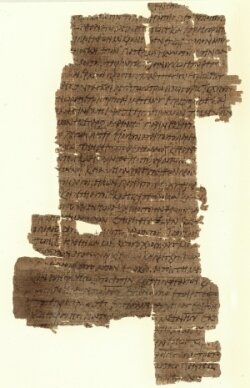
The front side of folios 13 and 14 of a Greek papyrus manuscript of the Gospel of Luke containing verses 11:50–12:12 and 13:6-24, P. Chester Beatty IBooks in the new testament referred to as the Gospels:

In Christianity, a gospel (from Old English, "good news") is generally one of four canonical books of the New Testament that describe the miraculous birth, life, ministry, crucifixion, and resurrection of Jesus. These books are the Gospels according to Matthew, Mark, Luke and John, written between 65 and 100 AD.

Many modern scholars argue that the sequence in which the Gospel accounts have traditionally been printed in the Bible is not the order of their composition, and that the first canonical gospel to have been written is Mark (c 65-70), which in turn was used as a source for the gospels of Matthew and Luke. Matthew and Luke may have also used the hypothetical Q Document. These first three gospels are called the synoptic gospels because they share a similar view. The last gospel, the gospel of John, presents a very different picture of Jesus and his ministry from the synoptics. The canonical gospels were originally written in Greek.

More...

Saturday, March 01, 2008

The Twelve Apostles

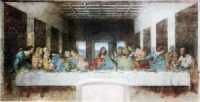
The Last Supper fresco in Milan (1498)  by Leonardo da VinciThe Twelve Apostles (in Koine Greek "απόστολος" apostolos, Liddell & Scott, Strong's G652, a delegate, messenger, one sent forth with orders) were men that according to the Synoptic Gospels and Christian tradition (see also Oral Tradition), were chosen from among the disciples of Jesus for a mission (see also: Seventy Disciples). According to the Bauer lexicon, Walter Bauer's Greek-English Lexicon of the New Testament: "...Judaism had an office known as apostle (שליח)".

The Gospel of Mark states that Jesus initially sent out these twelve in pairs (Mark 6:7-13, cf. Matthew 10:5-42, Luke 9:1-6), to towns in Galilee [map].

Literal readings of the text state that their initial instructions were to heal the sick and drive out demons, but some scholars read this more metaphorically as instructions to heal the spiritually sick and thus to drive away wicked behaviour. They are also instructed to only take their staffs, and that if any town rejects them they ought to shake the dust off their feet as they leave, a gesture which some scholars think was meant as a contemptuous threat (Miller 26). Their carrying of just a staff is sometimes given as the reason for the use by Christian Bishops of a staff of office, in those denominations that believe they maintain an Apostolic Succession.

Later in the Gospel narratives the Twelve Apostles are described as having been commissioned to preach the Gospel to the world, regardless of whether Jew or Gentile. Although the Apostles are portrayed as having been Galilean Jews, and 10 of their names are Aramaic, the other 4 names are Greek, suggesting a more metropolitan background.

More...

Thursday, February 21, 2008

Mount Hermon

View of Mount Hermon from ‘Biblical Places’  imaging © Microsoft® Virtual Earth&tradeMount Hermon (33°24′N 35°51′E ; Hebrew: הר חרמון, Har Hermon; Arabic: جبل الشيخ‎, Jabal el-Shaiykh, Djabl a-Shekh, "mountain of the chief" and "snowy mountain") is a mountain in the Anti-Lebanon mountain range. Its highest point is 2,814 m (9,230 feet) above sea level, and is on the border between Syria and Lebanon.

Though the summit remained under Syrian control, the southern and western slopes of Mount Hermon came under the control of Israel as part of the Golan Heights as a result of the Israeli victory in the 1967 Six-Day War, and were unilaterally annexed by Israel in 1980. the nation" in Israel because its altitude makes it Israel's primary strategic early warning system.


Biblical History

Mount Hermon was called Senir by the Amorites and Sirion by the Sidonians (Deuteronomy 3:9; Psalms 29:6; 1 Chronicles 5:23; Song of Solomon 4:8; Ezekiel 27:5). The mountain served as the northern boundary of the Promised Land (Deuteronomy 3:8) and also was the northern limit of the Conquest (Joshua 11:17; 12:1; 13:5).

The high places of Mount Hermon were apparently used by the Canaanites in Canaanite mythological rituals. They referred to the mountain as Mount Ba'al-Hermon (Judges 3:3).


The Gospels tell of Jesus and his disciples journeying north from Bethsaida on the Sea of Galilee to the city of Caesarea Philippi at the southern base of Mount Hermon (Matthew 16:13; Mark 8:27).


More...

Wednesday, February 20, 2008

Parable of the Mustard Seed

Mustard SeedIn Christianity, Parable of the Mustard Seed is a a short narrative that, according to the Gospels of Matthew (Matthew 13:31-32), Mark (Mark 4:30-32), Luke (Luke 13:18-19), and the non-canonical Thomas (Thomas 20) was told by Jesus. Possible Hebrew Bible parallels are Daniel 4:10-12, Daniel 4:20-22 and Ezekiel 17:22-23, 31:1-9.

18Then Jesus asked, "What is the kingdom of God like? What shall I compare it to? 19It is like a mustard seed, which a man took and planted in his garden. It grew and became a tree, and the birds of the air perched in its branches." – Luke 13:18–19


30Again he said, "What shall we say the kingdom of God is like, or what parable shall we use to describe it? 31It is like a mustard seed, which is the smallest seed you plant in the ground. 32Yet when planted, it grows and becomes the largest of all garden plants, with such big branches that the birds of the air can perch in its shade." –Mark 4:30–32


31He told them another parable: "The kingdom of heaven is like a mustard seed, which a man took and planted in his field. 32Though it is the smallest of all your seeds, yet when it grows, it is the largest of garden plants and becomes a tree, so that the birds of the air come and perch in its branches." -Matthew 13:31–32


The disciples said to Jesus, "Tell us what Heaven's kingdom is like." He said to them, "It's like a mustard seed, the smallest of all seeds, but when it falls on prepared soil, it produces a large plant and becomes a shelter for birds of the sky." – Thomas 20

The parable compares the Kingdom of Heaven to a mustard seed, which the parable says is the least among seed, yet grows to become a huge mustard plant that provides shelter for many birds. Much like the English saying Many an oak from a tiny acorn grows, and like the butterfly effect, the parable is usually interpreted as meaning that great things start from just tiny seeds of information, or from tiny actions.


It might also be interpreted to foreshadow the kingdom of Heaven growing forth from the small actions of the historical Jesus in life.


More...

Saturday, February 16, 2008

the gospels

The reverse side of Papyrus 37, a New Testament manuscript of the Gospel of Matthew. Most likely originated in Egypt. Currently housed in: University of Michigan, Ann Arbor Library, Date: 3rd/4th CenturyBooks in the new testament referred to as the Gospels:

Books in the new testament referred to as the Gospels:
In Christianity, a gospel (from Old English, "good news") is generally one of four canonical books of the New Testament that describe the miraculous birth, life, ministry, crucifixion, and resurrection of Jesus. These books are the Gospels according to Matthew, Mark, Luke and John, written between 65 and 100 AD.

Many modern scholars argue that the sequence in which the Gospel accounts have traditionally been printed in the Bible is not the order of their composition, and that the first canonical gospel to have been written is Mark (c 65-70), which in turn was used as a source for the gospels of Matthew and Luke. Matthew and Luke may have also used the hypothetical Q Document. These first three gospels are called the synoptic gospels because they share a similar view. The last gospel, the gospel of John, presents a very different picture of Jesus and his ministry from the synoptics. The canonical gospels were originally written in Greek.

Bethlehem, the Sermon on the Mount, the Beatitudes, the Last Supper, resurrection accounts, and the Great Commission.

Gospel has generally been used in three ways:

  1. To denote the proclamation of God's saving activity in Jesus of Nazareth or to denote the message proclaimed by Jesus of Nazareth. This is the original New Testament usage (for example Mark 1:14-15 or 1 Corinthians 15:1-9, see also Strong's G2098).

  2. More popularly to refer to the four canonical Gospels, which are attributed to the Four Evangelists: (Gospel of Matthew, Gospel of Mark, Gospel of Luke and Gospel of John); and sometimes other non-canonical works (eg. Gospel of Thomas), that offer a narrative of the life, death and resurrection of Jesus.

  3. Some modern scholars have used the term to denote a hypothetical genre of Early Christian literature (cf. Peter Stuhlmacher, ed., Das Evangelium und die Evangelien, Tübingen 1983, also in English: The Gospel and the Gospels).

More...

Monday, February 11, 2008

Transfiguration of Jesus

The Transfiguration, Raphael, 1516-1520 oil on wood, Pinacoteca Vaticana, Vatican City (1520), depicting Christ miraculously discoursing with Moses and ElijahThe Transfiguration of Jesus is an event reported by the Synoptic Gospels in which Jesus was transfigured upon a mountain ( Matthew 17:1-6, Mark 9:1-8, Luke 9:28-36). The original Greek term in the Gospels is metamorphothe, describing Jesus as having undergone metamorphosis.

The Gospels state that Jesus led three of his apostles - Simon Peter, John the Apostle, and James the Great - to pray at the top of a mountain. Once at the top, Jesus became transfigured, his face shining like the sun, and his clothes a brilliant white.

They claim that Elijah and Moses suddenly appeared with Jesus and talked with him; Matthew and Mark do not say what the conversation was about, but Luke states that it was about Jesus' future death. Once they had spoken with each other, the Gospels paralleling a similar event during the Baptism of Jesus.

4 Peter said to Jesus, "Lord, it is good for us to be here. If you wish, I will put up three shelters—one for you, one for Moses and one for Elijah."

5 While he was still speaking, a bright cloud enveloped them, and a voice from the cloud said, "This is my Son, whom I love; with him I am well pleased. Listen to him!"

6 When the disciples heard this, they fell facedown to the ground, terrified. (Matthew 17:4-6 (NIV))

More...

Friday, February 08, 2008

sayings of Jesus on the cross

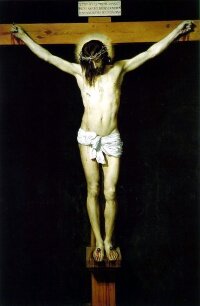
Jesus’ crucifixion as portrayed by Diego VelázquezThe seven sayings of Jesus on the cross are a traditional collection of seven short phrases uttered by Jesus at his crucifixion gathered from the four Gospels, immediately before he died.

Seven sayings

The seven sayings form part of a Christian meditation that is often used during
  • Lent,
  • Holy Week, and
  • Good Friday

The traditional order of the sayings is:

  1. Father, forgive them, for they know not what they do
    (Luke 23:34).

  2. Truly, I say to you, today you will be with me in paradise
    (Luke 23:43).

  3. Woman, behold your son: behold your mother
    (John 19:26).

  4. Eloi Eloi lama sabachthani?
    ("My God, My God, why have you forsaken me?", Matthew 27:46 and Mark 15:34).

  5. I thirst
    (John 19:28).

  6. It is finished
    (John 19:30).

  7. Father, into your hands I commit my spirit
    (Luke 23:46).


More...

Wednesday, February 06, 2008

Ministry of Jesus

Judaea and Galilee at the time of JesusAccording to the Gospels, the Ministry of Jesus began when Jesus was around 30 years old, and lasted a period of 1-3 years. In the Biblical narrative, Jesus' method of teaching involved parables, metaphor, allegory, sayings, proverbs, and a small number of direct sermons. This was the first coming of Jesus, most Christian denominations believe in a Second Coming when Jesus will return to the earth to fulfill aspects of Messianic prophecy, such as the general resurrection of the dead, last judgment of the dead and the living and the full establishment of the Kingdom of God on earth (also called the "Reign of God"), including the Messianic Age.

The start of Jesus' ministry

From Nazareth to Capernaum

Some time after having rejected Satan's temptation, Jesus is described as leaving Nazareth. While Matthew doesn't explain why Jesus did this, both he and Mark mention that John the Baptist was arrested by Herod Antipas at this time. Luke gives a different circumstance, stating that Jesus left when the people of Nazareth rejected him. The texts don't recount what occurred between Jesus being tempted and John being arrested, but Jones believes that some months likely elapsed, with Jesus frequently being seen as a disciple of John the Baptist, until this was no longer possible (due to John being arrested). France argues that it was the flight from Nazareth which resulted in Jesus carrying out a ministry based on itinerant preaching, which R. T. France sees as being quite different to the ministry which John the Baptist had carried out.

More...

Wednesday, January 23, 2008

Quartodecimanism

Vulgate, Catalogue of editions of the 1500’sQuartodecimanism ("fourteenism", derived from Latin) refers to the practice of fixing the celebration of Passover for Christians on the fourteenth day of Nisan in the Old Testament's Hebrew Calendar (for example Lev 23:5, in Latin "quarta decima"). This was the original method of fixing the date of the Passover, which is to be a "perpetual ordinance". According to the Gospel of John (for example John 19:14 ), this was the Friday that Jesus was crucified in Jerusalem, the Synoptic Gospels place the Friday on 15 Nisan. A controversy arose concerning whether it should also be a resurrection holiday, and thus whether it should instead be celebrated on one particular Sunday each year, which is now the floating holiday that is commonly called Easter Sunday.

Background

Since the Bible's calendar is lunisolar and the Roman/Western calendar is only solar, it is difficult to calculate Nisan 14 in the western calendar without knowledge of how a lunisolar calendar system works. For various reasons, the Church eventually chose to use a different method from the one that the Jews had used for their Passover.

Quartodecimanism was popular among Christians in Asia Minor and it is generally believed that this was the method specifically preferred by the followers of John the Apostle , since it was advocated by Polycarp who was a disciple of either John the Apostle or John the Presbyter, assuming they are not the same person.


More...

Tuesday, January 22, 2008

Joseph of Arimathea

Jesus being taken down from the cross by Joseph of ArimatheaJoseph of Arimathea, according to the Gospels, was the man who donated his own prepared tomb for the burial of Jesus after Jesus was crucified. A native of Arimathea, he was apparently a man of wealth, and a member of the Sanhedrin (which is the way bouleutes, literally "senator", is interpreted in Matthew 27:57 and Luke 23:50). Joseph was an "honourable counsellor, who waited (or "was searching" which is not the same thing) for the kingdom of God" (Mark, 15:43). As soon as he heard the news of Jesus' death, he "went in boldly" (literally "having summoned courage, he went") "unto Pilate, and craved the body of Jesus."

Pontius Pilate, who was reassured by a centurion that the death had really taken place, allowed Joseph's request. Joseph immediately purchased fine linen (Mark 15:46) and proceeded to Golgotha to take the body down from the cross. There, assisted by Nicodemus, he took the body and wrapped it in the fine linen, sprinkling it with the myrrh and aloes which Nicodemus had brought (John 19:39).

The body was then conveyed to a new tomb that had been hewn for Joseph himself out of a rock in his garden nearby. There they laid it, in the presence of Mary Magdalene, Mary, the mother of Jesus, and other women, and rolled a great stone to the entrance, and departed (Luke 23:53, 55). This was done speedily, "for the Sabbath was drawing on".

Joseph of Arimathea is venerated as a saint by the Catholic and Eastern Orthodox Churches. His feast-day is March 17 among Latins, and July 31 in the East. He appears in some early New Testament apocrypha, and a series of legends grew around him during the Middle Ages, which tied him to Britain and the Holy Grail.


More...

Tuesday, January 01, 2008

Acts

Acts 15:22–24 from the seventh-century Codex Laudianus in the Bodleian Library, written in parallel columns of Latin and Greek.The Acts of the Apostles (Greek Praxeis Apostolon) is a book of the Bible, which now stands fifth in the New Testament after the four gospels. This book describes the development of the early church from Christ's Ascension to Paul's sojourn at Rome. It is commonly referred to as simply Acts. The traditional view is that it was written by the Macedonian Christian physician and historian Luke the Evangelist (also the author of the gospel of Luke).

An alternative name for the book is Acts of the Holy Spirit. It describes many of the journeys and actions taken by the apostles, meaning "those who have been sent" by God, to be His witnesses.

This was originally applied exclusively to those who had personally seen and/or lived with Jesus of Nazareth. The book of Acts contains many descriptions of miraculous events (which were given as signs from God to validate the apostles' teachings), which were performed by the Holy Spirit through the apostles. These included miraculous healings, casting out evil spirits, the raising of the dead, and also historical descriptions of everyday life in The Roman Empire and in ancient Jerusalem.

Acts describes the beginning of the Jewish-Christian church on the Day of Pentecost, explains and describes the growth and spread of the Church despite (and because of) official persecution, narrates the inclusion of the gentile Greeks, Romans and other pagans of the Near East into the Church (and explains how this became possible), and focuses on the lives of the apostles, specifically Simon, called "Peter" of Galilee (who followed and lived with Jesus for probably three years) and Saul Paulus of Tarsus (who began as a Pharisee and a persecutor of the Church and was converted later on the Road to Damascus).

More...

Thursday, December 20, 2007

Gospel of Matthew

Saint Matthew, from the 9th-century Ebbo Gospels.The Gospel of Matthew (literally, "according to Matthew"; Greek, Κατά Μαθθαίον or Κατά Ματθαίον, Kata Maththaion or Kata Matthaion) is one of the four Gospel accounts of the New Testament. It narrates an account of the life and ministry of Jesus, from his genealogy to his post-resurrection commissioning of his Apostles to "go and make disciples of all nations." Bibles traditionally print Matthew as the first gospel, followed in order by Mark, and . The Christian community traditionally ascribes authorship to Matthew the Evangelist, one of Jesus's twelve apostles, while secular scholarship generally agrees it was written by an anonymous non-eyewitness to Jesus's ministry.

The Gospel of Matthew is written in Greek, not in Aramaic. That is to say, no copy of an Aramaic original has yet to be found. The Greek of the gospel of Matthew cannot easily be translated back to Aramiac. This is very suggestive that Matthew is not a Greek translation of an Aramiac original. It is also generally agreed that the Gospel of Mark is actually the earliest of the four gospels and that the author of Matthew substantially used the gospel of Mark in writing this gospel.

Overview

For convenience, the book can be divided into its four structurally distinct sections: Two introductory sections; the main section, which can be further broken into five sections, each with a narrative component followed by a long discourse of Jesus; and finally, the Passion and Resurrection section.


  1. Containing the genealogy, the birth, and the infancy of Jesus (Matthew 1; Matthew 2). The discourses and actions of John the Baptist preparatory to Christ's public ministry (Matthew 3; Matthew 4:11).
  2. The discourses and actions of Christ in Galilee (4:12–26:1).
    1. The Sermon on the Mount, concerning morality (Matthew 5–7)
    2. The Missionary Discourse, concerning the mission Jesus gave his Twelve Apostles. (Matthew 10–11:1)
    3. The Parable Discourse, stories that teach about the Kingdom of Heaven (Matthew 13).
    4. The "Church Order" Discourse, concerning relationships among Christians (Matthew 18–19:1).
    5. The Eschatological Discourse, which includes the Olivet Discourse and Judgement of the Nations, concerning his Second Coming and the Signs of the End of the Age (Matthew 24–25).
  3. The sufferings, death and Resurrection of Jesus, the Great Commission (Matthew 28:16–20).

More...

Thursday, December 13, 2007

Augustinian hypothesis

the evangelist Matthew inspired by an angelThe Augustinian hypothesis is a solution to the synoptic problem, which concerns the origin of the Gospels of the New Testament. The hypothesis holds that Matthew was written first, by Matthew the Evangelist, a disciple of Jesus of Nazareth. Mark the Evangelist, a disciple of the apostle Simon Peter, wrote the Gospel of Mark second, and used Matthew and the preaching of Peter as sources. Luke the Evangelist, a disciple of Paul of Tarsus, wrote the Gospel of Luke, and was aware of the two Gospels that preceded him. Unlike some competing hypotheses, this hypothesis does not rely on, nor does it argue for, the existence of any document that is not explicitly mentioned in historical testimony. Instead, the hypothesis draws primarily upon historical testimony, rather than textual criticism, as the central line of evidence. The foundation of evidence for the hypothesis is the writings of the Church Fathers: historical sources dating back to as early as the first half of the 2nd century, which have been held as authoritative by most Christians for nearly 2 millennia. Finally, adherents to the Augustinian hypothesis view it as a simple, coherent solution to the synoptic problem.

The Augustinian hypothesis addresses certain fundamental points of contention surrounding the synoptic problem, such as how reliable the early Christian tradition is, which gospel was written first, whether there were other unknown sources behind the gospels, to what extent, if any, the gospels were redacted, and to what extent the gospels were altered between the time they were originally written and the time the first surviving manuscripts appear. These and other matters are raised and alternate resolutions proposed by proponents of competing hypotheses, such as the Two-source hypothesis, its related Q hypothesis, the Farrer hypothesis, and others.

More...

Tuesday, December 04, 2007

Book of Kells

This page (folio 292r) contains the lavishly decorated text that opens the Gospel of JohnThe Book of Kells (Dublin, Trinity College Library, MS A. I. (58), less widely known as the Book of Columba) is an ornately illustrated manuscript, produced by Celtic monks around AD 800 in the style known as Insular art. It is one of the more lavishly illuminated manuscripts to survive from the Middle Ages and has been described as the zenith of Western calligraphy and illumination. It contains the four gospels of the Bible in Latin, along with prefatory and explanatory matter decorated with numerous colourful illustrations and illuminations. Today it is on permanent display at the Trinity College Library in Dublin, Ireland.

history


Origin

The Book of Kells is the high point of a group of manuscripts in what is known as the Insular style produced from the late 6th through the early 9th centuries in monasteries in Ireland, Scotland and northern England and in continental monasteries with Irish or English foundations.

These manuscripts include the Cathach of St. Columba, the Ambrosiana Orosius, a fragmentary gospel in the Durham cathedral library (all from the early 7th century), and the Book of Durrow (from the second half of the 7th century). From the early 8th century come the Durham Gospels, the Echternach Gospels, the Lindisfarne Gospels (see illustration at right), and the Lichfield Gospels. The St. Gall Gospel Book and the Macregal Gospels come from the late 8th century. The Book of Armagh (dated to 807–809), the Turin Gospel Book Fragment, the Leiden Priscian, the St. Gall Priscian and the Macdurnan Gospel all date from the early 9th century. Scholars place these manuscripts together based on similarities in artistic style, script, and textual traditions. The fully developed style of the ornamentation of the Book of Kells places it late in this series, either from the late eighth or early ninth century. The Book of Kells follows many of the iconographic and stylistic traditions found in these earlier manuscripts. For example, the form of the decorated letters found in the incipit pages for the Gospels is surprisingly consistent in Insular Gospels. Compare, for example, the incipit pages of the Gospel of Matthew in the Lindisfarne Gospels and in the Book of Kells both of which feature intricate decorative knotwork inside the outlines formed by the enlarged initial letters of the text. (For a more complete list of related manuscripts see: List of Hiberno-Saxon illustrated manuscripts.)

More...


Subscribe


LifeNews.com

Desiring God Blog

Youth for Christ International