Showing posts with label Gospel of John. Show all posts

Monday, September 27, 2010

Gospel of John

The Gospel of John, (literally, According to John; Greek, Κατά Ιωαννην, Kata Iōannēn) is the fourth gospel in the biblical canon of the New Testament, traditionally ascribed to John the Apostle. Like the three synoptic gospels, it contains an account of some of the actions and sayings of Jesus, but differs from them in ethos and theological emphases. The purpose is expressed in the conclusion, 20:30-31: "..these [Miracles of Jesus] are written so that you will put your faith in Jesus as the Messiah and the Son of God. If you have faith in Him, you will have true life."

According to Trinitarianism, of the four gospels, John presents the highest christology, implicitly declaring Jesus to be God (see The Word).

Compared to the synoptics, John focuses on Jesus' cosmic mission to redeem humanity. Only in John does Jesus talk at length about himself, and John includes a substantial amount of material that Jesus shared with the disciples only. Certain elements of the synoptics (such as the parables of Jesus, exorcisms, and the Second Coming of Christ) are not found in John.

Since the "higher criticism" of the 19th century, historians have largely rejected the gospel of John as a reliable source of information about the historical Jesus. "Some commentators regard the work as anonymous."

More...

Wednesday, September 30, 2009

Gospel of John

Apostle St John the Evangelist, artist EL GRECO, 1610-14, Oil on canvas, 97 x 77 cm, location Museo de El Greco, ToledoThe Gospel of John, (literally, According to John; Greek, Κατά Ιωαννην, Kata Iōannēn) is the fourth gospel in the biblical canon of the New Testament, traditionally ascribed to John the Apostle. Like the three synoptic gospels, it contains an account of some of the actions and sayings of Jesus, but differs from them in ethos and theological emphases. The purpose is expressed in the conclusion, 20:30-31: "..these [Miracles of Jesus] are written so that you will put your faith in Jesus as the Messiah and the Son of God. If you have faith in Him, you will have true life."

According to Trinitarianism, of the four gospels, John presents the highest Christology, implicitly declaring Jesus to be God.

Compared to the synoptics, John focuses on Jesus' cosmic mission to redeem humanity. Only in John does Jesus talk at length about himself, and John includes a substantial amount of material that Jesus shared with the disciples only. Certain elements of the synoptics (such as the parables of Jesus, exorcisms, and the Second Coming of Christ) are not found in John.

More...

Saturday, March 28, 2009

The Gospels

The front side of folios 13 and 14 of a Greek papyrus manuscript of the Gospel of Luke containing verses 11:50–12:12 and 13:6-24, P. Chester Beatty IBooks in the new testament referred to as the Gospels:

In Christianity, a gospel (from Old English, "good news") is generally one of four canonical books of the New Testament that describe the miraculous birth, life, ministry, crucifixion, and resurrection of Jesus. These books are the Gospels according to Matthew, Mark, Luke and John, written between 65 and 100 AD.

Many modern scholars argue that the sequence in which the Gospel accounts have traditionally been printed in the Bible is not the order of their composition, and that the first canonical gospel to have been written is Mark (c 65-70), which in turn was used as a source for the gospels of Matthew and Luke. Matthew and Luke may have also used the hypothetical Q Document. These first three gospels are called the synoptic gospels because they share a similar view. The last gospel, the gospel of John, presents a very different picture of Jesus and his ministry from the synoptics. The canonical gospels were originally written in Greek.

More...

Monday, December 15, 2008

Gospel of John

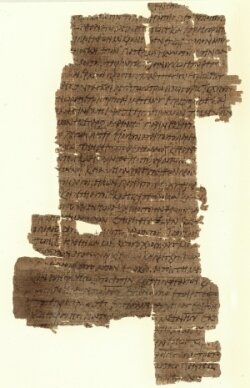
The Rylands Library Papyrus P52 is the earliest manuscript fragment found of the Gospel of John, dated to about 125The Gospel of John, (literally, According to John; Greek, Κατά Ιωαννην, Kata Iōannēn) is the fourth gospel in the canon of the New Testament, traditionally ascribed to John the Apostle. Like the three synoptic gospels, it contains an account of some of the actions and sayings of Jesus, but differs from them in ethos and theological emphases. The purpose is expressed in the conclusion, 20:30-31: "...these [Miracles of Jesus] are written so that you will put your faith in Jesus as the Messiah and the Son of God. If you have faith in him, you will have true life."

According to Trinitarianism, of the four gospels, John presents the highest christology, implicitly declaring Jesus to be God (see The Word).

Compared to the synoptics, John focuses on Jesus' cosmic mission to redeem humanity. Only in John does Jesus talk at length about himself, and John includes a substantial amount of material that Jesus shared with the disciples only. Certain elements of the synoptics (such as the parables of Jesus, exorcisms, and the Second Coming of Christ) are not found in John.

More...

Saturday, August 23, 2008

John 3:16

Jesus being taken down from the cross by Joseph of Arimathea and NicodemusJohn 3:16 (chapter 3, verse 16 of the Gospel of John) is one of the most widely quoted verses from the Christian Bible. It has been called the "Bible in a nutshell" because it is considered a summary of some of the most central doctrines of traditional Christianity:
16 "For God so loved the world, that he gave his only Son, that whoever believes in him should not perish but have eternal life.
(John 3:16 (ESV)
God "...didn't give Him into the hands of a trustworthy caregiver. He didn't give Him up for adoption by loving parents. He didn't even give Him up for a season only to have Him returned to Him unharmed. When God gave His only begotten Son, He gave Him up to be killed. That's how much God loved the world." -Jeff Miller , Th.M.

Context

The verse occurs in a narrative in the third chapter of John taking place in Jerusalem. Nicodemus, a member of the ruling council, comes to talk with Jesus, whom he calls Rabbi. Jesus' "miraculous signs" have convinced Nicodemus that Jesus is "from God." In reply,
5 Jesus answered, "I tell you the truth, no one can enter the kingdom of God unless he is born of water and the Spirit. 6 Flesh gives birth to flesh, but the Spirit gives birth to spirit."

More...

Tuesday, May 06, 2008

Shalom

“Shalom” (in blue) and “Salaam” (in green) mean “peace” in Hebrew and Arabic respectively and often represent a peace symbol.Shalom (שָׁלוֹם) is a Hebrew and Jewish word meaning peace, Nothing missing, Nothing broken, wellbeing, and complete , and used to mean hello, and goodbye. As it does in English, it can refer to either peace between two entities (especially between man and God or between two countries), or to the well-being, welfare or safety of an individual or a group of individuals. It is also used as a greeting to either say hello or farewell, and is found in many other expressions and names. Its equivalent cognate in Arabic is salaam, Shlomo (ܫܠܡܐ) in Syriac-Assyrian and sälam in Ethiopian Semitic languages from the Hebrew root shin-lamed-mem (ש.ל.ם).

In the bible

24 Then Gideon built an altar there to God and named it "God's Peace." It's still called that at Ophrah of Abiezer.
—Judges 6:24 (The Message)


4-8 David, out in the backcountry, heard that Nabal was shearing his sheep and sent ten of his young men off with these instructions: "Go to Carmel and approach Nabal. Greet him in my name, 'Peace! Life and peace to you. Peace to your household, peace to everyone here! I heard that it's sheep-shearing time. Here's the point: When your shepherds were camped near us we didn't take advantage of them. They didn't lose a thing all the time they were with us in Carmel. Ask your young men—they'll tell you. What I'm asking is that you be generous with my men—share the feast! Give whatever your heart tells you to your servants and to me, David your son.'"
—1 Samuel 25:4-8 The Message


5-6 "When you enter a home, greet the family, 'Peace.' If your greeting is received, then it's a good place to stay. But if it's not received, take it back and get out. Don't impose yourself.
— Luke 10:5-6 The Message


19-20 Later on that day, the disciples had gathered together, but, fearful of the Jews, had locked all the doors in the house. Jesus entered, stood among them, and said, "Peace to you." Then he showed them his hands and side.


20-21 The disciples, seeing the Master with their own eyes, were exuberant. Jesus repeated his greeting: "Peace to you. Just as the Father sent me, I send you."
—John 20:19-21 The Message


The Word "shalom" can be used for all parts of speech; as a noun, adjective, verb, and as an adverb. It categorizes all shaloms.

More...

Saturday, February 16, 2008

the gospels

The reverse side of Papyrus 37, a New Testament manuscript of the Gospel of Matthew. Most likely originated in Egypt. Currently housed in: University of Michigan, Ann Arbor Library, Date: 3rd/4th CenturyBooks in the new testament referred to as the Gospels:

Books in the new testament referred to as the Gospels:
In Christianity, a gospel (from Old English, "good news") is generally one of four canonical books of the New Testament that describe the miraculous birth, life, ministry, crucifixion, and resurrection of Jesus. These books are the Gospels according to Matthew, Mark, Luke and John, written between 65 and 100 AD.

Many modern scholars argue that the sequence in which the Gospel accounts have traditionally been printed in the Bible is not the order of their composition, and that the first canonical gospel to have been written is Mark (c 65-70), which in turn was used as a source for the gospels of Matthew and Luke. Matthew and Luke may have also used the hypothetical Q Document. These first three gospels are called the synoptic gospels because they share a similar view. The last gospel, the gospel of John, presents a very different picture of Jesus and his ministry from the synoptics. The canonical gospels were originally written in Greek.

Bethlehem, the Sermon on the Mount, the Beatitudes, the Last Supper, resurrection accounts, and the Great Commission.

Gospel has generally been used in three ways:

  1. To denote the proclamation of God's saving activity in Jesus of Nazareth or to denote the message proclaimed by Jesus of Nazareth. This is the original New Testament usage (for example Mark 1:14-15 or 1 Corinthians 15:1-9, see also Strong's G2098).

  2. More popularly to refer to the four canonical Gospels, which are attributed to the Four Evangelists: (Gospel of Matthew, Gospel of Mark, Gospel of Luke and Gospel of John); and sometimes other non-canonical works (eg. Gospel of Thomas), that offer a narrative of the life, death and resurrection of Jesus.

  3. Some modern scholars have used the term to denote a hypothetical genre of Early Christian literature (cf. Peter Stuhlmacher, ed., Das Evangelium und die Evangelien, Tübingen 1983, also in English: The Gospel and the Gospels).

More...

Wednesday, January 23, 2008

Quartodecimanism

Vulgate, Catalogue of editions of the 1500’sQuartodecimanism ("fourteenism", derived from Latin) refers to the practice of fixing the celebration of Passover for Christians on the fourteenth day of Nisan in the Old Testament's Hebrew Calendar (for example Lev 23:5, in Latin "quarta decima"). This was the original method of fixing the date of the Passover, which is to be a "perpetual ordinance". According to the Gospel of John (for example John 19:14 ), this was the Friday that Jesus was crucified in Jerusalem, the Synoptic Gospels place the Friday on 15 Nisan. A controversy arose concerning whether it should also be a resurrection holiday, and thus whether it should instead be celebrated on one particular Sunday each year, which is now the floating holiday that is commonly called Easter Sunday.

Background

Since the Bible's calendar is lunisolar and the Roman/Western calendar is only solar, it is difficult to calculate Nisan 14 in the western calendar without knowledge of how a lunisolar calendar system works. For various reasons, the Church eventually chose to use a different method from the one that the Jews had used for their Passover.

Quartodecimanism was popular among Christians in Asia Minor and it is generally believed that this was the method specifically preferred by the followers of John the Apostle , since it was advocated by Polycarp who was a disciple of either John the Apostle or John the Presbyter, assuming they are not the same person.


More...

Saturday, December 22, 2007

Epiphany

Joseph of Nazareth with the infant Jesus, by Guido Reni. c. 1635Epiphany (Greek: επιφάνεια, "appearance" or "manifestation") is a Christian feast intended to celebrate the "shining forth" or revelation of God to mankind in human form, in the person of Jesus. The feast is also called Twelfth Day, as it is the twelfth day after Christmas, or Three Kings Day.

History

The observance had its origins in the Eastern Christian churches, and was originally a general celebration of the Incarnation of Jesus Christ, and included the commemoration of: his birth; the visit of the Magi, or "Wise Men", who arrived in Bethlehem; all of Jesus' childhood events, up to and including His baptism in the Jordan River by John the Baptist; and even the miracle at the Wedding of Cana in Galilee. However, it seems fairly clear that the Baptism was the event predominantly commemorated.

The date of the feast was very early fixed on January 6. Ancient Liturgies speak of Illuminatio, Manifestatio, Declaratio (Lighting, Manifestation, Declaration); cf. Matthew 3:13–17; Luke 3:22; and John 2:1–11; where the Baptism and the Marriage at Cana are dwelt upon. Christian Churches have traditionally emphasized the "Revelation to the Gentiles" mentioned in the Gospel of Luke, where the term Gentile means all non-Jewish peoples. The Biblical Magi represent the non-Jewish peoples of the world.

More...

Thursday, December 20, 2007

Gospel of Matthew

Saint Matthew, from the 9th-century Ebbo Gospels.The Gospel of Matthew (literally, "according to Matthew"; Greek, Κατά Μαθθαίον or Κατά Ματθαίον, Kata Maththaion or Kata Matthaion) is one of the four Gospel accounts of the New Testament. It narrates an account of the life and ministry of Jesus, from his genealogy to his post-resurrection commissioning of his Apostles to "go and make disciples of all nations." Bibles traditionally print Matthew as the first gospel, followed in order by Mark, and . The Christian community traditionally ascribes authorship to Matthew the Evangelist, one of Jesus's twelve apostles, while secular scholarship generally agrees it was written by an anonymous non-eyewitness to Jesus's ministry.

The Gospel of Matthew is written in Greek, not in Aramaic. That is to say, no copy of an Aramaic original has yet to be found. The Greek of the gospel of Matthew cannot easily be translated back to Aramiac. This is very suggestive that Matthew is not a Greek translation of an Aramiac original. It is also generally agreed that the Gospel of Mark is actually the earliest of the four gospels and that the author of Matthew substantially used the gospel of Mark in writing this gospel.

Overview

For convenience, the book can be divided into its four structurally distinct sections: Two introductory sections; the main section, which can be further broken into five sections, each with a narrative component followed by a long discourse of Jesus; and finally, the Passion and Resurrection section.


  1. Containing the genealogy, the birth, and the infancy of Jesus (Matthew 1; Matthew 2). The discourses and actions of John the Baptist preparatory to Christ's public ministry (Matthew 3; Matthew 4:11).
  2. The discourses and actions of Christ in Galilee (4:12–26:1).
    1. The Sermon on the Mount, concerning morality (Matthew 5–7)
    2. The Missionary Discourse, concerning the mission Jesus gave his Twelve Apostles. (Matthew 10–11:1)
    3. The Parable Discourse, stories that teach about the Kingdom of Heaven (Matthew 13).
    4. The "Church Order" Discourse, concerning relationships among Christians (Matthew 18–19:1).
    5. The Eschatological Discourse, which includes the Olivet Discourse and Judgement of the Nations, concerning his Second Coming and the Signs of the End of the Age (Matthew 24–25).
  3. The sufferings, death and Resurrection of Jesus, the Great Commission (Matthew 28:16–20).

More...

Wednesday, December 19, 2007

Herod the Great

The taking of Jerusalem by Herod the Great, 36 BC, by Jean FouquetHordos הוֹרְדוֹס, also known as Herod I or Herod the Great, was a Roman client-king of Judaea (c. 74 BC - c. 5, 4 or 1 BC in Jerusalem). The details of his biography can best be gleaned from the works of the 1st century AD Jewish historiographer Josephus. To the majority of non-specialist Christians Herod is best known from the Gospel according to Matthew that gives in chapter 2 an account of the events leading up to and including what subsequently has come to be referred to by Christians as the Massacre of the Innocents, of which however no mention in other contemporary sources has come down to us.

Herod the Great arose from a wealthy, influential Idumaean family. The Idumaeans, successors to the Edomites of the Hebrew Bible, settled in Idumea, formerly known as Edom, in southern Judea.

When the Maccabean John Hyrcanus conquered Idumea in 130-140 BC, he required all Idumaeans to obey Jewish law or to leave; most Idumaeans thus converted to Judaism.

According to some, archaeological evidence suggests that Herod identified himself as Jewish, although according to the Mosaic Law he was not. For he was the second son of Antipater the Idumaean, founder of the Herodian dynasty, and his wife Cypros, a princess from Petra in Nabatea (now part of Jordan). The family rubbed shoulders with the great in Rome, such as Pompey, Cassius, and in 47 BC his father was appointed Procurator over Judea, who then appointed his son governor of Galilee at the age of 25.

More...

Friday, November 30, 2007

Oral Tradition

The Rylands Papyrus is the earliest manuscript fragment found of John’s Gospel; dated to about 125The Oral Tradition, Oral Torah, or Oral Law (Hebrew: תורה שבעל פה, Torah she-be-`al peh), according to Rabbinic Judaism, is an oral tradition received in conjunction with the written Torah (and the rest of the Hebrew Bible), which is known in this context as the "Written Torah" (Hebrew: תורה שבכתב, Torah she-bi-khtav). The traditions of the Oral Torah are believed to be the same as those recorded in the Mishnah and Talmud during the 2nd-5th centuries CE.

According to classical Judaism and the tenets of Orthodox Judaism, Moses and the Jews at Mount Sinai received an Oral as well as a written Torah ("teaching") from God. The books of the Tanakh (Hebrew Bible) were relayed with an oral tradition passed on by the scholarly and other religious leaders of each generation, and according to classical Rabbinic interpretation, the teachings of the Oral Law are a guide to that interpretation of the Written Law which is considered the authoritative reading. Jewish law and tradition thus is not based on a strictly literal reading of the Tanakh, but on combined oral and written traditions. Further, the basis of halakha (Jewish law) includes the premise that the Written Law is inherently bound together with an Oral Law. The "Oral Law" was ultimately recorded in the Talmud and Midrash.


Early Christian church

There was also an oral tradition in the early Christian Church.
In that over 90% of the material in John’s Gospel is unique, not found in the other gospels, the question of sources and how John is using them becomes prominent. It is our contention that John’s Gospel was written at about the same time as Matthew and Luke, for the evangelist shows virtually no awareness of the material found in the other gospels (typically common oral traditions being an exception). But if John did not get his material from these other sources, where did he get it from and why do they not employ it in their gospels? In particular, how is it possible that Luke, who spent two years in Palestine doing research for his Gospel, did not gain access to John’s pre-publication draft? It seems either that John’s circle was quite small—hence, the oral traditions generating from him made little impact on the mainstream of the gospel compilers; or else John drastically altered the shape of the material, packaging it for the hellenized audience of Asia Minor. We believe that the truth involves both of these possibilities. Our argument will accordingly be shaped by this consideration.
-Daniel B. Wallace

"The very basis of Irenaeus' five volume Against Heresies is that the leaders of the Church knew but one oral tradition, and that oral tradition had been delivered to them by the Apostles. He vehemently argued that anyone who disagreed with the oral tradition of the Chruch was, by definition, a heretic.".
-Larry D. Harper

More...

Saturday, November 17, 2007

Ravi Zacharias

Ravi ZachariasRavi Zacharias (full name Frederick Antony Ravi Kumar Zacharias, born 1946) is an Indian-born, Canadian-American evangelical Christian philosopher, apologist and evangelist. Zacharias is a descendant of two rich religious traditions, first Hindu priests (of the Nambudiri Brahmin caste), and later as Christian ministers. In one of his lectures, Zacharias asserts that a Swiss-German priest spoke to one of his ancestors about Christianity, and thereafter that branch of the family was converted and the family name was changed from Nambudiri to Zacharias. The biography Zacharias offers about himself is that he grew up in a nominally Anglican household, and was an atheist until the age of 17, when he unsuccessfully tried to commit suicide by swallowing poison. According to one of his books (Cries of the Heart), someone instructed his mother to read out the Gospel of John to him as he lay on a hospital bed in Delhi. Following that, he made the decision to become a Christian. He began preaching while still in his teens, and in 1974, shortly before the Khmer Rouge took over Cambodia, he was sent there to minister to the people in the country. He was also sent to Vietnam during the Vietnam War to minister to U.S. soldiers.

Biography

Zacharias was born near Madras, India and grew up in Delhi. In 1966, he and his family emigrated to Toronto; he is currently based outside Atlanta, Georgia. He holds dual U.S. and Canadian citizenship.

He briefly attended the University of Delhi as a pre-med student before transferring to the Institute of Hotel Management in Delhi. After moving to Canada, he worked in the hotel management business before enrolling in the Ontario Bible College in Toronto. Following that, he completed his Master of Divinity degree at the Trinity Evangelical Divinity School near Chicago. He was a visiting scholar at Cambridge University when he wrote his first book, A Shattered Visage: the Real Face of Atheism. Zacharias received honorary Doctor of Divinity degrees from Houghton College, NY, and from Tyndale University College and Seminary (the renamed Ontario Bible College). He also received an honorary Doctor of Laws degree from Asbury College in Kentucky. He is presently a Visiting Professor at Wycliffe Hall, Oxford University in Oxford, England (see also: The Oxford Centre for Christian Apologetics.


More...

Monday, October 29, 2007

John 3:16

Statue of Nicodemus by Giovanni Angelo Del Maino John 3:16 (chapter 3, verse 16 of the Gospel of John) is one of the most widely quoted verses from the Christian Bible. It has been called the "Bible in a nutshell" because it is considered a summary of some of the most central doctrines of traditional Christianity:
For God so loved the world, that He gave His only begotten Son, that whosoever believeth in Him shall not perish, but have everlasting life. — John 3:16 (KJV)
God "...didn't give Him into the hands of a trustworthy caregiver. He didn't give Him up for adoption by loving parents. He didn't even give Him up for a season only to have Him returned to Him unharmed. When God gave His only begotten Son, He gave Him up to be killed. That's how much God loved the world." -Jeff Miller , Th.M.

Context

The verse occurs in a narrative in the third chapter of John taking place in Jerusalem. Nicodemus, a member of the ruling council, comes to talk with Jesus, whom he calls Rabbi. Jesus' "miraculous signs" have convinced Nicodemus that Jesus is "from God." In reply, Jesus declares, "I tell you the truth, no one can see the kingdom of God unless he is born again" (verses 5–6). John 3:16 summarizes Jesus' lesson to Nicodemus: that belief in Jesus is the path to eternal life. In this passage, Jesus proclaims himself the Messiah and lays out important aspects of Christian theology. This shows a contrast with the Gospel of Mark, for instance, in which Jesus often tries to keep his divinity secret until his final trip to Jerusalem.


More...

Monday, October 01, 2007

Doctrine of the Trinity

depiction of The Holy TrinityGod is a single being existing simultaneously as three distinct persons: The Father, The Son, and the Holy Spirit. The doctrine of the trinity is a reference to the "tri-unity" of God. There is only one God, but this God is a unity of one (Deuteronomy 6:4; Isaiah 44:6-8; 45:5-6; 1 Tim 2:5; 1 Cor 8:4). This God is also a complexity within unity (Gen. 2:24; 11:6; 1 Cor 3:6-8).

Scripture and tradition

The word "Trinity" comes from "Trinitas", a Latin abstract noun that most literally means "three-ness" (or "the property of occurring three at once"). Or, simply put, "three are one". The first recorded use of this Latin word was by Tertullian in about 200, to refer to Father, Son and Holy Spirit, or, in general, to any set of three things.

The Greek term used for the Christian Trinity, "Τριάς" (a set of three or the number three), has given the English word triad. The Sanskrit word, "Trimurti," has a similar meaning, as has "Dreifaltigkeit" in German, and many other words in other languages.

The New Testament does not use the word "Τριάς" (Trinity), but only speaks of God (often called "the Father"), of Jesus Christ (often called "the Son"), and of the Holy Spirit, and of the relationships between them. The word "Trinity" began to be applied to them only in the course of later theological reflection.

The earliest Christians were noted for their insistence on the existence of one true God, in contrast to the polytheism of the prevailing culture. While maintaining strict monotheism, they believed also that the man Jesus Christ was at the same time something more than a man (a belief reflected, for instance, in the opening verses of the Letter to the Hebrews, which describe him as the reflection of God's glory and bearing the impress of God's own being, and, yet more explicitly, in the prologue of the Gospel according to John) and also with the implications of the presence and power of God that they believed was among them and that they referred to as the Holy Spirit. St Paul even goes so far as to state that "in [Jesus] lives all the fullness of Deity bodily" (Colossians 2:9).

More...

Friday, September 21, 2007

The parables of Jesus

The Good Samaritan, Rembrandt Harmensz. van RijnThe parables of Jesus, found in the Synoptic Gospels, embody much of Jesus' teaching. Jesus' parables are quite simple, memorable stories, often with humble imagery, each with a single message. Jesus, for example, likened the Kingdom of God to leaven (an image usually meant as corruption) or a mustard seed. Like his aphorisms, Jesus' parables were often surprising and paradoxical. The parable of the good Samaritan, for example, turned expectations on their head with the despised Samaritan proving to be the wounded man's neighbor. The parables were simple and memorable enough to survive in an oral tradition before being written down years after Jesus' death.

His parables are sometimes interpreted as allegories in the gospels themselves and in Christian tradition. In such an allegory, each element corresponds metaphorically to a class of people (e.g., false Christians), a heavenly reward, or some other topic. The gospel of John includes allegories but no parables. Parables are attributed to Jesus in the three synoptic gospels of the New Testament and the noncanonical Gospel of Thomas. According to some interpretations, the Gospel of John also contains a parable.

More...

Thursday, September 20, 2007

miracles of Jesus

Resurrection of Lazarus by Juan de Flandes, around 1500.According to the canonical Gospels, Jesus performed many miracles in the course of His ministry. The majority of them are various cures, although there are a large number of exorcisms, three instances of raising the dead, and various other miracles that do not fit into these categories.

Power over deathThe Gospels report three cases where Jesus calls a dead person back to life. In one, the daughter of Jairus had just died, and Jesus says she was only sleeping and wakes her with a word. Another case involves a young man being brought out for burial. When Jesus sees his widowed mother, he has pity and raises him from the dead. The third case involves a close friend of Jesus, Lazarus (right), who has been four days in the tomb.

Expelling demonsBelief in supernatural creatures was very common in the first century Judea, as it was nearly everywhere in the world.

According to a literal reading of the Synoptic Gospels, Jesus was present at multiple examples of demonic possession, while these incidents are not mentioned by the Gospel of John.

More...

Saturday, July 28, 2007

Capernaum

Ruins of the synagogue at CapernaumCapernaum (pronounced k-pûrn-m; Hebrew כפר נחום Kefar Nachum, "Nahum's hamlet") was a settlement on the shore of the Sea of Galilee. The site is a ruin today, but was inhabited from 150 BC to about AD 750.

The town is mentioned in the New Testament: in the Gospel of Luke it was reported to have been the home of the apostles Peter, Andrew, James and John, as well as the tax collector Matthew. In Matthew 4:13 the town was reported to have been the home of Jesus himself.

According to Luke, Jesus taught in the synagogue in Capernaum (see John 6:53-59 below), and a building which may have been a synagogue of that period has been found beneath the remains of a later synagogue.


More...

Saturday, July 07, 2007

gospels

In Christianity, gospel means "good news". Received opinion holds that the word gospel derives from the Old English word for "good news", a translation of the Greek word ευαγγέλιον, euangelion (from this word comes the term "evangelist" see evangelism). However, the word corresponding to "good" in Old English had a long vowel, and would normally develop into a MnE *goospel, leading some scholars to hold that the Old English term was not a translation of the Greek "good news," but rather a fresh coinage, "message concerning God."
Gospel has generally been used in three ways:


  1. To denote the proclamation of God's saving activity in Jesus of Nazareth or to denote the message proclaimed by Jesus. This is the original New Testament usage (see Romans 1.1 or Mark 1.1).

  2. More popularly to refer to the four canonical Gospels (Matthew, Mark, Luke and John) and sometimes other non-canonical works (eg. Gospel of Thomas), that offer a narrative of the life, death and resurrection of Jesus.

  3. Some modern scholars have used the term to denote a hypothetical genre of Early Christian literature (cf. Peter Stuhlmacher, ed., Das Evangelium und die Evangelien, Tübingen 1983, also in English: The Gospel and the Gospels).

The expression "gospel" was used by Paul before the literary Gospels of the New Testament canon had been produced, when he reminded the men of the church at Corinth "of the gospel I preached to you" (1 Corinthians 15.1) through which, Paul averred, they were being saved, and he characterized it in the simplest terms, emphasizing Christ's appearances after the Resurrection (1 Corinthians 15.3–8):


"For what I received I passed on to you as of first importance: that Christ died for our sins according to the Scriptures, that he was buried, that he was raised on the third day according to the Scriptures, and that he appeared to Peter, and then to the Twelve. After that, he appeared to more than five hundred of the brothers at the same time, most of whom are still living, though some have fallen asleep. Then he appeared to James, then to all the apostles, and last of all he appeared to me also, as to one abnormally born."

More...

Friday, July 06, 2007

Gospel of Matthew

The Gospel of Matthew (literally, "according to Matthew"; Greek, Κατά Μαθθαίον or Κατά Ματθαίον, Kata Maththaion or Kata Matthaion) is one of the four Gospel accounts of the New Testament. It narrates an account of the life and ministry of Jesus, from his genealogy to his post-resurrection commissioning of his Apostles to "go and make disciples of all nations." Bibles traditionally print Matthew as the first gospel, followed in order by Mark, Luke and John. The Christian community traditionally ascribes authorship to Matthew the Evangelist, one of Jesus's twelve disciples, while secular scholarship generally agrees it was written by an anonymous non-eyewitness to Jesus's ministry.

OverviewFor convenience, the book can be divided into its four structurally distinct sections: Two introductory sections; the main section, which can be further broken into five sections, each with a narrative component followed by a long discourse of Jesus; and finally, the Passion and Resurrection section.

Containing the genealogy, the birth, and the infancy of Jesus (Matthew 1; Matthew 2). The discourses and actions of John the Baptist preparatory to Christ's public ministry (Matthew 3; Matthew 4:11).


  1. Containing the genealogy, the birth, and the infancy of Jesus (Matthew 1; Matthew 2).
    The discourses and actions of John the Baptist preparatory to Christ's public ministry (Matthew 3; Matthew 4:11).

  2. The discourses and actions of Christ in Galilee (4:12–26:1).

    1. The Sermon on the Mount, concerning morality (Ch. 5–7)

    2. The Missionary Discourse, concerning the mission Jesus gave his Twelve Apostles. (10–11:1
    3. )
    4. The Parable Discourse, stories that teach about the Kingdom of Heaven (13).

    5. The "Church Order" Discourse, concerning relationships among Christians (18–19:1).

    6. The Eschatological Discourse, which includes the Olivet Discourse and Judgement of the Nations, concerning his Second Coming and the end of the age (24–25).


  3. The sufferings, death and Resurrection of Jesus, the Great Commission (28:16–20).


More...


Subscribe


LifeNews.com

Desiring God Blog

Youth for Christ International