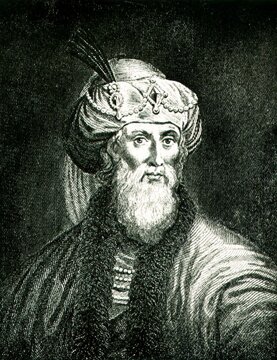
Showing posts with label Flavius Josephus. Show all posts

Wednesday, December 14, 2011

Samson

Samson, (Hebrew: שמשון Shimshown "like the sun")  is the third to last of the Judges of the ancient Children of Israel mentioned in the Tanakh, and the Talmud. He is described in the Book of Judges chapters 13 to 16.
Samson captured by the Philistines
The exploits of Samson also appear in Antiquities of the Jews written by Jewish historian Flavius Josephus in the last decade of the 1st Century AD, as well as in works by Pseudo-Philo, written slightly earlier.

Samson is a Herculean figure, who is granted tremendous strength through the Spirit of the Lord to combat his enemies and perform heroic feats unachievable by ordinary men: wrestling a lion, slaying an entire army with nothing more than the jawbone of an ass, and destroying a temple.

He is believed to be buried in Tel Tzora in Israel overlooking Nahal Sorek. There reside two large gravestones of Samson and his father Manoah. Nearby stands Manoach’s altar.
19 So Manoah took the young goat with the grain offering, and offered it on the rock to the LORD, to the one who works wonders, and Manoah and his wife were watching. 20 And when the flame went up toward heaven from the altar, the angel of the LORD went up in the flame of the altar. Now Manoah and his wife were watching, and they fell on their faces to the ground.

21 The angel of the LORD appeared no more to Manoah and to his wife. Then Manoah knew that he was the angel of the LORD. 22 And Manoah said to his wife, "We shall surely die, for we have seen God." 23 But his wife said to him, "If the LORD had meant to kill us, he would not have accepted a burnt offering and a grain offering at our hands, or shown us all these things, or now announced to us such things as these." 24 And the woman bore a son and called his name Samson. And the young man grew, and the LORD blessed him.
—Judges 13:19-24

The altar is located between the cities of Zorah and Eshtaol.

Biblical Narrative
Samson's activity takes place during a time when God was punishing the Israelites, by giving them "into the hand of the Philistines." An angel appears to Manoah, an Israelite from the tribe of Dan, in the city of Zorah, and to his wife, who had been unable to conceive. This angel proclaims that the couple will soon have a son who will begin to deliver the Israelites from the Philistines. The wife believed the angel, but her husband wasn't present, at first, and wanted the heavenly messenger to return, asking that he himself could also receive instruction about the child that was going to be born. Requirements were set up by the angel that Manoah's wife (as well as the child himself) is to abstain from all alcoholic beverages, and her promised child is not to shave or cut his hair. He was to be a "Nazirite" from birth. In ancient Israel, those wanting to be especially dedicated to God for awhile could take a nazarite vow, which included things like the aforementioned as well as other stipulations. After the angel returned, Manoah soon prepared a sacrifice, but the Messenger would only allow it to be for God, touching his staff to it, miraculously engulfing it in flames. The angel then ascended to Heaven in the fire. This was such dramatic evidence as to the nature of the messenger, that Manoah feared for his life, as it has been said that no-one can live after seeing God; however, his wife soon convinced him that if God planned to slay them, He would never have revealed such things to them to begin with. In due time the son, Samson, is born; he is reared according to these provisions.

More...

← Samson and Delilah

Monday, July 04, 2011

Meshech

Meshech (Hebrew: מֶשֶׁךְ Meshek, Mesech, or Meshech "drawing out" – descendants of Mesech are often mentioned in connection with Tubal, Magog, and other northern nations including the Moschi, a people on the borders of Colchis and Armenia).

Meshech is named as a son of Japheth in Genesis 10:2 and 1 Chronicles 1:5, and as a son of Shem in 1 Chronicles 1:17.

Meshech is named with Tubal as a principality of the prince of Gog and Magog in Ezekiel 38:2 and 39:1, apparently considered a Japhetite tribe, identified by Flavius Josephus with the Cappadocian Moschoi with the Biblical Japhetic tribe descended from Meshech in his writings on the Genealogy of the Nations in Genesis 10.

Nations Descended from Noah
1 These are the generations of the sons of Noah, Shem, Ham, and Japheth. Sons were born to them after the flood.

2 The sons of Japheth: Gomer, Magog, Madai, Javan, Tubal, Meshech, and Tiras. 3 The sons of Gomer: Ashkenaz, Riphath, and Togarmah. –Genesis 10:1-3

Genesis 10:1-3 This chapter shows concerning the three sons of Noah, that of them was the whole earth overspread. No nation but that of the Jews can be sure from which of these seventy it has come. The lists of names of fathers and sons were preserved of the Jews alone, for the sake of the Messiah. Many learned men, however, have, with some probability, shown which of the nations of the earth descended from each of the sons of Noah To the posterity of Japheth were allotted the isles of the gentiles; probably, the island of Britain among the rest. All places beyond the sea from Judea are called isles, Jeremiah 25:22. That promise, Isaiah 42:4, The isles shall wait for his law, speaks of the conversion of the gentiles to the faith of Christ.

More...

Saturday, January 29, 2011

Josephus on Jesus

In 93, the Jewish historian Flavius Josephus published his work Antiquities of the Jews. The extant copies of this work, which all derive from Christian sources, even the recently recovered Arabic version, contain two passages about Jesus. The one directly concerning Jesus has come to be known as the Testimonium Flavianum, and its authenticity has been disputed since the 17th century. The other passage concerns James the Just (also known as James the brother of Jesus).

The passage appears in Antiquities of the Jews xviii 3.3, which, in the translation of William Whiston, reads:
3. Now there was about this time Jesus, a wise man, if it be lawful to call him a man; for he was a doer of wonderful works, a teacher of such men as receive the truth with pleasure. He drew over to him both many of the Jews and many of the Gentiles. He was [the] Christ. And when Pilate, at the suggestion of the principal men amongst us, had condemned him to the cross,(9) those that loved him at the first did not forsake him; for he appeared to them alive again the third day;(10) as the divine prophets had foretold these and ten thousand other wonderful things concerning him. And the tribe of Christians, so named from him, are not extinct at this day. and also in Book XX, 9.1

1. And now Caesar, upon hearing the death of Festus, sent Albinus into Judea, as procurator. But the king deprived Joseph of the high priesthood, and bestowed the succession to that dignity on the son of Ananus, who was also himself called Ananus. Now the report goes that this eldest Ananus proved a most fortunate man; for he had five sons who had all performed the office of a high priest to God, and who had himself enjoyed that dignity a long time formerly, which had never happened to any other of our high priests. But this younger Ananus, who, as we have told you already, took the high priesthood, was a bold man in his temper, and very insolent; he was also of the sect of the Sadducees, who are very rigid in judging offenders, above all the rest of the Jews, as we have already observed; when, therefore, Ananus was of this disposition, he thought he had now a proper opportunity [to exercise his authority]. Festus was now dead, and Albinus was but upon the road; so he assembled the sanhedrim of judges, and brought before them the brother of Jesus, who was called Christ, whose name was James, and some others, [or, some of his companions]; and when he had formed an accusation against them as breakers of the law, he delivered them to be stoned: but as for those who seemed the most equitable of the citizens, and such as were the most uneasy at the breach of the laws, they disliked what was done; they also sent to the king [Agrippa], desiring him to send to Ananus that he should act so no more, for that what he had already done was not to be justified; nay, some of them went also to meet Albinus, as he was upon his journey from Alexandria, and informed him that it was not lawful for Ananus to assemble a sanhedrim without his consent.

As usual with ancient texts, the surviving sources for this passage are Greek manuscripts, all minuscules, the oldest of which dates from the 9th century. It is likely that these all derive from a single exemplar written in uncial, as is the case with most other ancient Greek texts transmitted to the present in medieval copies, and have come down through the hands of the church. The text of Antiquities appears to have been transmitted in two halves — books 1–10 and books 11–20. But other ad hoc copies of this passage also exist. However, other manuscripts existed which did not contain this passage, and one such was known to Isaac Vossius.

There are also citations in other writers of antiquity.

The first to cite this passage of Antiquities was Eusebius of Caesarea, writing in about 324, who quotes the passage in essentially the same form. This is evidence that this passage existed in at least some manuscripts of the Antiquities of the Jews at that time, though many scholars believe that Eusebius himself might be the author of the passage. Alice Whealey has demonstrated, however, that a Greek text differing in at least one respect existed in the late 4th century.

More

Monday, October 11, 2010

William Whiston

William Whiston (December 9, 1667 - August 22, 1752), English divine and mathematician, was born at Norton in Leicestershire, of which village his father was rector. He is probably best known for his translation of the Antiquities of the Jews by Flavius Josephus, his A New Theory of the Earth, and his Arianism.

He was educated privately, partly on account of the delicacy of his health, and partly that he might act as amanuensis (One employed to take dictation, or copy manuscripts; A clerk, secretary or stenographer, or scribe) to his father, who had lost his sight. After his father's death, he entered at Clare College, Cambridge, where he applied himself to mathematical study, and obtained a fellowship in 1693[1]. He next became chaplain to John Moore (1646-1714), the learned bishop of Ely, from whom he received the living of Lowestoft in 1698.

His A New Theory of the Earth (1696), an articulation of Creationism and flood geology which held that the global flood of Noah had been caused by a comet, obtained the praise of both Sir Isaac Newton and John Locke, the latter of whom classed the author among those who, if not adding much to our knowledge, "At least bring some new things to our thoughts." In 1701 he resigned his living to become deputy at Cambridge to Newton, whom two years later he succeeded as Lucasian professor of mathematics[2]. Here he engaged in joint research with his junior colleague Roger Cotes, appointed with Whiston's patronage to the Plumian chair of Astronomy in 1706.

More...

includes Youtube: Creflo Dollar on "Importance Of Character"

Monday, August 16, 2010

Machaerus

Machaerus is a fortress fifteen miles southeast of the mouth of the Jordan river, in the wild and desolate hills that overlook the Dead Sea from the east. The fortress was originally built by the Hasmonean king Alexander Jannaeus (104 BC-78 BC) in about the year 90 BC (Josephus, Wars 7.6.2). It was destroyed by Pompey's general Gabinius in 57 BC (Josephus, Wars 1.8.5), but later rebuilt by Herod the Great.

Flavius Josephus tells us that the Machaerus as the site of the imprisonment and execution of John the Baptist.

When Herod the Great died, it passed into the hands of Herod Antipas, and his foreign relations with Nabatea made the place, strategically oriented in the direction of Nabatea, of special importance to him.

Upon the death of Herod the Great, the fortress was passed to his son, Herod Antipas, who ruled from 4 BC until 39 AD. It was during this time, at the beginning of the first century AD, that John the Baptist was imprisoned and beheaded at Machaerus.

More...

Friday, June 25, 2010

The history of Ancient Israel

The history of Ancient Israel and Judah is known to us from classical sources including Judaism's Tanakh or Hebrew Bible (known to Christianity as the Old Testament), the Talmud, the Ethiopian Kebra Nagast, the writings of Nicolaus of Damascus, Artapanas, Philo of Alexandria and Flavius Josephus supplemented by ancient sources uncovered by biblical archaeology including Egyptian, Moabite, Assyrian, Babylonian as well as Israelite and Judean inscriptions.

It was also subject to domination by adjacent empires, beginning with Egypt in the late 3rd millennium BCE.

Traditions regarding the early history found in later works such as the Kebra Nagast and commentaries of Rashi, Philo of Alexandria, and numerous others, (besides of course, the Tanakh) refer to the early inhabitants as the sons of Shem and also speak of an invasion by the people known as Canaanites (see Canaan) descended from Ham.

The Book of Jubilees states that the land was originally allotted to Shem and Arphaxad (ancestor of the Hebrews) when it was still vacant, but was wrongfully occupied by Canaan and his son Sidon. Jubilees makes this, then, the true justification for the later war to drive out the Canaanites.

The Kebra Nagast, however, speaks of the Canaanites invading existing cities of Shem and Ibn Ezra, similarly notes that they had seized land from earlier inhabitants. Rashi mentions that the Canaanites were seizing land from the sons of Shem in the days of Abraham.

The patriarchal period

The patriarchal period begins with Abraham. The Bible places the events surrounding Abraham (originally Abram) circa 1800 BCE, give or take 100 years. The account of his life is found in Genesis 11, at the close of a genealogy of the sons of Shem (which includes among its members Eber, the eponym of the Hebrews).

His father Terah came from Ur Kasdim. His father moved his family, including his son Abram, from Ur Kasdim to the city of Haran.

More...

Friday, April 09, 2010

Essenes

The Essenes (es'-eenz) were followers of a religious way of living in Judaism that flourished from the 2nd century BC to the 1st century AD. Many scholars today argue that there were a number of separate but related groups that had in common mystic, eschatological, messianic, and ascetic beliefs that were referred to as the "Essenes". There are also contemporary movements which identify themselves as Essenes, including the "Orthodox" Christian Essenes.

The main source of information about the life and belief of Essenes is the detailed account contained in a work of the 1st century Jewish historiographer Josephus entitled The Jewish War written about 73-75 CE (War 2.119-161) and his shorter description in his Antiquities finished some 20 years later (Ant. 18.11 & 18-22). Claiming first hand knowledge (Life §§10-11), he refers to them by the name Essenoi and lists them as the followers of one of the three "choices" in "Jewish Philosophy'" (War 2.119) alongside the Pharisees and the Sadducees.

More...

Wednesday, February 17, 2010

Historical Jesus

Who was the historical Jesus?
This article is about Jesus the man, based upon historical methods to reconstruct a biography of his life and times. For disputes related to the existence of Jesus, theological perspectives about Jesus, and reliability of ancient texts relating to him, see:The historical Jesus is Jesus of Nazareth as reconstructed by historians (i.e. not necessarily and usually not Christian historians) using historical methods. These historical methods use critical literary analysis of Gospel texts as the primary source for the biography of Jesus, along with non-biblical sources to reconstruct the historical context of first-century Judea. These methods do not include theological or religious axioms, such as biblical inerrancy. Though the reconstructions vary, they generally agree on these basic points:
  • Jesus was a Jewish teacher who attracted a small following of Galileans and,
  • after a period of ministry, was crucified by the Romans in the Iudaea Province during the governorship of Pontius Pilate.
Eusebius of Caesarea (~275-339) is an example of an early Christian historian and Flavius Josephus is an example of a 1st-century Jewish historian.

More...

Monday, July 06, 2009

Flavius Josephus

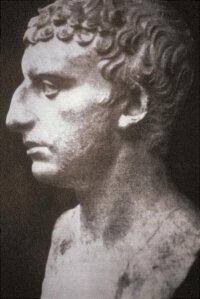
Bust of Flavius JosephusJosephus (c. 37 AD/CE – c. 100), who became known, in his capacity as a Roman citizen, as Flavius Josephus, was a 1st century Jewish historian and apologist of priestly and royal ancestry who survived and recorded the Destruction of Jerusalem in 70. His works give an important insight into first-century Judaism.

Josephus, who introduced himself in Greek as "Joseph, son of Matthias, a Hebrew by race, a priest from Jerusalem", fought the Romans in the First Jewish-Roman War of 66-73 as a Jewish military leader in Galilee. However, in circumstances that are somewhat unclear (see also Josephus problem), Josephus surrendered to the Roman forces invading Galilee in July 67.

He became a prisoner and provided the Romans with intelligence on the ongoing revolt.

The Roman forces were led by Flavius Vespasian and his son Titus (Titus Flavius Vespasianus), both subsequently Roman emperors). In 69 Josephus was released (cf. War IV. 622-629) and according to Josephus' own account, he appears to have played some role as a negotiator with the defenders in the Siege of Jerusalem in 70.

More...

Wednesday, June 17, 2009

Josephus on Jesus

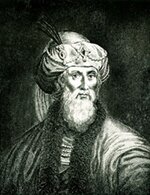
A woodcut of Flavius Josephus by John C. Winston.In 93, the Jewish historian Flavius Josephus published his work Antiquities of the Jews. The extant copies of this work, which all derive from Christian sources, even the recently recovered Arabic version, contain two passages about Jesus. The one directly concerning Jesus has come to be known as the Testimonium Flavianum, and its authenticity has been disputed since the 17th century. The other passage concerns James the brother of Jesus.

The passage appears in Antiquities of the Jews xviii 3.3, which, in the translation of William Whiston, reads:
3. Now there was about this time Jesus, a wise man, if it be lawful to call him a man; for he was a doer of wonderful works, a teacher of such men as receive the truth with pleasure. He drew over to him both many of the Jews and many of the Gentiles. He was [the] Christ. And when Pilate, at the suggestion of the principal men amongst us, had condemned him to the cross, those that loved him at the first did not forsake him; for he appeared to them alive again the third day; as the divine prophets had foretold these and ten thousand other wonderful things concerning him.

And the tribe of Christians, so named from him, are not extinct at this day.
More...

Thursday, April 03, 2008

history of Ancient Israel

1759 map of the tribal allotments of IsraelThe history of Ancient Israel and Judah is known to us from classical sources including Judaism's Tanakh or Hebrew Bible (known to Christianity as the Old Testament), the Talmud, the Ethiopian Kebra Nagast, the writings of Nicolaus of Damascus, Artapanas, Philo of Alexandria and Flavius Josephus supplemented by ancient sources uncovered by biblical archaeology including Egyptian, Moabite, Assyrian, Babylonian as well as Israelite and Judean inscriptions.

It was also subject to domination by adjacent empires, beginning with Egypt in the late 3rd millennium BCE.

In his book What did the Biblical Writers Know and When did they know it? William Dever suggests that rather than there being just one history there are in fact multiple histories and that we can distinguish nine types of history of Israel and Judah as follows.

  1. Theological history – the relationship between the God(s) and their believers.
  2. Political history – usually the account of “Great Men”, is generally episodic, chauvinistic and propagandist
  3. Narrative history – a running chronology of events, purporting to be factual but always very highly selective
  4. Socio-cultural history – a history of institutions, including their social underpinnings in family, clan, tribe and social class and the state
  5. Intellectual history – the literary history of ideas and their development, context and evolution as expressed through texts and documents
  6. Cultural history – is based upon a larger context of overall cultural evolution, demography, socio-economic and political structure and ethnicit
  7. Technological history – a history of the techniques by which humans adapt to, exploit and make use of the resources of their environment
  8. Natural history – is a geographic history of how humans discover and adapt to the ecological understandings of their natural environment
  9. Material history – as shown in the study of artifacts as correlates of human changes in behaviour.


More...

Monday, January 28, 2008

Shechem

Shechem Baal Berith templeShechem, Sichem, or Shkhem (Hebrew: שְׁכֶם‎ / שְׁכָם "Shoulder") was an Israelite city in the tribe of Ephraim, situated at Tell Balatah 32°12′11″N, 35°18′40″E, 2 km east of present-day Nablus) was the first capital of the Kingdom of Israel.

Archaeological evidence indicates that the city was razed and reconstructed up to 22 times before its final demise in 200 CE.

Within the remains of the city can still be found a number of walls and gates built for defense, a government house, a residential quarter and the ruins of a temple raised to Zeus by the Roman Emperor Hadrian, the latter dating to the second century CE.

Its position is clearly indicated in the Bible: it lay north of Bethal and Silo, on the high road going from Jerusalem to the northern districts (Judges 21, 19), at a short distance from Machmethath (Joshua 17:7) and of Dothain (Genesis 37:12-17); it was in the hill-country of Ephraim (Joshua 20:7; 21:21; 1 Kings 12:25; 1 Chronicles 6:67; 7:28), immediately below Mount Gerizim (Judges 9:6-7).

These indications are completed by Flavius Josephus, who says that the city lay between Mount Ebal and Mount Gerizim, and by the Madaba Map, which places Sychem, also called Sikima between the Tour Gobel (Ebal) and the Tour Garizin (Garizim).

More...

Wednesday, December 19, 2007

Herod the Great

The taking of Jerusalem by Herod the Great, 36 BC, by Jean FouquetHordos הוֹרְדוֹס, also known as Herod I or Herod the Great, was a Roman client-king of Judaea (c. 74 BC - c. 5, 4 or 1 BC in Jerusalem). The details of his biography can best be gleaned from the works of the 1st century AD Jewish historiographer Josephus. To the majority of non-specialist Christians Herod is best known from the Gospel according to Matthew that gives in chapter 2 an account of the events leading up to and including what subsequently has come to be referred to by Christians as the Massacre of the Innocents, of which however no mention in other contemporary sources has come down to us.

Herod the Great arose from a wealthy, influential Idumaean family. The Idumaeans, successors to the Edomites of the Hebrew Bible, settled in Idumea, formerly known as Edom, in southern Judea.

When the Maccabean John Hyrcanus conquered Idumea in 130-140 BC, he required all Idumaeans to obey Jewish law or to leave; most Idumaeans thus converted to Judaism.

According to some, archaeological evidence suggests that Herod identified himself as Jewish, although according to the Mosaic Law he was not. For he was the second son of Antipater the Idumaean, founder of the Herodian dynasty, and his wife Cypros, a princess from Petra in Nabatea (now part of Jordan). The family rubbed shoulders with the great in Rome, such as Pompey, Cassius, and in 47 BC his father was appointed Procurator over Judea, who then appointed his son governor of Galilee at the age of 25.

More...

Wednesday, December 12, 2007

historical Jesus

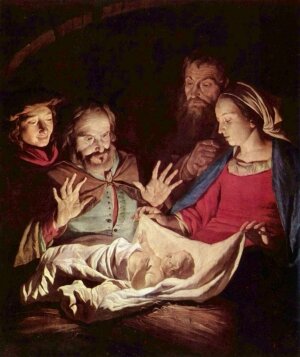
The infant Jesus in Adoration of the Shepherds, Gerard van HonthorstThis article is about Jesus the man, based upon historical methods to reconstruct a biography of his life and times. For disputes about the existence of Jesus and reliability of ancient texts relating to him, see historicity of Jesus. For theological perspectives, see Jesus, chronology of Jesus, genealogy of Jesus, etc.

The historical Jesus is Jesus of Nazareth as reconstructed by historians (i.e. not necessarily and usually not Christian historians) using historical methods. These historical methods use critical analysis of gospel texts as the primary source for the biography of Jesus, along with non-biblical sources to reconstruct the historical context of first-century Judea. These methods do not include theological or religious axioms, such as biblical inerrancy. Though the reconstructions vary, they generally agree on these basic points: Jesus was a Jewish teacher who attracted a small following of Galileans and, after a period of ministry, was crucified by the Romans in the Iudaea Province during the governorship of Pontius Pilate. The quest for the historical Jesus began with the work of Hermann Samuel Reimarus. Eusebius of Caesarea (~275–339) is an example of an early Christian historian and Flavius Josephus is an example of a 1st-century Jewish historian.

More...

Tuesday, October 23, 2007

Census of Quirinius

The Virgin and St. Joseph register for the census before Governor Quirinius. Byzantine mosaic c. 1315.The Census of Quirinius refers to the enrollment of the Roman Provinces of Syria and Iudaea for the purpose of taxation taken during the reign of the Roman Emperor Augustus when Publius Sulpicius Quirinius was appointed governor of Syria. An account of the census was given by the historian Josephus, who associated it with the beginning of the Zealot movement. The Gospel of Luke associates the birth of Jesus with this census, but appears to date it a decade earlier. Most scholars regard this as an error, but some have suggested ways of reconciling the two.

This was the first census that took place while Quirinius was governor of Syria. -Luke 2:2

Before becoming too "theologically preoccupied" with the doubts on Luke's accuracy regarding the Census of Quirinius, there are several things to consider...

More...

Saturday, October 06, 2007

Zealot

Simon the Zealot was a brother of James the Great and St Jude Thaddeus. He is portrayed with a large, serrated saw. It was with this that he was eventually martyred for his faith. St Simon was cut in half by heathens in a most gruesome way. (image courtesy of www.art.nl)A member of an ancient Jewish sect in Judea in the first century who fought to the death against the Romans and who killed or persecuted Jews who collaborated with the Romans. Zealotry (with an upper case "Z") was a movement in first century Judaism, described by Flavius Josephus as one of the "four sects" at this time. The term Zealot, Kanahi (Hebrew: קנאי, plural: kanahim, קנאים); is a term given for a "zealot". It literally means one who is "jealous" on behalf of God.The term is Greek in origin. The lower case form in modern English is used to refer to any form of zeal, especially in cases where activism and ambition in relation to ideology have become excessive, possibly to the point of being harmful to others, oneself, and one's own cause. A zealous person is called a zealot. In non-political or non-religious terms, zeal is an ordinary word and simply means extreme enthusiasm and passion for a particular activity.


History

Zealotism denotes zeal in excess, usually on behalf of Israel's God. The original Zealots were a Jewish political movement in the 1st century AD which sought to incite the people of Iudaea Province to rebel against the Roman Empire and expel it from the country by force of arms during the Great Jewish Revolt (AD 66-70). When the Romans introduced the imperial cult, the Jews had rebelled and been put down. The Zealots continued to oppose the Romans, on the grounds that Israel belonged only to a Jewish king descended from David.

More...

Friday, September 21, 2007

New Testament view on the life of Jesus

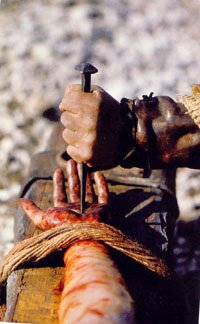
Jesus Christ being nailed to the cross The four canonical gospels of the New Testament are the main sources of information for the traditional Christian narrative of Jesus' life.

The Gospels give two accounts of Jesus' genealogy: one in the male line through his legal father Joseph of Nazareth (Matt 1:2–16 and one through his mother, Mary, while referencing his supposed father; Luke 3:23–38). Both accounts trace his line back to King David and from there to Abraham. These lists are identical between Abraham and David, but they differ between David and Joseph. Matthew starts with Solomon and proceeds through the kings of Judah to the last king, Jeconiah. After Jeconiah the line of kings terminated when Babylon conquered Judah. Thus, Matthew shows that Jesus is the legal heir to the throne of Israel. Luke's genealogy is longer than Matthew's; it goes back to Adam and provides more names between David and Jesus, thus giving us direct descendants from Adam to Jesus through Mary.

Joseph of Nazareth appears only in descriptions of Jesus' childhood. With Jesus commending Mary into the care of the beloved disciple during his crucifixion (John 19:25–27), it is likely that he had died by the time of Jesus' ministry. Both Matthew 13:55–56 and Mark 6:3 tell of Jesus' relatives. Mark 6:3 reports that those hearing Jesus asked, "Isn't this the carpenter? Isn't this Mary's son and the brother of James, Joseph, Judas and Simon? Aren't his sisters here with us?" The apostle Paul, in his letter to the Galatians, mentions at 1:19 that "I saw none of the other apostles—only James, the Lord's brother." The first-century Jewish historian Flavius Josephus also describes James the Just as "the brother of Jesus, who was called Christ" (translation of William Whiston), though this passage has been suggested as an interpolation (see Josephus on Jesus). Additionally, the Christian historian Eusebius (who wrote in the 4th century but quoted earlier sources that are now lost) refers to James the Just as Jesus' brother (see Desposyni). However, Epiphanius argued that they were "Joseph's children by his (unrecorded) first wife", while Jerome argued that they were "Jesus' cousins". The Greek word adelphos in these verses is often translated as brother in many Bible translations. However, the word can refer to any familial relation, and Roman Catholic and Eastern Orthodox traditions, along with certain other Christians, cite later revelations concerning the perpetual virginity of Mary, contend the correct translation of adelphos is kinsman or cousin.

More...

Wednesday, September 19, 2007

Josephus on Jesus

A woodcut of Flavius Josephus by John C. Winston.In 93, the Jewish historian Flavius Josephus published his work Antiquities of the Jews. The extant copies of this work, which all derive from Christian sources, even the recently recovered Arabic version, contain two passages about Jesus. The one directly concerning Jesus has come to be known as the Testimonium Flavianum, and its authenticity has been disputed since the 17th century. The other passage concerns James the brother of Jesus.

Testimonium Flavianum

Greek version

The passage appears in Antiquities of the Jews xviii 3.3, which, in the translation of William Whiston, reads:

3. Now there was about this time Jesus, a wise man, if it be lawful to call him a man; for he was a doer of wonderful works, a teacher of such men as
receive the truth with pleasure. He drew over to him both many of the Jews and
many of the Gentiles. He was [the] Christ. And when Pilate, at the suggestion of
the principal men amongst us, had condemned him to the cross, those that loved
him at the first did not forsake him; for he appeared to them alive again the
third day; as the divine prophets had foretold these and ten thousand other
wonderful things concerning him.

And the tribe of Christians, so named from him, are not extinct at this day.

As usual with ancient texts, the surviving sources for this passage are Greek manuscripts, all minuscules, the oldest of which dates from the 9th century. It is likely that these all derive from a single exemplar written in uncial, as is the case with most other ancient Greek texts transmitted to the present in medieval copies, and have come down through the hands of the church. The text of Antiquities appears to have been transmitted in two halves — books 1–10 and books 11–20. But other ad hoc copies of this passage also exist. However, other manuscripts existed which did not contain this passage, and one such was known to Isaac Vossius.

There are also citations in other writers of antiquity.

More...

Wednesday, June 20, 2007

Hasmonean Kingdom

At the beginning of the 2nd century BCE, the Seleucid Empire (in yellow) expanded into Israel at the expense of Ptolemaic Egypt (blue). The Hasmoneans (Hebrew: חשמונאים, Hashmonaiym) were the ruling dynasty of the Hasmonean Kingdom (140 BCE–37 BCE), an autonomous Jewish state in ancient Israel. The Hasmonean dynasty was established under the leadership of Simon Maccabaeus, two decades after his brother Judah the Maccabee defeated the Seleucid army during the Maccabee Revolt in 165 BCE. The Kingdom was the only independent Jewish state to exist in the four centuries after the Kingdom of Judah was destroyed by Babylonia in 586 BCE. It survived for over 100 years before becoming a client Kingdom of the Roman Empire under the Herodian Dynasty, in 37 BCE.

According to historical sources including the books 1 Maccabees and 2 Maccabees and the first book of The Wars of the Jews by the Jewish historian Flavius Josephus (37–c.100 CE), the Hasmonean Kingdom rose after a successful revolt by Jews against the Seleucid Antiochus IV. After Antiochus' successful invasion of Ptolemaic Egypt was turned back by the intervention of the Roman Republic, he moved instead to assert strict control over Israel, sacking Jerusalem and its Temple, suppressing Jewish religious and cultural observances, and imposing Hellenistic practices.


More...

Monday, May 28, 2007

Essenes

Dead Sea Scroll fragmentThe Essenes (es'-eenz) were followers of a religious way of living in Judaism that flourished from the 2nd century BC to the 1st century AD. Many scholars today argue that there were a number of separate but related groups that had in common mystic, eschatological, messianic, and ascetic beliefs that were referred to as the "Essenes". There are also contemporary movements which identify themselves as Essenes, including the "Orthodox" Christian Essenes.

The main source of information about the life and belief of Essenes is the detailed account contained in a work of the 1st century Jewish historiographer Josephus entitled The Jewish War written about 73-75 CE (War 2.119-161) and his shorter description in his Antiquities finished some 20 years later (Ant. 18.11 & 18-22). Claiming first hand knowledge (Life §§10-11), he refers to them by the name Essenoi and lists them as the followers of one of the three "choices" in "Jewish Philosophy'" (War 2.119) alongside the Pharisees and the Sadducees. The only other known contemporary accounts about the Essenes are two similarly detailed ones by the Jewish philosopher Philo (fl. c. 20 BCE - c. 54 CE; Quod Omnis Probus Liber Sit XII.75-87, and the excerpt from his Hypothetica 11.1-18 preserved by Eusebius, Praep. Evang. Bk VIII), who, however, admits to not being quite certain of the Greek form of their name that he recalls as Essaioi (Quod Omn. Prob. XII.75), and the brief reference to them by the Roman equestrian Pliny the Elder (fl. 23 CE - 79 CE; Natural History, Bk 5.73).
More...
 

Subscribe


LifeNews.com

Desiring God Blog

Youth for Christ International