Showing posts with label historical Jesus. Show all posts

Sunday, April 04, 2010

William Lane Craig

William Lane Craig (born August 23, 1949) is an American philosopher, theologian, and Christian apologist. He is a prolific author and lecturer on a wide range of issues related to the philosophy of religion, the historical Jesus, the coherence of the Christian worldview, and Intelligent Design. He is married and lives in Atlanta, Georgia, and is currently a Research Professor of Philosophy at Talbot School of Theology, Biola University in La Mirada, California. Craig is a fellow of the Discovery Institute's Center for Science and Culture, which is the hub of the Intelligent Design movement.

Craig has been critical of
  • philosophical naturalism,
  • logical positivism,
  • moral relativism,
  • liberal theology, and
  • the Jesus Seminar.
He has defended the middle knowledge view of divine providence and is also notable for his work in the philosophy of time. He is a founding member and has served as president of the Philosophy of Time Society

More...

Wednesday, February 17, 2010

Historical Jesus

Who was the historical Jesus?
This article is about Jesus the man, based upon historical methods to reconstruct a biography of his life and times. For disputes related to the existence of Jesus, theological perspectives about Jesus, and reliability of ancient texts relating to him, see:The historical Jesus is Jesus of Nazareth as reconstructed by historians (i.e. not necessarily and usually not Christian historians) using historical methods. These historical methods use critical literary analysis of Gospel texts as the primary source for the biography of Jesus, along with non-biblical sources to reconstruct the historical context of first-century Judea. These methods do not include theological or religious axioms, such as biblical inerrancy. Though the reconstructions vary, they generally agree on these basic points:
  • Jesus was a Jewish teacher who attracted a small following of Galileans and,
  • after a period of ministry, was crucified by the Romans in the Iudaea Province during the governorship of Pontius Pilate.
Eusebius of Caesarea (~275-339) is an example of an early Christian historian and Flavius Josephus is an example of a 1st-century Jewish historian.

More...

Saturday, July 11, 2009

historicity of Jesus

Jesus, aged 12, teaching the doctors of the FaithThe historicity of Jesus (i.e., his existence as an actual historical figure), is accepted as a theological axiom by three world religions, Christianity, Islam and the Bahá’í Faith, based on their respective scriptures.

The earliest known sources are Christian writings - the New Testament - which, according to modern historians, were written only 20-30 years after Jesus died.

However, while Christianity considers Jesus to be the Christ (Messiah) and Son of God, and Islam views him only as a prophet, secular historians and followers of most other world religions (including Judaism) tend to regard him as an ordinary human. Messianic Judaism, however, also considers Jesus (Yeshua HaMashiach) to be the Jewish Messiah.

More...

Tuesday, January 01, 2008

Acts

Acts 15:22–24 from the seventh-century Codex Laudianus in the Bodleian Library, written in parallel columns of Latin and Greek.The Acts of the Apostles (Greek Praxeis Apostolon) is a book of the Bible, which now stands fifth in the New Testament after the four gospels. This book describes the development of the early church from Christ's Ascension to Paul's sojourn at Rome. It is commonly referred to as simply Acts. The traditional view is that it was written by the Macedonian Christian physician and historian Luke the Evangelist (also the author of the gospel of Luke).

An alternative name for the book is Acts of the Holy Spirit. It describes many of the journeys and actions taken by the apostles, meaning "those who have been sent" by God, to be His witnesses.

This was originally applied exclusively to those who had personally seen and/or lived with Jesus of Nazareth. The book of Acts contains many descriptions of miraculous events (which were given as signs from God to validate the apostles' teachings), which were performed by the Holy Spirit through the apostles. These included miraculous healings, casting out evil spirits, the raising of the dead, and also historical descriptions of everyday life in The Roman Empire and in ancient Jerusalem.

Acts describes the beginning of the Jewish-Christian church on the Day of Pentecost, explains and describes the growth and spread of the Church despite (and because of) official persecution, narrates the inclusion of the gentile Greeks, Romans and other pagans of the Near East into the Church (and explains how this became possible), and focuses on the lives of the apostles, specifically Simon, called "Peter" of Galilee (who followed and lived with Jesus for probably three years) and Saul Paulus of Tarsus (who began as a Pharisee and a persecutor of the Church and was converted later on the Road to Damascus).

More...

Friday, December 28, 2007

Messianic Judaism

The Baruch Hashem Messianic Synagogue in Dallas, TexasMessianic Judaism is a religious movement of Jews and non-Jews whose adherents believe that Jesus of Nazareth, whom they call by the Hebrew name Yeshua, is both the resurrected Jewish Messiah and their divine savior.

As of 1993 there were 160,000 adherents of Messianic Judaism in the United States and 350,000 worldwide. As of 2003, there were at least 150 Messianic synagogues in the U.S. and over 400 worldwide.

Messianic Jews practice their faith in a way they consider to be authentically Torah-observant and culturally Jewish. However, Jews of all denominations and many Christians do not consider Messianic Judaism to be a form of Judaism, but a form of Christianity.

Self identity

Although words used to identify aspects of Messianic Judaism are frequently disputed and sometimes contradictory, the term itself generally describes a belief that Jesus is the Jewish Messiah and that obedience of the Scriptures is the proper expression of faith. Adherents are described as Messianic believers or Messianics for short. Messianic Judaism is a relatively new term, coined as recently as 1895 to help separate the practices of its followers from those of common Christianity as a whole, and in order to more closely align its faith with that of biblical and historical Judaism.

More...

Thursday, December 13, 2007

Augustinian hypothesis

the evangelist Matthew inspired by an angelThe Augustinian hypothesis is a solution to the synoptic problem, which concerns the origin of the Gospels of the New Testament. The hypothesis holds that Matthew was written first, by Matthew the Evangelist, a disciple of Jesus of Nazareth. Mark the Evangelist, a disciple of the apostle Simon Peter, wrote the Gospel of Mark second, and used Matthew and the preaching of Peter as sources. Luke the Evangelist, a disciple of Paul of Tarsus, wrote the Gospel of Luke, and was aware of the two Gospels that preceded him. Unlike some competing hypotheses, this hypothesis does not rely on, nor does it argue for, the existence of any document that is not explicitly mentioned in historical testimony. Instead, the hypothesis draws primarily upon historical testimony, rather than textual criticism, as the central line of evidence. The foundation of evidence for the hypothesis is the writings of the Church Fathers: historical sources dating back to as early as the first half of the 2nd century, which have been held as authoritative by most Christians for nearly 2 millennia. Finally, adherents to the Augustinian hypothesis view it as a simple, coherent solution to the synoptic problem.

The Augustinian hypothesis addresses certain fundamental points of contention surrounding the synoptic problem, such as how reliable the early Christian tradition is, which gospel was written first, whether there were other unknown sources behind the gospels, to what extent, if any, the gospels were redacted, and to what extent the gospels were altered between the time they were originally written and the time the first surviving manuscripts appear. These and other matters are raised and alternate resolutions proposed by proponents of competing hypotheses, such as the Two-source hypothesis, its related Q hypothesis, the Farrer hypothesis, and others.

More...

Wednesday, December 12, 2007

historical Jesus

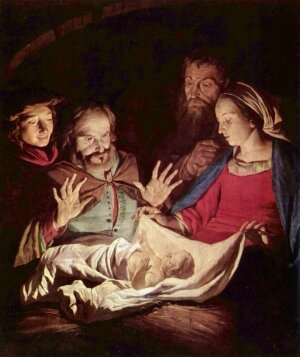
The infant Jesus in Adoration of the Shepherds, Gerard van HonthorstThis article is about Jesus the man, based upon historical methods to reconstruct a biography of his life and times. For disputes about the existence of Jesus and reliability of ancient texts relating to him, see historicity of Jesus. For theological perspectives, see Jesus, chronology of Jesus, genealogy of Jesus, etc.

The historical Jesus is Jesus of Nazareth as reconstructed by historians (i.e. not necessarily and usually not Christian historians) using historical methods. These historical methods use critical analysis of gospel texts as the primary source for the biography of Jesus, along with non-biblical sources to reconstruct the historical context of first-century Judea. These methods do not include theological or religious axioms, such as biblical inerrancy. Though the reconstructions vary, they generally agree on these basic points: Jesus was a Jewish teacher who attracted a small following of Galileans and, after a period of ministry, was crucified by the Romans in the Iudaea Province during the governorship of Pontius Pilate. The quest for the historical Jesus began with the work of Hermann Samuel Reimarus. Eusebius of Caesarea (~275–339) is an example of an early Christian historian and Flavius Josephus is an example of a 1st-century Jewish historian.

More...

Monday, September 17, 2007

historicity of Jesus

Jesus, aged 12, teaching the doctors of the faithThe historicity of Jesus (i.e., his existence as an actual historical figure), is accepted as a theological axiom by three world religions, Christianity, Islam and the Bahá’í Faith, based on their respective scriptures.

The earliest known sources are Christian writings - the New Testament - which, according to modern historians, were written several decades after he is said to have died.

However, while Christianity and the Bahá'í Faith also consider Jesus to be the Christ (Messiah) and Son of God, and Islam views him as a prophet, secular historians and followers of most other world religions (including Judaism) tend to regard him as an ordinary human.

Most scholars, however, agree that Jesus was an historical figure regardless of their perspectives on His teaching, His message of salvation, or statements about Himself.

More...

Tuesday, September 11, 2007

Damascus

Wall of the New Testament period (called Bab Kisan) in Damascus where Paul escaped to begin his ministry.Damascus (Arabic: دمشق‎) is the capital and largest city of Syria, with close ties to Israel. Founded approximately 2500 BCE, it is thought to be the oldest continuously inhabited city in the world, before Al Fayyum, and Gaziantep. Its current population is estimated at about 4.5 million.

Name


In Arabic, the city is called دمشق الشام Dimashq ash-Shām.


Although this is often shortened to Dimashq by many, the citizens of Damascus, and of Syria and some other Arab neighbors, colloquially call the city ash-Shām. Ash-Shām is an Arabic term for North and for Syria. (Syria — particularly historical Greater Syria — is called Bilād ash-Shām — بلاد الشام, 'country of the north' — in Arabic.) The English name for Damascus is taken from the Greek Δαμασκός, via Latin. This comes from the old Aramaic (see also: Aramaic of Jesus) name for the city — דרמשק Darmeśeq, which means "a well-watered place". However, pre-Aramaic tablets unearthed at Ebla refer to a city to the south of Ebla named Damaski. It is possible that the name 'Damascus' pre-dates the Aramaic era of the city. Damascus is designated as having been part of the ancient province of Amurru in the Hyksos Kingdom, from 1720 to 1570 BC. (MacMillan, pp. 30-31).


More...

Tuesday, July 31, 2007

historicity of Jesus

Jesus, aged 12, teaching the doctors of the FaithThe historicity of Jesus (i.e., his existence as an actual historical figure), is accepted as a theological axiom by three world religions, Christianity, Islam and the Bahá’í Faith, based on their respective scriptures.

The earliest known sources are Christian writings - the New Testament - which, according to modern historians, were written several decades after he is said to have died.

However, while Christianity and the Bahá'í Faith also consider Jesus to be the Christ (Messiah) and Son of God, and Islam views him as a prophet, secular historians and followers of most other world religions (including Judaism) tend to regard him as an ordinary human. Most scholars, however, agree that Jesus was an historical figure regardless of their perspectives on His teaching, His message of salvation, or statements about Himself.


More...

Tuesday, July 03, 2007

Gospel of John

The Rylands Papyrus is the earliest manuscript fragment found of John's Gospel; dated to about 125.
The Gospel of John, (literally, According to John; Greek, Κατά Ιωαννην, Kata Iōannēn) is the fourth gospel in the canon of the New Testament, traditionally ascribed to John the Evangelist. Like the three synoptic gospels, it contains an account of some of the actions and sayings of Jesus, but differs from them in ethos and theological emphases. The purpose is expressed in the conclusion, 20:30-31: "...these [Miracles of Jesus] are written that you may (come to) believe that Jesus is the Messiah, the Son of God, and that through this belief you may have life in his name.

According to Trinitarianism, (see also Trinitarianism— Scripture and tradition), of the four gospels, John presents the highest christology, implicitly declaring Jesus to be God.
Compared to the synoptics, John focuses on Jesus' cosmic mission to redeem humanity. Only in John does Jesus talk at length about himself, and John includes a substantial amount of material that Jesus shared with the disciples only. Certain elements of the synoptics (such as parables, exorcisms, and the Second Coming) are not found in John.
Since the "higher criticism" of the 19th century, historians have largely rejected the gospel of John as a reliable source of information about the historical Jesus. "[M]ost commentators regard the work as anonymous."

More...

Tuesday, June 26, 2007

resurrection of Jesus

The resurrection of Jesus as depicted by Matthias GrünewaldAccording to the Trinitarian (the Trinity) interpretation of the New Testament, Jesus was both human and God, so he had the power to lay his life down and to take it up again; thus after Jesus died, he came back to life. This event is referred to in Christian terminology as the resurrection of Jesus Christ, and is commemorated and celebrated by most Christians annually on Easter Sunday.

Most Christians, even those who do not interpret other parts of the Bible literally, accept the New Testament story as an historical account of an actual event central to their faith, though some do not accept a literal bodily resurrection, sometimes arguing for docetism. But it so seems that in the past, a large group of Christians known as the Gnostics, who were later declared heretics and partially exterminated, argued against its singular importance, and claimed that the New Testament supported their claims. Non-Christians generally view the story as legend or as allegory.

Resurrection accounts
The New Testament

The primary accounts of the resurrection are in the last chapters of the Canonical Gospels:


  • Matthew 28,
  • Mark 16,
  • Luke 24,
  • John 20-21


More...

Friday, June 08, 2007

Old Testament

Tora Scroll, Germany about 1830. Part of the exhibition in the Jewish Museum Westphalia, Dorsten, GermanyThe first of the two main divisions of the bible, containing the books of the old or Mosaic Covenant, and including the historical books, the prophets, and poetical books.

The Old Testament or the Hebrew Scriptures (also called the Hebrew Bible) constitutes the first major part of the Bible according to Christianity. It is usually divided into the categories of law, history, poetry (or wisdom books) and prophecy. All of these books were written before the birth of Jesus of Nazareth, who is the subject of the subsequent Christian New Testament. The Bible of Jesus is the Old Testament, specifically according to the Gospel of Luke 24:44–45 "written in the law of Moses, and in the prophets, and in the psalms ... the scriptures". According to historians, the Old Testament was composed between the 5th century BC and the 2nd century BC, though parts of it, such as the Torah, date back much earlier.

More...

Sunday, June 03, 2007

Bible

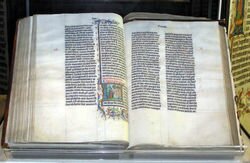
A Bible handwritten in Latin, on display in Malmesbury Abbey, Wiltshire, England. This Bible was transcribed in Belgium in 1407 for reading aloud in a monastery.The writings of the old and new testaments, as accepted by the Christian church as a divine revelation: in certain churches embracing also parts of the Apocrypha (not in the canonical Hebrew Scriptures nor in the Authorized Version).

If one takes a thoughful, unbiased look at the Judeo-Christian texts (Old and New Testaments, in any language), eliminating all presuppositions, they will discover that they all point to one thing: the Messiah.

Jesus is the Messiah.

Speaking to the serpent, God said,

"And I will put enmity between you and the woman, and between your offspring and hers; he will crush your head, and you will strike his heel." -Genesis 3 (3:15)
The Bible is the most widely distributed book in the world. Both Hebrew Scripture and the Christian Bible have been translated more times and into more languages (more than 2,100 languages) than any other book. It is said that more than five billion copies of the Bible have been sold since 1815, making it the best-selling book of all-time.


Because of Christian domination of Europe from the late Roman era to the Age of Enlightenment, the Bible has influenced not only religion but language, law and, until the modern era, the natural philosophy of mainstream Western Civilization. The Age of Enlightenment and the Scientific Revolution in Europe and America brought skepticism regarding the divine origin and historical accuracy of the Bible.

More...

Saturday, April 28, 2007

William Lane Craig

William Lane CraigWilliam Lane Craig (born August 23, 1949) is an American philosopher, theologian, and Christian apologist. He is a prolific author and lecturer on a wide range of issues related to the philosophy of religion, the historical Jesus, the coherence of the Christian worldview, and Intelligent Design. He is married and lives in Atlanta, Georgia, and is currently a Research Professor of Philosophy at Talbot School of Theology, Biola University in La Mirada, California. Craig is a fellow of the Discovery Institute's Center for Science and Culture, which is the hub of the Intelligent Design movement.


Craig became a Christian believer in high school at the age of 16. His vocation and academic studies reflect his religious commitment to Christian beliefs within the Protestant Evangelical tradition.

In theological commitments he holds to an Arminian (specifically, Molinist) view concerning the grace of God and the role of the human will in conversion. He has had friendly connections with para-church ministries such as Campus Crusade for Christ and Christian International Ministries (Europe).

In his early reading and studies, Craig was influenced by the writings of Francis Schaeffer and Edward John Carnell. He studied philosophy under Stuart Hackett.
More...

Sunday, April 08, 2007

resurrection of Jesus

The resurrection of Jesus as depicted by Matthias GrünewaldAccording to the Trinitarian interpretation of the New Testament, Jesus was both human and God, so he had the power to lay his life down and to take it up again; thus after Jesus died, he came back to life. This event is referred to in Christian terminology as the resurrection of Jesus Christ, and is commemorated and celebrated by most Christians annually on Easter Sunday.

Most Christians, even those who do not interpret other parts of the Bible literally, accept the New Testament story as an historical account of an actual event central to their faith, though some do not accept a literal bodily resurrection, sometimes arguing for docetism. But it so seems that in the past, a large group of Christians known as the Gnostics, who were later declared heretics and partially exterminated, argued against its singular importance, and claimed that the New Testament supported their claims. Non-Christians generally view the story as legend or as allegory.


The New Testament
The primary accounts of the resurrection are in the last chapters of the Canonical Gospels: Matthew 28, Mark 16, Luke 24, John 20-21.


All the Canonical Gospel accounts agree that Jesus was crucified late on Friday afternoon and placed in a tomb belonging to Joseph of Arimathea. On Sunday, after the Saturday Jewish day of rest, one or more of Jesus' female followers, one or more of whom were called Mary, returned to the tomb, to complete the burial rites. When they arrived they discovered that the tomb was empty, or more accurately it did not contain Jesus' body. They then conversed with (an) angel(s)/male youth who informed them that Jesus was resurrected/not there, and so they departed. According to the traditional ending of Mark 16, and the surviving versions of the other Gospels, the women returned with some of Jesus' disciples to confirm the emptiness of the tomb. However, ancient manuscripts of Mark 16 vary heavily after this point, some ancient manuscripts even halt at this point, and most scholars do not believe the traditional ending was the original one.


More...

Monday, March 19, 2007

Acts of the Apostles

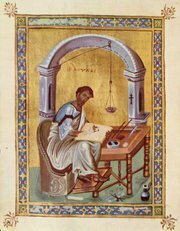
Statue of Apostle Luka on Saint Isaac's cathedral. Saint Petersburg, RussiaThe Acts of the Apostles (Greek Praxeis Apostolon) is a book of the Bible, which now stands fifth in the New Testament after the four gospels. This book describes the development of the early church from Christ's Ascension to Paul's sojourn at Rome. It is commonly referred to as simply Acts. The traditional view is that it was written by the Macedonian Christian physician and historian Luke the Evangelist (also the author of the gospel of Luke).

An alternative name for the book is Acts of the Holy Spirit. It describes many of the journeys and actions taken by the apostles, meaning "those who have been sent" by God, to be His witnesses.


This was originally applied exclusively to those who had personally seen and/or lived with Jesus of Nazareth. The book of Acts contains many descriptions of miraculous events (which were given as signs from God to validate the apostles' teachings), which were performed by the Holy Spirit through the apostles. These included miraculous healings, casting out evil spirits, the raising of the dead, and also historical descriptions of everyday life in The Roman Empire and in ancient Jerusalem.


More...

Saturday, March 03, 2007

Joshua

Moses names Joshua his successorJoshua or Yehoshúa (יְהוֹשֻׁעַ "The LORD of/is help/court") is a Biblical character, much of whose life is described in the Book of Joshua. The lack of a vav after the shin would normally indicate a pronunciation of Yehoshēa`, and in three places he is actually called Hoshēa. In Greek he is called Ιησούς (Iēsoûs) του Ναυή, the same as the name of Jesus of Nazareth and others bearing the Hebrew name Yēshua`. He is a historical figure, and would have lived sometime between the 18th century BC and the late 13th century BC.

Joshua was the son of Nun, of the tribe of Ephraim and the successor to Moses as the leader of Israel. See also History of ancient Israel and Judah. He is called Jehoshua in Num. 13:16 (A.V.), and Jesus in Acts 7:45 and Heb. 4:8 (R.V., Joshua).


He was born in Egypt, and was probably of the age of Caleb, with whom he is generally associated. He shared in all the events of the Exodus, and held the place of commander of the host of the Israelites at their great battle against the Amalekites in Rephidim (Ex. 17:8-16).


He became Moses' minister, and accompanied him part of the way when he ascended Mount Sinai to receive the (Exodus 32:17). He was also one of the twelve spies who were sent on by Moses to explore the land of Canaan (Num. 13:16, 17), and only he and Caleb gave an encouraging report.


More...

Thursday, January 11, 2007

Acts of the Apostles

Statue of Apostle Luka on Saint Isaac’s cathedral. Saint Petersburg, RussiaThe Acts of the Apostles (Greek Praxeis Apostolon) is a book of the Bible, which now stands fifth in the New Testament after the four gospels. This book describes the development of the early church from Christ's Ascension to Paul's sojourn at Rome. It is commonly referred to as simply Acts. The traditional view is that it was written by the Macedonian Christian physician and historian Luke the Evangelist (also the author of the gospel of Luke).

An alternative name for the book is Acts of the Holy Spirit. It describes many of the journeys and actions taken by the apostles, meaning "those who have been sent" by God, to be His witnesses. This was originally applied exclusively to those who had personally seen and/or lived with Jesus of Nazareth. The book of Acts contains many descriptions of miraculous events (which were given as signs from God to validate the apostles' teachings), which were performed by the Holy Spirit through the apostles. These included miraculous healings, casting out evil spirits, the raising of the dead, and also historical descriptions of everyday life in The Roman Empire and in ancient Jerusalem.

More...

Monday, June 26, 2006

historicity of Jesus

The historicity of Jesus (i.e., his existence as an actual historical figure), is accepted as a theological axiom by three world religions, Christianity, Islam and the Bahá’í Faith, based on their respective scriptures.


The earliest known sources are Christian writings - the New Testament - which, according to modern historians, were written several decades after he is said to have died. However, while Christianity and the Bahá'í Faith also consider Jesus to be the Christ (Messiah) and Son of God, and Islam views him as a prophet, secular historians and followers of most other world religions (including Judaism) tend to regard him as an ordinary human. Most scholars, however, agree that Jesus was an historical figure regardless of their perspectives on His teaching, His message of salvation, or statements about Himself.

More...


Subscribe


LifeNews.com

Desiring God Blog

Youth for Christ International