Showing posts with label Paul of Tarsus. Show all posts

Saturday, September 03, 2011

Epistle to the Romans

Often referred to as "Romans," The Epistle of St. Paul the Apostle to the Romans is one of the letters of the New Testament canon of the Christian Bible. It is one of the seven currently undisputed letters of Paul. It is even counted among the four letters accepted as authentic (known in German scholarship as Hauptbriefe) by Ferdinand Christian Baur and the Tübingen School of historical criticism of texts in the 19th century.

The book, according to Joseph Fitzmyer, "overwhelms the reader by the density and sublimity of the topic with which it deals, the gospel of the justification and salvation of Jew and Greek alike by the grace of God through faith in Jesus Christ, revealing the uprightness and love of God the father." N.T. Wright notes that Romans is "neither a systematic theology nor a summary of Paul's lifework, but it is by common consent his masterpiece.

Paul's Epistle to the Romans dwarfs most of his other writings, an Alpine peak towering over hills and villages. Not all onlookers have viewed it in the same light or from the same angle, and their snapshots and paintings of it are sometimes remarkably unalike. Not all climbers have taken the same route up its sheer sides, and there is frequent disagreement on the best approach. What nobody doubts is that we are here dealing with a work of massive substance, presenting a formidable intellectual challenge while offering a breathtaking theological and spiritual vision".

I. The doctrinal part of the epistles instructs us,

1. Concerning the way of salvation (1.) The foundation of it laid in justification, and that not by the Gentiles’ works of nature (ch. 1), nor by the Jews’ works of the law (ch. 2, 3), for both Jews and Gentiles were liable to the curse; but only by faith in Jesus Christ, ch. 3:21, etc.; ch. 4. (2.) The steps of this salvation are, [1.] Peace with God, ch. 5. [2.] Sanctification, ch. 6, 7. [3.] Glorification, ch. 8.
2. Concerning the persons saved, such as belong to the election of grace (ch. 9), Gentiles and Jews, ch. 10, 11. By this is appears that the subject he discourses of were such as were then the present truths, as the apostle speaks, 2 Peter 1:12. Two things the Jews then stumbled at-justification by faith without the works of the law, and the admission of the Gentiles into the church; and therefore both these he studied to clear and vindicate.

II. The practical part follows, wherein we find, 1. Several general exhortations proper for all Christians, ch. 12. 2. Directions for our behaviour, as members of civil society, ch. 13. 3. Rules for the conduct of Christians to one another, as members of the Christian church, ch. 14 and ch. 15:1-14.

III. As he draws towards a conclusion, he makes an apology for writing to them (ch. 15:14-16), gives them an account of himself and his own affairs (v. 17-21), promises them a visit (v. 22-29), begs their prayers (v. 30-32), sends particular salutations to many friends there (ch. 16:1-16), warns them against those who caused divisions (v. 17-20), adds the salutations of his friends with him (v. 21-23), and ends with a benediction to them and a doxology to God (v. 24-27).

Henry, Matthew. "Introduction to Romans."

More...

→ Yale University: Paul’s Letter to the Romans
Tuesday, October 19, 2010

Paul of Tarsus

Paul of Tarsus, also known as Paul, Paulus, and Saint Paul the Apostle, (AD 3-67) is widely considered to be central to the early development and spread of Christianity, particularly westward from Judea. Many Christians view him as an important interpreter of the teachings of Jesus. Paul is described in the New Testament as a Hellenized Jew and Roman citizen from Tarsus (present-day Turkey), and as a persistent persecutor of early Christians, almost all of whom were Jewish, prior to his "Road to Damascus" experience, which brought about his conversion to faith in Jesus as Messiah, not only for Jews, but for all, regardless of ethnic background.

Paul made the first great effort, through his Epistles to Gentile Christian communities, to show that the God of Abraham is for all people, rather than for Jews only, though he did not originate the idea, for example see Isaiah 56:6-8 or proselyte or Great Commission, or Simon Peter's vision of the sheet descending from Heaven in Acts 10:9-23a.

Paul is venerated as a Saint by all the churches that honor saints, including those of the Roman Catholic, Eastern Orthodox, and Anglican traditions, and some Lutheran sects.

More...

Includes Youtube video  Paul the Apostle

Sunday, August 29, 2010

Epistle to the Romans

The Epistle of St. Paul the Apostle to the Romans (often referred to as "Romans") is one of the letters of the New Testament canon of the Christian Bible. It is one of the seven currently undisputed letters of Paul. It is even counted among the four letters accepted as authentic (known in German scholarship as Hauptbriefe) by Ferdinand Christian Baur and the Tübingen School of historical criticism of texts in the 19th century.

The book, according to Joseph Fitzmyer, "overwhelms the reader by the density and sublimity of the topic with which it deals, the gospel of the justification and salvation of Jew and Greek alike by the grace of God through faith in Jesus Christ, revealing the uprightness and love of God the father." N.T. Wright notes that Romans is "neither a systematic theology nor a summary of Paul's lifework, but it is by common consent his masterpiece.

Paul's Epistle to the Romans dwarfs most of his other writings, an Alpine peak towering over hills and villages. Not all onlookers have viewed it in the same light or from the same angle, and their snapshots and paintings of it are sometimes remarkably unalike. Not all climbers have taken the same route up its sheer sides, and there is frequent disagreement on the best approach. What nobody doubts is that we are here dealing with a work of massive substance, presenting a formidable intellectual challenge while offering a breathtaking theological and spiritual vision".

More...

Saturday, January 30, 2010

The Letters of Paul


The Pauline epistles are the thirteen or fourteen letters in the New Testament of the Christian Bible traditionally believed to have been written by the apostle Paul. Among them are some of the earliest extant (still existing) Christian documents. They provide an insight into the beliefs and controversies of formative Christianity and, as part of the biblical canon of the New Testament, they have also been, and continue to be, hugely influential in Christian theology and Christian ethics.

The Letters of Paul are as follows:
  • Romans
  • 1 Corinthians
  • 2 Corinthians
  • Galatians
  • Ephesians
  • Philippians
  • Colossians
  • 1 Thessalonians
  • 2 Thessalonians
  • 1 Timothy
  • 2 Timothy
  • Titus
  • Philemon


More...

Saturday, September 19, 2009

Epistle to the Romans

St PaulThe Epistle of St. Paul the Apostle to the Romans (often referred to as "Romans") is one of the letters of the New Testament canon of the Christian Bible. It is one of the seven currently undisputed letters of Paul. It is even counted among the four letters accepted as authentic (known in German scholarship as Hauptbriefe) by Ferdinand Christian Baur and the Tübingen School of historical criticism of texts in the 19th century.

The book, according to Joseph Fitzmyer, "overwhelms the reader by the density and sublimity of the topic with which it deals, the gospel of the justification and salvation of Jew and Greek alike by the grace of God through faith in Jesus Christ, revealing the uprightness and love of God the father." N.T. Wright notes that Romans is "neither a systematic theology nor a summary of Paul's lifework, but it is by common consent his masterpiece.

Paul's Epistle to the Romans dwarfs most of his other writings, an Alpine peak towering over hills and villages. Not all onlookers have viewed it in the same light or from the same angle, and their snapshots and paintings of it are sometimes remarkably unalike. Not all climbers have taken the same route up its sheer sides, and there is frequent disagreement on the best approach. What nobody doubts is that we are here dealing with a work of massive substance, presenting a formidable intellectual challenge while offering a breathtaking theological and spiritual vision".

More...

Friday, July 24, 2009

Pauline Christianity

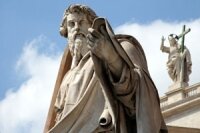
St. Paul statue in front of St. Peters Basilica, VaticanPauline Christianity is a term used to refer a branch of Early Christianity associated with the beliefs and doctrines espoused by Paul the Apostle through his writings. Most of mainstream Christianity relies heavily on these teachings and considers them to be amplifications and explanations of the teachings of Jesus. Others perceive in Paul's writings teachings that are radically different from the original teachings of Jesus documented in the canonical gospels, early Acts and the rest of the New Testament, such as the Epistle of James.

Proponents of the perceived Pauline distinctive include Marcion of Sinope, the 2nd century theologian who asserted that Paul was the only apostle who had rightly understood the new message of salvation as delivered by Christ.

Opponents of the same era include the Ebionites and Nazarenes, who rejected Paul for straying from "normative" Judaism.

Sunday, February 08, 2009

Paul the Apostle

St Paul Healing the Cripple at LystraPaul the Apostle, also known as Paul, Paulus, Paul of Tarsus, and Saint Paul the Apostle, (AD 3—67) is widely considered to be central to the early development and spread of Christianity, particularly westward from Judea. Many Christians view him as an important interpreter of the teachings of Jesus. Paul is described in the New Testament as a Hellenized Jew and Roman citizen from Tarsus (present-day Turkey), and as a persistent persecutor of early Christians, almost all of whom were Jewish, prior to his "Road to Damascus" experience, which brought about his conversion to faith in Jesus as Messiah, not only for Jews, but for all, regardless of ethnic background.

Paul made the first great effort, through his Epistles to Gentile Christian communities, to show that the God of Abraham is for all people, rather than for Jews only, though he did not originate the idea, for example see Isaiah 56:6-8 or proselyte or Great Commission, or Simon Peter's vision of the sheet descending from Heaven in Acts 10:9-23a.

Paul is venerated as a Saint by all the churches that honor saints, including those of the Roman Catholic, Eastern Orthodox, and Anglican traditions, and some Lutheran sects.

He is the 'patron saint' of the City of London and has also had several cities named in his honor, including Sao Paulo, Brazil and Saint Paul, Minnesota in the United States. He did much to advance Christianity among the Gentiles, and is considered to be one source (if not the primary source) of early Church doctrine, and the founder of Pauline Christianity. His epistles form a fundamental section of the New Testament. Some argue that he was instrumental in establishing Christianity as a distinct religion, rather than a sect of Judaism, as Christianity was first known.

Due to his body of work and his undoubted influence on the development of Christianity, some modern scholars have considered Paul to be the founder of Christianity, who modified Jesus' teachings and added important new doctrines. However, this view remains controversial. Most Christian scholars say that no teachings were modified, and assert that Paul taught in complete harmony with Jesus. Some Christians, however, particularly those who embrace dispensationalism, believe that Jesus' teachings are for the Jews — especially those teachings found in Matthew — and that Christians necessarily have a different belief system since Christianity, according to this perspective, only arose as a result of the rejection by the Jews of Jesus as their Messiah.

More...

Thursday, June 05, 2008

Pauline Christianity

St. Paul, by El GrecoPauline Christianity is a term used to refer a branch of Early Christianity associated with the beliefs and doctrines espoused by Paul the Apostle through his writings. Most of mainstream Christianity relies heavily on these teachings and considers them to be amplifications and explanations of the teachings of Jesus. Others perceive in Paul's writings teachings that are radically different from the original teachings of Jesus documented in the canonical gospels, early Acts and the rest of the New Testament, such as the Epistle of James.

Proponents of the perceived Pauline distinctive include Marcion of Sinope, the 2nd century theologian who asserted that Paul was the only apostle who had rightly understood the new message of salvation as delivered by Christ.

Opponents of the same era include the Ebionites and Nazarenes, who rejected Paul for straying from "normative" Judaism.

Pauline Christianity, as an expression, first came into use in the twentieth century amongst those scholars who proposed different strands of thought within Early Christianity, wherein Paul was a powerful influence. It has come into widespread use amongst non-Christian scholars and depends on the claim, advanced in different ages, that the form of the faith found in the writings of Paul is radically different from that found elsewhere in the New Testament, but also that his influence came to predominate. Reference is also made to the large number of non-canonical texts, some of which have been discovered during the last hundred years, and which show the many movements and strands of thought emanating from Jesus's life and teaching or which may be contemporary with them, some of which can be contrasted with Paul's thought. Of the more significant are Ebionism and Gnosticism.

More...

Thursday, May 08, 2008

Ephesus

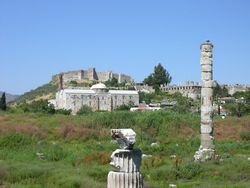
Site of the Temple of Artemis.Ephesus (Greek: Έφεσος see also List of traditional Greek place names, Turkish: Efes) was one of the great cities of the Ionian Greeks in Asia Minor, located in Lydia where the Cayster river flows into the Aegean Sea (in modern day Turkey). It was founded by colonists principally from Athens. The ruins of Ephesus are a major tourist attraction, especially for people traveling to Turkey by cruise ship via the port of Kuşadası.

Ancient Ephesus

Ephesus is believed by many to be the Apasa (or Abasa) mentioned in Hittite sources as the capital of the kingdom of Arzawa. Mycenaean pottery has been found in excavations at the site.

The many-breasted "Lady of Ephesus", identified by Greeks with Artemis, was venerated in the Temple of Artemis, the largest building of the ancient world, according to Pausanias (4.31.8) and one of the Seven Wonders of the World, of which scarcely a trace remains.

Achaichus, (1 Cor. 16:17), was one of the members of the church of Corinth who, with Fortunatus and Stephanas, visited Paul while he was at Ephesus, for the purpose of consulting him on the affairs of the church. These three probably were the bearers of the letter from Corinth to the apostle to which he alludes in 1 Cor. 7:1.

There was a Jew of Ephesus named Alexander who took a prominent part in the uproar raised there by the preaching of Paul (Acts 19:33). The Jews put him forward to plead their cause before the mob. It was probably intended that he should show that he and the other Jews had no sympathy with Paul any more than the Ephesians had.

More...

Saturday, March 15, 2008

Barnabas

Paul and Barnabas at Lystra. 1650 Oil on canvas. Musée d’Art, Saint-Etienne
Barnabas was an early Christian mentioned in the New Testament. His Hellenic Jewish parents called him Joseph, (although the Byzantine text-type calls him Joses, the Aramaic version of Joseph, (Aramaic of Jesus) but when he sold all his goods and gave the money to the apostles in Jerusalem they gave him a new name: Barnabas, which means huios parakleseos (Greek: υιος παρακλήσεως) "son of exhortation," or 'man of encouragement.' see Acts 11:23) and connotes a prophet in the Early Christian sense of the word (see Acts 13:1; 15:32). His feast day is June 11. In many English translations of the Bible, including the New International Version (NIV), King James Version (KJV), and New American Standard Bible (NASB), Barnabas is called an apostle. In Acts 14:14 of these translations, he is listed ahead of Paul, "Barnabas and Paul," instead of "Paul and Barnabas;" both men being described as apostles. Whether Barnabas was an apostle became an important political issue, which was debated in the Middle Ages.

8-10 There was a man in Lystra who couldn't walk. He sat there,
crippled since the day of his birth. He heard Paul talking, and Paul, looking
him in the eye, saw that he was ripe for God's work, ready to believe. So he
said, loud enough for everyone to hear, "Up on your feet!" The man was up in a
flash—jumped up and walked around as if he'd been walking all his life.

11-13 When the crowd saw what Paul had done, they went wild,
calling out in their Lyconian dialect, "The gods have come down! These men are
gods!" They called Barnabas "Zeus" and Paul "Hermes" (since Paul did most of the
speaking). The priest of the local Zeus shrine got up a parade—bulls and banners
and people lined right up to the gates, ready for the ritual of sacrifice.

14-15 When Barnabas and Paul finally realized what was going on,
they stopped them. Waving their arms, they interrupted the parade, calling out,
"What do you think you're doing! We're not gods! We are men just like you, and
we're here to bring you the Message, to persuade you to abandon these silly
god-superstitions and embrace God himself, the living God. We don't make God; he makes us, and all of this—sky, earth, sea, and everything in them. -Acts 14:10-15 (The Message)


More...

Wednesday, March 12, 2008

Epistle to the Romans

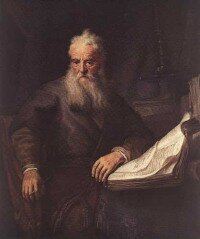
Portrait of St. Paul by Rembrandt The Epistle of St. Paul the Apostle to the Romans is one of the letters of the New Testament canon of the Christian Bible. Often referred to simply as Romans, it is one of the seven currently undisputed letters of Paul. It is even counted among the four letters accepted as authentic (known in German scholarship as Hauptbriefe) by F. C. Baur and the Tübingen School of historical criticism of texts in the 19th century.

The book, according to Joseph Fitzmyer, "overwhelms the reader by the density and sublimity of the topic with which it deals, the gospel of the justification and salvation of Jew and Greek alike by the grace of God through faith in Jesus Christ, revealing the uprightness and love of God the father." N.T. Wright notes that Romans is "neither a systematic theology nor a summary of Paul's lifework, but it is by common consent his masterpiece. It dwarfs most of his other writings, an Alpine peak towering over hills and villages. Not all onlookers have viewed it in the same light or from the same angle, and their snapshots and paintings of it are sometimes remarkably unalike. Not all climbers have taken the same route up its sheer sides, and there is frequent disagreement on the best approach. What nobody doubts is that we are here dealing with a work of massive substance, presenting a formidable intellectual challenge while offering a breathtaking theological and spiritual vision".

More...

Wednesday, March 05, 2008

Authorship of the Pauline epistles

Portrait of St. Paul by RembrandtThe Pauline epistles are the fourteen books in the New Testament traditionally attributed to Paul of Tarsus, of which thirteen are explicitly ascribed to Paul, and one, Hebrews, is anonymous. Except for Hebrews (see Antilegomena), the Pauline authorship of these letters was not academically questioned until the nineteenth century.

Seven letters are generally classified as “undisputed”, expressing contemporary scholarly near consensus that they are the work of Paul: Romans, 1 & 2 Corinthians, Galatians, Philippians, 1 Thessalonians, and Philemon. Six additional letters bearing Paul's name do not currently enjoy the same academic consensus: Ephesians, Colossians, 2 Thessalonians, 1 & 2 Timothy, and Titus. The first three, called the "Deutero-Pauline Epistles," have no consensus on whether or not they are authentic letters of Paul. The latter three, the "Pastoral Epistles", are widely regarded as pseudographs, though certain scholars do consider them genuine. There are two examples of pseudonymous letters written in Paul’s name apart from the alleged New Testament epistles. Since the early centuries of the church, there has been debate concerning the authorship of the anonymous Epistle to the Hebrews, and contemporary scholars reject Pauline authorship.


More...

Tuesday, February 19, 2008

Thessalonica

Bird’s Eye View of ThessalonicaThessalonica or Thessaloniki (Greek: Θεσσαλονίκη), is Greece's second-largest city and the capital of the Greek region of Macedonia.

Thessalonica had a Jewish colony, established during the first century, and was an early centre of Christianity. On his second missionary journey, Paul of Tarsus preached in the city's synagogue, the chief synagogue of the Jews in that part of Thessaloniki, and laid the foundations of a church. Opposition against him from the Jews drove him from the city, and he fled to Veroia. Paul wrote two of his epistles to the Christian community at Thessalonica, the First Epistle to the Thessalonians and the Second Epistle to the Thessalonians.

Paul's teaching about the end of the world is expressed most clearly in his letters to the Christians at Thessalonica. Heavily persecuted, it appears that they had written asking him first about those who had died already, and, secondly, when they should expect the end. Paul regarded the age as passing and, in such difficult times, he therefore encouraged marriage as a means of happiness. He assures them that the dead will rise first and be followed by those left alive (1 Thessalonians 4:16).

16For the Lord himself will come down from heaven, with a loud command, with the voice of the archangel and with the trumpet call of God, and the dead in Christ will rise first.

This suggests an imminence of the end but he is unspecific about times and seasons, and encourages his hearers to expect a delay. The form of the end will be a battle between Jesus and the Man of Lawlessness (3ff) whose conclusion is the triumph of Christ.

More...

Friday, January 18, 2008

Early Christianity

Tertullian, Paul of Tarsus, Clement of Alexandria, James the JustThe term Early Christianity here refers to Christianity of the period after the Death of Jesus in the early 30s and before the First Council of Nicaea in 325. The term is sometimes used in a narrower sense of just the very first followers (disciples) of Jesus of Nazareth and the faith as preached and practiced by the Twelve Apostles, their contemporaries, and their immediate successors, also called the Apostolic Age.

Early Christianity, which began within Judaism, became clearly distinct from Rabbinic Judaism. It continued to revere the Jewish Bible, generally using the Septuagint translation that was in general use among Greek-speaking Jews and Gentile Godfearers, and added to it the writings that would become the New Testament, thus developing the first Christian biblical canons. It defended Christian beliefs against criticism by non-believing Jews and followers of other Roman religions, survived various persecutions, consisted of divisions that accused each other of heresy, and developed church hierarchy. What started as a religious movement within Second Temple Judaism became, by the end of this period, the favored religion of the Roman Empire under Constantine the Great (leading later to the rise of Christendom), and a significant religion also outside of the empire. The First Council of Nicaea marks the end of this era and the beginning of the period of the first Seven Ecumenical Councils (325 - 787).

Origin of Christianity as a distinct religion

The followers of Jesus composed an apocalyptic Jewish sect during the late Second Temple period of the 1st century. Some groups (collectively called Jewish Christians) that followed Jesus were strictly Jewish, or those strongly attracted to Jewish practice, including the church leaders in Jerusalem. Traditionally the Roman Centurion Cornelius is considered the first Gentile (non-Jewish) convert. Paul of Tarsus, after his legendary incident on the Road to Damascus, had success in proselytizing among the Gentiles. He started the division from Judaism by his Theology and Gentile Mission, and persuaded the leaders of the Jerusalem Church to allow Gentile converts exemption from full Jewish law against the position of the Judaizers. Jews who did not convert to Christianity and the growing Christian community gradually became more hostile toward each other. After the Destruction of the Second Temple in 70, Jerusalem ceased to be the center of Jewish religious life, and probably Christian religious life as well. Rabbinic Judaism developed as mainstream Jewish practice, first in Yavne, where the Great Sanhedrin was first reconstituted. Christianity established itself as a predominantly Gentile religion that spanned the Roman Empire and beyond. Scholar James D. G. Dunn has proposed that Peter was the bridge-man (i.e. the pontifex maximus) between the two other "prominent leading figures": Paul and James the Just.

More...

Thursday, December 27, 2007

Macedonia

Ancient Macedon, Roman Province, Byzantine province (approximate borders), Ottoman period (approximate)The Roman province of Macedonia was officially established in 146 BC, after the Roman general Quintus Caecilius Metellus defeated Andriscus of Macedon in 148 BC, and after the four client republics established by Rome in the region were dissolved. The province incorporated Epirus Vetus, Thessaly, and parts of Illyria and Thrace.

In the 3rd or 4th century, the province of Macedonia was divided into Macedonia Prima (in the south) and Macedonia Salutaris (in the north).

Macedonia Prima and Macedonia Salutaris were included in the Diocese of Macedonia, one of three dioceses which were included in the Prefecture of Illyricum, organized in 318. When the Prefecture of Illyricum was divided into a Western and Eastern Illyricum in 379, the Macedonian provinces were included in Eastern Illyricum. After the split of the Roman Empire into a Western and Eastern Empire in 395, Macedonia passed into the Byzantine Empire.

In his writings, Paul of Tarsus mentions Macedonia numerous times:

More...

Thursday, December 13, 2007

Augustinian hypothesis

the evangelist Matthew inspired by an angelThe Augustinian hypothesis is a solution to the synoptic problem, which concerns the origin of the Gospels of the New Testament. The hypothesis holds that Matthew was written first, by Matthew the Evangelist, a disciple of Jesus of Nazareth. Mark the Evangelist, a disciple of the apostle Simon Peter, wrote the Gospel of Mark second, and used Matthew and the preaching of Peter as sources. Luke the Evangelist, a disciple of Paul of Tarsus, wrote the Gospel of Luke, and was aware of the two Gospels that preceded him. Unlike some competing hypotheses, this hypothesis does not rely on, nor does it argue for, the existence of any document that is not explicitly mentioned in historical testimony. Instead, the hypothesis draws primarily upon historical testimony, rather than textual criticism, as the central line of evidence. The foundation of evidence for the hypothesis is the writings of the Church Fathers: historical sources dating back to as early as the first half of the 2nd century, which have been held as authoritative by most Christians for nearly 2 millennia. Finally, adherents to the Augustinian hypothesis view it as a simple, coherent solution to the synoptic problem.

The Augustinian hypothesis addresses certain fundamental points of contention surrounding the synoptic problem, such as how reliable the early Christian tradition is, which gospel was written first, whether there were other unknown sources behind the gospels, to what extent, if any, the gospels were redacted, and to what extent the gospels were altered between the time they were originally written and the time the first surviving manuscripts appear. These and other matters are raised and alternate resolutions proposed by proponents of competing hypotheses, such as the Two-source hypothesis, its related Q hypothesis, the Farrer hypothesis, and others.

More...

Wednesday, November 21, 2007

Thessalonica

The White Tower of Thessaloniki;  the city’s landmark.Thessalonica or Thessaloniki (Greek: Θεσσαλονίκη), is Greece's second-largest city and the capital of the Greek region of Macedonia.

Thessalonica had a Jewish colony, established during the first century, and was an early centre of Christianity. On his second missionary journey, Paul of Tarsus preached in the city's synagogue, the chief synagogue of the Jews in that part of Thessaloniki, and laid the foundations of a church. Opposition against him from the Jews drove him from the city, and he fled to Veroia. Paul wrote two of his epistles to the Christian community at Thessalonica, the First Epistle to the Thessalonians and the Second Epistle to the Thessalonians.

Thessaloniki is commonly called the 'Συμπρωτεύουσα' 'Symprotevousa' (lit. co-capital) of Greece since the National Schism, due to both its long history and its strategic geographic and economic importance. According to official data, the Thessaloniki Urban Area curves round the Thermaic Gulf for approximately 17 km; it comprises 13 municipalities and according to the 2001 census it has a population of 809,457. The Thessaloniki prefecture has a population of 1,099,598 (2005). The alternate name Salonica, formerly the common name used in some western European languages, is derived from a variant form Σαλονίκη (Saloníki) in popular Greek speech. The city's name is also rendered Thessalloníki or Salloníki (with a dark l typical of the Macedonian dialect of Greek) in the Macedonian dialect, سلانيك Selânik in Ottoman Turkish, Солун (Solun) in the Slavic languages of the region, Sãrunã in Aromanian, and Selanik in Ladino.

More...

Tuesday, November 20, 2007

Andrew

St. Andrew by Camillo Rusconi. Nave of the Basilica of St. John Lateran (Rome).Saint Andrew (Greek: Ανδρέας Andreas, "manly"), called in the Orthodox tradition Protocletos, or the First-called, is a Christian Apostle, brother of Simon Peter.

Biography

According to Christian tradition, Andrew was born at Bethsaida on the Sea of Galilee (John 1:44). Since he was a Jew, Andreas was almost certainly not his given name, but no Hebrew or Aramaic name is recorded for him (see also: Aramaic of Jesus). He had been a disciple of John the Baptist (John 1:37-40) and was one of the first to follow Jesus. He lived at Capernaum (Mark 1:29). In the gospels he is referred to as being present on some important occasions as one of the disciples more closely attached to Jesus (Mark 13:3; John 6:8, 12:22); in Acts there is only a bare mention of him (Acts 1:13).

The Kievan hill where St Andrew is said to have erected the cross is commemorated by the cathedral dedicated in his name. Eusebius quotes Origen as saying Andrew preached in Asia Minor and in Scythia, along the Black Sea as far as the Volga. Hence he became a patron saint of Romania and Russia. Traditionally, he became the first bishop of Byzantium in 38, a position which would later become Patriarch of Constantinople.

He is said to have suffered crucifixion at Patras (Patrae) in Achaea, on a cross of the form called Crux decussata (X-shaped cross) and commonly known as "St. Andrew's cross." or saltire. St Andrew is the patron of Patras. According to tradition his relics were removed from Patras to Constantinople, and thence to St Andrews (see below). Local legends say that the relics were sold to the Romans by the local priests in exchange of the Romans constructing a water reservoir for the city. In recent years, the relics were kept in the Vatican City, but were sent back to Patras by decision of the Pope Paul VI in 1964. The relics, which consist of the small finger and part of the top of the cranium of St Andrew, are since kept in the Church of St Andrew at Patras in a special tomb, and are reverenced in a special ceremony every November 30.

More...

Tuesday, November 06, 2007

Pauline Epistles

Portrait of St. Paul by RembrandtThe Pauline Epistles are as follows:
  • Romans
  • 1 Corinthians
  • 2 Corinthians
  • Galatians
  • Ephesians
  • Philippians
  • Colossians
  • 1 Thessalonians
  • 2 Thessalonians
  • 1 Timothy
  • 2 Timothy
  • Titus
  • Philemon

The Epistle to the Romans

The Epistle to the Romans is one of the letters of the New Testament canon of the Christian Bible. When it is clear that the Bible is being discussed, it is often referred to as simply "Romans". Romans is one of the seven currently (as of 2004) undisputed letters of Paul and even among the four letters accepted as authentically his (in German scholarship, the Hauptbriefe) by F. C. Baur and the Tübingen School of historical criticism of texts in the 19th century.

History

It was probably written at Corinth or possibly in nearby Cenchrea, transcribed by Tertius. Phoebe (Romans 16:1) of Cenchrea, the Aegean port of Corinth, conveyed it to Rome, and Gaius of Corinth entertained the apostle Paul at the time of his writing it (Romans 16:23; 1 Cor 1:14), and Erastus was chamberlain of the city, that is, of Corinth (2 Tim 4:20).

The precise time at which it was written is not mentioned in the epistle, but it was obviously written when the collection for Jerusalem had been assembled and Paul was about to "go unto Jerusalem to minister unto the saints", that is, at the close of his second visit to Greece, during the winter preceding his last visit to that city (Rom. 15:25; cf. Acts 19:21; 20:2, 3, 16; 1 Cor 16:1–4) early in 58.


More...

Monday, October 01, 2007

Doctrine of the Trinity

depiction of The Holy TrinityGod is a single being existing simultaneously as three distinct persons: The Father, The Son, and the Holy Spirit. The doctrine of the trinity is a reference to the "tri-unity" of God. There is only one God, but this God is a unity of one (Deuteronomy 6:4; Isaiah 44:6-8; 45:5-6; 1 Tim 2:5; 1 Cor 8:4). This God is also a complexity within unity (Gen. 2:24; 11:6; 1 Cor 3:6-8).

Scripture and tradition

The word "Trinity" comes from "Trinitas", a Latin abstract noun that most literally means "three-ness" (or "the property of occurring three at once"). Or, simply put, "three are one". The first recorded use of this Latin word was by Tertullian in about 200, to refer to Father, Son and Holy Spirit, or, in general, to any set of three things.

The Greek term used for the Christian Trinity, "Τριάς" (a set of three or the number three), has given the English word triad. The Sanskrit word, "Trimurti," has a similar meaning, as has "Dreifaltigkeit" in German, and many other words in other languages.

The New Testament does not use the word "Τριάς" (Trinity), but only speaks of God (often called "the Father"), of Jesus Christ (often called "the Son"), and of the Holy Spirit, and of the relationships between them. The word "Trinity" began to be applied to them only in the course of later theological reflection.

The earliest Christians were noted for their insistence on the existence of one true God, in contrast to the polytheism of the prevailing culture. While maintaining strict monotheism, they believed also that the man Jesus Christ was at the same time something more than a man (a belief reflected, for instance, in the opening verses of the Letter to the Hebrews, which describe him as the reflection of God's glory and bearing the impress of God's own being, and, yet more explicitly, in the prologue of the Gospel according to John) and also with the implications of the presence and power of God that they believed was among them and that they referred to as the Holy Spirit. St Paul even goes so far as to state that "in [Jesus] lives all the fullness of Deity bodily" (Colossians 2:9).

More...


Subscribe


LifeNews.com

Desiring God Blog

Youth for Christ International