Showing posts with label First Council of Nicaea. Show all posts

Friday, January 18, 2008

Early Christianity

Tertullian, Paul of Tarsus, Clement of Alexandria, James the JustThe term Early Christianity here refers to Christianity of the period after the Death of Jesus in the early 30s and before the First Council of Nicaea in 325. The term is sometimes used in a narrower sense of just the very first followers (disciples) of Jesus of Nazareth and the faith as preached and practiced by the Twelve Apostles, their contemporaries, and their immediate successors, also called the Apostolic Age.

Early Christianity, which began within Judaism, became clearly distinct from Rabbinic Judaism. It continued to revere the Jewish Bible, generally using the Septuagint translation that was in general use among Greek-speaking Jews and Gentile Godfearers, and added to it the writings that would become the New Testament, thus developing the first Christian biblical canons. It defended Christian beliefs against criticism by non-believing Jews and followers of other Roman religions, survived various persecutions, consisted of divisions that accused each other of heresy, and developed church hierarchy. What started as a religious movement within Second Temple Judaism became, by the end of this period, the favored religion of the Roman Empire under Constantine the Great (leading later to the rise of Christendom), and a significant religion also outside of the empire. The First Council of Nicaea marks the end of this era and the beginning of the period of the first Seven Ecumenical Councils (325 - 787).

Origin of Christianity as a distinct religion

The followers of Jesus composed an apocalyptic Jewish sect during the late Second Temple period of the 1st century. Some groups (collectively called Jewish Christians) that followed Jesus were strictly Jewish, or those strongly attracted to Jewish practice, including the church leaders in Jerusalem. Traditionally the Roman Centurion Cornelius is considered the first Gentile (non-Jewish) convert. Paul of Tarsus, after his legendary incident on the Road to Damascus, had success in proselytizing among the Gentiles. He started the division from Judaism by his Theology and Gentile Mission, and persuaded the leaders of the Jerusalem Church to allow Gentile converts exemption from full Jewish law against the position of the Judaizers. Jews who did not convert to Christianity and the growing Christian community gradually became more hostile toward each other. After the Destruction of the Second Temple in 70, Jerusalem ceased to be the center of Jewish religious life, and probably Christian religious life as well. Rabbinic Judaism developed as mainstream Jewish practice, first in Yavne, where the Great Sanhedrin was first reconstituted. Christianity established itself as a predominantly Gentile religion that spanned the Roman Empire and beyond. Scholar James D. G. Dunn has proposed that Peter was the bridge-man (i.e. the pontifex maximus) between the two other "prominent leading figures": Paul and James the Just.

More...

Wednesday, June 13, 2007

First Council of Nicaea

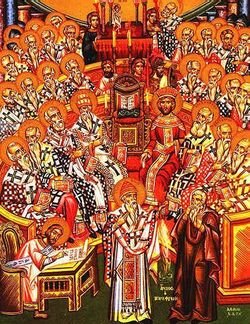
Icon depicting the First Council of NicaeaThe First Council of Nicaea, convoked by the Roman emperor Constantine the great in ad 325, was the first ecumenical conference of bishops of the Christian church.

The purpose of the council (also called a synod) was to resolve disagreements in the church of Alexandria over the nature of Jesus in relationship to the father: in particular whether Jesus was of the same or of similar substance as God the Father. St. Alexander of Alexandria took the first position; the popular presbyter Arius, from whom the term arian controversy comes, took the second. The council decided against the Arians.

Another result of the council was an agreement on the date of the Christian Passover, now called Easter, the most important feast of the church's life. The council decided in favour of celebrating passover on the first Sunday after the Spring Equinox, independently of the bible's Hebrew calendar, and authorized the Bishop of Alexandria (presumably using the Alexandrian calendar) to annually announce the exact date to his fellow bishops.

The Council of Nicaea was historically significant because it was the first effort to attain consensus in the church through an assembly representing all of Christendom. "It was the first occasion for the development of technical Christology". Further, "Constantine in convoking and presiding over the council signaled a measure of imperial control over the church."

More...

Tuesday, April 03, 2007

First Council of Nicaea

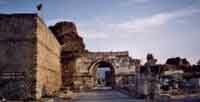
The Walls of NicaeaSeparation of Easter from the Jewish Passover
After the June 19 settlement of the most important topic, the question of the date of the Christian Passover (Easter), was brought up. This feast is linked to the Jewish Passover, as crucifixion and resurrection of Jesus occurred during that festival. By the year 300, most Churches had adopted the Western style of celebrating the feast on the Sunday after the Passover, placing the emphasis on the resurrection, which occurred on a Sunday. Others however celebrated the feast on the 14th of the Jewish month Nisan, the date of the crucifixion according to the Bible's Hebrew calendar. Hence this group was called Quartodecimans. The Eastern Churches of Syria, Cilicia, and Mesopotamia determined the date of Christian Passover in relation to the 14th day of Nisan, in the Bible's Hebrew calendar. Alexandria and Rome, however, followed a different calculation, attributed to Pope Soter, so that Christian Passover would never coincide with the Jewish observance and decided in favour of celebrating on the first Sunday after the first full moon following the vernal equinox, independently of the Bible's Hebrew calendar.

More...

Tuesday, August 01, 2006

Constantine the Great

Head of Constantine's colossal statue at Musei CapitoliniGaius Flavius Valerius Aurelius Constantinus (Latin: IMP CÆSAR FLAVIVS CONSTANTINVS PIVS FELIX INVICTVS AVGVSTVS) (February 27, 272–May 22, 337), commonly known as Constantine I, Constantine the Great, or (among Orthodox Christians) Saint Constantine, was proclaimed Augustus by his troops on July 25, 306 and ruled an ever-growing portion of the Roman Empire until his death. Constantine is famed for his refounding of Byzantium (modern Istanbul) as "Nova Roma" (New Rome) or Constantinople (Constantine's City).

Constantine is best remembered in modern times for the Edict of Milan in 313 and the Council of Nicaea in 325, which fully legalized Christianity in the Empire for the first time. These actions are considered major factors in that religion's spread, and his reputation as the "first Christian Emperor" has been promulgated by historians from Lactantius and Eusebius of Caesarea to the present day, though he himself was baptized only on his death bed.

More...

Tuesday, May 23, 2006

First Council of Nicaea

The First Council of Nicaea, convoked by the Roman emperor Constantine the great in ad 325, was the first ecumenical conference of bishops of the Christian church.

The purpose of the council (also called a synod) was to resolve disagreements in the church of Alexandria over the nature of Jesus in relationship to the father: in particular whether Jesus was of the same or of similar substance as God the Father. St. Alexander of Alexandria took the first position; the popular presbyter arius, from whom the term arian controversy comes, took the second. The council decided against the Arians.

Another result of the council was an agreement on the date of the Christian Passover, now called Easter, the most important feast of the church's life. The council decided in favour of celebrating passover on the first Sunday after the Spring Equinox, independently of the bible's Hebrew calendar, and authorized the Bishop of Alexandria (presumably using the Alexandrian calendar) to annually announce the exact date to his fellow bishops.

More...
 

Subscribe


LifeNews.com

Desiring God Blog

Youth for Christ International