Showing posts with label Early Christianity. Show all posts

Saturday, January 30, 2010

The Letters of Paul


The Pauline epistles are the thirteen or fourteen letters in the New Testament of the Christian Bible traditionally believed to have been written by the apostle Paul. Among them are some of the earliest extant (still existing) Christian documents. They provide an insight into the beliefs and controversies of formative Christianity and, as part of the biblical canon of the New Testament, they have also been, and continue to be, hugely influential in Christian theology and Christian ethics.

The Letters of Paul are as follows:
  • Romans
  • 1 Corinthians
  • 2 Corinthians
  • Galatians
  • Ephesians
  • Philippians
  • Colossians
  • 1 Thessalonians
  • 2 Thessalonians
  • 1 Timothy
  • 2 Timothy
  • Titus
  • Philemon


More...

Thursday, October 29, 2009

seven churches of Asia

Location of the seven churches of AsiaThe seven churches of Asia (properly Asia Minor) are seven major churches of the early Christianity, as mentioned in the New Testament Book of Revelation. All sites are in modern-day Turkey. In Revelation, Jesus Christ instructs John the Apostle to:
"Write in a book what you see and send it to the seven churches, to Ephesus, to Smyrna, to Pergamum, to Thyatira, to Sardis, to Philadelphia, and to Laodicea."
(Revelation 1:11)

19"Write, therefore, what you have seen, what is now and what will take place later.

20The mystery of the seven stars that you saw in my right hand and of the seven golden lampstands is this: The seven stars are the angels of the seven churches, and the seven lampstands are the seven churches.
(Revelation 1:19-20)
It should be understood that "churches," in this context, refers to the community of Christians living in each city, and not merely to the building or buildings in which they gathered for worship. This letter should also apply to the community of Christians today (the Christian Church, the Body of Christ).

More...

Friday, July 24, 2009

Pauline Christianity

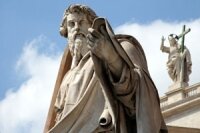
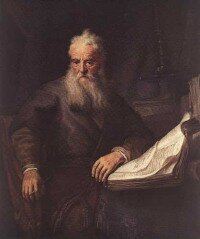
St. Paul statue in front of St. Peters Basilica, VaticanPauline Christianity is a term used to refer a branch of Early Christianity associated with the beliefs and doctrines espoused by Paul the Apostle through his writings. Most of mainstream Christianity relies heavily on these teachings and considers them to be amplifications and explanations of the teachings of Jesus. Others perceive in Paul's writings teachings that are radically different from the original teachings of Jesus documented in the canonical gospels, early Acts and the rest of the New Testament, such as the Epistle of James.

Proponents of the perceived Pauline distinctive include Marcion of Sinope, the 2nd century theologian who asserted that Paul was the only apostle who had rightly understood the new message of salvation as delivered by Christ.

Opponents of the same era include the Ebionites and Nazarenes, who rejected Paul for straying from "normative" Judaism.

Sunday, June 14, 2009

Seven Churches of Asia

The Seven Churchs of AsiaThe seven churches of Asia (properly Asia Minor) are seven major churches of the early Christianity, as mentioned in the New Testament Book of Revelation. All sites are in modern-day Turkey. In Revelation, Jesus Christ instructs John the Apostle to:
"Write in a book what you see and send it to the seven churches, to Ephesus, to Smyrna, to Pergamum, to Thyatira, to Sardis, to Philadelphia, and to Laodicea."
(Revelation 1:11)

19"Write, therefore, what you have seen, what is now and what will take place later.

20The mystery of the seven stars that you saw in my right hand and of the seven golden lampstands is this: The seven stars are the angels of the seven churches, and the seven lampstands are the seven churches. (Revelation 1:19-20)
It should be understood that "churches," in this context, refers to the community of Christians living in each city, and not merely to the building or buildings in which they gathered for worship. This letter should also apply to the community of Christians today (the Christian Church, the Body of Christ).

More...

Monday, April 13, 2009

Early Christianity

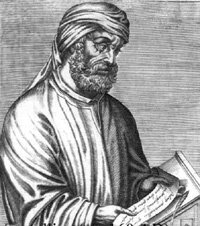
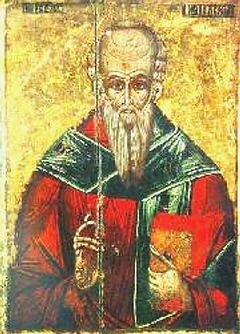
Tertullian, Paul of Tarsus, Clement of Alexandria, and James the JustThe term Early Christianity here refers to Christianity of the period after the Death of Jesus in the early 30s and before the First Council of Nicaea in 325. The term is sometimes used in a narrower sense of just the very first followers (disciples) of Jesus of Nazareth and the faith as preached and practiced by the Twelve Apostles, their contemporaries, and their immediate successors, also called the Apostolic Age.

Early Christianity, which began within Judaism, became clearly distinct from Rabbinic Judaism. It continued to revere the Hebrew Bible, generally using the Septuagint translation that was in general use among Greek-speaking Jews and Gentile Godfearers, and added to it the writings that would become the New Testament, thus developing the first Christian biblical canons. It defended Christian beliefs against criticism by non-believing Jews and followers of other Roman religions, survived various persecutions, consisted of divisions that accused each other of heresy, and developed church hierarchy.

What started as a religious movement within Second Temple Judaism became, by the end of this period, the favored religion of the Roman Empire under Constantine the Great (leading later to the rise of Christendom), and a significant religion also outside of the empire. The First Council of Nicaea marks the end of this era and the beginning of the period of the first Seven Ecumenical Councils (325 - 787).

More...

Thursday, March 26, 2009

Tertullian

Quintus Septimius Florens Tertullianus, anglicized as Tertullian, (ca. 155–230) was a church leader and prolific author during the early years of Christianity. He was born, lived, and died in Carthage [vmap of Carthage] in what is today Tunisia.

Tertullian denounced Christian doctrines he considered heretical, but later in life adopted views that came to be regarded as heretical themselves. He was the first great writer of Latin Christianity, thus sometimes known as the "father of the Latin Church".

He introduced the term Trinity, as the Latin trinitas, to the Christian vocabulary and also probably of the formula "three Persons, one Substance" as the Latin "tres Personae, una Substantia" (itself from the Koine Greek "treis Hypostases, Homoousios") and also the terms vetus testamentum ("old testament") and novum testamentum ("new testament").

More...

Thursday, December 18, 2008

Tacitus on Jesus

Codex Mediceus 68 II fol. 38The Roman historian Tacitus wrote concerning the Great Fire of Rome, in book 15, chapter 44 of his Annals (c. 116) including an account of how the emperor Nero blamed the Christians in Rome for the disaster and initiated the first known persecution of early Christians by the Romans. This has become one of the best known and most discussed passages of Tacitus' works. Although partly aimed at showing the inhumanity of the emperor, Tacitus' remarks have been studied more by modern scholars for information about his own religious attitudes and about the early history of Christianity:
Consequently, to get rid of the report, Nero fastened the guilt and inflicted the most exquisite tortures on a class hated for their abominations, called Christians by the populace. Christus, from whom the name had its origin, suffered the extreme penalty during the reign of Tiberius Caesar at the hands of one of our procurators, Pontius Pilatus, and a most mischievous superstition, thus checked for the moment, again broke out not only in Judaea, the first source of the evil, but even in Rome, where all things hideous and shameful from every part of the world find their centre and become popular. Accordingly, an arrest was first made of all who pleaded guilty; then, upon their information, an immense multitude was convicted, not so much of the crime of firing the city, as of hatred against mankind. Mockery of every sort was added to their deaths. Covered with the skins of beasts, they were torn by dogs and perished, or were nailed to crosses, or were doomed to the flames and burnt, to serve as a nightly illumination, when daylight had expired.
More...

Thursday, June 05, 2008

Pauline Christianity

St. Paul, by El GrecoPauline Christianity is a term used to refer a branch of Early Christianity associated with the beliefs and doctrines espoused by Paul the Apostle through his writings. Most of mainstream Christianity relies heavily on these teachings and considers them to be amplifications and explanations of the teachings of Jesus. Others perceive in Paul's writings teachings that are radically different from the original teachings of Jesus documented in the canonical gospels, early Acts and the rest of the New Testament, such as the Epistle of James.

Proponents of the perceived Pauline distinctive include Marcion of Sinope, the 2nd century theologian who asserted that Paul was the only apostle who had rightly understood the new message of salvation as delivered by Christ.

Opponents of the same era include the Ebionites and Nazarenes, who rejected Paul for straying from "normative" Judaism.

Pauline Christianity, as an expression, first came into use in the twentieth century amongst those scholars who proposed different strands of thought within Early Christianity, wherein Paul was a powerful influence. It has come into widespread use amongst non-Christian scholars and depends on the claim, advanced in different ages, that the form of the faith found in the writings of Paul is radically different from that found elsewhere in the New Testament, but also that his influence came to predominate. Reference is also made to the large number of non-canonical texts, some of which have been discovered during the last hundred years, and which show the many movements and strands of thought emanating from Jesus's life and teaching or which may be contemporary with them, some of which can be contrasted with Paul's thought. Of the more significant are Ebionism and Gnosticism.

More...

Tuesday, April 08, 2008

Clement of Alexandria

Clement of Alexandria (Titus Flavius Clemens)Clement of Alexandria (Titus Flavius Clemens), was the first member of the Church of Alexandria to be more than a name, and one of its most distinguished teachers. He was born about the middle of the 2nd century, and died between 211 and 216.

Life

He was not born in Egypt (Stromata, i. 1). Athens is named as his birthplace by the sixth-century Epiphanius Scholasticus, and this is supported by the classical quality of his Greek. His parents seem to have been wealthy pagans of some social standing. The thoroughness of his education is shown by his constant quotation of the Greek poets and philosophers. He travelled in Greece, Italy, Palestine, and finally Egypt. He became the colleague of Pantaenus, the head of the catechetical school of Alexandria, and finally succeeded him in the direction of the school.

During the persecution of Septimius Severus (202 or 203) he sought refuge with Alexander, then bishop [possibly of Flaviada] in Cappadocia, afterward of Jerusalem, from whom he brought a letter to Antioch in 211. One of his most popular pupils was Origen.

He united Greek philosophical traditions with Christian doctrine and valued gnosis that with communion for all people could be held by common Christians. He developed a Christian Platonism. Like Origen, he arose from Alexandria's Catechical School and was well versed in pagan literature. Origen succeeded Clement as head of the school.

More...

Wednesday, April 02, 2008

Christianity

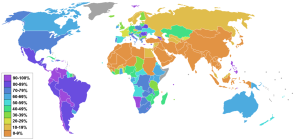
Christianity percentage by countryChristianity is a monotheistic religion centered on the life, teachings, and actions of Jesus, the Christ, as recounted in the New Testament.

With an estimated 2.1 billion adherents, Christianity is the world's largest religion. Its origins are intertwined with Judaism, with which it shares much sacred text and early history; specifically, it shares the Hebrew Bible, known in the Christian context as the Old Testament. Christianity is considered an Abrahamic religion, along with Judaism.

In the Christian scriptures, the name "Christian" (thus "Christianity") is first attested in Acts 11:26: "For a whole year they met with the church and taught a great many people.

And in Antioch Jesus' disciples were first called Christians" (Greek χριστιανους, from Christ Greek Χριστός, which means "the anointed").

Within Christianity, numerous distinct groups have developed, with diverse beliefs that vary widely by culture and place. Since the Reformation, Christianity is usually represented as being divided into three main branches:

More...

Friday, March 28, 2008

Eusebius of Caesarea

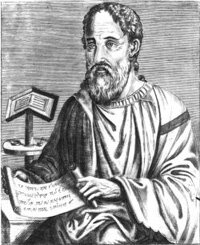
Eusebius of Caesarea, early Christian church historianEusebius of Caesarea (c. 275 – May 30, 339) (often called Eusebius Pamphili, "Eusebius [the friend] of Pamphilus") was a bishop of Caesarea in Palestine and is often referred to as the father of church history because of his work in recording the history of the early Christian church. An earlier history by Hegesippus that he referred to has not survived.

Biography

His exact date and place of birth are unknown, and little is known of his youth. He became acquainted with the presbyter Dorotheus in Antioch and probably received exegetical instruction from him. In 296 he was in Palestine and saw Constantine who visited the country with Diocletian.

He was in Caesarea when Agapius was bishop and became friendly with Pamphilus of Caesarea, with whom he seems to have studied the text of the Bible, with the aid of Origen's Hexapla and commentaries collected by Pamphilus, in an attempt to prepare a correct version.

In 307, Pamphilus was imprisoned, but Eusebius continued their project. The resulting defence of Origen, in which they had collaborated, was finished by Eusebius after the death of Pamphilus and sent to the martyrs in the mines of Phaeno in Egypt. Eusebius then seems to have gone to Tyre and later to Egypt, where he first suffered persecution.

More...

Tuesday, March 18, 2008

history of Christianity

The Sermon On the Mount by Carl Heinrich Bloch, Danish painter, d. 1890.The history of Christianity concerns the history of the Christian religion and the Church, from Jesus and His Twelve Apostles to contemporary times. Christianity is the monotheistic religion which considers itself based on the revelation of Jesus Christ. "The Church" is understood theologically as the institution founded by Jesus for the salvation of mankind.

Christianity began in the 1st century AD as a Jewish sect but quickly spread throughout the Greco-Roman world.

Rapid early spread of Christianity

Although it was originally persecuted under the Roman empire, it would ultimately become the state religion. In the Middle Ages it spread beyond the old borders of the Empire into Northern Europe and Russia. During the Age of Exploration, Christianity expanded throughout the world; it is the world's largest religion.

Throughout its history, the religion weathered schisms and theological disputes that have resulted in the development of three main branches: Catholicism, Eastern Christianity (Eastern Orthodoxy), and Protestantism.

More...

Monday, March 03, 2008

hope

M 17 Omega Nebula, © NASA / Hubble Hope is one of the three theological virtues in Christian tradition (Faith, Hope and Love).

Hope being a combination of the desire for something and expectation of receiving it, the virtue is hoping for Divine union and thus eternal happiness. Like all virtues, it arises from the will, not the passions.

13 Brothers, we do not want you to be ignorant about those who fall asleep, or to grieve like the rest of men, who have no hope. (1 Thessalonians 4:13)

9 For God did not appoint us to suffer wrath but to receive salvation through our Lord Jesus Christ. 10 He died for us so that, whether we are awake or asleep, we may live together with him. 11 Therefore encourage one another and build each other up, just as in fact you are doing. (1 Thessalonians 5:9-11)
More...

Saturday, March 01, 2008

The Twelve Apostles

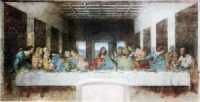
The Last Supper fresco in Milan (1498)  by Leonardo da VinciThe Twelve Apostles (in Koine Greek "απόστολος" apostolos, Liddell & Scott, Strong's G652, a delegate, messenger, one sent forth with orders) were men that according to the Synoptic Gospels and Christian tradition (see also Oral Tradition), were chosen from among the disciples of Jesus for a mission (see also: Seventy Disciples). According to the Bauer lexicon, Walter Bauer's Greek-English Lexicon of the New Testament: "...Judaism had an office known as apostle (שליח)".

The Gospel of Mark states that Jesus initially sent out these twelve in pairs (Mark 6:7-13, cf. Matthew 10:5-42, Luke 9:1-6), to towns in Galilee [map].

Literal readings of the text state that their initial instructions were to heal the sick and drive out demons, but some scholars read this more metaphorically as instructions to heal the spiritually sick and thus to drive away wicked behaviour. They are also instructed to only take their staffs, and that if any town rejects them they ought to shake the dust off their feet as they leave, a gesture which some scholars think was meant as a contemptuous threat (Miller 26). Their carrying of just a staff is sometimes given as the reason for the use by Christian Bishops of a staff of office, in those denominations that believe they maintain an Apostolic Succession.

Later in the Gospel narratives the Twelve Apostles are described as having been commissioned to preach the Gospel to the world, regardless of whether Jew or Gentile. Although the Apostles are portrayed as having been Galilean Jews, and 10 of their names are Aramaic, the other 4 names are Greek, suggesting a more metropolitan background.

More...

Thursday, February 28, 2008

timeline of Christianity

A folio from P46, early 3rd c. New Testament manuscript useful in discerning the early Christian canon.The purpose of this chronology is to give a detailed account of Christianity from the beginning of the current era to the present. Question marks on dates indicate approximate dates.

For "Old Testament" chronology, see History of ancient Israel.

Era of Jesus

The year one is the first year in the Christian calendar (there is no year zero), which is the calendar presently used (in unison with the Gregorian calendar) almost everywhere in the world, because of the current dominance of the Western world. Traditionally, this was held to be the year Jesus was born, however most modern scholars argue for an earlier date and later dates, the most agreed upon being between 6 B.C. and 4 B.C.
  • 6 Herod Archelaus deposed by Augustus Caesar; Samaria, Judea and Idumea annexed as Iudaea Province under direct Roman administration, capital at Caesarea, Publius Sulpicius Quirinius became Legate (Governor) of Syria, conducted Census of Quirinius, opposed by Zealots (JA18, Luke 2:1-3, Acts 5:37)

Tuesday, February 19, 2008

Thessalonica

Bird’s Eye View of ThessalonicaThessalonica or Thessaloniki (Greek: Θεσσαλονίκη), is Greece's second-largest city and the capital of the Greek region of Macedonia.

Thessalonica had a Jewish colony, established during the first century, and was an early centre of Christianity. On his second missionary journey, Paul of Tarsus preached in the city's synagogue, the chief synagogue of the Jews in that part of Thessaloniki, and laid the foundations of a church. Opposition against him from the Jews drove him from the city, and he fled to Veroia. Paul wrote two of his epistles to the Christian community at Thessalonica, the First Epistle to the Thessalonians and the Second Epistle to the Thessalonians.

Paul's teaching about the end of the world is expressed most clearly in his letters to the Christians at Thessalonica. Heavily persecuted, it appears that they had written asking him first about those who had died already, and, secondly, when they should expect the end. Paul regarded the age as passing and, in such difficult times, he therefore encouraged marriage as a means of happiness. He assures them that the dead will rise first and be followed by those left alive (1 Thessalonians 4:16).

16For the Lord himself will come down from heaven, with a loud command, with the voice of the archangel and with the trumpet call of God, and the dead in Christ will rise first.

This suggests an imminence of the end but he is unspecific about times and seasons, and encourages his hearers to expect a delay. The form of the end will be a battle between Jesus and the Man of Lawlessness (3ff) whose conclusion is the triumph of Christ.

More...

Monday, February 18, 2008

temple

The western wall of the temple mount, sacred place for JudaismThe architectural structure in Jerusalem that was the focal point of worship and the national life of Israel form the 10th century B.C. when it was built by king Solomon, until it was destructed by Rome in A.D. 70. The temple was rebuilt two times and had three periods during which the temples of Solomon, Zurubabbel, and Herod were in existance.

A temple (from the Latin word templum) is a structure reserved for religious or spiritual activities, such as prayer and sacrifice, or analogous rites. A ‘’templum’’ constituted a sacred precinct as defined by a priest, or augur. It has the same root as the word “ template,’’ a plan in preparation of the building that was marked out on the ground by the augur. Though a templum, technically speaking, is not a “house of the gods” but a diagram that for the Romans linked the geometries of heaven and earth, it was also indicative of a dwelling place of a god or gods. This tradition, of course, dates back to prehistoric times. For the ancient Egyptians, the word pr could refer not only to a house, but also to a sacred structure since it was believed that the gods resided in houses. The word ‘temple’ (which dates to about the 6th century BCE), despite the specific set of meanings associated with the religion of the ancient Rome, has now become quite widely used to describe a house of worship for any number of religions and is even used for time periods prior to the Romans. Stated differently, temple was once a species of sacred structures; today it is, in the English language, often used as a genus.

More...

Saturday, February 16, 2008

the gospels

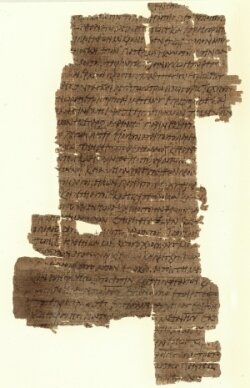
The reverse side of Papyrus 37, a New Testament manuscript of the Gospel of Matthew. Most likely originated in Egypt. Currently housed in: University of Michigan, Ann Arbor Library, Date: 3rd/4th CenturyBooks in the new testament referred to as the Gospels:

Books in the new testament referred to as the Gospels:
In Christianity, a gospel (from Old English, "good news") is generally one of four canonical books of the New Testament that describe the miraculous birth, life, ministry, crucifixion, and resurrection of Jesus. These books are the Gospels according to Matthew, Mark, Luke and John, written between 65 and 100 AD.

Many modern scholars argue that the sequence in which the Gospel accounts have traditionally been printed in the Bible is not the order of their composition, and that the first canonical gospel to have been written is Mark (c 65-70), which in turn was used as a source for the gospels of Matthew and Luke. Matthew and Luke may have also used the hypothetical Q Document. These first three gospels are called the synoptic gospels because they share a similar view. The last gospel, the gospel of John, presents a very different picture of Jesus and his ministry from the synoptics. The canonical gospels were originally written in Greek.

Bethlehem, the Sermon on the Mount, the Beatitudes, the Last Supper, resurrection accounts, and the Great Commission.

Gospel has generally been used in three ways:

  1. To denote the proclamation of God's saving activity in Jesus of Nazareth or to denote the message proclaimed by Jesus of Nazareth. This is the original New Testament usage (for example Mark 1:14-15 or 1 Corinthians 15:1-9, see also Strong's G2098).

  2. More popularly to refer to the four canonical Gospels, which are attributed to the Four Evangelists: (Gospel of Matthew, Gospel of Mark, Gospel of Luke and Gospel of John); and sometimes other non-canonical works (eg. Gospel of Thomas), that offer a narrative of the life, death and resurrection of Jesus.

  3. Some modern scholars have used the term to denote a hypothetical genre of Early Christian literature (cf. Peter Stuhlmacher, ed., Das Evangelium und die Evangelien, Tübingen 1983, also in English: The Gospel and the Gospels).

More...

Tuesday, February 05, 2008

The seven churches of Asia

The seven churches of Asia (properly Asia Minor) are seven major churches of the early Christianity, as mentioned in the New Testament Book of Revelation. All sites are in modern-day Turkey. In Revelation, Jesus Christ instructs 'Saint John the Evangelist' to:
"Write in a book what you see and send it to the seven churches, to Ephesus, to Smyrna, to Pergamum, to Thyatira, to Sardis, to Philadelphia, and to Laodicea."(Revelation 1:11)

It should be understood that "churches," in this context, refers to the community of Christians living in each city, and not merely to the building or buildings in which they gathered for worship. This letter should also apply to the community of Christians today (the Christian Church).

The seven churches are located in...


More...

Monday, February 04, 2008

Søren Kierkegaard

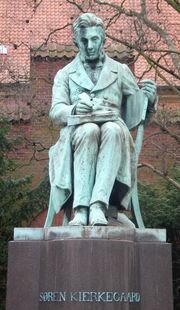
The Søren Kierkegaard Statue in Copenhagen.Søren Aabye Kierkegaard (5 May 1813 – 11 November 1855) was a prolific 19th century Danish philosopher and theologian. Kierkegaard strongly criticized both the Hegelianism of his time, and what he saw as the empty formalities of the Danish church. Much of his work deals with religious problems such as the nature of faith, the institution of the Christian Church, Christian ethics and theology, and the emotions and feelings of individuals when faced with life choices. His early work was written under various pseudonyms who present their own distinctive viewpoints in a complex dialogue. Kierkegaard left the task of discovering the meaning of the works to the reader, because "the task must be made difficult, for only the difficult inspires the noble-hearted". Subsequently, many have interpreted Kierkegaard as an existentialist, neo-orthodoxist, postmodernist, humanist, individualist, etc. Crossing the boundaries of philosophy, theology, psychology, and literature, Kierkegaard came to be regarded as a highly significant and influential figure in contemporary thought.

Life

Early years (1813–1841)

Søren Kierkegaard was born to an affluent family in Copenhagen, the capital of Denmark. His mother, Ane Sørensdatter Lund Kierkegaard, had served as a maid in the household before marrying Søren's father. She was an unassuming figure: quiet, plain, and not formally educated. She is not directly referred to in Kierkegaard's books, although she too affected his later writings. His mother died on July 31, 1834, age 66.

His father, Michael Pedersen Kierkegaard, was a melancholic, anxious, deeply pious, and fiercely intelligent man. Convinced that he had earned God's wrath, he believed that none of his children would live past the age attained by Jesus Christ, that of 33. He believed his personal sins, such as cursing the name of God in his youth and possibly impregnating Ane out of wedlock, necessitated this punishment. Though many of his seven children died young, his prediction was disproved when two of them surpassed this age: Søren and Peter Christian Kierkegaard, a Lutheran bishop several years Søren's senior. This early introduction to the notion of sin and its connection from father and son laid the foundation for much of Kierkegaard's work (particularly Fear and Trembling). Despite his father's occasional religious melancholy, Kierkegaard and his father shared a close bond. Kierkegaard learned to explore the realm of his imagination through a series of exercises and games they played together.

More...
 

Subscribe


LifeNews.com

Desiring God Blog

Youth for Christ International