Showing posts with label Simon the Zealot. Show all posts

Thursday, August 26, 2010

Simon the Zealot

The apostle Simon, called Simon the Zealot in Luke 6:15 and Acts 1:13; and Simon Kananaios ("Simon" signifying שמעון "hearkening; listening", Standard Hebrew Šimʿon, Tiberian Hebrew Šimʿôn), was one of the most obscure among the apostles of Jesus; little is recorded of him aside from his name. Few pseudepigraphical writings were connected to him (but see below), and Jerome does not include him in De viris illustribus.

The name of Simon occurs in all the passages of the synoptic gospels and Acts that give a list of apostles, without further details.

Simon the Zealot was listed as one the the twelve disciples of Christ (Matthew 10:4; Acts 1:13) sometimes referred to as "Simon the Cananean" (Mark 3:18; Luke 6:15) and some identify with Simeon of Jerusalem, which others dispute on the grounds that Simeon was described at the time of Jesus' birth some thirty years before, as an old man not far from death. Simon, the name, stems from the Hebrew "Shimon" which means "hearing." The word "Cananean" stems from old Aramaic, meaning "zealous one."

He was chosen as one the Christ's twelve disciples (Matthew 10:2-4; Acts 1:13), sent on a mission to the the lost sheep of the house of Israel to preach "the kingdom of heaven is at hand," to heal the sick, cleanse the lepers, raise the dead, and cast out demons. He was told, "You received without paying; give without pay." (Matthew 10:5-8), present with the other disciples at the Last Supper (Matthew 26:20), and was with the other disciples for the Great Commission and Christ's Ascension.

..."Go therefore and make disciples of all nations, baptizing them in the name of the Father and of the Son and of the Holy Spirit, 20 teaching them to observe all that I have commanded you. And behold, I am with you always, to the end of the age." –Matthew 28:19-20

More...

Saturday, September 05, 2009

Simon the Zealot

Simon the Zealot was a brother of James the Great and St Jude ThaddeusThe apostle Simon, called Simon the Zealot in Luke 6:15 and Acts 1:13; and Simon Kananaios ("Simon" Hebrew: שמעון signifying "hearkening; listening", Standard Hebrew Šimʿon, Tiberian Hebrew Šimʿôn), was one of the most obscure among the apostles of Jesus; little is recorded of him aside from his name. Few pseudepigraphical (see pseudepigrapha) writings were connected to him (but see below), and Jerome does not include him in De viris illustribus.

The name of Simon occurs in all the passages of the synoptic gospels and Acts that give a list of apostles, without further details.

Simon the Zealot was listed as one the the twelve disciples of Christ (Matthew 10:4; Acts 1:13) sometimes referred to as "Simon the Cananean" (Mark 3:18; Luke 6:15) and some identify with Simeon of Jerusalem, which others dispute on the grounds that Simeon was described at the time of Jesus' birth some thirty years before, as an old man not far from death. . Simon, the name, stems from the Hebrew "Shimon" which means "hearing." The word "Cananean" stems from old Aramaic, meaning "zealous one."

More...

Sunday, November 09, 2008

Simon the Zealot

Simon the Zealot was a brother of James the Great and St Jude Thaddeus. He is portrayed with a large, serrated saw. It was with this that he was eventually martyred for his faith. St Simon was cut in half by heathens in a most gruesome way. Image courtesy of www.art.nlThe apostle Simon, called Simon the Zealot in Luke 6:15 and Acts 1:13; and Simon Kananaios ("Simon" signifying שמעון "hearkening; listening", Standard Hebrew Šimʿon, Tiberian Hebrew Šimʿôn), was one of the most obscure among the apostles of Jesus; little is recorded of him aside from his name. Few pseudepigraphical (see pseudepigrapha) writings were connected to him (but see below), and Jerome does not include him in De viris illustribus.

The name of Simon occurs in all the passages of the synoptic gospels and Acts that give a list of apostles, without further details.

Simon the Zealot was listed as one the the twelve disciples of Christ (Matthew 10:4; Acts 1:13) sometimes referred to as "Simon the Cananean" (Mark 3:18; Luke 6:15) and some identify with Simeon of Jerusalem, which others dispute on the grounds that Simeon was described at the time of Jesus' birth some thirty years before, as an old man not far from death. . Simon, the name, stems from the Hebrew "Shimon" which means "hearing." The word "Cananean" stems from old Aramaic, meaning "zealous one."

He was chosen as one the Christ's twelve disciples (Matthew 10:2-4; Acts 1:13), sent on a mission to the the lost sheep of the house of Israel to preach "the kingdom of heaven is at hand," to heal the sick, cleanse the lepers, raise the dead, and cast out demons. He was told, "You received without paying; give without pay." (Matthew 10:5-8), present with the other disciples at the Last Supper (Matthew 26:20), and was with the other disciples for the Great Commission and Christ's Ascension (Matthew 28:16-20).

More...

Saturday, March 01, 2008

The Twelve Apostles

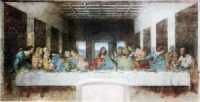
The Last Supper fresco in Milan (1498)  by Leonardo da VinciThe Twelve Apostles (in Koine Greek "απόστολος" apostolos, Liddell & Scott, Strong's G652, a delegate, messenger, one sent forth with orders) were men that according to the Synoptic Gospels and Christian tradition (see also Oral Tradition), were chosen from among the disciples of Jesus for a mission (see also: Seventy Disciples). According to the Bauer lexicon, Walter Bauer's Greek-English Lexicon of the New Testament: "...Judaism had an office known as apostle (שליח)".

The Gospel of Mark states that Jesus initially sent out these twelve in pairs (Mark 6:7-13, cf. Matthew 10:5-42, Luke 9:1-6), to towns in Galilee [map].

Literal readings of the text state that their initial instructions were to heal the sick and drive out demons, but some scholars read this more metaphorically as instructions to heal the spiritually sick and thus to drive away wicked behaviour. They are also instructed to only take their staffs, and that if any town rejects them they ought to shake the dust off their feet as they leave, a gesture which some scholars think was meant as a contemptuous threat (Miller 26). Their carrying of just a staff is sometimes given as the reason for the use by Christian Bishops of a staff of office, in those denominations that believe they maintain an Apostolic Succession.

Later in the Gospel narratives the Twelve Apostles are described as having been commissioned to preach the Gospel to the world, regardless of whether Jew or Gentile. Although the Apostles are portrayed as having been Galilean Jews, and 10 of their names are Aramaic, the other 4 names are Greek, suggesting a more metropolitan background.

More...


Subscribe


LifeNews.com

Desiring God Blog

Youth for Christ International