Showing posts with label Oral Tradition. Show all posts

Friday, July 30, 2010

Masoretic Text

Nash Papyrus (2nd century BCE) contains a portion of the
pre-Masoretic Text, specifically the Ten Commandments and the Shema Yisrael prayer
The Masoretic Text (MT) is the Hebrew text of the Jewish Bible (Tanakh). It defines not just the books of the Jewish canon, but also the precise letter-text of the biblical books in Judaism, as well as their vocalization and accentuation for both public reading and private study. The MT is also widely used as the basis for translations of the Old Testament in Protestant Bibles, and in recent decades also for Catholic Bibles.

The MT was primarily copied, edited and distributed by a group of Jews known as the Masoretes between the seventh and tenth centuries CE. Though the consonants differ little from the text generally accepted in the early second century, it has numerous differences of both little and great significance when compared to (extant 4th century) versions of the Septuagint, originally a Greek translation (around 300 BCE) of the Hebrew Scriptures in popular use in Palestine during the common era and often quoted in the second part of the Christian Bible (known as the New Testament).

The Hebrew word mesorah (מסורה, alt. מסורת) refers to the transmission of a tradition. In a very broad sense it can refer to the entire chain of Jewish tradition (Oral tradition), but in reference to the masoretic text the word mesorah has a very specific meaning: the diacritic markings of the text of the Hebrew Bible and concise marginal notes in manuscripts (and later printings) of the Hebrew Bible which note textual details, usually about the precise spelling of words.

More...

Saturday, July 17, 2010

Oral Tradition

The Oral Torah or Oral Law (Hebrew: תורה שבעל פה, Torah she-be-`al peh), according to Rabbinic Judaism, is an oral tradition received in conjunction with the written Torah (and the rest of the Hebrew Bible), which is known in this context as the "Written Torah" (Hebrew: תורה שבכתב, Torah she-bi-khtav). The traditions of the Oral Torah are believed to be the same as those recorded in the Mishnah and Talmud during the 2nd-5th centuries CE.

According to classical Judaism and the tenets of Orthodox Judaism, Moses and the Jews at Mount Sinai received an Oral as well as a written Torah ("teaching") from God. The books of the Tanakh (Hebrew Bible) were relayed with an oral tradition passed on by the scholarly and other religious leaders of each generation, and according to classical Rabbinic interpretation, the teachings of the Oral Law are a guide to that interpretation of the Written Law which is considered the authoritative reading. Jewish law and tradition thus is not based on a strictly literal reading of the Tanakh, but on combined oral and written traditions. Further, the basis of halakha (הלכה, (nf. law, rule, dogma; theory; Jewish religious laws) includes the premise that the Written Law is inherently bound together with an Oral Law.

The "Oral Law" was ultimately recorded in the Talmud and Midrash.

More...

Friday, May 14, 2010

Kabbalah

Kabbalah
(Hebrew: קבלה standard vocalization: Qabbala; Tiberian vocalization: Qabbālāh; literally a "receiving" in the sense of a "received tradition") is an esoteric form of Jewish mysticism, which attempts to reveal hidden mystical insights in the Tanakh (Hebrew Bible). It offers mystical insight into divine nature.

The term "Kabbalah" was originally used in Talmudic texts (see Talmud), among the Geonim (early medieval rabbis) and by Rishonim (later medieval rabbis) as a reference to the full body of the oral tradition of Jewish teaching, which was publicly available.

Even the works of Prophets were referred to as Kabbalah, before they were cannonized (see biblical canon) as part of the written tradition. In this sense Kabbalah was used in referring to all of Judaism's oral law. Over time, the oral law was recorded, but the esoteric teachings remained an oral tradition. Thus, this term became connected with doctrines of esoteric knowledge concerning God, God's creation of the universe and the laws of nature, reasons for the commandments in the Torah and the ways by which God administers the existence of the universe. Now, even the esoteric teachings of the Torah are recorded, but it is still known as Kabbalah.

More...

Saturday, July 18, 2009

Oral Tradition

The Rylands Library Papyrus P52 is the earliest manuscript fragment found from John's Gospel; dated to about 125The Oral Torah, Oral Law, or Oral Tradition (Hebrew: תורה שבעל פה, Torah she-be-`al peh), according to Rabbinic Judaism, is an oral tradition received in conjunction with the written Torah (and the rest of the Hebrew Bible), which is known in this context as the "Written Torah" (Hebrew: תורה שבכתב, Torah she-bi-khtav). The traditions of the Oral Torah are believed to be the same as those recorded in the Mishnah and Talmud during the 2nd-5th centuries CE.

According to classical Judaism and the tenets of Orthodox Judaism, Moses and the Jews at Mount Sinai received an Oral as well as a written Torah ("teaching") from God. The books of the Tanakh (Hebrew Bible) were relayed with an oral tradition passed on by the scholarly and other religious leaders of each generation, and according to classical Rabbinic interpretation, the teachings of the Oral Law are a guide to that interpretation of the Written Law which is considered the authoritative reading. Jewish law and tradition thus is not based on a strictly literal reading of the Tanakh, but on combined oral and written traditions. Further, the basis of halakha (Jewish law) includes the premise that the Written Law is inherently bound together with an Oral Law.

More...

Saturday, March 01, 2008

The Twelve Apostles

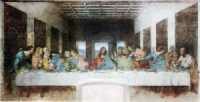
The Last Supper fresco in Milan (1498)  by Leonardo da VinciThe Twelve Apostles (in Koine Greek "απόστολος" apostolos, Liddell & Scott, Strong's G652, a delegate, messenger, one sent forth with orders) were men that according to the Synoptic Gospels and Christian tradition (see also Oral Tradition), were chosen from among the disciples of Jesus for a mission (see also: Seventy Disciples). According to the Bauer lexicon, Walter Bauer's Greek-English Lexicon of the New Testament: "...Judaism had an office known as apostle (שליח)".

The Gospel of Mark states that Jesus initially sent out these twelve in pairs (Mark 6:7-13, cf. Matthew 10:5-42, Luke 9:1-6), to towns in Galilee [map].

Literal readings of the text state that their initial instructions were to heal the sick and drive out demons, but some scholars read this more metaphorically as instructions to heal the spiritually sick and thus to drive away wicked behaviour. They are also instructed to only take their staffs, and that if any town rejects them they ought to shake the dust off their feet as they leave, a gesture which some scholars think was meant as a contemptuous threat (Miller 26). Their carrying of just a staff is sometimes given as the reason for the use by Christian Bishops of a staff of office, in those denominations that believe they maintain an Apostolic Succession.

Later in the Gospel narratives the Twelve Apostles are described as having been commissioned to preach the Gospel to the world, regardless of whether Jew or Gentile. Although the Apostles are portrayed as having been Galilean Jews, and 10 of their names are Aramaic, the other 4 names are Greek, suggesting a more metropolitan background.

More...

Friday, November 30, 2007

Oral Tradition

The Rylands Papyrus is the earliest manuscript fragment found of John’s Gospel; dated to about 125The Oral Tradition, Oral Torah, or Oral Law (Hebrew: תורה שבעל פה, Torah she-be-`al peh), according to Rabbinic Judaism, is an oral tradition received in conjunction with the written Torah (and the rest of the Hebrew Bible), which is known in this context as the "Written Torah" (Hebrew: תורה שבכתב, Torah she-bi-khtav). The traditions of the Oral Torah are believed to be the same as those recorded in the Mishnah and Talmud during the 2nd-5th centuries CE.

According to classical Judaism and the tenets of Orthodox Judaism, Moses and the Jews at Mount Sinai received an Oral as well as a written Torah ("teaching") from God. The books of the Tanakh (Hebrew Bible) were relayed with an oral tradition passed on by the scholarly and other religious leaders of each generation, and according to classical Rabbinic interpretation, the teachings of the Oral Law are a guide to that interpretation of the Written Law which is considered the authoritative reading. Jewish law and tradition thus is not based on a strictly literal reading of the Tanakh, but on combined oral and written traditions. Further, the basis of halakha (Jewish law) includes the premise that the Written Law is inherently bound together with an Oral Law. The "Oral Law" was ultimately recorded in the Talmud and Midrash.


Early Christian church

There was also an oral tradition in the early Christian Church.
In that over 90% of the material in John’s Gospel is unique, not found in the other gospels, the question of sources and how John is using them becomes prominent. It is our contention that John’s Gospel was written at about the same time as Matthew and Luke, for the evangelist shows virtually no awareness of the material found in the other gospels (typically common oral traditions being an exception). But if John did not get his material from these other sources, where did he get it from and why do they not employ it in their gospels? In particular, how is it possible that Luke, who spent two years in Palestine doing research for his Gospel, did not gain access to John’s pre-publication draft? It seems either that John’s circle was quite small—hence, the oral traditions generating from him made little impact on the mainstream of the gospel compilers; or else John drastically altered the shape of the material, packaging it for the hellenized audience of Asia Minor. We believe that the truth involves both of these possibilities. Our argument will accordingly be shaped by this consideration.
-Daniel B. Wallace

"The very basis of Irenaeus' five volume Against Heresies is that the leaders of the Church knew but one oral tradition, and that oral tradition had been delivered to them by the Apostles. He vehemently argued that anyone who disagreed with the oral tradition of the Chruch was, by definition, a heretic.".
-Larry D. Harper

More...

Friday, September 21, 2007

The parables of Jesus

The Good Samaritan, Rembrandt Harmensz. van RijnThe parables of Jesus, found in the Synoptic Gospels, embody much of Jesus' teaching. Jesus' parables are quite simple, memorable stories, often with humble imagery, each with a single message. Jesus, for example, likened the Kingdom of God to leaven (an image usually meant as corruption) or a mustard seed. Like his aphorisms, Jesus' parables were often surprising and paradoxical. The parable of the good Samaritan, for example, turned expectations on their head with the despised Samaritan proving to be the wounded man's neighbor. The parables were simple and memorable enough to survive in an oral tradition before being written down years after Jesus' death.

His parables are sometimes interpreted as allegories in the gospels themselves and in Christian tradition. In such an allegory, each element corresponds metaphorically to a class of people (e.g., false Christians), a heavenly reward, or some other topic. The gospel of John includes allegories but no parables. Parables are attributed to Jesus in the three synoptic gospels of the New Testament and the noncanonical Gospel of Thomas. According to some interpretations, the Gospel of John also contains a parable.

More...

Thursday, August 02, 2007

Masoretic Text

Nash Papyrus (2nd century BCE) contains a portion of the pre-Masoretic Text, specifically the Ten Commandments and the Shema Yisrael prayer The Masoretic Text (MT) is the Hebrew text of the Jewish Bible (Tanakh). It defines not just the books of the Jewish canon, but also the precise letter-text of the biblical books in Judaism, as well as their vocalization and accentuation for both public reading and private study. The MT is also widely used as the basis for translations of the Old Testament in Protestant Bibles, and in recent decades also for Catholic Bibles.

The MT was primarily copied, edited and distributed by a group of Jews known as the Masoretes between the seventh and tenth centuries CE. Though the consonants differ little from the text generally accepted in the early second century, it has numerous differences of both little and great significance when compared to (extant 4th century) versions of the Septuagint, originally a Greek translation (around 300 BCE) of the Hebrew Scriptures in popular use in Palestine during the common era and often quoted in the second part of the Christian Bible (known as the New Testament).

The Hebrew word mesorah (מסורה, alt. מסורת) refers to the transmission of a tradition. In a very broad sense it can refer to the entire chain of Jewish tradition (see Oral law), but in reference to the masoretic text the word mesorah has a very specific meaning: the diacritic markings of the text of the Hebrew Bible and concise marginal notes in manuscripts (and later printings) of the Hebrew Bible which note textual details, usually about the precise spelling of words.

More...

Saturday, June 02, 2007

Masoretic Text

Nash Papyrus (2nd century BCE) contains a portion of the pre-Masoretic Text, specifically the Ten Commandments and the Shema Yisrael prayerThe Masoretic Text (MT) is the Hebrew text of the Jewish Bible (Tanakh). It defines not just the books of the Jewish canon, but also the precise letter-text of the biblical books in Judaism, as well as their vocalization and accentuation for both public reading and private study. The MT is also widely used as the basis for translations of the Old Testament in Protestant Bibles, and in recent decades also for Catholic Bibles.

The MT was primarily copied, edited and distributed by a group of Jews known as the Masoretes between the seventh and tenth centuries CE. Though the consonants differ little from the text generally accepted in the early second century, it has numerous differences of both little and great significance when compared to (extant 4th century) versions of the Septuagint, originally a Greek translation (around 300 BCE) of the Hebrew Scriptures in popular use in Palestine during the common era and often quoted in the second part of the Christian Bible (known as the New Testament).

The Hebrew word mesorah (מסורה, alt. מסורת) refers to the transmission of a tradition. In a very broad sense it can refer to the entire chain of Jewish tradition (see Oral law), but in reference to the masoretic text the word mesorah has a very specific meaning: the diacritic markings of the text of the Hebrew Bible and concise marginal notes in manuscripts (and later printings) of the Hebrew Bible which note textual details, usually about the precise spelling of words.

More...
 

Subscribe


LifeNews.com

Desiring God Blog

Youth for Christ International