Showing posts with label John. Show all posts

Tuesday, February 01, 2011

The Gospels

Books in the new testament referred to as the Gospels:

In Christianity, a gospel (from Old English, "good news") is generally one of four canonical books of the New Testament that describe the miraculous birth, life, ministry, crucifixion, and resurrection of Jesus. These books are the Gospels according to Matthew, Mark, Luke and John, written between 65 and 100 AD.

Many modern scholars argue that the sequence in which the Gospel accounts have traditionally been printed in the Bible is not the order of their composition, and that the first canonical gospel to have been written is Mark (c 65-70), which in turn was used as a source for the gospels of Matthew and Luke. Matthew and Luke may have also used the hypothetical Q Document. These first three gospels are called the synoptic gospels because they share a similar view. The last gospel, the gospel of John, presents a very different picture of Jesus and his ministry from the synoptics.

The vast majority of biblical scholars believe the canonical gospels were originally written in Greek, although some believe the gospel of Matthew was originally written in Aramaic or Hebrew and later translated to Greek. However, Eusebius wrote that Matthew composed the Gospel According to the Hebrews and his Church Catalog suggests that it was the only Jewish Gospel. Yet, some have accused Eusebius of falsification.

Originally, the "gospel" meant the proclamation of God's saving activity in Jesus of Nazareth, or the agape (love) message proclaimed by Jesus of Nazareth. This is the original New Testament usage (for example Mark 1:14-15 or 1 Corinthians 15:1-9; see also Strong's G2098). The word is still used in this sense. Ancient, non-canonical works that purport to quote Jesus (e.g., Gospel of Thomas) are also called gospels, and the term refers, in general, to works of a genre of Early Christian literature (cf. Peter Stuhlmacher, ed., Das Evangelium und die Evangelien, Tübingen 1983, also in English: The Gospel and the Gospels).

More

Saturday, August 14, 2010

Augustinian hypothesis

the evangelist Matthew
inspired by an angel
The Augustinian hypothesis is a solution to the synoptic problem, which concerns the origin of the Gospels of the New Testament. The hypothesis holds that Matthew was written first, by Matthew the Evangelist, a disciple of Jesus of Nazareth. Mark the Evangelist, a disciple of the apostle Simon Peter, wrote the Gospel of Mark second, and used Matthew and the preaching of Simon Peter as sources. Luke the Evangelist, a disciple of Paul of Tarsus, wrote the Gospel of Luke, and was aware of the two Gospels that preceded him. Unlike some competing hypotheses, this hypothesis does not rely on, nor does it argue for, the existence of any document that is not explicitly mentioned in historical testimony. Instead, the hypothesis draws primarily upon historical testimony, rather than textual criticism, as the central line of evidence. The foundation of evidence for the hypothesis is the writings of the Early Church Fathers: historical sources dating back to as early as the first half of the 2nd century, which have been held as authoritative by most Christians for nearly 2 millennia. Finally, adherents to the Augustinian hypothesis view it as a simple, coherent solution to the synoptic problem.

The problem of the Relationship of the Synoptists was first seriously discussed by Augustine (d. 430), in his three books De Consensu Evangelistarum (Opera, Tom. III., 1041–1230, ed. Migne). He defends the order in our canon, first Matthew, last John, and the two apostolic disciples in the middle, like sons to be embraced and thus placed in the middle and between the two (in loco medio constituti tamquam filii amplectendi, I., 2), but wrongly makes Mark dependent on Matthew. His view prevailed during the middle ages and down to the close of the eighteenth century.


More...

Friday, February 19, 2010

Sanhedrin Trial of Jesus

The Sanhedrin Trial of Jesus is an event reported by all the canonical gospels, in
  • Mark 14:53–65,
  • Matthew 26:57–68,
  • Luke 22:63–71 and
  • John 18:12-24.
After the arrest of Jesus, the gospels report that Jesus was taken to the Sanhedrin, a legal body composed of the chief Sadduccees, Pharisees, and elders (Kilgallen 255). The precise location and nature of the trial varies between the canonical Gospels, and particularly between the Synoptic Gospels and the Gospel of John.

In the Synoptics, Jesus is taken to the Sanhedrin, with Matthew adding that the Sanhedrin had assembled where Caiaphas was located, possibly implying that the gathering occurred at the home of Caiaphas.

At the time in which the narrative is set, this body was an ad hoc gathering, rather than a fixed court (Brown 146), as in the latter Council of Jamnia, and its gathering in Caiaphas' home is historically plausible, though irregular. Daniel J. Harrington argues that being located in a home makes it more likely that this was a small first preliminary hearing and not a full trial. According to Rabbinic Judaism, the Sanhedrin of the Pharisees, probably a different sanhedrin, was led by Gamaliel from approximately the year 9 to 50. This is believed to be the same Gamaliel who appears in Acts 5:34 and 22:3. Shammai may have also played a role.

More...

Friday, March 27, 2009

John the Apostle

St John the Evangelist, imagined by Jacopo Pontormo, ca 1525 (Santa Felicita, Florence)John the Apostle (יוחנן "The LORD is merciful", Greek Ευαγγελιστής Ιωάννης), was one of The Twelve Apostles of Jesus. Christian tradition proclaims he is the same person who wrote:
  • the Gospel of John and first epistle of John (the author of these is also referred to as John the Evangelist, John the Theologian or John the Divine)
  • the second and third Epistle of John (the author of these is sometimes distinguished under the name of John the Presbyter).
  • the Book of Revelation (the author is sometimes referred to as John of Patmos or John the Revelator).
John the Apostle was the son of Zebedee, and the brother of James. One tradition gives his mother's name as Salome.

John and James were originally fishermen and fished with their father in the Lake of Genesareth (the Sea of Galilee).

More...

Wednesday, March 19, 2008

John the Apostle

St John the Evangelist, imagined by Jacopo Pontormo, ca 1525 (Santa Felicita, Florence)John the Apostle (יוחנן "The LORD is merciful", Greek Ευαγγελιστής Ιωάννης), was one of The Twelve Apostles of Jesus. Christian tradition proclaims he is the same person who wrote:
  • the Gospel of John and first epistle of John (the author of these is also referred to as John the Evangelist, John the Theologian or John the Divine)
  • the second and third Epistle of John (the author of these is sometimes distinguished under the name of John the Presbyter).
  • the Book of Revelation (the author is sometimes referred to as John of Patmos or John the Revelator).

In the Bible

John the Apostle was the son of Zebedee, and the brother of James. One tradition gives his mother's name as Salome.

John and James were originally fishermen and fished with their father in the Lake of Genesareth (the Sea of Galilee).

He was first a disciple of John the Baptist and later one of The Twelve Apostles of Jesus. He is revered as a saint by most of Christianity. The Roman Catholic Church commemorates him on December 27. He is also remembered in the liturgy on January 3. The Eastern Orthodox Church commemorates him on September 26, and also remembers him on May 8, on which date Christians used to draw forth from his grave fine ashes which were believed to be effective for healing the sick.

More...

Saturday, March 01, 2008

The Twelve Apostles

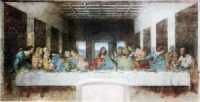
The Last Supper fresco in Milan (1498)  by Leonardo da VinciThe Twelve Apostles (in Koine Greek "απόστολος" apostolos, Liddell & Scott, Strong's G652, a delegate, messenger, one sent forth with orders) were men that according to the Synoptic Gospels and Christian tradition (see also Oral Tradition), were chosen from among the disciples of Jesus for a mission (see also: Seventy Disciples). According to the Bauer lexicon, Walter Bauer's Greek-English Lexicon of the New Testament: "...Judaism had an office known as apostle (שליח)".

The Gospel of Mark states that Jesus initially sent out these twelve in pairs (Mark 6:7-13, cf. Matthew 10:5-42, Luke 9:1-6), to towns in Galilee [map].

Literal readings of the text state that their initial instructions were to heal the sick and drive out demons, but some scholars read this more metaphorically as instructions to heal the spiritually sick and thus to drive away wicked behaviour. They are also instructed to only take their staffs, and that if any town rejects them they ought to shake the dust off their feet as they leave, a gesture which some scholars think was meant as a contemptuous threat (Miller 26). Their carrying of just a staff is sometimes given as the reason for the use by Christian Bishops of a staff of office, in those denominations that believe they maintain an Apostolic Succession.

Later in the Gospel narratives the Twelve Apostles are described as having been commissioned to preach the Gospel to the world, regardless of whether Jew or Gentile. Although the Apostles are portrayed as having been Galilean Jews, and 10 of their names are Aramaic, the other 4 names are Greek, suggesting a more metropolitan background.

More...


Subscribe


LifeNews.com

Desiring God Blog

Youth for Christ International