Showing posts with label Gospel of Matthew. Show all posts

Sunday, December 05, 2010

The Genealogy of Jesus

The Genealogy of Jesus is recorded in two places in the bible:
1) Matthew 1:1-17, and

2) Luke 3:23-38 (in addition to several other new testament references: Mark 10:47, luke 1:32, Acts 2:29-30, Rev. 5:5, 22:16).

The Matthew 1:1-17 and Luke 3:23-38 accounts differ because, Luke follows Mary's lineage (Jesus' blood mother), through David's son Nathan (Luke's genealogy focused on Jesus' descent from God through the virgin birth. It placed no emphasis on Jesus being the descendant of king David) and the Matthew genealogy follows Joseph's line (Joseph being the legal father of Jesus, see below) through David's son Solomon.

God's promise to David  was fulfilled because Mary was the biological parent of Jesus.

The virgin birth also addressed the curse God had pronounced upon Jehoiakim. Kingship was an inherited right. By Joseph, Jesus inherited a legal claim to the throne of David. However, he was exempt from the curse of Jehoiakim (Jeremiah 36:1-32, i.e. Joseph's offspring could not claim David's throne because of the curse) because Joseph was not the genetic father of Jesus.

More...


 Understanding the Genealogy of Jesus

Friday, December 04, 2009

gospel of Matthew

The Inspiration of Saint Matthew. Artist: Michelangelo Caravaggio. Date: 1602.The Gospel of Matthew (literally, "according to Matthew"; Greek, Κατά Μαθθαίον or Κατά Ματθαίον, Kata Maththaion or Kata Matthaion) is one of the four Gospel accounts of the New Testament. It narrates an account of the life and ministry of Jesus, from his genealogy to his post-resurrection commissioning of his Apostles to "go and make disciples of all nations." Bibles traditionally print Matthew as the first gospel, followed in order by Mark, and . The Christian community traditionally ascribes authorship to Matthew the Evangelist, one of Jesus's twelve apostles, while secular scholarship generally agrees it was written by an anonymous non-eyewitness to Jesus's ministry.

The Gospel of Matthew is written in Greek, not in Aramaic. The Greek of the gospel of Matthew cannot easily be translated back to Aramiac. This is very suggestive that Matthew is not a Greek translation of an Aramiac original. It is also generally agreed that the Gospel of Mark is actually the earliest of the four gospels and that the author of Matthew substantially used the gospel of Mark in writing this gospel.

A minority of scholars defend the tradition that asserts Matthean priority, with Mark borrowing from Matthew (cf. Augustinian hypothesis and Griesbach hypothesis). Then in 1911, the Pontifical Biblical Commission asserted that Matthew was the first gospel written, that it was written by the evangelist Matthew, and that it was written in Aramaic.

For convenience, the book can be divided into its four structurally distinct sections: Two introductory sections; the main section, which can be further broken into five sections, each with a narrative component followed by a long discourse of Jesus; and finally, the Passion and Resurrection section.

More...

Saturday, March 28, 2009

The Gospels

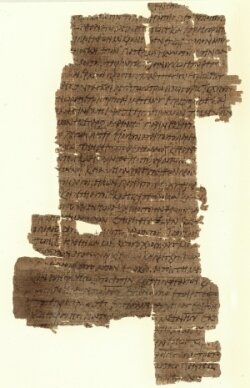
The front side of folios 13 and 14 of a Greek papyrus manuscript of the Gospel of Luke containing verses 11:50–12:12 and 13:6-24, P. Chester Beatty IBooks in the new testament referred to as the Gospels:

In Christianity, a gospel (from Old English, "good news") is generally one of four canonical books of the New Testament that describe the miraculous birth, life, ministry, crucifixion, and resurrection of Jesus. These books are the Gospels according to Matthew, Mark, Luke and John, written between 65 and 100 AD.

Many modern scholars argue that the sequence in which the Gospel accounts have traditionally been printed in the Bible is not the order of their composition, and that the first canonical gospel to have been written is Mark (c 65-70), which in turn was used as a source for the gospels of Matthew and Luke. Matthew and Luke may have also used the hypothetical Q Document. These first three gospels are called the synoptic gospels because they share a similar view. The last gospel, the gospel of John, presents a very different picture of Jesus and his ministry from the synoptics. The canonical gospels were originally written in Greek.

More...

Thursday, December 04, 2008

Gospel of Matthew

Apostle St Matthew, artist EL GRECO, 1610-14, Oil on canvas, 97 x 77 cm, location Museo de El Greco, ToledoThe Gospel of Matthew (literally, "according to Matthew"; Greek, Κατά Μαθθαίον or Κατά Ματθαίον, Kata Maththaion or Kata Matthaion) is one of the four Gospel accounts of the New Testament. It narrates an account of the life and ministry of Jesus, from his genealogy to his post-resurrection commissioning of his Apostles to "go and make disciples of all nations" (Mat 28:19) Bibles traditionally print Matthew as the first gospel, followed in order by Mark, and . The Christian community traditionally ascribes authorship to Matthew the Evangelist, one of Jesus's twelve apostles, while secular scholarship generally agrees it was written by an anonymous non-eyewitness to Jesus's ministry.

The Gospel of Matthew is written in Greek, not in Aramaic. The Greek of the gospel of Matthew cannot easily be translated back to Aramiac. This is very suggestive that Matthew is not a Greek translation of an Aramiac original. It is also generally agreed that the Gospel of Mark is actually the earliest of the four gospels and that the author of Matthew substantially used the Gospel of Mark in writing this gospel.

A minority of scholars defend the tradition that asserts Matthean priority, with Mark borrowing from Matthew (cf. Augustinian hypothesis and Griesbach hypothesis). Then in 1911, the Pontifical Biblical Commission asserted that Matthew was the first gospel written, that it was written by the evangelist Matthew, and that it was written in Aramaic.

More...

Saturday, March 01, 2008

The Twelve Apostles

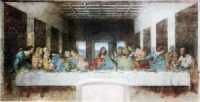
The Last Supper fresco in Milan (1498)  by Leonardo da VinciThe Twelve Apostles (in Koine Greek "απόστολος" apostolos, Liddell & Scott, Strong's G652, a delegate, messenger, one sent forth with orders) were men that according to the Synoptic Gospels and Christian tradition (see also Oral Tradition), were chosen from among the disciples of Jesus for a mission (see also: Seventy Disciples). According to the Bauer lexicon, Walter Bauer's Greek-English Lexicon of the New Testament: "...Judaism had an office known as apostle (שליח)".

The Gospel of Mark states that Jesus initially sent out these twelve in pairs (Mark 6:7-13, cf. Matthew 10:5-42, Luke 9:1-6), to towns in Galilee [map].

Literal readings of the text state that their initial instructions were to heal the sick and drive out demons, but some scholars read this more metaphorically as instructions to heal the spiritually sick and thus to drive away wicked behaviour. They are also instructed to only take their staffs, and that if any town rejects them they ought to shake the dust off their feet as they leave, a gesture which some scholars think was meant as a contemptuous threat (Miller 26). Their carrying of just a staff is sometimes given as the reason for the use by Christian Bishops of a staff of office, in those denominations that believe they maintain an Apostolic Succession.

Later in the Gospel narratives the Twelve Apostles are described as having been commissioned to preach the Gospel to the world, regardless of whether Jew or Gentile. Although the Apostles are portrayed as having been Galilean Jews, and 10 of their names are Aramaic, the other 4 names are Greek, suggesting a more metropolitan background.

More...

Saturday, February 23, 2008

Temple Tax

Silver shekel, BMC Phoenicia, Tyre mint, 92 - 91 B.C.; obverse laureate head of Melqarth right, lion’s skin knotted around neck; reverse TUROUIERAS KAIASULOU (of Tyre the holy and inviolable), eagle l., r. foot on ship’s ram, palm frond behind, date EL (year 35) over club and palm frond l., D right, Phoenician kaph between legs. image © forumancientcoins.comThe Gospel of Matthew tells us that Jesus paid the temple tax. In Jesus' day, the denarius was the form of money used to pay Caesar, but the temple tax was paid with the drachma. Luke 20 tells us that the teachers of the law and the chief priests sent spies to watch Jesus. They asked Him,
22 "Is it right for us to pay taxes to Caesar or not?" 23 He saw through their duplicity and said to them, 24 "Show me a denarius. Whose portrait and inscription are on it?"
Jesus asked to see a denarius and whose portrait and inscription were on it knowing that Caesar's portrait and inscription were on it, and He taught that it was right to uphold our witness as citizens of the communities where God has placed us.

In the time of Jesus, adult Jewish males (twenty years old or more) were required to pay a two-drachma tax each year, based upon the Old Testament Atonement Offering of Exodus 30:11-16, which was to be paid in the form of a half shekel (a weight of twenty gerahs or approximately 1/5 once or 6 grams). In Matthew's day, after the temple was destroyed this tax remained, but the tax was to be paid to the Roman government.

More...

Saturday, February 16, 2008

the gospels

The reverse side of Papyrus 37, a New Testament manuscript of the Gospel of Matthew. Most likely originated in Egypt. Currently housed in: University of Michigan, Ann Arbor Library, Date: 3rd/4th CenturyBooks in the new testament referred to as the Gospels:

Books in the new testament referred to as the Gospels:
In Christianity, a gospel (from Old English, "good news") is generally one of four canonical books of the New Testament that describe the miraculous birth, life, ministry, crucifixion, and resurrection of Jesus. These books are the Gospels according to Matthew, Mark, Luke and John, written between 65 and 100 AD.

Many modern scholars argue that the sequence in which the Gospel accounts have traditionally been printed in the Bible is not the order of their composition, and that the first canonical gospel to have been written is Mark (c 65-70), which in turn was used as a source for the gospels of Matthew and Luke. Matthew and Luke may have also used the hypothetical Q Document. These first three gospels are called the synoptic gospels because they share a similar view. The last gospel, the gospel of John, presents a very different picture of Jesus and his ministry from the synoptics. The canonical gospels were originally written in Greek.

Bethlehem, the Sermon on the Mount, the Beatitudes, the Last Supper, resurrection accounts, and the Great Commission.

Gospel has generally been used in three ways:

  1. To denote the proclamation of God's saving activity in Jesus of Nazareth or to denote the message proclaimed by Jesus of Nazareth. This is the original New Testament usage (for example Mark 1:14-15 or 1 Corinthians 15:1-9, see also Strong's G2098).

  2. More popularly to refer to the four canonical Gospels, which are attributed to the Four Evangelists: (Gospel of Matthew, Gospel of Mark, Gospel of Luke and Gospel of John); and sometimes other non-canonical works (eg. Gospel of Thomas), that offer a narrative of the life, death and resurrection of Jesus.

  3. Some modern scholars have used the term to denote a hypothetical genre of Early Christian literature (cf. Peter Stuhlmacher, ed., Das Evangelium und die Evangelien, Tübingen 1983, also in English: The Gospel and the Gospels).

More...

Monday, December 24, 2007

Christmas

Wise Men visiting Jesus after his birthChristmas (literally, the Mass of Christ) is a traditional holiday commonly observed on 25 December. In most Eastern Orthodox Churches, even where the civil calendar used is the Gregorian, the event is observed according to the Julian calendar, which coincides with the predominant reckoning of 7 January. It is celebrated by most Christians to mark the birth of Jesus, which is believed to have occurred in Bethlehem in the Roman Province of Judea between 6 BC and AD 6. Christ's birth, or nativity, was said by his followers to fulfill the prophecies of Judaism that a messiah would come, from the house of David, to redeem the world from sin. Efforts to decide upon a date on which to celebrate his birth began some centuries later.

The word Christmas is a contraction of Christ's Mass, derived from the Old English Cristes mæsse.

It is sometimes abbreviated Xmas, probably because X resembles the Greek letter Χ (chi) which has often historically been used as an abbreviation for Christ (Χριστός in Greek).

The Nativity

The Nativity of Jesus refers to the Christian belief that the Messiah was born to the Virgin Mary. The story of Christmas is based on the biblical accounts given in the Gospel of Matthew, namely Matthew 1:18-Matthew 2:12 and the Gospel of Luke, specifically Luke 1:26-Luke 2:40. According to these accounts, Jesus was born to Mary, assisted by her husband Joseph, in the city of Bethlehem. According to popular tradition, the birth took place in a "stable", surrounded by farm animals, though neither the “stable” nor the animals are mentioned in the Biblical accounts. However, a "manger" is mentioned in Luke 2:7 where it states "She wrapped him in cloths and placed him in a manger, because there was no room for them in the inn." Shepherds from the fields surrounding Bethlehem were told of the birth by an angel, and were the first to see the child. Christians believe that the birth of Jesus fulfilled many prophecies made hundreds of years before his birth.

More...

Saturday, December 22, 2007

Epiphany

Joseph of Nazareth with the infant Jesus, by Guido Reni. c. 1635Epiphany (Greek: επιφάνεια, "appearance" or "manifestation") is a Christian feast intended to celebrate the "shining forth" or revelation of God to mankind in human form, in the person of Jesus. The feast is also called Twelfth Day, as it is the twelfth day after Christmas, or Three Kings Day.

History

The observance had its origins in the Eastern Christian churches, and was originally a general celebration of the Incarnation of Jesus Christ, and included the commemoration of: his birth; the visit of the Magi, or "Wise Men", who arrived in Bethlehem; all of Jesus' childhood events, up to and including His baptism in the Jordan River by John the Baptist; and even the miracle at the Wedding of Cana in Galilee. However, it seems fairly clear that the Baptism was the event predominantly commemorated.

The date of the feast was very early fixed on January 6. Ancient Liturgies speak of Illuminatio, Manifestatio, Declaratio (Lighting, Manifestation, Declaration); cf. Matthew 3:13–17; Luke 3:22; and John 2:1–11; where the Baptism and the Marriage at Cana are dwelt upon. Christian Churches have traditionally emphasized the "Revelation to the Gentiles" mentioned in the Gospel of Luke, where the term Gentile means all non-Jewish peoples. The Biblical Magi represent the non-Jewish peoples of the world.

More...

Thursday, December 20, 2007

Gospel of Matthew

Saint Matthew, from the 9th-century Ebbo Gospels.The Gospel of Matthew (literally, "according to Matthew"; Greek, Κατά Μαθθαίον or Κατά Ματθαίον, Kata Maththaion or Kata Matthaion) is one of the four Gospel accounts of the New Testament. It narrates an account of the life and ministry of Jesus, from his genealogy to his post-resurrection commissioning of his Apostles to "go and make disciples of all nations." Bibles traditionally print Matthew as the first gospel, followed in order by Mark, and . The Christian community traditionally ascribes authorship to Matthew the Evangelist, one of Jesus's twelve apostles, while secular scholarship generally agrees it was written by an anonymous non-eyewitness to Jesus's ministry.

The Gospel of Matthew is written in Greek, not in Aramaic. That is to say, no copy of an Aramaic original has yet to be found. The Greek of the gospel of Matthew cannot easily be translated back to Aramiac. This is very suggestive that Matthew is not a Greek translation of an Aramiac original. It is also generally agreed that the Gospel of Mark is actually the earliest of the four gospels and that the author of Matthew substantially used the gospel of Mark in writing this gospel.

Overview

For convenience, the book can be divided into its four structurally distinct sections: Two introductory sections; the main section, which can be further broken into five sections, each with a narrative component followed by a long discourse of Jesus; and finally, the Passion and Resurrection section.


  1. Containing the genealogy, the birth, and the infancy of Jesus (Matthew 1; Matthew 2). The discourses and actions of John the Baptist preparatory to Christ's public ministry (Matthew 3; Matthew 4:11).
  2. The discourses and actions of Christ in Galilee (4:12–26:1).
    1. The Sermon on the Mount, concerning morality (Matthew 5–7)
    2. The Missionary Discourse, concerning the mission Jesus gave his Twelve Apostles. (Matthew 10–11:1)
    3. The Parable Discourse, stories that teach about the Kingdom of Heaven (Matthew 13).
    4. The "Church Order" Discourse, concerning relationships among Christians (Matthew 18–19:1).
    5. The Eschatological Discourse, which includes the Olivet Discourse and Judgement of the Nations, concerning his Second Coming and the Signs of the End of the Age (Matthew 24–25).
  3. The sufferings, death and Resurrection of Jesus, the Great Commission (Matthew 28:16–20).

More...

Wednesday, December 19, 2007

Herod the Great

The taking of Jerusalem by Herod the Great, 36 BC, by Jean FouquetHordos הוֹרְדוֹס, also known as Herod I or Herod the Great, was a Roman client-king of Judaea (c. 74 BC - c. 5, 4 or 1 BC in Jerusalem). The details of his biography can best be gleaned from the works of the 1st century AD Jewish historiographer Josephus. To the majority of non-specialist Christians Herod is best known from the Gospel according to Matthew that gives in chapter 2 an account of the events leading up to and including what subsequently has come to be referred to by Christians as the Massacre of the Innocents, of which however no mention in other contemporary sources has come down to us.

Herod the Great arose from a wealthy, influential Idumaean family. The Idumaeans, successors to the Edomites of the Hebrew Bible, settled in Idumea, formerly known as Edom, in southern Judea.

When the Maccabean John Hyrcanus conquered Idumea in 130-140 BC, he required all Idumaeans to obey Jewish law or to leave; most Idumaeans thus converted to Judaism.

According to some, archaeological evidence suggests that Herod identified himself as Jewish, although according to the Mosaic Law he was not. For he was the second son of Antipater the Idumaean, founder of the Herodian dynasty, and his wife Cypros, a princess from Petra in Nabatea (now part of Jordan). The family rubbed shoulders with the great in Rome, such as Pompey, Cassius, and in 47 BC his father was appointed Procurator over Judea, who then appointed his son governor of Galilee at the age of 25.

More...

Thursday, December 13, 2007

Augustinian hypothesis

the evangelist Matthew inspired by an angelThe Augustinian hypothesis is a solution to the synoptic problem, which concerns the origin of the Gospels of the New Testament. The hypothesis holds that Matthew was written first, by Matthew the Evangelist, a disciple of Jesus of Nazareth. Mark the Evangelist, a disciple of the apostle Simon Peter, wrote the Gospel of Mark second, and used Matthew and the preaching of Peter as sources. Luke the Evangelist, a disciple of Paul of Tarsus, wrote the Gospel of Luke, and was aware of the two Gospels that preceded him. Unlike some competing hypotheses, this hypothesis does not rely on, nor does it argue for, the existence of any document that is not explicitly mentioned in historical testimony. Instead, the hypothesis draws primarily upon historical testimony, rather than textual criticism, as the central line of evidence. The foundation of evidence for the hypothesis is the writings of the Church Fathers: historical sources dating back to as early as the first half of the 2nd century, which have been held as authoritative by most Christians for nearly 2 millennia. Finally, adherents to the Augustinian hypothesis view it as a simple, coherent solution to the synoptic problem.

The Augustinian hypothesis addresses certain fundamental points of contention surrounding the synoptic problem, such as how reliable the early Christian tradition is, which gospel was written first, whether there were other unknown sources behind the gospels, to what extent, if any, the gospels were redacted, and to what extent the gospels were altered between the time they were originally written and the time the first surviving manuscripts appear. These and other matters are raised and alternate resolutions proposed by proponents of competing hypotheses, such as the Two-source hypothesis, its related Q hypothesis, the Farrer hypothesis, and others.

More...

Tuesday, December 04, 2007

Book of Kells

This page (folio 292r) contains the lavishly decorated text that opens the Gospel of JohnThe Book of Kells (Dublin, Trinity College Library, MS A. I. (58), less widely known as the Book of Columba) is an ornately illustrated manuscript, produced by Celtic monks around AD 800 in the style known as Insular art. It is one of the more lavishly illuminated manuscripts to survive from the Middle Ages and has been described as the zenith of Western calligraphy and illumination. It contains the four gospels of the Bible in Latin, along with prefatory and explanatory matter decorated with numerous colourful illustrations and illuminations. Today it is on permanent display at the Trinity College Library in Dublin, Ireland.

history


Origin

The Book of Kells is the high point of a group of manuscripts in what is known as the Insular style produced from the late 6th through the early 9th centuries in monasteries in Ireland, Scotland and northern England and in continental monasteries with Irish or English foundations.

These manuscripts include the Cathach of St. Columba, the Ambrosiana Orosius, a fragmentary gospel in the Durham cathedral library (all from the early 7th century), and the Book of Durrow (from the second half of the 7th century). From the early 8th century come the Durham Gospels, the Echternach Gospels, the Lindisfarne Gospels (see illustration at right), and the Lichfield Gospels. The St. Gall Gospel Book and the Macregal Gospels come from the late 8th century. The Book of Armagh (dated to 807–809), the Turin Gospel Book Fragment, the Leiden Priscian, the St. Gall Priscian and the Macdurnan Gospel all date from the early 9th century. Scholars place these manuscripts together based on similarities in artistic style, script, and textual traditions. The fully developed style of the ornamentation of the Book of Kells places it late in this series, either from the late eighth or early ninth century. The Book of Kells follows many of the iconographic and stylistic traditions found in these earlier manuscripts. For example, the form of the decorated letters found in the incipit pages for the Gospels is surprisingly consistent in Insular Gospels. Compare, for example, the incipit pages of the Gospel of Matthew in the Lindisfarne Gospels and in the Book of Kells both of which feature intricate decorative knotwork inside the outlines formed by the enlarged initial letters of the text. (For a more complete list of related manuscripts see: List of Hiberno-Saxon illustrated manuscripts.)

More...

Friday, November 30, 2007

Oral Tradition

The Rylands Papyrus is the earliest manuscript fragment found of John’s Gospel; dated to about 125The Oral Tradition, Oral Torah, or Oral Law (Hebrew: תורה שבעל פה, Torah she-be-`al peh), according to Rabbinic Judaism, is an oral tradition received in conjunction with the written Torah (and the rest of the Hebrew Bible), which is known in this context as the "Written Torah" (Hebrew: תורה שבכתב, Torah she-bi-khtav). The traditions of the Oral Torah are believed to be the same as those recorded in the Mishnah and Talmud during the 2nd-5th centuries CE.

According to classical Judaism and the tenets of Orthodox Judaism, Moses and the Jews at Mount Sinai received an Oral as well as a written Torah ("teaching") from God. The books of the Tanakh (Hebrew Bible) were relayed with an oral tradition passed on by the scholarly and other religious leaders of each generation, and according to classical Rabbinic interpretation, the teachings of the Oral Law are a guide to that interpretation of the Written Law which is considered the authoritative reading. Jewish law and tradition thus is not based on a strictly literal reading of the Tanakh, but on combined oral and written traditions. Further, the basis of halakha (Jewish law) includes the premise that the Written Law is inherently bound together with an Oral Law. The "Oral Law" was ultimately recorded in the Talmud and Midrash.


Early Christian church

There was also an oral tradition in the early Christian Church.
In that over 90% of the material in John’s Gospel is unique, not found in the other gospels, the question of sources and how John is using them becomes prominent. It is our contention that John’s Gospel was written at about the same time as Matthew and Luke, for the evangelist shows virtually no awareness of the material found in the other gospels (typically common oral traditions being an exception). But if John did not get his material from these other sources, where did he get it from and why do they not employ it in their gospels? In particular, how is it possible that Luke, who spent two years in Palestine doing research for his Gospel, did not gain access to John’s pre-publication draft? It seems either that John’s circle was quite small—hence, the oral traditions generating from him made little impact on the mainstream of the gospel compilers; or else John drastically altered the shape of the material, packaging it for the hellenized audience of Asia Minor. We believe that the truth involves both of these possibilities. Our argument will accordingly be shaped by this consideration.
-Daniel B. Wallace

"The very basis of Irenaeus' five volume Against Heresies is that the leaders of the Church knew but one oral tradition, and that oral tradition had been delivered to them by the Apostles. He vehemently argued that anyone who disagreed with the oral tradition of the Chruch was, by definition, a heretic.".
-Larry D. Harper

More...

Saturday, July 28, 2007

Capernaum

Ruins of the synagogue at CapernaumCapernaum (pronounced k-pûrn-m; Hebrew כפר נחום Kefar Nachum, "Nahum's hamlet") was a settlement on the shore of the Sea of Galilee. The site is a ruin today, but was inhabited from 150 BC to about AD 750.

The town is mentioned in the New Testament: in the Gospel of Luke it was reported to have been the home of the apostles Peter, Andrew, James and John, as well as the tax collector Matthew. In Matthew 4:13 the town was reported to have been the home of Jesus himself.

According to Luke, Jesus taught in the synagogue in Capernaum (see John 6:53-59 below), and a building which may have been a synagogue of that period has been found beneath the remains of a later synagogue.


More...

Saturday, July 07, 2007

gospels

In Christianity, gospel means "good news". Received opinion holds that the word gospel derives from the Old English word for "good news", a translation of the Greek word ευαγγέλιον, euangelion (from this word comes the term "evangelist" see evangelism). However, the word corresponding to "good" in Old English had a long vowel, and would normally develop into a MnE *goospel, leading some scholars to hold that the Old English term was not a translation of the Greek "good news," but rather a fresh coinage, "message concerning God."
Gospel has generally been used in three ways:


  1. To denote the proclamation of God's saving activity in Jesus of Nazareth or to denote the message proclaimed by Jesus. This is the original New Testament usage (see Romans 1.1 or Mark 1.1).

  2. More popularly to refer to the four canonical Gospels (Matthew, Mark, Luke and John) and sometimes other non-canonical works (eg. Gospel of Thomas), that offer a narrative of the life, death and resurrection of Jesus.

  3. Some modern scholars have used the term to denote a hypothetical genre of Early Christian literature (cf. Peter Stuhlmacher, ed., Das Evangelium und die Evangelien, Tübingen 1983, also in English: The Gospel and the Gospels).

The expression "gospel" was used by Paul before the literary Gospels of the New Testament canon had been produced, when he reminded the men of the church at Corinth "of the gospel I preached to you" (1 Corinthians 15.1) through which, Paul averred, they were being saved, and he characterized it in the simplest terms, emphasizing Christ's appearances after the Resurrection (1 Corinthians 15.3–8):


"For what I received I passed on to you as of first importance: that Christ died for our sins according to the Scriptures, that he was buried, that he was raised on the third day according to the Scriptures, and that he appeared to Peter, and then to the Twelve. After that, he appeared to more than five hundred of the brothers at the same time, most of whom are still living, though some have fallen asleep. Then he appeared to James, then to all the apostles, and last of all he appeared to me also, as to one abnormally born."

More...

Friday, July 06, 2007

Gospel of Matthew

The Gospel of Matthew (literally, "according to Matthew"; Greek, Κατά Μαθθαίον or Κατά Ματθαίον, Kata Maththaion or Kata Matthaion) is one of the four Gospel accounts of the New Testament. It narrates an account of the life and ministry of Jesus, from his genealogy to his post-resurrection commissioning of his Apostles to "go and make disciples of all nations." Bibles traditionally print Matthew as the first gospel, followed in order by Mark, Luke and John. The Christian community traditionally ascribes authorship to Matthew the Evangelist, one of Jesus's twelve disciples, while secular scholarship generally agrees it was written by an anonymous non-eyewitness to Jesus's ministry.

OverviewFor convenience, the book can be divided into its four structurally distinct sections: Two introductory sections; the main section, which can be further broken into five sections, each with a narrative component followed by a long discourse of Jesus; and finally, the Passion and Resurrection section.

Containing the genealogy, the birth, and the infancy of Jesus (Matthew 1; Matthew 2). The discourses and actions of John the Baptist preparatory to Christ's public ministry (Matthew 3; Matthew 4:11).


  1. Containing the genealogy, the birth, and the infancy of Jesus (Matthew 1; Matthew 2).
    The discourses and actions of John the Baptist preparatory to Christ's public ministry (Matthew 3; Matthew 4:11).

  2. The discourses and actions of Christ in Galilee (4:12–26:1).

    1. The Sermon on the Mount, concerning morality (Ch. 5–7)

    2. The Missionary Discourse, concerning the mission Jesus gave his Twelve Apostles. (10–11:1
    3. )
    4. The Parable Discourse, stories that teach about the Kingdom of Heaven (13).

    5. The "Church Order" Discourse, concerning relationships among Christians (18–19:1).

    6. The Eschatological Discourse, which includes the Olivet Discourse and Judgement of the Nations, concerning his Second Coming and the end of the age (24–25).


  3. The sufferings, death and Resurrection of Jesus, the Great Commission (28:16–20).


More...

Thursday, July 05, 2007

Gospel of Mark

Head of St. Mark, Fra AngelicoThe Gospel of Mark (literally, according to Mark; Greek, Κατά Μαρκον, Kata Markon), (anonymous but ascribed to Mark the Evangelist) is a Gospel of the New Testament. It narrates the life of Jesus from John the Baptist to the Ascension (or to the empty tomb in the shorter recension), but it concentrates particularly on the last week of his life (chapters 11-16, the trip to Jerusalem). It portrays Jesus as an exorcist, a healer and miracle worker, the Christ, the Son of Man, and a few times as the Son of God.

Two important themes of Mark are the Messianic secret and the obtuseness of the disciples. In Mark, Jesus is not generally recognized as the Son of God, except by demons (whom he commands to silence) and at his death. Jesus uses parables to obscure his message and fulfill prophecy (4:10-12). At times, the disciples have trouble understanding the parables, but Jesus explains what they mean, in secret (4:13-20, 4:33-34). They also fail to understand the implication of the miracles that he performs before them.

Mark usually appears second in the New Testament after the Gospel of Matthew and traditionally Matthew was thought to be the first gospel to be composed with Mark the second. However most contemporary scholars date Mark to the late 60s or the early 70s, and, contrary to the traditional view, regard it as the earliest of the canonical gospels, and a source for material in the other synoptic gospels, Matthew and Luke.
More...

Saturday, June 30, 2007

Sanhedrin Trial of Jesus

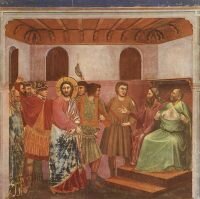
A depiction of the Sanhedrin trial of Jesus, by Giotto The Sanhedrin Trial of Jesus is an event reported by all the Canonical Gospels, in Mark 14:53–65, Matthew 26:57–68, Luke 22:63–71 and John 18:12-24. After the arrest of Jesus, the Canonical Gospels report that Jesus was taken to the Sanhedrin, a legal body composed of the chief Sadduccees, Pharisees, and elders (Kilgallen 255). The precise location and nature of the trial varies between the canonical Gospels, and particularly between the Synoptic Gospels and the Gospel of John.

In the Synoptics, Jesus is taken to the Sanhedrin, with Matthew adding that the Sanhedrin had assembled where Caiaphas was located, possibly implying that the gathering occurred at the home of Caiaphas.

At the time in which the narrative is set, this body was an ad hoc gathering, rather than a fixed court (Brown 146), as in the latter Council of Jamnia, and its gathering in Caiaphas' home is historically plausible, though irregular. Daniel J. Harrington argues that being located in a home makes it more likely that this was a small first preliminary hearing and not a full trial. According to Rabbinic Judaism, the Sanhedrin of the Pharisees, probably a different sanhedrin, was led by Gamaliel from approximately the year 9 to 50. This is believed to be the same Gamaliel who appears in Acts 5:34 and 22:3. Shammai may have also played a role.

More...

Thursday, June 28, 2007

death of Jesus

Burial of Jesus, Carl Heinrich Bloch The death of Jesus is an event described by the New Testament, as occurring after the Passion of Jesus, as a result of his crucifixion. In Christianity the quasi-annual day of commemoration of the event is a highly important feast day, known as Good Friday.

In the accounts, as Jesus is dying, a darkness appears over the land. The Gospel of Mark states it was at the sixth hour (noon). Some have interpreted the darkness as a solar eclipse, but this is astronomically impossible, since Jesus is described as dying around the time of the Passover, a date on the Hebrew calendar fixed to a full moon, while solar eclipses can only occur at a new moon. It is clearly phrased for dramatic effect, but it could simply mean that the day was overcast.

Both Matthew and Mark state that Jesus cried out his last words - My God, My God, why have you forsaken me, Mark indicating that it was the ninth hour (3 PM). John states that Jesus just said I thirst. A passer is described by both the synoptics and John as then wetting a sponge with vinegar and offering it to Jesus via a stick, but the crowd is described as saying that they should wait to see if Elijah will come to save Jesus. John states that Jesus drank what was offered. Elijah fails to arrive, and shortly after the sponge is offered, Jesus [gives] up the ghost, crying out wordlessly (according to Matthew and Mark), or crying his last words according to Luke and John, and dying.

Luke and Mark report that the veil of the temple split at this point, but Matthew claims that there were earthquakes, splitting rocks, and that dead saints were resurrected. The synoptics report that the immediate events after Jesus' death led a centurion to say Truly this man is [a/the] Son of God (there is no article in the original Greek, so this could as equally be a Son of God as the Son of God), which might be considered a vindication of Jesus (Brown 147), or might be sarcastic (Miller 51). John makes no such supernatural claims, and doesn't mention the centurion.

More...


Subscribe


LifeNews.com

Desiring God Blog

Youth for Christ International