Showing posts with label Aramaic of Jesus. Show all posts

Saturday, September 10, 2011

Aramaic of Jesus

Most scholars believe that Jesus spoke Aramaic with some Hebrew, and possibly Greek. Generally, scholars believe that the towns of Nazareth and Capernaum where Jesus lived were Aramaic-speaking communities, that he was knowledgeable enough in Hebrew to discuss the Hebrew Bible, and that he might have known some Greek through commerce as a carpenter in nearby Sepphoris. Accordingly, Jesus is believed to have addressed primarily Aramaic-speaking audiences. The following verses are evidence of the Aramaic language being a commonly used language of the Jews: John 5:2; 19:20; Acts 21:40; 22:2; 26:14; Revelation 9:11.

This article explores Aramaic reconstructions of phrases in the New Testament as attributed to Jesus (Hebrew-Aramaic: Eashoa' "the Life-Giver" Msheekha "the Anointed One") – Eashoa' Msheekha: The Anointed Life-Giver The Hebrew יְהוֹשׁוּעַ Yĕhowshuwa` (Joshua or Jehoshua = "Jehovah is salvation" or "YHVH is salvation"), and New Testament figures.

It is generally accepted that Jesus was born a Jew, and grew up in a Jewish family in Roman-controlled Palestine. For over a half-millennium, the colloquial language for Palestinian Jews was Aramaic, stemming from the Babylonian exile and invading Assyrian empire. Golgotha, the place where Jesus was crucified, is Aramaic (Matthew 27:33; Mark 15:22; John 19:17) For some Jews Hebrew remained a colloquial language, until the end of the 3rd century AD.

Nearly all of the Jewish scriptures were written in Hebrew, making it likely that a Jew who knew the Jewish scriptures also knew at least some Hebrew (especially as Hebrew and Aramaic are fairly kindred).

There were also the Targums, Aramaic translations of the Hebrew Bible, in Galilee or Judea in the days of Jesus during the Early Roman Period. The use of Targums in the synagogue did not become customary until the 3rd century, after the use of spoken Hebrew declined in the aftermath of the catastrophic Bar Kochba Revolt.

More...

Tuesday, November 02, 2010

N.T. Wright

Tom (N.T.) Wright is the Bishop of Durham of the Anglican Church and a leading British New Testament scholar. Ordinarily he is known as "Tom Wright", although his academic work has always been published under the name "NT Wright" (Nicholas Thomas). He is generally perceived as coming from a moderately evangelical perspective. He is associated with the so-called Third Quest for the Historical Jesus, and the New Perspective on Paul (a complex movement with many unique positions, originating from the probing works of James Dunn and E. P. Sanders). He argues that the current understanding of Jesus must be connected with what is known to be true about him from the historical perspective of first century Judaism and Christianity.

Wright has written over 30 books.

He has completed three books in a projected six-volume scholarly series Christian Origins and the Question of God. These are:
  1. The New Testament and the People of God,
  2. Jesus and the Victory of God, and
  3. The Resurrection of the Son of God.
He has also written books on a popular level, including The Challenge of Jesus and the projected twelve volume For Everyone Bible commentary series in a similar vein to William Barclay's Daily Study Bible series.

His work has been praised by scholars from a wide range of views, such as Professor James DG Dunn, Richard B. Hays and Rowan Williams, Archbishop of Canterbury. However, critics of his work are also found across the broad range of theological camps, from conservatives such as J. Ligon Duncan to liberals like Robert J. Miller.

More...
plus: N.T. Wright Simply Christian (Part 1 & 2) by apologetics101

Friday, November 27, 2009

Lamb of God

Madonna and Child with the Lamb of God, Artist: CESARE da Sesto, c. 1515, Oil on panel, 37 x 30 cm, Museo Poldi Pezzoli, MilanLamb of God (Latin: Agnus Dei, Greek ἀμνός θεός amnos theos) is one of the titles given to Jesus in the New Testament and consequently in the Christian tradition. It is believed to refer to Jesus' role as a sacrificial lamb atoning for the sins of man in Christian theology (Acts 8:32), harkening back to Isaiah's prophesy (Isa 53:7, 8) and also to the ancient Korban Jewish Temple sacrifices in which a lamb was slain during the passover:
"you shall say, 'It is the sacrifice of the Lord 's Passover, for he passed over the houses of the people of Israel in Egypt, when he struck the Egyptians but spared our houses.'" -Exodus 12:27


"Agnus Dei" - Worthy is the Lamb - Third Day


The Biblical significance of the title is rendered in the context of earlier lamb symbolism in addition to the literal reference to Jesus in chapter 53.

The blood of the paschal lamb of the Old Testament protects and saves the Israelites in Exodus 12. This link is made explicit in 1 Corinthians 5:7. For Paul, Christians are saved by Christ as their true paschal lamb.

The Hebrew Bible also testifies to the earlier practice of sin offerings as a possible means of atonement. Lambs could be used in these offerings (e.g. Leviticus 4:32-34 and 5:6), and this link is strongly suggested by John 1:29 and 1 Peter 1:19. Like the sin of a person could be forgiven through the offering and the pouring out of the blood of an "unblemished" lamb (cf. Lev 4:32), so Christians would be freed from sin by the blood of Jesus as the unblemished Lamb of God. See Sin for further discussion about the concept of sin and the means of atonement in Judaism.

More...


It's all about Jesus... (Isaiah 53 ESV)... written between 701 and 681 B.C. approximately 700 years before the birth of Jesus.

Friday, September 25, 2009

Aramaic of Jesus

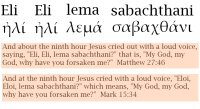
Eloi Eloi lama sabachthani --which means, My God, my God, why have you forsaken me?Most scholars believe that Jesus spoke Aramaic with some Hebrew, and possibly Greek. Generally, scholars believe that the towns of Nazareth [] and Capernaum [] where Jesus lived were Aramaic-speaking communities, that he was knowledgeable enough in Hebrew to discuss the Hebrew Bible, and that he might have known some Greek through commerce as a carpenter in nearby Sepphoris (see Tzippori). Accordingly, Jesus is believed to have addressed primarily Aramaic-speaking audiences.

This article explores Aramaic reconstructions of phrases in the New Testament as attributed to Jesus (Hebrew-Aramaic ישוע Yeshua, meaning "YHVH is salvation") and New Testament figures.

It is generally accepted that Jesus was born a Jew, and grew up in a Jewish family in Roman-controlled Palestine. For over a half-millennium, the colloquial language for Palestinian Jews was Aramaic, stemming from the Babylonian exile and invading Assyrian empire. For some Jews Hebrew remained a colloquial language, until the end of the 3rd century AD.

More...

Thursday, May 28, 2009

Aramaic

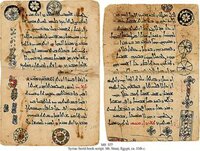
11th century book in Syriac Serto, Mount Sinai, Egypt.Aramaic is a Semitic language with a 3,000-year history. It has been the language of administration of empires and the language of divine worship. It is the original language of large sections of the biblical books of Daniel and Ezra, and is the main language of the Talmud. Aramaic is believed to have been the native language of Jesus (see also: Aramaic of Jesus). In the following passage, spoken by Jesus while being crucified, "Eloi, Eloi, lama sabachthani" is Aramaic. Matthew 27:46 has a direct parallel in Psalm 22 (written by David nearly 1,000 years before the birth of Jesus):
About the ninth hour Jesus cried out in a loud voice, "Eloi, Eloi, lama sabachthani?"—which means, "My God, my God, why have you forsaken me?" -Matthew 27:46
Even at the threshold of death, Jesus quotes scripture (See Psalm 22:1)
And this seems to be the state of this psalm, which is understood of the Messiah, by the Hebrew doctors themselves, and by Christ himself and by his apostles. And there are many passages in it, which were literally accomplished in him, and cannot be understood of any other. In this psalm David speaks of the humiliation of Christ, ver. 1 - 21. Of the exaltation of Christ, ver. 22 - 31. To the chief musician upon Aijeleth Shahar, A psalm of David.

Christian Classics Ethereal Library of Calvin College.
John Wesley's notes on Psalm 22


More...

Monday, December 08, 2008

Aramaic of Jesus

Eloi Eloi lama sabachthani --which means, My God, my God, why have you forsaken me? can be found in verses Matthew 27:46 and Mark 15:34Eloi Eloi lama sabachthani --which means, My God, my God, why have you forsaken me? can be found in verses Matthew 27:46 and Mark 15:34
Most scholars believe that Jesus spoke Aramaic with some Hebrew, and possibly Greek. Generally, scholars believe that the towns of Nazareth and Capernaum where Jesus lived were Aramaic-speaking communities, that he was knowledgeable enough in Hebrew to discuss the Hebrew Bible, and that he might have known some Greek through commerce as a carpenter in nearby Sepphoris (see Tzippori). Accordingly, Jesus is believed to have addressed primarily Aramaic-speaking audiences.

This article explores Aramaic reconstructions of phrases in the New Testament as attributed to Jesus (Hebrew-Aramaic ישוע Yeshua, meaning "YHVH is salvation") and New Testament figures.

It is generally accepted that Jesus was born a Jew, and grew up in a Jewish family in Roman-controlled Palestine. For over a half-millennium, the colloquial language for Palestinian Jews was Aramaic, stemming from the Babylonian exile and invading Assyrian empire. For some Jews Hebrew remained a colloquial language, until the end of the 3rd century AD.

More...

Thursday, March 20, 2008

The Last Supper

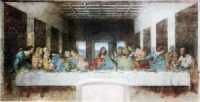
The Last Supper fresco in Milan (1498)  by Leonardo da Vinci.In the Christian faith, the Last Supper was the last meal Jesus shared with his apostles before his death. The Last Supper has been the subject of many different paintings, perhaps the most famous by Leonardo da Vinci. Christians celebrate the related events quasi-annually (annually on a Lunar Calendar) as Maundy Thursday.

In the New Testament

Chronology

The meal is discussed at length in the Gospel of Luke, chapter 22 of the Bible. It was the seder for the Passover, and it was in the morning of the same day the Paschal lamb, for the meal, had been sacrificed (see also: Korban).

However, under the Jewish method of reckoning time, the day was considered to begin straight after dusk, and so the Passover feast would be regarded as ocurring on the day after the lamb was sacrificed. This implies that either the synoptic gospels are not written with an awareness of the Jewish method of time reckoning (Kilgallen 264), or that they used the literary technique of telescoping events that actually happened on different days into just happening on single ones (Brown et al. 625).

More...

Saturday, February 23, 2008

Temple Tax

Silver shekel, BMC Phoenicia, Tyre mint, 92 - 91 B.C.; obverse laureate head of Melqarth right, lion’s skin knotted around neck; reverse TUROUIERAS KAIASULOU (of Tyre the holy and inviolable), eagle l., r. foot on ship’s ram, palm frond behind, date EL (year 35) over club and palm frond l., D right, Phoenician kaph between legs. image © forumancientcoins.comThe Gospel of Matthew tells us that Jesus paid the temple tax. In Jesus' day, the denarius was the form of money used to pay Caesar, but the temple tax was paid with the drachma. Luke 20 tells us that the teachers of the law and the chief priests sent spies to watch Jesus. They asked Him,
22 "Is it right for us to pay taxes to Caesar or not?" 23 He saw through their duplicity and said to them, 24 "Show me a denarius. Whose portrait and inscription are on it?"
Jesus asked to see a denarius and whose portrait and inscription were on it knowing that Caesar's portrait and inscription were on it, and He taught that it was right to uphold our witness as citizens of the communities where God has placed us.

In the time of Jesus, adult Jewish males (twenty years old or more) were required to pay a two-drachma tax each year, based upon the Old Testament Atonement Offering of Exodus 30:11-16, which was to be paid in the form of a half shekel (a weight of twenty gerahs or approximately 1/5 once or 6 grams). In Matthew's day, after the temple was destroyed this tax remained, but the tax was to be paid to the Roman government.

More...

Monday, December 03, 2007

Aramaic of Jesus

Eloi Eloi lama sabachthani --which means, My God, my God, why have you forsaken me?Most scholars believe that Jesus spoke Aramaic with some Hebrew, and possibly Greek. Generally, scholars believe that the towns of Nazareth and Capernaum where Jesus lived were Aramaic-speaking communities, that he was knowledgeable enough in Hebrew to discuss the Hebrew Bible, and that he might have known some Greek through commerce as a carpenter in nearby Sepphoris (see Tzippori). Accordingly, Jesus is believed to have addressed primarily Aramaic-speaking audiences.
This article explores Aramaic reconstructions of phrases in the New Testament as attributed to Jesus (Hebrew-Aramaic ישוע Yeshua, meaning "YHVH is salvation") and New Testament figures

Cultural and linguistic background

It is generally accepted that Jesus was born a Jew, and grew up in a Jewish family in Roman-controlled Palestine. For over a half-millennium, the colloquial language for Palestinian Jews was Aramaic, stemming from the Babylonian captivity and invading Assyrian empire. For some Jews Hebrew remained a colloquial language, until the end of the 3rd century AD. Nearly all of the Jewish scriptures were written in Hebrew, making it likely that a Jew who knew the Jewish scriptures also knew at least some Hebrew (especially as Hebrew and Aramaic are fairly cognate).

More...


Subscribe


LifeNews.com

Desiring God Blog

Youth for Christ International