Showing posts with label Nazareth. Show all posts

Saturday, September 10, 2011

Aramaic of Jesus

Most scholars believe that Jesus spoke Aramaic with some Hebrew, and possibly Greek. Generally, scholars believe that the towns of Nazareth and Capernaum where Jesus lived were Aramaic-speaking communities, that he was knowledgeable enough in Hebrew to discuss the Hebrew Bible, and that he might have known some Greek through commerce as a carpenter in nearby Sepphoris. Accordingly, Jesus is believed to have addressed primarily Aramaic-speaking audiences. The following verses are evidence of the Aramaic language being a commonly used language of the Jews: John 5:2; 19:20; Acts 21:40; 22:2; 26:14; Revelation 9:11.

This article explores Aramaic reconstructions of phrases in the New Testament as attributed to Jesus (Hebrew-Aramaic: Eashoa' "the Life-Giver" Msheekha "the Anointed One") – Eashoa' Msheekha: The Anointed Life-Giver The Hebrew יְהוֹשׁוּעַ Yĕhowshuwa` (Joshua or Jehoshua = "Jehovah is salvation" or "YHVH is salvation"), and New Testament figures.

It is generally accepted that Jesus was born a Jew, and grew up in a Jewish family in Roman-controlled Palestine. For over a half-millennium, the colloquial language for Palestinian Jews was Aramaic, stemming from the Babylonian exile and invading Assyrian empire. Golgotha, the place where Jesus was crucified, is Aramaic (Matthew 27:33; Mark 15:22; John 19:17) For some Jews Hebrew remained a colloquial language, until the end of the 3rd century AD.

Nearly all of the Jewish scriptures were written in Hebrew, making it likely that a Jew who knew the Jewish scriptures also knew at least some Hebrew (especially as Hebrew and Aramaic are fairly kindred).

There were also the Targums, Aramaic translations of the Hebrew Bible, in Galilee or Judea in the days of Jesus during the Early Roman Period. The use of Targums in the synagogue did not become customary until the 3rd century, after the use of spoken Hebrew declined in the aftermath of the catastrophic Bar Kochba Revolt.

More...

Sunday, February 27, 2011

Nazareth

Nazareth (Ναζαρά Nazara "the guarded one," Arabic: الناصرة) is an ancient town in the North District in Israel. In the New Testament, it is described as ordinary residence and home town of Jesus Christ, and is a center of Christian pilgrimage, with many shrines commemorating biblical associations.

Etymology
The etymology of Nazareth from as early as Eusebius up until the 20th century has been said to derive from netser, a "shoot" or "sprout", while the apocryphal Gospel of Phillip derives the name from Nazara meaning "truth". "Nazarene," meaning "of the village of Nazareth," should not be confused with "Nazirite," meaning a "separated" Jew.

Modern-day Nazareth is nestled in a hollow plateau some 1,200 feet (350m) above sea level, located between 1,600 foot high hills that form the most southerly points of the Lebanon mountain range. It is about 25 km from the Sea of Galilee and about 9 km west from Mount Tabor. The modern city lies lower down upon the hill than did the ancient one. The main road for traffic between Egypt and the interior of Asia passes by Nazareth near the foot of Tabor, and thence northward to Damascus.

Nazareth has an estimated population of 60,000. The majority of residents are Israeli Arabs, about 35-40% of whom are Christians and the rest Muslims.

Archaeological history
Archaeological research has revealed a funerary and cult center at Kfar HaHoresh, about two miles from Nazareth, dating roughly 9000 years ago (in what is known as the Pre-Pottery Neolithic B era). The remains of some 65 individuals were found, buried under huge horizontal headstone structures, some of which consisted of up to 3 tons of locally-produced white plaster. Decorated human skulls found have led archaeologists to believe that Kfar HaHoresh was a major cult center in that remote era.

More...

also includes Mars Hill Church video with @pastormark  in Nazareth talking about Luke 1:46-56.

Monday, December 08, 2008

Aramaic of Jesus

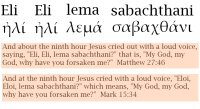
Eloi Eloi lama sabachthani --which means, My God, my God, why have you forsaken me? can be found in verses Matthew 27:46 and Mark 15:34Eloi Eloi lama sabachthani --which means, My God, my God, why have you forsaken me? can be found in verses Matthew 27:46 and Mark 15:34
Most scholars believe that Jesus spoke Aramaic with some Hebrew, and possibly Greek. Generally, scholars believe that the towns of Nazareth and Capernaum where Jesus lived were Aramaic-speaking communities, that he was knowledgeable enough in Hebrew to discuss the Hebrew Bible, and that he might have known some Greek through commerce as a carpenter in nearby Sepphoris (see Tzippori). Accordingly, Jesus is believed to have addressed primarily Aramaic-speaking audiences.

This article explores Aramaic reconstructions of phrases in the New Testament as attributed to Jesus (Hebrew-Aramaic ישוע Yeshua, meaning "YHVH is salvation") and New Testament figures.

It is generally accepted that Jesus was born a Jew, and grew up in a Jewish family in Roman-controlled Palestine. For over a half-millennium, the colloquial language for Palestinian Jews was Aramaic, stemming from the Babylonian exile and invading Assyrian empire. For some Jews Hebrew remained a colloquial language, until the end of the 3rd century AD.

More...

Tuesday, December 18, 2007

Nazareth

Nazareth on the map of IsraelNazareth (Arabic الناصرة) is an ancient town in the North District in Israel. In the New Testament, it is described as the childhood home of Jesus, and is a center of Christian pilgrimage, with many shrines commemorating biblical associations.

Etymology

The etymology of Nazareth from as early as Eusebius up until the 20th century has been said to derive from netser, a "shoot" or "sprout", while the apocryphal Gospel of Phillip derives the name from Nazara meaning "truth". "Nazarene," meaning "of the village of Nazareth," should not be confused with "Nazirite," meaning a "separated" Jew.

Geography and Population

Modern-day Nazareth is nestled in a hollow plateau some 1,200 feet (350m) above sea level, located between 1,600 foot high hills that form the most southerly points of the Lebanon mountain range. It is about 25 km from the Sea of Galilee and about 9 km west from Mount Tabor. The modern city lies lower down upon the hill than did the ancient one. The main road for traffic between Egypt and the interior of Asia passes by Nazareth near the foot of Tabor, and thence northward to Damascus.

Nazareth has an estimated population of 60,000. The majority of residents are Israeli Arabs, about 35-40% of whom are Christians and the rest Muslims.

More...


Subscribe


LifeNews.com

Desiring God Blog

Youth for Christ International