Showing posts with label Hebrew. Show all posts

Saturday, September 10, 2011

Aramaic of Jesus

Most scholars believe that Jesus spoke Aramaic with some Hebrew, and possibly Greek. Generally, scholars believe that the towns of Nazareth and Capernaum where Jesus lived were Aramaic-speaking communities, that he was knowledgeable enough in Hebrew to discuss the Hebrew Bible, and that he might have known some Greek through commerce as a carpenter in nearby Sepphoris. Accordingly, Jesus is believed to have addressed primarily Aramaic-speaking audiences. The following verses are evidence of the Aramaic language being a commonly used language of the Jews: John 5:2; 19:20; Acts 21:40; 22:2; 26:14; Revelation 9:11.

This article explores Aramaic reconstructions of phrases in the New Testament as attributed to Jesus (Hebrew-Aramaic: Eashoa' "the Life-Giver" Msheekha "the Anointed One") – Eashoa' Msheekha: The Anointed Life-Giver The Hebrew יְהוֹשׁוּעַ Yĕhowshuwa` (Joshua or Jehoshua = "Jehovah is salvation" or "YHVH is salvation"), and New Testament figures.

It is generally accepted that Jesus was born a Jew, and grew up in a Jewish family in Roman-controlled Palestine. For over a half-millennium, the colloquial language for Palestinian Jews was Aramaic, stemming from the Babylonian exile and invading Assyrian empire. Golgotha, the place where Jesus was crucified, is Aramaic (Matthew 27:33; Mark 15:22; John 19:17) For some Jews Hebrew remained a colloquial language, until the end of the 3rd century AD.

Nearly all of the Jewish scriptures were written in Hebrew, making it likely that a Jew who knew the Jewish scriptures also knew at least some Hebrew (especially as Hebrew and Aramaic are fairly kindred).

There were also the Targums, Aramaic translations of the Hebrew Bible, in Galilee or Judea in the days of Jesus during the Early Roman Period. The use of Targums in the synagogue did not become customary until the 3rd century, after the use of spoken Hebrew declined in the aftermath of the catastrophic Bar Kochba Revolt.

More...

Monday, August 29, 2011

Ariel

Ari'al, Shomron, Israel
The city of 'Ari'el (Hebrew: אֲרִיאֵל Arabic: اريئيل‎) is an Israeli settlement on the West Bank, in the Biblical region of Samaria near the ancient village of Timnath-serah. Established in 1978, its population as of 17,600 (2009), including 7,000 immigrants from the former Soviet Union. It is the fifth largest Israeli community in the territories that Israel captured from Jordan of as a result of the Six-Day War in 1967. The Israeli Ministry of the Interior gave the municipality of Ariel the status of a city council in 1998.

Ariel is situated approximately 40 kilometres (25 mi) (25 miles) east of Tel Aviv, 40 kilometres (25 mi) (25 miles) west of the Jordan River, and 60 kilometres (37 mi) (38 miles) northwest of Jerusalem. It lies southwest of Nablus/Shechem, north of Ramallah and southeast of Qalqilyah. The city is connected to the Tel Aviv area by the Trans-Samaria Highway and to Jerusalem by Route 60.

In Hebrew, Ariel (אֲרִיאֵל), literally means "Lion of God" or "lioness of God" (See also: 2 Sam 23:20, 1 Chr 11:22). "Ari" (Lion) in Hebrew is also a synonym for bravery and courage and it is also the symbol of the tribe of Judah. Ariel in the Hebrew Bible is one of the names for Jerusalem and the Temple of Jerusalem.

More...

Ariel - City with a Heart by CityAriel

Thursday, April 14, 2011

Passover Seder

The Passover Seder (Hebrew: סדר, Seder, "order", "arrangement") is a special Jewish ritual which takes place on the first evening of the Jewish feast of Passover (the 15th day of Nisan on the Hebrew calendar) in Israel , and on the first and second evenings of Passover (the 15th and 16th days of Nisan) in the Jewish Diaspora.
This year's Passover begins on sunset of Monday, April 18 and goes through Monday the 25th of April, 2011
Incorporating the holiday meal, the Seder relives the enslavement and subsequent Exodus of the Children of Israel from Ancient Egypt through the words of the Haggadah, the drinking of Four Cups of Wine, the eating of matzot, and the eating of and reference to symbolic foods placed on the Passover Seder Plate.

In the following passage from exodus, the Hebrew word for feast is חג chag, meaning "festival, feast, festival-gathering, pilgrim-feast" from חָגַג chagag, "to hold a feast, hold a festival, make pilgrimage, keep a pilgrim-feast, celebrate, dance, stagger."

The Seder itself is based on the Biblical verse commanding Jews to retell the story of the Exodus from Egypt:
8 You shall tell your son on that day, 'It is because of what the LORD did for me when I came out of Egypt.' (Exodus 13:8 ESV)

The Seder is considered an integral aspect of Jewish faith and identity. As the Haggadah—which contains the complete Seder service—explains, without the Exodus, the Jews would still be slaves to the Egyptian Pharaoh and would never have realized their role as a nation. Therefore this is an occasion for much praise and thanksgiving to God. It is considered a mitzvah (commandment) to embellish one's retelling of the Exodus on this night. Often the Seder lasts into the early hours of the morning of the next day, as participants continue to learn Torah and talk about the events of the night and sing special Passover songs included in the Haggadah.

More...

Saturday, November 27, 2010

Isaac

Isaac (Hebrew: יצחק Yitschaq "he will laugh" or "he laughs") was the only son of Abraham (אברם 'Abram / אברהם 'Abraham) and Sarah (שרי Saray / שרה Sarah) and the father of Jacob (יעקב Ya`aqob) and Esau (עשו `Esav) as described in the book of Genesis of the Hebrew Bible. Isaac was the longest-lived of the patriarchs (one hundred and eighty years), and the only biblical patriarch whose name was not changed. Isaac was also the only patriarch who did not leave Canaan, although he once tried to leave and God told him not to do so:
1 Now there was a famine in the land, besides the former famine that was in the days of Abraham. And Isaac went to Gerar to Abimelech king of the Philistines. 2 And the LORD appeared to him and said, "Do not go down to Egypt; dwell in the land of which I shall tell you. 3 Sojourn in this land, and I will be with you and will bless you, for to you and to your offspring I will give all these lands, and I will establish the oath that I swore to Abraham your father. 4 I will multiply your offspring as the stars of heaven and will give to your offspring all these lands. And in your offspring all the nations of the earth shall be blessed, 5 because Abraham obeyed my voice and kept my charge, my commandments, my statutes, and my laws.

Compared to other patriarchs in the Bible, his story is less colorful, relating few incidents of his life.

Abraham's willingness to follow God's command to sacrifice Isaac has been viewed by early as well as modern Christianity as an example of faith and obedience.

More...

 Isaac and Abimelech — Genesis 26:1–34

Thursday, November 04, 2010

Zealot

feature: Music by
Ofra Haza
"Yerushalaim Shel Zahav"
"Jerusalem of Gold"
A member of an ancient Jewish sect in Judea in the first century who fought to the death against the Romans and who killed or persecuted Jews who collaborated with the Romans. Zealotry (with an upper case "Z") was a movement in first century Judaism, described by Flavius Josephus as one of the "four sects" at this time. The term Zealot, Kanahi (or qana' Hebrew: קנאי plural: kanahim, קנאים); is a term given for a "zealot". It literally means one who is "burning with zeal" on behalf of God. The term is Greek in origin. The lower case form in modern English is used to refer to any form of zeal, especially in cases where activism and ambition in relation to ideology have become excessive, possibly to the point of being harmful to others, oneself, and one's own cause. A zealous person is called a zealot. In non-political or non-religious terms, zeal is an ordinary word and simply means extreme enthusiasm and passion for a particular activity.

Zealotry was originally a political movement in first century Judaism which sought to incite the people of Iudaea Province to rebel against the Roman Empire and expel it from the holy land by force of arms, most notably during the Great Jewish Revolt (AD 66-70).Two of Judas' sons, Jacob and Paul, were involved in a revolt and were executed by Tiberius Alexander, the procurator of Iudaea province from 46 to 48. Zealotry was described by Jewish historian Flavius Josephus as one of the "four sects" at this time.

More...

Thursday, July 29, 2010

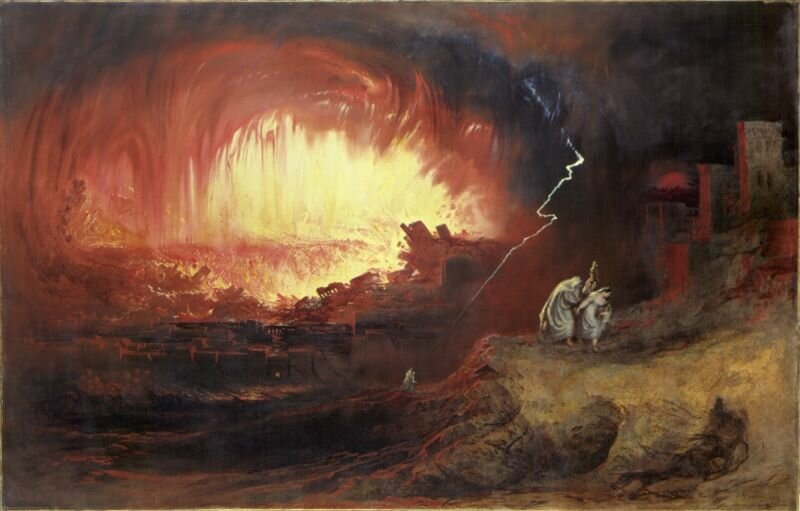
Sodom and Gomorrah

In the Bible, (סְדֹם) Sodom and (עֲמֹרָה) Gomorrah were two cities destroyed by God for their sins. In Hebrew Sodom, a city in the Valley of Siddim near the south end of the Dead Sea, which with three others was destroyed in the time of Abraham and submerged in the Dead Sea. (numerous: Gen 10:19 - Rev 11:8) Hence vines of Sodom, which were probably degenerated and inferior, (comp. the apples of Sodom Jos. B. J. 4. 8.4) are put Deut. 32 as the emblem of a degenerate state:
For their vine comes from the vine of Sodom and from the fields of Gomorrah; their grapes are grapes of poison; their clusters are bitter;
comp. Jer. 2:21:
Yet I planted you a choice vine, wholly of pure seed. How then have you turned degenerate and become a wild vine?
Also judges of Sodom, i. q. unjust and corrupt judges, Is. 1:10:
Hear the word of the Lord, you rulers of Sodom! Give ear to the teaching of our God, you people of Gomorrah!
The name may signify burning, conflagration, as being built on a bituminous soil and therefore perhaps exposed to frequent fires; comp. the name Karaxixavfiivtj given to a part of Phrygia. Or it may be i. q. nallE field, vineyard, q. v.— On the site and catastrophe of Sodom.

More...

Friday, June 25, 2010

The history of Ancient Israel

The history of Ancient Israel and Judah is known to us from classical sources including Judaism's Tanakh or Hebrew Bible (known to Christianity as the Old Testament), the Talmud, the Ethiopian Kebra Nagast, the writings of Nicolaus of Damascus, Artapanas, Philo of Alexandria and Flavius Josephus supplemented by ancient sources uncovered by biblical archaeology including Egyptian, Moabite, Assyrian, Babylonian as well as Israelite and Judean inscriptions.

It was also subject to domination by adjacent empires, beginning with Egypt in the late 3rd millennium BCE.

Traditions regarding the early history found in later works such as the Kebra Nagast and commentaries of Rashi, Philo of Alexandria, and numerous others, (besides of course, the Tanakh) refer to the early inhabitants as the sons of Shem and also speak of an invasion by the people known as Canaanites (see Canaan) descended from Ham.

The Book of Jubilees states that the land was originally allotted to Shem and Arphaxad (ancestor of the Hebrews) when it was still vacant, but was wrongfully occupied by Canaan and his son Sidon. Jubilees makes this, then, the true justification for the later war to drive out the Canaanites.

The Kebra Nagast, however, speaks of the Canaanites invading existing cities of Shem and Ibn Ezra, similarly notes that they had seized land from earlier inhabitants. Rashi mentions that the Canaanites were seizing land from the sons of Shem in the days of Abraham.

The patriarchal period

The patriarchal period begins with Abraham. The Bible places the events surrounding Abraham (originally Abram) circa 1800 BCE, give or take 100 years. The account of his life is found in Genesis 11, at the close of a genealogy of the sons of Shem (which includes among its members Eber, the eponym of the Hebrews).

His father Terah came from Ur Kasdim. His father moved his family, including his son Abram, from Ur Kasdim to the city of Haran.

More...

Monday, April 12, 2010

Zechariah

Zechariah or Zecharya (Hebrew: זְכַרְיָה, "Renowned/Remembered of/is the Lord") was a person in the Old Testament bible and Jewish Tanakh. He was the author of the Book of Zechariah.

It is a theophoric name, the ending -iah being a short Hebrew form for the Tetragrammaton.

He was a prophet of the two-tribe kingdom of Judah, and the eleventh of the minor prophets. Like Ezekiel, he was of priestly extraction. He describes himself (Zechariah 1:1) as "the son of Berechiah." In Ezra 5:1 and 6:14 he is called "the son of Iddo," who was properly his grandfather. His prophetical career began in the second year of Darius, king of Persia (B.C. 520), about sixteen years after the return of the first company from their Babylonian exile. He was contemporary with Haggai (Ezra 5:1).

Although there is an indication in Targum Lamentations that "Zechariah son of Iddo" was killed in the Temple, scholars generally understand this as a reference to the death of a much earlier figure, Zechariah Ben Jehoiada.

More...

Wednesday, June 04, 2008

Samuel

The prophet Samuel. The Fresco Painting. Circa 1112 From the Mikhailovskr Monastery of KievSamuel or Shmu'el (Hebrew: שְׁמוּאֵל) is an important leader of ancient Israel in the Book(s) of Samuel in the Hebrew Bible.

His status, as viewed by rabbinical literature, is that he was the last of the Hebrew Judges and the first of the major prophets who began to prophesy inside the Land of Israel. He was thus at the cusp between two eras.

According to the text of the Book(s) of Samuel, he also selected/anointed the first two kings of the Kingdom of Israel: King Saul and King David.

Name


According to 1 Samuel 1:20, Hannah was the mother of Samuel and named him in memory of her requesting a child from God and God listening. However, this position is disputed by some textual scholars who consider that the passage originally referred to Saul, and was later doctored.

For the suggested etymology of the passage to work for the name Samuel requires it to be translated as Heard of God ('Shama', heard; 'El', god/El (a god)), or possibly as a sentence "God has heard", with "Shama" as the verb and "El" as the subject. Saul on the other hand means asked, and so certain scholars think an anti-monarchial editor changed the narrative so that Saul would no longer appear to have a divinely appointed birth.

More...
 

Subscribe


LifeNews.com

Desiring God Blog

Youth for Christ International