Showing posts with label Old Testament. Show all posts

Tuesday, October 04, 2011

Abrahamic religion

In the study of comparative religion, an Abrahamic religion is any of those religions deriving from a common ancient Semitic tradition and traced by their adherents to Abraham (Hebrew: אברהם 'Abraham "Father/Leader of many", previously אברם 'Abram see Gen 17:5, Arabic ابراهيم), a patriarch whose life is narrated in the Hebrew Bible/Old Testament, and as a prophet in the Qur'an.

This forms a large group of related, largely monotheistic religions, generally held to include Judaism, Christianity, Islam, and the Bahá’í Faith (based upon Islam), and comprises about half of the world's religious adherents.

According to the Jewish tradition, Abraham was the first person to reject idolatry, hence he symbolically appears as the founder of monotheistic religions. In that sense, Abrahamic religion could be simply equated with monotheistic religion, but not all monotheistic religions are Abrahamic. In Islam he is considered as the first monotheist and is often refered to as Ibrahim al-Hanif or Abraham the Monotheist. The term, desert monotheism, is sometimes used for a similar purpose of comparison in historical contexts, but not for modern faiths.

All the Abrahamic religions are derived to some extent from Judaism as practiced in ancient kingdoms of Israel and Judah prior to the Babylonian Exile, at the beginning of the 1st millennium BCE. Many believe that Judaism in Biblical Israel was renovated and reformed to some extent in the 6th century BCE by Ezra and other priests returning to Israel from the exile. Samaritanism separated from Judaism in the next few centuries.

Christianity originated in Judea, at the end of the 1st century, as a radically reformed branch of Judaism; it spread to ancient Greece and Rome, and from there to most of Europe, Asia, the Americas, and many other parts of the world. Over the centuries, Christianity split into many separate churches and denominations. A major split in the 5th century separated various Oriental Churches from the Catholic church centered in Rome. Other major splits were the East-West Schism in the 11th century, separating the Roman Catholic Church from the Eastern Orthodox Churches; and the Protestant Reformation of the 16th century, that gave birth to hundreds of independent Protestant denominations.

More...

Friday, June 25, 2010

The history of Ancient Israel

The history of Ancient Israel and Judah is known to us from classical sources including Judaism's Tanakh or Hebrew Bible (known to Christianity as the Old Testament), the Talmud, the Ethiopian Kebra Nagast, the writings of Nicolaus of Damascus, Artapanas, Philo of Alexandria and Flavius Josephus supplemented by ancient sources uncovered by biblical archaeology including Egyptian, Moabite, Assyrian, Babylonian as well as Israelite and Judean inscriptions.

It was also subject to domination by adjacent empires, beginning with Egypt in the late 3rd millennium BCE.

Traditions regarding the early history found in later works such as the Kebra Nagast and commentaries of Rashi, Philo of Alexandria, and numerous others, (besides of course, the Tanakh) refer to the early inhabitants as the sons of Shem and also speak of an invasion by the people known as Canaanites (see Canaan) descended from Ham.

The Book of Jubilees states that the land was originally allotted to Shem and Arphaxad (ancestor of the Hebrews) when it was still vacant, but was wrongfully occupied by Canaan and his son Sidon. Jubilees makes this, then, the true justification for the later war to drive out the Canaanites.

The Kebra Nagast, however, speaks of the Canaanites invading existing cities of Shem and Ibn Ezra, similarly notes that they had seized land from earlier inhabitants. Rashi mentions that the Canaanites were seizing land from the sons of Shem in the days of Abraham.

The patriarchal period

The patriarchal period begins with Abraham. The Bible places the events surrounding Abraham (originally Abram) circa 1800 BCE, give or take 100 years. The account of his life is found in Genesis 11, at the close of a genealogy of the sons of Shem (which includes among its members Eber, the eponym of the Hebrews).

His father Terah came from Ur Kasdim. His father moved his family, including his son Abram, from Ur Kasdim to the city of Haran.

More...

Thursday, July 17, 2008

Exodus

The Schøyen Collection MS 206, Oslo and London. Hebrew square book script. Iraq, 1st half of 11th c. MS in Hebrew and Aramaic on vellum, Iraq, first half of 11th c., 8 ff., 39x33 cm, 2 columns, (25x25 cm), 23 lines in a large Hebrew square book script, by a scribe perhaps originating from the Maghreb (North Africa probably Tunisia). Provenance: 1. The Genizah of a Kurdistan Jewish community, North Iraq (until 1950/59); 2. Dr. Fischel, U.S.A.(from 1950/59; 3. Bernard Rosenthal, San Francisco. Commentary: The Aramaic translation is verse by verse. Among the earliest group of surviving Hebrew targum Bible MSS in codex form. Exhibited: XVI Congress of the International Organization for the study of the Old Testament. Library of Law Faculty, University of Oslo, 29 July - 7 August 1998. Elizabeth G. Sørenssen & Jingru Høivik: photography and formatting. The text covers Exodus 12:25-31, beginning in Hebrew with the second word. The first word is the end of the Aramaic Targum of v.24; The Targum of v.31 is not complete, presumably continuing on the next page.The (Greek: "departure") book of Exodus is the second book of the Torah (the Pentateuch Genesis, Exodus, Leviticus, Numbers, Deuteronomy;) and also the Tanakh (the Hebrew bible), and Christian old testament. The major events of the book concern the exodus, a departure of Hebrew slaves from Egypt, through the wilderness, under the leadership of Moses to the Mountain of God (Mount Sinai). Jews call the book by its first words ve-eleh shemoth (i.e., "and these are the names") or simply "shemoth" שמות. The septuagint designates the second book of the Pentateuch as "exodus", meaning "departure" or "out-going".

The Latin translation adopted the name, which thence passed into other languages. As a result of the theme of the first half of the book, the term "an exodus" has come to mean a departure of a great number of people.

The book is generally broken into six sections:

  1. The account of the growth of the Israelites into a peoples, their enslavement in Egypt, and eventual escape (Chapters 1-12);
  2. The journey from Egypt to Mount Sinai (Chapters 13-18);
  3. The formation of a covenant between Yahweh and the people, and its associated laws (Chapters 19-24);
  4. Intricate instructions for the construction of a tabernacle, priestly robes, and other ritual objects (Chapters 25-31);
  5. The episode of the golden calf, and the regiving of the law (Chapters 32-34);
  6. The construction of the tabernacle, priestly robes, and other ritual objects (Chapters 35-40).

More...

Friday, June 08, 2007

Old Testament

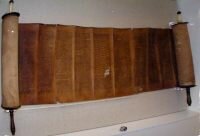
Tora Scroll, Germany about 1830. Part of the exhibition in the Jewish Museum Westphalia, Dorsten, GermanyThe first of the two main divisions of the bible, containing the books of the old or Mosaic Covenant, and including the historical books, the prophets, and poetical books.

The Old Testament or the Hebrew Scriptures (also called the Hebrew Bible) constitutes the first major part of the Bible according to Christianity. It is usually divided into the categories of law, history, poetry (or wisdom books) and prophecy. All of these books were written before the birth of Jesus of Nazareth, who is the subject of the subsequent Christian New Testament. The Bible of Jesus is the Old Testament, specifically according to the Gospel of Luke 24:44–45 "written in the law of Moses, and in the prophets, and in the psalms ... the scriptures". According to historians, the Old Testament was composed between the 5th century BC and the 2nd century BC, though parts of it, such as the Torah, date back much earlier.

More...
 

Subscribe


LifeNews.com

Desiring God Blog

Youth for Christ International