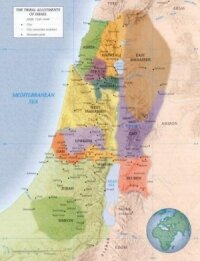
Showing posts with label Judah. Show all posts

Saturday, September 24, 2011

Tribes Of Israel

Israel had 12 sons, as follows: Reuben, (ראובן Rĕ'uwben, Jacob's firstborn); Simeon, (שמעון Shim`own); Levi, (לוי Leviy); Judah, (יהודה Yĕhuwdah); Dan, (דן Dan); Naphtali, (נפתלי Naphtaliy); Gad, גד( Gad); Asher, (אשר 'Asher); Issachar, (יששכר Yissaskar); Zebulun, (זבולון Zĕbuwluwn); Joseph, (יוסף Yowceph); –Manasseh, (מנשה Mĕnashsheh); Ephraim, (אפרים 'Ephrayim);– and Benjamin (בנימין Binyamiyn). (Jacob was renamed Israel Gen. 32:27-29)

Yĕhowshuwa` (יְהוֹשׁוּעַ)
Lion Of Judah
(King of Kings)
The Tribe of Levi was set apart from the others in the sense that, the members of the Tribe of Levi were to be in charge of the tabernacle of the Testimony.
The Tribe of Joseph is not usually listed with the Hebrew tribes although Joseph is one of Jacobs twelve sons, the eldest of Rachel. It is sometimes referred to as the House of Joseph. Rather, the two tribes founded by his sons Ephraim and Manasseh are listed separately.

More...

Thursday, September 30, 2010

Judah

Judah ("Praise") is the name of several Biblical and historical figures. The original Greek text of the New Testament makes no difference between the names "Judah", "Judas" and "Jude", rendering them all as Yĕhuwdah; but in many English translations "Judah" is used for the Old Testament figure and the tribe (tribe of Judah) named after him, "Judas" is used primarily for Judas Iscariot, and "Jude" for other New Testament persons of the same name.
  • One of the sons of the Biblical patriarch Jacob.
  • The tribe of Judah formed by Judah's offspring
The kingdom ruled by the house of David after the Kingdom of Israel broke off following the death of King Solomon.

Judah (Hebrew: יהודה Yĕhuwdah from the root word יָדָה yadah "to throw, to confess, to point out with hand extended") was, according to the Book of Genesis, the fourth son of Jacob and Leah, and the founder of the Israelite Tribe of Judah; however some Biblical scholars view this as postdiction, an eponymous metaphor providing an etiology of the connectedness of the tribe to others in the Israelite confederation. With Leah as a matriarch, Biblical scholars regard the tribe as having been believed by the text's authors to have been part of the original Israelite confederation; however, it is worthy of note that the tribe of Judah was not purely Israelite, but contained a large admixture of non-Israelites, with a number of Kenizzite groups, the Jerahmeelites, and the Kenites, merging into the tribe at various points.

More...

Tuesday, September 21, 2010

The Tribes of Israel

Israel had 12 sons, as follows: Reuben, (ראובן Rĕ'uwben, Jacob's firstborn); Simeon, (שמעון Shim`own); Levi, (לוי Leviy); Judah, (יהודה Yĕhuwdah); Dan, (דן Dan); Naphtali, (נפתלי Naphtaliy); Gad, גד (Gad); Asher, (אשר 'Asher); Issachar, (יששכר Yissaskar); Zebulun, (זבולון Zĕbuwluwn); Joseph, (יוסף Yowceph);  –Manasseh, (מנשה Mĕnashsheh); and Ephraim– (אפרים 'Ephrayim); and Benjamin (בנימין Binyamiyn). (Jacob was renamed Israel Gen. 32:27-29)

The House of Joseph (sometimes referred to as the Tribe of Joseph) were the Old Testament tribes of Ephraim and Manasseh. Both of these tribes were descendants of Joseph's two sons, Ephraim and Manasseh, who are both first mentioned in Genesis 41:50-52. In Genesis 48 Ephraim and Manasseh are taken to see a dying Jacob, who blesses Ephraim (the younger son) with his right hand and Manasseh with his left hand (see Genesis 48:14,19).

The Tribe of Levi was set apart from the others in the sense that, the members of the Tribe of Levi were to be in charge of the tabernacle of the Testimony.

The Tribe of Joseph is not usually listed with the Hebrew tribes although Joseph is one of Jacobs twelve sons, the eldest of Rachel. It is sometimes referred to as the House of Joseph. Rather, the two tribes founded by his sons Ephraim and Manasseh are listed separately.

Tribal Divisions

Politically, the Israelites were composed of thirteen tribes: Reuben, Simeon, Levi, Judah, Dan, Naphtali, Gad, Asher, Issachar, Zebulun, Manasseh, Ephraim, and Benjamin. In parts of the Bible, Ephraim and Manasseh are treated as together constituting the House of Joseph, while the Levi have a special religious role and had only scattered cities as territory; whence traditionally either Ephraim and Manasseh were counted as one tribe, or Levi wasn't counted, so that together the tribes were the Twelve Tribes of Israel (see also: Gen. 32: 27-29, Gen. 48:5).

More...

Friday, June 25, 2010

The history of Ancient Israel

The history of Ancient Israel and Judah is known to us from classical sources including Judaism's Tanakh or Hebrew Bible (known to Christianity as the Old Testament), the Talmud, the Ethiopian Kebra Nagast, the writings of Nicolaus of Damascus, Artapanas, Philo of Alexandria and Flavius Josephus supplemented by ancient sources uncovered by biblical archaeology including Egyptian, Moabite, Assyrian, Babylonian as well as Israelite and Judean inscriptions.

It was also subject to domination by adjacent empires, beginning with Egypt in the late 3rd millennium BCE.

Traditions regarding the early history found in later works such as the Kebra Nagast and commentaries of Rashi, Philo of Alexandria, and numerous others, (besides of course, the Tanakh) refer to the early inhabitants as the sons of Shem and also speak of an invasion by the people known as Canaanites (see Canaan) descended from Ham.

The Book of Jubilees states that the land was originally allotted to Shem and Arphaxad (ancestor of the Hebrews) when it was still vacant, but was wrongfully occupied by Canaan and his son Sidon. Jubilees makes this, then, the true justification for the later war to drive out the Canaanites.

The Kebra Nagast, however, speaks of the Canaanites invading existing cities of Shem and Ibn Ezra, similarly notes that they had seized land from earlier inhabitants. Rashi mentions that the Canaanites were seizing land from the sons of Shem in the days of Abraham.

The patriarchal period

The patriarchal period begins with Abraham. The Bible places the events surrounding Abraham (originally Abram) circa 1800 BCE, give or take 100 years. The account of his life is found in Genesis 11, at the close of a genealogy of the sons of Shem (which includes among its members Eber, the eponym of the Hebrews).

His father Terah came from Ur Kasdim. His father moved his family, including his son Abram, from Ur Kasdim to the city of Haran.

More...

Saturday, April 17, 2010

Tree of Jesse

The Tree of Jesse (Hebrew:ישי Yishay) refers to a passage in the biblical Book of Isaiah which metaphorically describes the descent of the Messiah and is accepted by Christians as pertaining to Jesus, and is often represented in art, particularly in that of the Medieval period, the earliest dating from the 11th century.
1 There shall come forth a shoot from the stump of Jesse, and a branch from his roots shall bear fruit.

2 And the Spirit of the LORD shall rest upon him, the Spirit of wisdom and understanding, the Spirit of counsel and might, the Spirit of knowledge and the fear of the LORD.

3 And his delight shall be in the fear of the LORD. He shall not judge by what his eyes see, or decide disputes by what his ears hear,” (Isaiah 11:1-3 ESV)

More...

Wednesday, March 24, 2010

Joel

Joel (Hebrew: יואל‎) was a prophet of ancient Israel, the second of the twelve minor prophets and the author of the Book of Joel.

He is mentioned by name only once in the Hebrew Bible, in the introduction to his own brief book, as the son of Pethuel (Joel 1:1⁠). The name Joel combines the covenant name of God, YHWH (sometimes written Jehovah), and el (god), and has been translated as "one to whom Jehovah is God," that is, a worshipper of YHWH.

The dates of his life are unknown; he may have lived anywhere from the 9th century BCE to the 5th century BCE, depending on the dating of his book. He was from Judah/Judea, and, judging from its prominence in his prophecy, was quite possibly a prophet associated with the ritual of the temple of Jerusalem.

More...

Friday, January 08, 2010

Kingdom of Judah

Map of the Tribe of Judah areaThe Kingdom of Judah (Hebrew מַלְכוּת יְהוּדָה) in the times of the Hebrew Bible, was the nation formed from the territories of the tribes of Judah, Simeon, and Benjamin after the Kingdom of Israel was divided, and was named after Judah, son of Jacob (Israel, see sons of Jacob). The name Judah itself means "Praise of God."

Judah is often referred to as the Southern Kingdom to distinguish it from the Northern Kingdom (the Kingdom of Israel) after the division of the Kingdom. Judah's capital was Jerusalem. (see also History of ancient Israel)

After the death of king Saul (2 Samuel 2:1-11), around 920 BCE, Jeroboam led the revolt of the northern tribes, and established the Kingdom of Israel (1 Kings 11-14), consisting of nine tribes: Zebulun, Issachar, Asher, Naphtali, Dan, Menasseh, Ephraim, Reuben and Gad (and some of Levi), with Samaria as its capital. But very soon after the tribe of Benjamin joined the tribe of Judah, and Jerusalem became the capital of the new kingdom (Joshua 18:28), which was called the kingdom of Judah.

More...

Monday, June 29, 2009

Tribe of Judah

Map of the twelve tribes of IsraelThe Tribe of Judah (hebrew: יְהוּדָה, "praise" n. Judea; Judah, Yehuda (name), Jude; nm. Judaization) is one of the Hebrew tribes of Israel, founded by Judah, son of Jacob.

Together with the Tribe of Benjamin, descendants of Judah eventually formed the southern kingdom of Judah in the ancient land of Israel, when the kingdom of Israel was divided. These two tribes were thus not carried into captivity with the ten tribes of the northern kingdom of Israel when it fell. This started the tradition (some say myth) of the ten lost tribes of Israel.

As the Tribe of Benjamin was always very much the minor partner, in time the tribe of Judah became identified with the entire Israelite nation, and even the entire Hebrew nation, and gave their name to the Jews.

Judah and his three surviving sons went down with Jacob into Ancient Egypt (Gen. 46:12; Ex. 1:2). At the time of the Exodus, when we meet with the family of Judah again, they have increased to the number of 74,600 males (Num. 1:26-27).

More...

Tuesday, January 13, 2009

Judah

Tribe of JudahJudah (יְהוּדָה "Praise") is the name of several Biblical and historical figures. The original Greek text of the New Testament makes no difference between the names "Judah", "Judas" and "Jude", rendering them all as Yĕhuwdah; but in many English translations "Judah" is used for the Old Testament figure and the tribe (tribe of Judah) named after him, "Judas" is used primarily for Judas Iscariot, and "Jude" for other New Testament persons of the same name.

The kingdom ruled by the house of David after the Kingdom of Israel broke off following the death of King Solomon, see Kingdom of Judah.

Judah/Yehuda (Hebrew: יְהוּדָה)) was, according to the Book of Genesis, the fourth son of Jacob and Leah, and the founder of the Israelite Tribe of Judah; however some Biblical scholars view this as postdiction, an eponymous metaphor providing an etiology of the connectedness of the tribe to others in the Israelite confederation. With Leah as a matriarch, Biblical scholars regard the tribe as having been believed by the text's authors to have been part of the original Israelite confederation; however, it is worthy of note that the tribe of Judah was not purely Israelite, but contained a large admixture of non-Israelites, with a number of Kenizzite groups, the Jerahmeelites, and the Kenites, merging into the tribe at various points.

The text of the Torah argues that the name of Judah refers to Leah's intent to praise Yahweh, on account of having achieved four children, and derived from odeh, meaning I will give praise. In classical rabbinical literature, the name is interpreted as just being a combination of Yahweh and a dalet (the letter d); in Gematria, the dalet has the numerical value 4, which these rabbinical sources argue refers to Judah being Jacob's fourth son.

More...

Tuesday, June 24, 2008

Tribes of Israel

The sons of Jacob ordered left to right by birthIsrael had 12 sons, as follows:
Reuben, Simeon, Levi, Judah, Dan, Naphtali, Gad, Asher, Issachar, Zebulun, Joseph, and Benjamin. (Jacob was renamed Israel Gen. 32:27-29)

The Tribe of Levi was set apart from the others in the sense that, the members of the Tribe of Levi were to be in charge of the tabernacle of the Testimony. (see: Num. 1).

The Tribe of Joseph is not usually listed with the Hebrew tribes although Joseph is one of Jacobs twelve sons, the eldest of Rachel. It is sometimes referred to as the House of Joseph. Rather, the two tribes founded by his sons Ephraim and Manasseh are listed separately.

Tribal Divisions

Politically, the Israelites were composed of thirteen tribes: Reuben, Simeon, Levi, Judah, Dan, Naphtali, Gad, Asher, Issachar, Zebulun, Manasseh, Ephraim, and Benjamin. In parts of the Bible, Ephraim and Manasseh are treated as together constituting the House of Joseph, while the Levi have a special religious role and had only scattered cities as territory; whence traditionally either Ephraim and Manasseh were counted as one tribe, or Levi wasn't counted, so that together the tribes were the Twelve Tribes of Israel.

The division into Tribes was geographical, as well as genealogical; each tribe held a distinct territory, though there are a few peculiarities. Levi's territory was very discontinuous, consisting entirely of towns and cities scattered as enclaves within the territory of the other tribes, Simeon's territory was entirely inside the territory of Judah, and Manasseh was split between the half tribe west of the Jordan, and the other half tribe on the eastern side. The Kingdom of Judah consisted of Judah, Simeon, Benjamin, and the parts of Levi within those lands, while the Kingdom of Israel contained Reuben, Dan, Naphtali, Gad, Asher, Issachar, Zebulun, Manasseh, Ephraim, and the remainder of Levi.

More...


Subscribe


LifeNews.com

Desiring God Blog

Youth for Christ International