Showing posts with label tribes of Israel. Show all posts

Thursday, July 08, 2010

Levi

Levi/Levy (Hebrew: לוי Leviy, n. Levi, Levite, "joining") was, according to the Book of Genesis, the third son of Jacob and Leah:
Again she conceived and bore a son, and said, "Now this time my husband will be attached to me, because I have borne him three sons." Therefore his name was called Levi. —Gen 29:34 ESV

The sons of Leah: Reuben (Jacob's firstborn), Simeon, Levi, Judah, Issachar, and Zebulun. —Gen 35:23 ESV
Levi is also known the progenitor of the Israelite tribe of Levi (the Levites); however some Biblical scholars view this as postdiction, an eponymous metaphor providing an Etiology of the connectedness of the tribe to others in the Israelite confederation. Certain religious and political functions were reserved for the Levites, and, according to textual scholars, the early sources of the Torah - the Jahwist and Elohist - appear to treat the term Levi as just being a word meaning priest; scholars suspect that "levi" was originally a general term for a priest, and had no connection to ancestry, and that it was only later, for example in the priestly source and Blessing of Moses, that the existence of a tribe named Levi became assumed, in order to explain the origin of the priestly caste.

Many scholars suspect that it simply means priest, either by being a loan word originating from the Minaean word lawi'u, meaning priest, or by referring to those people who were joined to the Ark of the Covenant. Some scholars believe that the Levites were not originally Israelite, instead originating as migrants, and consequently consider the name to refer to the Levites joining with either the Israelites in general, or the earlier Israelite priesthood in particular. It has also been suggested that the term Levi may just be a corruption of the name Leah (or vice versa), or cognate with the word leviathan, whose exact translation remains highly debated.

More...

Monday, February 01, 2010

Tribe of Asher

The Tribe of Asher (Hebrew: אשר "happy") is one of the Hebrew tribes of Israel, founded by Asher the eighth son of Jacob. Asher, his four sons and a daughter, settled in Egypt.
And Leah said, "Happy am I! For women have called me happy." So she called his name Asher. —Gen 30:13
The tribe may be the same as the Weshesh mentioned in Egyptian accounts (the W of Weshesh is a modern invention for ease of pronunciation, the egyptian records containing mention of the group refer to Uashesh). The Weshesh were part of a tribal confederation known as the Sea Peoples, which also included Peleset (the Philistines), Danua (possibly Dan), Tjekker (thought to mean of Acco, and thus may refer to Manasseh), Shekelesh (thought to mean men of Sheker, and thus may refer to Issachar).

Records only state that the Sea People attacked Egypt, and other nations, but not where hey came from or where they went to. As such there has been much speculation, with some thinking they either invaded, or returned home to, coastal Canaan, and subsequently their federation for some unknown reason split, with some tribes joining the Israelite federation.

More...

Friday, January 08, 2010

Kingdom of Judah

Map of the Tribe of Judah areaThe Kingdom of Judah (Hebrew מַלְכוּת יְהוּדָה) in the times of the Hebrew Bible, was the nation formed from the territories of the tribes of Judah, Simeon, and Benjamin after the Kingdom of Israel was divided, and was named after Judah, son of Jacob (Israel, see sons of Jacob). The name Judah itself means "Praise of God."
Judah is often referred to as the Southern Kingdom to distinguish it from the Northern Kingdom (the Kingdom of Israel) after the division of the Kingdom. Judah's capital was Jerusalem. (see also History of ancient Israel)

After the death of king Saul (2 Samuel 2:1-11), around 920 BCE, Jeroboam led the revolt of the northern tribes, and established the Kingdom of Israel (1 Kings 11-14), consisting of nine tribes: Zebulun, Issachar, Asher, Naphtali, Dan, Menasseh, Ephraim, Reuben and Gad (and some of Levi), with Samaria as its capital. But very soon after the tribe of Benjamin joined the tribe of Judah, and Jerusalem became the capital of the new kingdom (Joshua 18:28), which was called the kingdom of Judah.

More...

Friday, July 31, 2009

Tribes of Israel

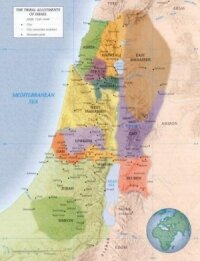
Map of the twelve tribes of IsraelIsrael had 12 sons, as follows: Reuben, (ראובן Rĕ'uwben, Jacob's firstborn); Simeon, (שמעון Shim`own); Levi, (לוי Leviy); Judah, (יהודה Yĕhuwdah); Dan, (דן Dan); Naphtali, (נפתלי Naphtaliy); Gad, גד( Gad); Asher, (אשר 'Asher); Issachar, (יששכר Yissaskar); Zebulun, (זבולון Zĕbuwluwn); Joseph, (יוסף Yowceph); Manasseh, (מנשה Mĕnashsheh); Ephraim, (אפרים 'Ephrayim); Benjamin (בנימין Binyamiyn). (Jacob was renamed Israel Gen. 32:27-29)

The Tribe of Levi was set apart from the others in the sense that, the members of the Tribe of Levi were to be in charge of the tabernacle of the Testimony.
(see: Num. 1).

The Tribe of Joseph is not usually listed with the Hebrew tribes although Joseph is one of Jacobs twelve sons, the eldest of Rachel. It is sometimes referred to as the House of Joseph. Rather, the two tribes founded by his sons Ephraim and Manasseh are listed separately. (see Tribe of Joseph)

Politically, the Israelites were composed of thirteen tribes: Reuben, Simeon, Levi, Judah, Dan, Naphtali, Gad, Asher, Issachar, Zebulun, Manasseh, Ephraim, and Benjamin. In parts of the Bible, Ephraim and Manasseh are treated as together constituting the House of Joseph, while the Levi have a special religious role and had only scattered cities as territory; whence traditionally either Ephraim and Manasseh were counted as one tribe, or Levi wasn't counted, so that together the tribes were the Twelve Tribes of Israel (see also: Gen. 32: 27-29, Gen. 48:5).

More...

Thursday, July 31, 2008

Tribe of Judah

Territories of the 12 tribes of Israel, before the move of Dan to the northThe Tribe of Judah (hebrew: יְהוּדָה, "praise";) is one of the Hebrew tribes of Israel, founded by Judah, son of Jacob. (see also sons of Jacob)

Together with the Tribe of Benjamin, descendants of Judah eventually formed the southern kingdom of Judah in the ancient land of Israel, when the kingdom of Israel was divided. These two tribes were thus not carried into captivity with the ten tribes of the northern kingdom of Israel when it fell. This started the tradition (some say myth) of the ten lost tribes of Israel.

As the Tribe of Benjamin was always very much the minor partner, in time the tribe of Judah became identified with the entire Israelite nation, and even the entire Hebrew nation, and gave their name to the Jews.

Judah and his three surviving sons went down with Jacob into Ancient Egypt (Gen. 46:12; Ex. 1:2). At the time of the Exodus, when we meet with the family of Judah again, they have increased to the number of 74,600 males (Num. 1:26-27).

More...

Tuesday, June 24, 2008

Tribes of Israel

The sons of Jacob ordered left to right by birthIsrael had 12 sons, as follows:
Reuben, Simeon, Levi, Judah, Dan, Naphtali, Gad, Asher, Issachar, Zebulun, Joseph, and Benjamin. (Jacob was renamed Israel Gen. 32:27-29)

The Tribe of Levi was set apart from the others in the sense that, the members of the Tribe of Levi were to be in charge of the tabernacle of the Testimony. (see: Num. 1).

The Tribe of Joseph is not usually listed with the Hebrew tribes although Joseph is one of Jacobs twelve sons, the eldest of Rachel. It is sometimes referred to as the House of Joseph. Rather, the two tribes founded by his sons Ephraim and Manasseh are listed separately.

Tribal Divisions

Politically, the Israelites were composed of thirteen tribes: Reuben, Simeon, Levi, Judah, Dan, Naphtali, Gad, Asher, Issachar, Zebulun, Manasseh, Ephraim, and Benjamin. In parts of the Bible, Ephraim and Manasseh are treated as together constituting the House of Joseph, while the Levi have a special religious role and had only scattered cities as territory; whence traditionally either Ephraim and Manasseh were counted as one tribe, or Levi wasn't counted, so that together the tribes were the Twelve Tribes of Israel.

The division into Tribes was geographical, as well as genealogical; each tribe held a distinct territory, though there are a few peculiarities. Levi's territory was very discontinuous, consisting entirely of towns and cities scattered as enclaves within the territory of the other tribes, Simeon's territory was entirely inside the territory of Judah, and Manasseh was split between the half tribe west of the Jordan, and the other half tribe on the eastern side. The Kingdom of Judah consisted of Judah, Simeon, Benjamin, and the parts of Levi within those lands, while the Kingdom of Israel contained Reuben, Dan, Naphtali, Gad, Asher, Issachar, Zebulun, Manasseh, Ephraim, and the remainder of Levi.

More...

Friday, October 19, 2007

Tribes of Israel

Map of the twelve tribes of IsraelIsrael had 12 sons, as follows: Reuben, Simeon, Levi, Judah, Dan, Naphtali, Gad, Asher, Issachar, Zebulun, Joseph, and Benjamin (Jacob was renamed Israel Gen. 32:27-29)The Tribe of Levi was set apart from the others in the sense that, the members of the Tribe of Levi were to be in charge of the tabernacle of the Testimony. (see: Num. 1).

The Tribe of Joseph is not usually listed with the Hebrew tribes although Joseph is one of Jacobs twelve sons, the eldest of Rachel. It is sometimes referred to as the House of Joseph. Rather, the two tribes founded by his sons Ephraim and Manasseh are listed separately.

Tribal Divisions

Politically, the Israelites were composed of thirteen tribes: Reuben, Simeon, Levi, Judah, Dan, Naphtali, Gad, Asher, Issachar, Zebulun, Manasseh, Ephraim, and Benjamin. In parts of the Bible, Ephraim and Manasseh are treated as together constituting the House of Joseph, while the Levi have a special religious role and had only scattered cities as territory; whence traditionally either Ephraim and Manasseh were counted as one tribe, or Levi wasn't counted, so that together the tribes were the Twelve Tribes of Israel.

The division into Tribes was geographical, as well as genealogical; each tribe held a distinct territory, though there are a few peculiarities. Levi's territory was very discontinuous, consisting entirely of towns and cities scattered as enclaves within the territory of the other tribes, Simeon's territory was entirely inside the territory of Judah, and Manasseh was split between the half tribe west of the Jordan, and the other half tribe on the eastern side. The Kingdom of Judah consisted of Judah, Simeon, Benjamin, and the parts of Levi within those lands, while the Kingdom of Israel contained Reuben, Dan, Naphtali, Gad, Asher, Issachar, Zebulun, Manasseh, Ephraim, and the remainder of Levi.

More...

Wednesday, April 11, 2007

Tribes of Israel

Map of the twelve tribes of IsraelIsrael had 12 sons, as follows: Reuben, Simeon, Levi, Judah, Dan, Naphtali, Gad, Asher, Issachar, Zebulun, Joseph, and Benjamin. (Jacob was renamed Israel Gen. 32:27-29) The Tribe of Levi was set apart from the others in the sense that, the members of the Tribe of Levi were to be in charge of the tabernacle of the Testimony.

The Tribe of Joseph is not usually listed with the Hebrew tribes although Joseph is one of Jacobs twelve sons, the eldest of Rachel. It is sometimes referred to as the House of Joseph. Rather, the two tribes founded by his sons Ephraim and Manasseh are listed separately.

Tribal Divisions
Politically, the Israelites were composed of thirteen tribes: Reuben, Simeon, Levi, Judah, Dan, Naphtali, Gad, Asher, Issachar, Zebulun, Manasseh, Ephraim, and Benjamin. In parts of the Bible, Ephraim and Manasseh are treated as together constituting the House of Joseph, while the Levi have a special religious role and had only scattered cities as territory; whence traditionally either Ephraim and Manasseh were counted as one tribe, or Levi wasn't counted, so that together the tribes were the Twelve Tribes of Israel.

More...

Monday, March 05, 2007

tribes of Israel

Map of the twelve tribes of IsraelIsrael had 12 sons, as follows: Reuben, Simeon, Levi, Judah, Dan, Naphtali, Gad, Asher, Issachar, Zebulun, Joseph, and Benjamin. (Jacob was renamed Israel Gen. 32:27-29). The Tribe of Levi was set apart from the others in the sense that, the members of the Tribe of Levi were to be in charge of the tabernacle of the Testimony. (see: Num. 1). The Tribe of Joseph is not usually listed with the Hebrew tribes although Joseph is one of Jacobs twelve sons, the eldest of Rachel. It is sometimes referred to as the House of Joseph. Rather, the two tribes founded by his sons Ephraim and Manasseh are listed separately.

The Ten Lost Tribes are those from the northern Kingdom of Israel who were deported by the Assyrians in the 8th century BC to Khorason. In Jewish popular culture, the ten tribes disappeared from history, leaving only the tribes of Benjamin and Judah and Levi who evolved into the modern day Jews.

More...


Subscribe


LifeNews.com

Desiring God Blog

Youth for Christ International