Showing posts with label Aramaic. Show all posts

Wednesday, October 05, 2011

Andrew

(Greek: Andreas, Ανδρέας "manly"), called in the Orthodox tradition Protocletos, or the First-called, is a Christian Apostle, brother of Simon Peter.
One of the two who heard John speak and followed Jesus was Andrew, Simon Peter’s brother. John:1:40 ESV

Biography
According to Christian tradition, Andrew was born at Bethsaida (Greek: Βηθσαϊδά Bēthsaïda "house or place of hunting or fishing" of Aramaic origin בַּיִת צַיָּד bayith "house" tsayad "hunter"), a small fishing village on the west shore of Lake Gennesaret Sea of Galilee, home of Andrew, Peter, Philip and John (John 1:44). Since he was a Jew, Andreas was almost certainly not his given name, but no Hebrew or Aramaic name is recorded for him. He had been a disciple of John the Baptist (John 1:37-40) and was one of the first to follow Jesus. He lived at Capernaum (Mark 1:29). In the gospels he is referred to as being present on some important occasions as one of the disciples more closely attached to Jesus (Mark 13:3; John 6:8, 12:22). In the book of Matthew, Jesus said, to Andrew and his brother Simon, "Follow me, and I will make you fishers of men." (Greek: ἁλιεύς ἄνθρωπος halieus "a fisherman, fisher" anthrōpos "a human being, whether male or female") in Acts there is only a bare mention of him (Acts 1:13).
More...

John Piper Apostles and Church Growth

Tuesday, October 05, 2010

Ancient Egypt

Ancient Egypt was a civilization located along the Lower Nile, reaching from the Nile Delta in the north to as far south as Jebel Barkal at the time of its greatest extension (15th century BC). It lasted for three millennia, from circa 3200 BC to 343 BC, ending when Artaxerxes III conquered Egypt. As a civilization based on irrigation it is the quintessential example of an "hydraulic empire."

Egypt was a transcontinental nation located mostly in North Africa, with the Sinai Peninsula lying in Asia.

There are several words used in the bible that refer to Egypt, 2 are Hebrew/Aramaic and 2 are Greek.


Hebrew/Aramaic (Old Testament)
Strongs # Hebrew Transliteration Pronunciation English
H4714 מִצְרַיִם dual for מָצוֹר Mitsrayim mits·rah'·yim Egypt, Egyptian, Mizraim, Egyptians
H4713 מִצְרִי Mitsriy mits·rē' Egyptian, Egyptian, Egypt, Egyptian women

Greek (New Testament)
Strongs # Greek Transliteration Pronunciation English
G125 Αἴγυπτος Aigyptos ī'-güp-tos Egypt
G124 Αἰγύπτιος Aigyptios ī-gü'p-tē-os Egyptian, Egyptians
(blueletterbible.org)


More...

Monday, July 26, 2010

Tel Dan Stele

The Tel Dan Stele is a black basalt stele erected by an Aramaean king in northernmost Israel containing an Aramaic inscription to commemorate his victory over the ancient Hebrews. Although the name of the author of the stele does not seem to appear on the available fragments, it is most likely a king of neighboring Damascus. Language, time, and location make it plausible that the author was Hazael or his son, Bar Hadad II/III, who were kings of Damascus and enemies of the kingdom of Israel. The stele was discovered at Tel Dan, by a team of scholars and workers led by Israeli archaeologist Avraham Biran (1909 - 2008). The Stele was previously named Tell el-Qadi, after a mound where a city once stood at the northern tip of Israel. Fragment A was discovered in 1993, and fragments B1 and B2, which fit together, were discovered in 1994. Biran's excavations began in 1966 and ended in 1993, making the Tel Dan excavation the longest continuously excavated site in Israel.

The inscription generated excitement among biblical scholars and biblical archaeologists because the letters 'ביתדוד' are identical to the Hebrew for "house of David." If these letters refer to the Davidic line then this is the first time the name "David" has been recognized at any archaeological site. The scholarly consensus among archaeologists and epigraphers is that the fragment is an authentic reference to the Biblical King David.

More...

Thursday, May 28, 2009

Aramaic

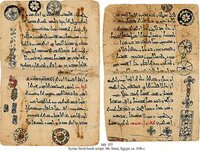
11th century book in Syriac Serto, Mount Sinai, Egypt.Aramaic is a Semitic language with a 3,000-year history. It has been the language of administration of empires and the language of divine worship. It is the original language of large sections of the biblical books of Daniel and Ezra, and is the main language of the Talmud. Aramaic is believed to have been the native language of Jesus (see also: Aramaic of Jesus). In the following passage, spoken by Jesus while being crucified, "Eloi, Eloi, lama sabachthani" is Aramaic. Matthew 27:46 has a direct parallel in Psalm 22 (written by David nearly 1,000 years before the birth of Jesus):
About the ninth hour Jesus cried out in a loud voice, "Eloi, Eloi, lama sabachthani?"—which means, "My God, my God, why have you forsaken me?" -Matthew 27:46
Even at the threshold of death, Jesus quotes scripture (See Psalm 22:1)
And this seems to be the state of this psalm, which is understood of the Messiah, by the Hebrew doctors themselves, and by Christ himself and by his apostles. And there are many passages in it, which were literally accomplished in him, and cannot be understood of any other. In this psalm David speaks of the humiliation of Christ, ver. 1 - 21. Of the exaltation of Christ, ver. 22 - 31. To the chief musician upon Aijeleth Shahar, A psalm of David.

Christian Classics Ethereal Library of Calvin College.
John Wesley's notes on Psalm 22


More...

Saturday, October 13, 2007

Aramaic

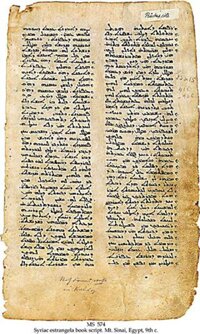
9th century Syriac Estrangela manuscript of John Chrysostom's Homily on the Gospel of JohnAramaic is a Semitic language with a 3,000-year history. It has been the language of administration of empires and the language of divine worship. It is the original language of large sections of the biblical books of Daniel and Ezra, and is the main language of the Talmud. Aramaic is believed to have been the native language of Jesus. In the following passage, spoken by Jesus while being crucified, "Eloi, Eloi, lama sabachthani" is Aramaic. Matthew 27:46 has a direct parallel in Psalm 22 (written by David nearly 1,000 years before the birth of Jesus):
About the ninth hour Jesus cried out in a loud voice, "Eloi, Eloi, lama sabachthani?"—which means, "My God, my God, why have you forsaken me?" -Matthew 27:46

Even at the threshold of death, Jesus quotes scripture (see Psalm 22:1).

It is confessed that David was a type of Christ, and that many passages of the Psalms, though literally understood of David, yet had a further and mystical reference to Christ. But there are some other passages, which were directly, and immediately intended for, and are properly to be understood of the Messiah; though withal there may be some respect and allusion to the state of the penman himself. And this seems to be the state of this psalm, which is understood of the Messiah, by the Hebrew doctors themselves, and by Christ himself and by his apostles. And there are many passages in it, which were literally accomplished in him, and cannot be understood of any other. In this psalm David speaks of the humiliation of Christ, ver. 1 - 21. Of the exaltation of Christ, ver. 22 - 31. To the chief musician upon Aijeleth Shahar, A psalm of David.
Christian Classics Ethereal Library of Calvin College.
John Wesley's notes on Psalm 22

More...


Subscribe


LifeNews.com

Desiring God Blog

Youth for Christ International