Showing posts with label Jesus Christ. Show all posts

Monday, May 02, 2011

history of Jerusalem

The earliest traces of human settlement in Jerusalem (Hebrew: Yĕruwshalaim יְרוּשָׁלַם yer·ü·shä·lah'·im) date back to the late Chalcolithic Period and Early Bronze Age (c. 3000 BC). The Egyptian Execration Texts (c. 1900-1800 BC) and the Amarna letters (14th century BCE) show that the city was under the power of ancient Egypt. In one of the Amarna letters the city's governor, Abdi-Heba, asks for help from Egypt to fight the Habiru (possibly identical to the Hebrews).

This city has known many wars, and various periods of sovereignty. According to Genesis 14:18-20, the city (named as Salem) was ruled by king Melchizedek, a priest of God. According to one Jewish tradition reported by the midrash, it was founded by Abraham's forefathers Shem and Eber.

Later, according to the Biblical narrative of the Books of Samuel, it was controlled by the Jebusites, a group that scholars generally believe to have been Hittite.

It is probable that Melchizedek was himself a Jebusite; the -zedek part of the name occurring in other rulers such as Adonizedek, and in some biblical references to Jerusalem itself, such as neweh zedek (Jeremiah 31:23, where it is often translated as home of righteousness).

According to the Books of Samuel, the Jebusites managed to resist attempts by the Israelites to capture the city, and by the time of King David were mocking such attempts, claiming that even the blind and lame could defeat the Israelite army. Nevertheless, the masoretic text for the Books of Samuel states that David managed to capture the city by stealth, sending his forces through a water shaft and attacking the city from the inside; archaeologists now view this as implausible as the Gihon spring - the only known location from which water shafts lead into the city - is now known to have been heavily defended (and hence an attack via this route would have been obvious rather than secretive). The Septuagint text, however, suggests that rather than by a water shaft, David's forces defeated the Jebusites by using daggers.

More...

Saturday, April 03, 2010

Resurrection of Jesus

According to the Trinitarian interpretation of the New Testament, Jesus was both human and God, so he had the power to lay his life down and to take it up again; thus after Jesus died, he came back to life. This event is referred to in Christian terminology as the resurrection of Jesus Christ, and is commemorated and celebrated by most Christians annually on Easter Sunday.

Most Christians, even those who do not interpret other parts of the Bible literally, accept the New Testament story as an historical account of an actual event central to their faith, though some do not accept a literal bodily resurrection, sometimes arguing for docetism. But it so seems that in the past, a large group of Christians known as the Gnostics, who were later declared heretics and partially exterminated, argued against its singular importance, and claimed that the New Testament supported their claims. Non-Christians generally view the story as legend or as allegory.

More...

Friday, July 04, 2008

The Word

The Sermon On the Mount by Carl Heinrich Bloch, Danish painter, d. 1890.
1 In the beginning was the Word, and the Word was with God, and the Word was God. 2 He was in the beginning with God. 3 All things were made through him, and without him was not any thing made that was made. (John 1:1-3 ESV)
Jesus (8–2 BC/BCE to 29–36 AD/CE) is the central figure of Christianity. He is also called Jesus Christ, where "Jesus" is an Anglicization of the Greek: Ίησους (Iēsous), itself a Hellenization of the Hebrew יהושע (Yehoshua) or Aramaic ישוע (Yeshua), meaning "YHVH is salvation"; and where "Christ" is a title derived from the Greek christós, meaning the "Anointed One," which corresponds to the Hebrew-derived "Messiah." Jesus is the incarnate Son of God, the second person of the Trinity, and the prophesied Hebrew Messiah (Anointed One, deliverer of Israel). Jesus is also known as "Jesus Christ", "Jesus of Nazareth", and "Jesus the Nazarene."

Christian views of Jesus (known as Christology) are both diverse and complex. Most Christians are Trinitarian and affirm the Nicene Creed, believing that Jesus is both the Son of God and God made incarnate1, sent to provide salvation and reconciliation with God by atoning for the sins of humanity (see also Christian worldview).

The most detailed accounts of Jesus' birth are contained in the Gospel of Matthew (probably written between 60 and 85 AD/CE) and the Gospel of Luke (probably written between 60 and 100 AD/CE). There is considerable debate about the details of Jesus' birth even among Christian scholars, and few scholars claim to know either the year or the date of his birth or of his death.

More...

Monday, June 30, 2008

imputation

Diego Velasquez, Christ on the Cross Museo del Prado, Madrid, c. 1632Imputation is a concept in Christian theology which proposes that righteousness of Jesus Christ satisfies all criteria necessary to share in God's grace. Those who trust in the promise that the death of Jesus Christ on the cross atones for their sins believe in this type of righteousness as opposed to imparted righteousness and sanctification. The teaching of imputed righteousness is a signature doctrine of the Lutheran and Reformed traditions of Christianity.

The case for imputed righteousness

Imputed righteousness is the Protestant solution to a "divine predicament." On the one hand, God is infinitely merciful, "not wishing for any to perish, but for all to come to repentance." (2 Peter 3:9). On the other, God is infinitely holy and just, which means that he cannot approve of or even look upon evil (Habakkuk 1:13), neither can he justify a wicked person (Prov. 17:15). Because the Bible describes all men as sinners and says that there are none who are righteous (Rom. 3:23, 10), these two "competing" traits in God's nature appear to put him in a dilemma.

  1. The imputation of Adam's sin to his descendants
  2. The imputation of the believer's sin to Christ
  3. The imputation of Christ's righteousness to the believer.
More...

Friday, April 25, 2008

Christian art

Rembrandt, The Descent from the CrossChristian art is art that spans many segments of Christianity. Per each religious sect, art mediums, style, and representations change; however, the unifying theme is ultimately the representation of the life and times of Jesus Christ and in some cases the Old Testament.

History

Much of the art surviving from Europe after the fall of the Roman Empire is Christian art. While the Western Roman Empire's political structure essentially collapsed after the fall of Rome, its religious hierarchy, what is today the modern-day Catholic Church funded and supported production of sacred art. The Orthodox Church of Constantinople, which enjoyed greater stability within the surviving Eastern Empire was key in funding arts there, and glorifying Christianity.

As a stable Western European society emerged during the Middle Ages, the Catholic Church led the way in terms of art, using its resources to commission paintings and sculptures. Christian art is found in architecture principally in the form of churches, cathedrals, monasteries and tombs.
The development of Christian art in the Byzantine empire continued the oriental and Hellenistic previously known trends. The controversy over the use of graven images, the interpretaion of the Second Commandment, and the crisis of Iconoclasm led to two main results: It led to a standardization of religious imagery within the Eastern Orthodoxy, and it led to a minimalist aesthetic in the Protestant Church.


As a secular, non-sectarian, universal notion of art arose in 19th century Western Europe, ancient and Medieval Christian art began to be collected for art appreciation rather than worship, while contemporary Christian art was considered marginal to art history.


More...

Wednesday, April 09, 2008

Christlike

Christ in Gethsemane, Carl Heinrich BlochTo be like Christ; showing the spirit of Christ.
35 Very early in the morning, while it was still dark, Jesus got up, left the house and went off to a solitary place, where he prayed. 36 Simon and his companions went to look for him, 37 and when they found him, they exclaimed: “Everyone is looking for you!” —Mark 1:35-37, NIV
We know about Jesus
  •   healing the sick;
  •   raising the dead;
  •   throwing the money-changers out of the House of God;
  •   having mercey on the woman caught in the act of adultery;
  •   feeding the five thousand from a few pieces of bread and a few fish;
  •   performing many miracles
However, in the above passage we see Jesus in the fullness of His character.

We see Him as one who not only carried out the will of God, but one who sought God's Will during times of solitude in prayer. Jesus sacrificed Himself to carry out the will of God. He could have stopped it at any time, but He allowed it to happen because it was God's Will and because He loves us that much.

Going a little farther, he fell with his face to the ground and prayed, "My Father, if it is possible, may this cup be taken from me. Yet not as I will, but as you will." -Matthew 26:39

More...

Tuesday, February 05, 2008

The seven churches of Asia

The seven churches of Asia (properly Asia Minor) are seven major churches of the early Christianity, as mentioned in the New Testament Book of Revelation. All sites are in modern-day Turkey. In Revelation, Jesus Christ instructs 'Saint John the Evangelist' to:
"Write in a book what you see and send it to the seven churches, to Ephesus, to Smyrna, to Pergamum, to Thyatira, to Sardis, to Philadelphia, and to Laodicea."(Revelation 1:11)

It should be understood that "churches," in this context, refers to the community of Christians living in each city, and not merely to the building or buildings in which they gathered for worship. This letter should also apply to the community of Christians today (the Christian Church).

The seven churches are located in...


More...

Monday, February 04, 2008

Søren Kierkegaard

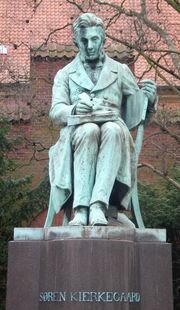
The Søren Kierkegaard Statue in Copenhagen.Søren Aabye Kierkegaard (5 May 1813 – 11 November 1855) was a prolific 19th century Danish philosopher and theologian. Kierkegaard strongly criticized both the Hegelianism of his time, and what he saw as the empty formalities of the Danish church. Much of his work deals with religious problems such as the nature of faith, the institution of the Christian Church, Christian ethics and theology, and the emotions and feelings of individuals when faced with life choices. His early work was written under various pseudonyms who present their own distinctive viewpoints in a complex dialogue. Kierkegaard left the task of discovering the meaning of the works to the reader, because "the task must be made difficult, for only the difficult inspires the noble-hearted". Subsequently, many have interpreted Kierkegaard as an existentialist, neo-orthodoxist, postmodernist, humanist, individualist, etc. Crossing the boundaries of philosophy, theology, psychology, and literature, Kierkegaard came to be regarded as a highly significant and influential figure in contemporary thought.

Life

Early years (1813–1841)

Søren Kierkegaard was born to an affluent family in Copenhagen, the capital of Denmark. His mother, Ane Sørensdatter Lund Kierkegaard, had served as a maid in the household before marrying Søren's father. She was an unassuming figure: quiet, plain, and not formally educated. She is not directly referred to in Kierkegaard's books, although she too affected his later writings. His mother died on July 31, 1834, age 66.

His father, Michael Pedersen Kierkegaard, was a melancholic, anxious, deeply pious, and fiercely intelligent man. Convinced that he had earned God's wrath, he believed that none of his children would live past the age attained by Jesus Christ, that of 33. He believed his personal sins, such as cursing the name of God in his youth and possibly impregnating Ane out of wedlock, necessitated this punishment. Though many of his seven children died young, his prediction was disproved when two of them surpassed this age: Søren and Peter Christian Kierkegaard, a Lutheran bishop several years Søren's senior. This early introduction to the notion of sin and its connection from father and son laid the foundation for much of Kierkegaard's work (particularly Fear and Trembling). Despite his father's occasional religious melancholy, Kierkegaard and his father shared a close bond. Kierkegaard learned to explore the realm of his imagination through a series of exercises and games they played together.

More...

Monday, January 21, 2008

The emerging church

The Emerging ChurchThe emerging church or emergent church is a diverse movement within Protestant Christianity that arose in the late 20th century as a reaction to the influence of modernism in Western Christianity. The movement is usually called a "conversation" by its proponents to emphasize its diffuse nature with contributions from many people and no explicitly defined leadership or direction. The emerging church seeks to deconstruct and reconstruct Christianity as its mainly Western members live in a postmodern culture.

While practices and even core doctrine vary, most emergents can be recognized by the following values:


  • Missional living - Christians go out into the world to serve God rather than isolate themselves within communities of like-minded individuals.
  • Narrative theology - Teaching focuses on narrative presentations of faith and the Bible rather than systematic theology or biblical reductionism.
  • Christ-likeness - While not neglecting the study of scripture or the love of the church, Christians focus their lives on the worship and emulation of the person of Jesus Christ.
  • Authenticity - People in the postmodern culture seek real and authentic experiences in preference over scripted or superficial experiences. Emerging churches strive to be relevant to today's culture and daily life, whether it be through worship or service opportunities. The core Christian message is unchanged but emerging churches attempt, as the church has throughout the centuries, to find ways to reach God's people where they are to hear God's message of unconditional love.
  • Social Action "doing a “180” is putting others before yourself and also a willingness to be counter cultural." -© ginkworld.net 180

Emergent Christians are predominantly found in Western Europe, North America, and the South Pacific. Some attend local independent churches that specifically identify themselves as being "emergent", while many others contribute to the conversation from within existing mainline denominations.

During recent centuries Western Christianity, like all of Western civilization, has been influenced significantly by modernism. In the 19th century modernist Protestant theologians sought to examine the individual narratives of the Bible and from them extract a set of underlying truths or "meta-narratives". By using methods borrowed from scientific reductionism it was hoped that a grand truth and worldview would be attained. In practice, however, the modernist approach led to additional schism within the Church (cf. Christian liberalism, Christian fundamentalism).

More...

Monday, January 14, 2008

Apostolic Succession

Canterbury Cathedral: West Front, Nave and Central Tower. The Canterbury Cathedral is one of the oldest and most famous Christian structures in England and forms part of a World Heritage SiteIn Christianity, the doctrine of Apostolic Succession (or the belief that the Church is 'apostolic') maintains that the Christian Church today is the spiritual successor to the original body of believers in Christ composed of the Apostles. Different Christian denominations interpret this doctrine in different ways.

In episcopal churches, the Apostolic Succession is understood to be the basis of the authority of bishops (the episcopate). Specifically in the case of the Catholic Church, the Apostolic Succession as passed on through Saint Peter is also the basis for the specific claim of papal primacy. Within the Anglican Communion this is seen more as a symbolic precedence, not unlike the Eastern Orthodox Patriarch of Constantinople. In any event, all these communions recognize Apostolic Succession as the determining criterion of a particular group's legitimacy as a catholic Church.

Mainstream Christianity

Catholic and Orthodox Churches

The Catholic Church (including its rites), Eastern Orthodox, Oriental Orthodox, Assyrian, Independent Catholic, and some others hold that apostolic succession is maintained through the consecration of their bishops in unbroken personal succession back to the apostles. In Catholic and Orthodox theology, the unbrokenness of apostolic succession is significant because of Jesus Christ's promise that the "gates of hell" (Matthew 16:18) would not prevail against the Church, and his promise that he himself would be with the apostles to "the end of the age" (Matthew 28:20). According to this interpretation, a complete disruption or end of such apostolic succession would mean that these promises were not kept as would an apostolic succession which, while formally intact, completely abandoned the teachings of the Apostles and their immediate successors; as, for example, if all the bishops of the world agreed to abrogate the Nicene Creed or to repudiate the Bible.

More...

Monday, December 24, 2007

Christmas

Wise Men visiting Jesus after his birthChristmas (literally, the Mass of Christ) is a traditional holiday commonly observed on 25 December. In most Eastern Orthodox Churches, even where the civil calendar used is the Gregorian, the event is observed according to the Julian calendar, which coincides with the predominant reckoning of 7 January. It is celebrated by most Christians to mark the birth of Jesus, which is believed to have occurred in Bethlehem in the Roman Province of Judea between 6 BC and AD 6. Christ's birth, or nativity, was said by his followers to fulfill the prophecies of Judaism that a messiah would come, from the house of David, to redeem the world from sin. Efforts to decide upon a date on which to celebrate his birth began some centuries later.

The word Christmas is a contraction of Christ's Mass, derived from the Old English Cristes mæsse.

It is sometimes abbreviated Xmas, probably because X resembles the Greek letter Χ (chi) which has often historically been used as an abbreviation for Christ (Χριστός in Greek).

The Nativity

The Nativity of Jesus refers to the Christian belief that the Messiah was born to the Virgin Mary. The story of Christmas is based on the biblical accounts given in the Gospel of Matthew, namely Matthew 1:18-Matthew 2:12 and the Gospel of Luke, specifically Luke 1:26-Luke 2:40. According to these accounts, Jesus was born to Mary, assisted by her husband Joseph, in the city of Bethlehem. According to popular tradition, the birth took place in a "stable", surrounded by farm animals, though neither the “stable” nor the animals are mentioned in the Biblical accounts. However, a "manger" is mentioned in Luke 2:7 where it states "She wrapped him in cloths and placed him in a manger, because there was no room for them in the inn." Shepherds from the fields surrounding Bethlehem were told of the birth by an angel, and were the first to see the child. Christians believe that the birth of Jesus fulfilled many prophecies made hundreds of years before his birth.

More...

Sunday, December 23, 2007

Nativity of Jesus

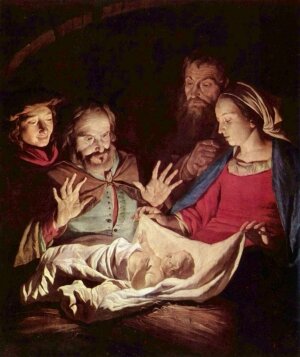
The infant Jesus in Adoration of the Shepherds, Gerard van HonthorstThe Nativity refers to the birth of Jesus. According to traditional telling of the birth of Jesus Christ, Jesus was born in the city of Bethlehem in a stable, surrounded by farm animals and shepherds, and Jesus was born into a manger from the Virgin Mary assisted by her husband Joseph.

Remembering or re-creating the Nativity is one of the central ways that Christians celebrate Christmas. For example, the Eastern Orthodox Church practices the Nativity Fast in anticipation of the birth of Jesus Christ, while the Roman Catholic Church celebrates Advent. In some Christian churches, children often perform plays re-creating the events of the Nativity, or sing some of the numerous Christmas carols that reference the event. Many Christians also display a small re-creation of the Nativity known as a Nativity scene in their homes, using small figurines to portray the key characters of the event. Live Nativity scenes are also re-enacted using Human actors and live animals to portray the event with more realism.

Biblical narratives

Gospel of Luke

The Gospel of Luke states that Mary learned from the angel Gabriel that the Holy Spirit would cause her to be with child. Mary pointed out that she was a virgin and the angel responded that "nothing will be impossible with God". "Here am I, the servant of the Lord; let it be with me according to your word," Mary responded.

At the time that Mary was due to give birth, she and her husband Joseph traveled from their home in Nazareth about 150 kilometres (90 miles) south to Joseph's ancestral home, Bethlehem, in order to register in a census ordered by Emperor Caesar Augustus, the Census of Quirinius. Having found no place for themselves in the inn, they lodged in a room where animals were kept. There Mary gave birth to Jesus.

An angel of the Lord visited the shepherds that were guarding their flocks in fields nearby and brought them the "good news of great joy" that "to you is born this day in the city of David a Saviour, who is the Messiah, the Lord". The angel told them they would find, "a child wrapped in bands of cloth and lying in a manger." A "heavenly host" joined the angel and said, "Glory to God in the highest heaven, and on earth peace among those whom he favors!" NRSV. The Authorized King James Version (1611) reads, "Glory to God in the highest, and on earth peace, good will toward men." The shepherds hurried to the manger in Bethlehem where they found Mary, Joseph and Jesus. They repeated what they were told by the angel, and then returned to their flocks.

More...

Saturday, December 22, 2007

Epiphany

Joseph of Nazareth with the infant Jesus, by Guido Reni. c. 1635Epiphany (Greek: επιφάνεια, "appearance" or "manifestation") is a Christian feast intended to celebrate the "shining forth" or revelation of God to mankind in human form, in the person of Jesus. The feast is also called Twelfth Day, as it is the twelfth day after Christmas, or Three Kings Day.

History

The observance had its origins in the Eastern Christian churches, and was originally a general celebration of the Incarnation of Jesus Christ, and included the commemoration of: his birth; the visit of the Magi, or "Wise Men", who arrived in Bethlehem; all of Jesus' childhood events, up to and including His baptism in the Jordan River by John the Baptist; and even the miracle at the Wedding of Cana in Galilee. However, it seems fairly clear that the Baptism was the event predominantly commemorated.

The date of the feast was very early fixed on January 6. Ancient Liturgies speak of Illuminatio, Manifestatio, Declaratio (Lighting, Manifestation, Declaration); cf. Matthew 3:13–17; Luke 3:22; and John 2:1–11; where the Baptism and the Marriage at Cana are dwelt upon. Christian Churches have traditionally emphasized the "Revelation to the Gentiles" mentioned in the Gospel of Luke, where the term Gentile means all non-Jewish peoples. The Biblical Magi represent the non-Jewish peoples of the world.

More...

Thursday, December 20, 2007

Gospel of Matthew

Saint Matthew, from the 9th-century Ebbo Gospels.The Gospel of Matthew (literally, "according to Matthew"; Greek, Κατά Μαθθαίον or Κατά Ματθαίον, Kata Maththaion or Kata Matthaion) is one of the four Gospel accounts of the New Testament. It narrates an account of the life and ministry of Jesus, from his genealogy to his post-resurrection commissioning of his Apostles to "go and make disciples of all nations." Bibles traditionally print Matthew as the first gospel, followed in order by Mark, and . The Christian community traditionally ascribes authorship to Matthew the Evangelist, one of Jesus's twelve apostles, while secular scholarship generally agrees it was written by an anonymous non-eyewitness to Jesus's ministry.

The Gospel of Matthew is written in Greek, not in Aramaic. That is to say, no copy of an Aramaic original has yet to be found. The Greek of the gospel of Matthew cannot easily be translated back to Aramiac. This is very suggestive that Matthew is not a Greek translation of an Aramiac original. It is also generally agreed that the Gospel of Mark is actually the earliest of the four gospels and that the author of Matthew substantially used the gospel of Mark in writing this gospel.

Overview

For convenience, the book can be divided into its four structurally distinct sections: Two introductory sections; the main section, which can be further broken into five sections, each with a narrative component followed by a long discourse of Jesus; and finally, the Passion and Resurrection section.


  1. Containing the genealogy, the birth, and the infancy of Jesus (Matthew 1; Matthew 2). The discourses and actions of John the Baptist preparatory to Christ's public ministry (Matthew 3; Matthew 4:11).
  2. The discourses and actions of Christ in Galilee (4:12–26:1).
    1. The Sermon on the Mount, concerning morality (Matthew 5–7)
    2. The Missionary Discourse, concerning the mission Jesus gave his Twelve Apostles. (Matthew 10–11:1)
    3. The Parable Discourse, stories that teach about the Kingdom of Heaven (Matthew 13).
    4. The "Church Order" Discourse, concerning relationships among Christians (Matthew 18–19:1).
    5. The Eschatological Discourse, which includes the Olivet Discourse and Judgement of the Nations, concerning his Second Coming and the Signs of the End of the Age (Matthew 24–25).
  3. The sufferings, death and Resurrection of Jesus, the Great Commission (Matthew 28:16–20).

More...

Thursday, December 06, 2007

Trinity

Within Christianity, the doctrine of the Trinity states that God is a single "Being" who exists, simultaneously and eternally, as a communion of three persons (personae, prosopa): Father (the Source, the Eternal Majesty); the Son (the eternal Logos or Word, incarnate as Jesus of Nazareth); and the Holy Spirit. Since the 4th Century AD, in both Eastern and Western Christianity, this doctrine has been stated as "One God in Three Persons," all three of whom, as distinct and co-eternal "persons" or "hypostases," share a single Divine essence, being, or nature.

The word Trinity comes from the Latin noun Trinitas, meaning the state or condition of being three, or a group of three persons or things. The first recorded application of this Latin word to Father, Son and Holy Spirit was by Tertullian in about 200 where he probably combined Latin words for three and one. Although the word Trinity is not found in Scripture, the principle is:

19Therefore go and make disciples of all nations, baptizing them in the name of the Father and of the Son and of the Holy Spirit (Matt. 28:19)
The Greek term with the same meaning, Τρίας, has given the English word triad. The Sanskrit word, Trimurti, has a similar meaning.

In view of what is stated about Tertullian, it would be vain to look for the word "Τρίας" (Trinity) in the New Testament, which only speaks of God (often called "the Father"), of Jesus Christ (often called "the Son"), and of the Holy Spirit, and of the relationships between these.


More...

Monday, November 26, 2007

Christian mysticism

PhiloChristian mysticism is traditionally practised through the disciplines of:
  • prayer (including oratio, meditation and contemplation);
  • self-denial, including fasting, broadly called asceticism; and
  • service to others, again broadly called almsgiving.
Christian mystics interpret sacred texts and the life, sermons and parables of Jesus metaphorically: e.g. Jesus' Sermon on the Mount (Matthew 5–7) in its totality contains the way for direct union.

Whereas Christian doctrine generally maintains that God dwells in all Christians and that they can experience God directly through belief in Jesus, Christian mysticism aspires to apprehend spiritual truths inaccessible through intellectual means, typically by emulation of Christ. William Inge divides this scala perfectionis into three stages:

  1. the "purgative" or ascetic stage,
  2. the "illuminative" or contemplative stage, and
  3. the "unitive" stage, in which God may be beheld "face to face."

In his book "A History of Christian Thought From Its Judaic and Hellenistic Origins to Existentialism", Paul Tillich says this about Christian mysticism:

Mysticism is something that we find in Philo of Alexandria, for example. He developed a doctrine of ecstasy, (Greek: ek-statis) which means "standing outside oneself". This is the highest form of piety which lies beyond faith. This mysticism unites prophetic ecstacy with "enthusiasm", a word which comes from the Gree word en-theosmania, meaning "to possess the devine". From this there comes finally the fully developed mystical system of the Neo-Platonists, for example, of Dionysius the Areopagite. In this mystical system the ecstasy of the individual person leads to a union with the One, with the Absolute, with God.

More...

Wednesday, November 14, 2007

Anselmian satisfaction theory

Anselmian satisfaction theory or the satisfaction view of the atonement is a doctrine in Christian theology related to the meaning and effect of the death of Jesus Christ and has been traditionally taught in Catholic, Lutheran, and Reformed circles. Theologically and historically, the word "satisfaction" does not mean gratification as in common usage, but rather "to make restitution": mending what has been broken, paying back what was taken. It is thus connected with the legal concept of balancing out an injustice. Drawing primarily from the works of Anselm of Canterbury, the satisfaction theory teaches that Christ suffered as a substitute on behalf of humankind satisfying the demands of God's honor by his infinite merit. Anselm regarded his satisfaction view of the atonement as a distinct improvement over the older ransom theory of the atonement, which he saw as inadequate. Anselm's theory was a precursor to the refinements of Thomas Aquinas and John Calvin which introduced the idea of punishment to meet the demands of divine justice.

Development of the doctrine

The classic Anselmian formulation of the satisfaction view should be distinguished from penal substitution. Both are forms of satisfaction doctrine in that they speak of how Christ's death was satisfactory, but penal substitution and Anselmian satisfaction both offer different understandings of how Christ's death was satisfactory. Anselm speaks of human sin as defrauding God of the honour he is due. Christ's death, the ultimate act of obedience, brings God great honour. As it was beyond the call of duty for Christ, it is more honour than he was obliged to give. Christ's surplus can therefore repay our deficit. Hence Christ's death is substitutionary; he pays the honour instead of us. Penal substitution differs in that it sees Christ's death not as repaying God for lost honour but rather paying the penalty of death that had always been the moral consequence for sin (e.g., Genesis 2:17; Romans 6:23). The key difference here is that for Anselm, satisfaction is an alternative to punishment, "The honor taken away must be repaid, or punishment must follow." By Christ satisfying our debt of honor to God, we avoid punishment. In Calvinist Penal Substitution, it is the punishment which satisfies the demands of justice.

More...

Saturday, October 27, 2007

imputation

Diego Velasquez, Christ on the Cross Museo del Prado, Madrid, c. 1632Imputation is a concept in Christian theology which proposes that righteousness of Jesus Christ satisfies all criteria necessary to share in God's grace. Those who trust in the promise that the death of Jesus Christ on the cross atones for their sins believe in this type of righteousness as opposed to imparted righteousness and sanctification. The teaching of imputed righteousness is a signature doctrine of the Lutheran and Reformed traditions of Christianity.

The case for imputed righteousness

Imputed righteousness is the Protestant solution to a "divine predicament." On the one hand, God is infinitely merciful, "not wishing for any to perish, but for all to come to repentance." (2 Peter 3:9). On the other, God is infinitely holy and just, which means that he cannot approve of or even look upon evil (Habakkuk 1:13), neither can he justify a wicked person (Prov. 17:15). Because the Bible describes all men as sinners and says that there are none who are righteous (Rom. 3:23, 10), these two "competing" traits in God's nature appear to put him in a dilemma.

More...

Wednesday, October 17, 2007

YHVH

YHVH, the name of God  or Tetragrammaton, in Phoenician (1100 BC to AD 300), Aramaic (10th Century BC to 0)and modern Hebrew scripts.The convenant name of God. It means "I AM WHO I AM."

Also Yahweh: a name for the God of the Old Testament as transliterated from the Hebrew consonants YHVH (Yod)(Heh)(Vav)(Heh), it is the distinctive personal name of the God of Abraham, Isaac and Jacob.

This is the same name ("I AM") that Jesus used when the high priest asked if He was the Christ (Mark 14:61-62).

Of all the names of God, the one which occurs most frequently is the Tetragrammaton, appearing 6,823 times, according to the Jewish Encyclopedia. The Biblia Hebraica and Biblia Hebraica Stuttgartensia texts of the Hebrew Scriptures each contain the Tetragrammaton 6,828 times.

In Judaism, the Tetragrammaton is the ineffable name of God, and is therefore not to be read aloud. In the reading aloud of the scripture or in prayer, it is replaced with Adonai (Lord). Other written forms such as:

י (yod) ו (vav) (YW or Yaw); or י (yod) ה (heh) (YH or Yah)
are read in the same way.

More...

Saturday, October 13, 2007

Aramaic

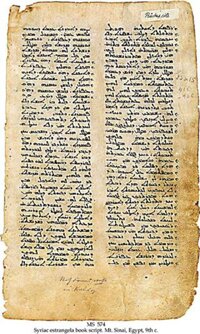
9th century Syriac Estrangela manuscript of John Chrysostom's Homily on the Gospel of JohnAramaic is a Semitic language with a 3,000-year history. It has been the language of administration of empires and the language of divine worship. It is the original language of large sections of the biblical books of Daniel and Ezra, and is the main language of the Talmud. Aramaic is believed to have been the native language of Jesus. In the following passage, spoken by Jesus while being crucified, "Eloi, Eloi, lama sabachthani" is Aramaic. Matthew 27:46 has a direct parallel in Psalm 22 (written by David nearly 1,000 years before the birth of Jesus):
About the ninth hour Jesus cried out in a loud voice, "Eloi, Eloi, lama sabachthani?"—which means, "My God, my God, why have you forsaken me?" -Matthew 27:46

Even at the threshold of death, Jesus quotes scripture (see Psalm 22:1).

It is confessed that David was a type of Christ, and that many passages of the Psalms, though literally understood of David, yet had a further and mystical reference to Christ. But there are some other passages, which were directly, and immediately intended for, and are properly to be understood of the Messiah; though withal there may be some respect and allusion to the state of the penman himself. And this seems to be the state of this psalm, which is understood of the Messiah, by the Hebrew doctors themselves, and by Christ himself and by his apostles. And there are many passages in it, which were literally accomplished in him, and cannot be understood of any other. In this psalm David speaks of the humiliation of Christ, ver. 1 - 21. Of the exaltation of Christ, ver. 22 - 31. To the chief musician upon Aijeleth Shahar, A psalm of David.
Christian Classics Ethereal Library of Calvin College.
John Wesley's notes on Psalm 22

More...


Subscribe


LifeNews.com

Desiring God Blog

Youth for Christ International