Showing posts with label Heaven. Show all posts

Wednesday, October 27, 2010

Heaven

Heaven (Hebrew שמים shamayim) "heaven, heavens, sky, stars, as the visible universe," Heaven (as the abode of God). Also (Hebrew: רָקִיעַ raqiya`) "extended surface (solid), expanse, firmament," firmament (of vault of heaven supporting waters above), considered by Hebrews as solid and supporting 'waters' above.

And God called the firmament Heaven. And the evening and the morning were the second day. –Gen 1:8

Those who believe in heaven, especially those of the Judeo-Christian faith, generally hold that it (or Hell) is one of the two possible afterlife destinations all humans. In unusual instances, humans have had, according to many testimonies and traditions, personal knowledge of Heaven. They assert this is for the purpose of teaching the rest of humanity about life, Heaven, and God.

Conceptions
While there are abundant and varied sources for conceptions of Heaven, the typical believer's view appears to depend largely on his particular religious tradition. Various religions have described Heaven as being populated by angels, demons, gods and goddesses, and/or heroes (especially in Greek mythology). Heaven is generally thought of as a place of eternal happiness.

In old and new testament biblical religions, the belief in heaven appears to have supplanted the earlier concept of Sheol (mentioned in Isaiah 38:18, Psalms 6:5 and Job 7:7-10). Jewish converts to this concept of heaven and hell included the group known as the Pharisees. The larger, dogmatically conservative Sadducees maintained their belief in Sheol. While it was the Sadducees that represented the Jewish religious majority it was the Pharisees who best weathered Roman occupation, and their belief in Zoroaster's heaven and hell was passed on to both Christianity and Islam (in which heaven is referred to as Jannah (Arabic: جنّة‎), the Islamic conception of paradise).

More...

Wednesday, February 20, 2008

Parable of the Mustard Seed

Mustard SeedIn Christianity, Parable of the Mustard Seed is a a short narrative that, according to the Gospels of Matthew (Matthew 13:31-32), Mark (Mark 4:30-32), Luke (Luke 13:18-19), and the non-canonical Thomas (Thomas 20) was told by Jesus. Possible Hebrew Bible parallels are Daniel 4:10-12, Daniel 4:20-22 and Ezekiel 17:22-23, 31:1-9.

18Then Jesus asked, "What is the kingdom of God like? What shall I compare it to? 19It is like a mustard seed, which a man took and planted in his garden. It grew and became a tree, and the birds of the air perched in its branches." – Luke 13:18–19


30Again he said, "What shall we say the kingdom of God is like, or what parable shall we use to describe it? 31It is like a mustard seed, which is the smallest seed you plant in the ground. 32Yet when planted, it grows and becomes the largest of all garden plants, with such big branches that the birds of the air can perch in its shade." –Mark 4:30–32


31He told them another parable: "The kingdom of heaven is like a mustard seed, which a man took and planted in his field. 32Though it is the smallest of all your seeds, yet when it grows, it is the largest of garden plants and becomes a tree, so that the birds of the air come and perch in its branches." -Matthew 13:31–32


The disciples said to Jesus, "Tell us what Heaven's kingdom is like." He said to them, "It's like a mustard seed, the smallest of all seeds, but when it falls on prepared soil, it produces a large plant and becomes a shelter for birds of the sky." – Thomas 20

The parable compares the Kingdom of Heaven to a mustard seed, which the parable says is the least among seed, yet grows to become a huge mustard plant that provides shelter for many birds. Much like the English saying Many an oak from a tiny acorn grows, and like the butterfly effect, the parable is usually interpreted as meaning that great things start from just tiny seeds of information, or from tiny actions.


It might also be interpreted to foreshadow the kingdom of Heaven growing forth from the small actions of the historical Jesus in life.


More...

Tuesday, February 19, 2008

Thessalonica

Bird’s Eye View of ThessalonicaThessalonica or Thessaloniki (Greek: Θεσσαλονίκη), is Greece's second-largest city and the capital of the Greek region of Macedonia.

Thessalonica had a Jewish colony, established during the first century, and was an early centre of Christianity. On his second missionary journey, Paul of Tarsus preached in the city's synagogue, the chief synagogue of the Jews in that part of Thessaloniki, and laid the foundations of a church. Opposition against him from the Jews drove him from the city, and he fled to Veroia. Paul wrote two of his epistles to the Christian community at Thessalonica, the First Epistle to the Thessalonians and the Second Epistle to the Thessalonians.

Paul's teaching about the end of the world is expressed most clearly in his letters to the Christians at Thessalonica. Heavily persecuted, it appears that they had written asking him first about those who had died already, and, secondly, when they should expect the end. Paul regarded the age as passing and, in such difficult times, he therefore encouraged marriage as a means of happiness. He assures them that the dead will rise first and be followed by those left alive (1 Thessalonians 4:16).

16For the Lord himself will come down from heaven, with a loud command, with the voice of the archangel and with the trumpet call of God, and the dead in Christ will rise first.

This suggests an imminence of the end but he is unspecific about times and seasons, and encourages his hearers to expect a delay. The form of the end will be a battle between Jesus and the Man of Lawlessness (3ff) whose conclusion is the triumph of Christ.

More...

Monday, February 18, 2008

temple

The western wall of the temple mount, sacred place for JudaismThe architectural structure in Jerusalem that was the focal point of worship and the national life of Israel form the 10th century B.C. when it was built by king Solomon, until it was destructed by Rome in A.D. 70. The temple was rebuilt two times and had three periods during which the temples of Solomon, Zurubabbel, and Herod were in existance.

A temple (from the Latin word templum) is a structure reserved for religious or spiritual activities, such as prayer and sacrifice, or analogous rites. A ‘’templum’’ constituted a sacred precinct as defined by a priest, or augur. It has the same root as the word “ template,’’ a plan in preparation of the building that was marked out on the ground by the augur. Though a templum, technically speaking, is not a “house of the gods” but a diagram that for the Romans linked the geometries of heaven and earth, it was also indicative of a dwelling place of a god or gods. This tradition, of course, dates back to prehistoric times. For the ancient Egyptians, the word pr could refer not only to a house, but also to a sacred structure since it was believed that the gods resided in houses. The word ‘temple’ (which dates to about the 6th century BCE), despite the specific set of meanings associated with the religion of the ancient Rome, has now become quite widely used to describe a house of worship for any number of religions and is even used for time periods prior to the Romans. Stated differently, temple was once a species of sacred structures; today it is, in the English language, often used as a genus.

More...

Sunday, December 23, 2007

Nativity of Jesus

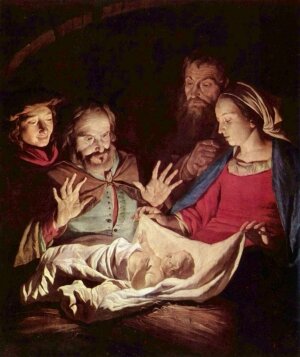
The infant Jesus in Adoration of the Shepherds, Gerard van HonthorstThe Nativity refers to the birth of Jesus. According to traditional telling of the birth of Jesus Christ, Jesus was born in the city of Bethlehem in a stable, surrounded by farm animals and shepherds, and Jesus was born into a manger from the Virgin Mary assisted by her husband Joseph.

Remembering or re-creating the Nativity is one of the central ways that Christians celebrate Christmas. For example, the Eastern Orthodox Church practices the Nativity Fast in anticipation of the birth of Jesus Christ, while the Roman Catholic Church celebrates Advent. In some Christian churches, children often perform plays re-creating the events of the Nativity, or sing some of the numerous Christmas carols that reference the event. Many Christians also display a small re-creation of the Nativity known as a Nativity scene in their homes, using small figurines to portray the key characters of the event. Live Nativity scenes are also re-enacted using Human actors and live animals to portray the event with more realism.

Biblical narratives

Gospel of Luke

The Gospel of Luke states that Mary learned from the angel Gabriel that the Holy Spirit would cause her to be with child. Mary pointed out that she was a virgin and the angel responded that "nothing will be impossible with God". "Here am I, the servant of the Lord; let it be with me according to your word," Mary responded.

At the time that Mary was due to give birth, she and her husband Joseph traveled from their home in Nazareth about 150 kilometres (90 miles) south to Joseph's ancestral home, Bethlehem, in order to register in a census ordered by Emperor Caesar Augustus, the Census of Quirinius. Having found no place for themselves in the inn, they lodged in a room where animals were kept. There Mary gave birth to Jesus.

An angel of the Lord visited the shepherds that were guarding their flocks in fields nearby and brought them the "good news of great joy" that "to you is born this day in the city of David a Saviour, who is the Messiah, the Lord". The angel told them they would find, "a child wrapped in bands of cloth and lying in a manger." A "heavenly host" joined the angel and said, "Glory to God in the highest heaven, and on earth peace among those whom he favors!" NRSV. The Authorized King James Version (1611) reads, "Glory to God in the highest, and on earth peace, good will toward men." The shepherds hurried to the manger in Bethlehem where they found Mary, Joseph and Jesus. They repeated what they were told by the angel, and then returned to their flocks.

More...

Thursday, December 20, 2007

Gospel of Matthew

Saint Matthew, from the 9th-century Ebbo Gospels.The Gospel of Matthew (literally, "according to Matthew"; Greek, Κατά Μαθθαίον or Κατά Ματθαίον, Kata Maththaion or Kata Matthaion) is one of the four Gospel accounts of the New Testament. It narrates an account of the life and ministry of Jesus, from his genealogy to his post-resurrection commissioning of his Apostles to "go and make disciples of all nations." Bibles traditionally print Matthew as the first gospel, followed in order by Mark, and . The Christian community traditionally ascribes authorship to Matthew the Evangelist, one of Jesus's twelve apostles, while secular scholarship generally agrees it was written by an anonymous non-eyewitness to Jesus's ministry.

The Gospel of Matthew is written in Greek, not in Aramaic. That is to say, no copy of an Aramaic original has yet to be found. The Greek of the gospel of Matthew cannot easily be translated back to Aramiac. This is very suggestive that Matthew is not a Greek translation of an Aramiac original. It is also generally agreed that the Gospel of Mark is actually the earliest of the four gospels and that the author of Matthew substantially used the gospel of Mark in writing this gospel.

Overview

For convenience, the book can be divided into its four structurally distinct sections: Two introductory sections; the main section, which can be further broken into five sections, each with a narrative component followed by a long discourse of Jesus; and finally, the Passion and Resurrection section.


  1. Containing the genealogy, the birth, and the infancy of Jesus (Matthew 1; Matthew 2). The discourses and actions of John the Baptist preparatory to Christ's public ministry (Matthew 3; Matthew 4:11).
  2. The discourses and actions of Christ in Galilee (4:12–26:1).
    1. The Sermon on the Mount, concerning morality (Matthew 5–7)
    2. The Missionary Discourse, concerning the mission Jesus gave his Twelve Apostles. (Matthew 10–11:1)
    3. The Parable Discourse, stories that teach about the Kingdom of Heaven (Matthew 13).
    4. The "Church Order" Discourse, concerning relationships among Christians (Matthew 18–19:1).
    5. The Eschatological Discourse, which includes the Olivet Discourse and Judgement of the Nations, concerning his Second Coming and the Signs of the End of the Age (Matthew 24–25).
  3. The sufferings, death and Resurrection of Jesus, the Great Commission (Matthew 28:16–20).

More...

Monday, November 05, 2007

Heaven

Heaven is an afterlife concept found in many religions or spiritual philosophies.

Those who believe in heaven, especially those of the Judeo-Christian faith, generally hold that it (or Hell) is one of the two possible afterlife destinations of many or all humans. In unusual instances, humans have had, according to many testimonies and traditions, personal knowledge of Heaven. They presume this is for the purpose of teaching the rest of humanity about life, Heaven, and God.


Conceptions


While there are abundant and varied sources for conceptions of Heaven, the typical believer's view appears to depend largely on his particular religious tradition. Various religions have described Heaven as being populated by angels, demons, gods and goddesses, and/or heroes (especially in Greek mythology). Heaven is generally thought of as a place of eternal happiness.


In Western religions, the belief in heaven appears to have supplanted the earlier concept of Sheol (mentioned in Isaiah 38:18, Psalms 6:5 and Job 7:7-10). Jewish converts to this concept of heaven and hell included the group known as the Pharisees. The larger, dogmatically conservative Sadducees maintained their belief in Sheol. While it was the Sadducees that represented the Jewish religious majority it was the Pharisees who best weathered Roman occupation, and their belief in Zoroaster's heaven and hell was passed on to both Christianity and Islam (in which heaven is referred to as Jannah).


More...

Friday, October 26, 2007

sanctification

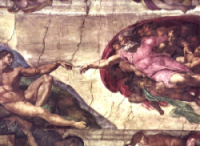
God creates Adam; Sistine Chapel, Michelangelo Buonarroti.Sanctification or in its verb form, sanctify, literally means to set apart for special use or purpose, that is to make holy or sacred (from the Latin verb sanctificare, which in turn derives from sanctus, "holy" and facere, "to make".). The Greek word is hagiasmos (άγιασμος), meaning "holiness, consecration, or sanctification." It comes from the root hagios (άγιος), which means holy or sacred. Sanctification then refers to the state or process of being set apart or made holy. What is often missed, or overlooked, is the relational aspect that is associated with the word sanctification. Only God is truly holy. Everything else, whether it is things or people, is holy only because of its relationship to God.

Definition and descriptions

The concept of sanctification is widespread among religions, but is perhaps more common among the various branches of the Christian religion, especially those of the Protestant-Reformed and Wesleyan-Arminian traditions. The term can be used to refer to objects which are set apart for special purposes (i.e., the Temple vessels), but the most common use within Christian theology is in reference to the change brought about by God in a believer, begun at the point of salvation or justification and continuing throughout the life of the believer. Many forms of Christianity believe that this process will only be completed in Heaven, but some believe that complete holiness is possible in this life on earth--particularly in the final days before the ultimate return of Jesus. Some Protestants denominations call the completion of sanctification "glorification".

More...

Saturday, September 01, 2007

Mount of Olives

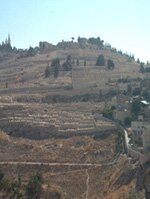
The Jewish cemetery on the Mount of Olives, overlooking the Old CityThe Mount of Olives (also Mount Olivet, Hebrew: Har HaZeitim הר הזיתים, sometimes Jebel et-Tur, "Mount of the Summit," or Jebel ez-Zeitun, "Mount of Olives") is a mountain ridge to the east of Jerusalem. It is named from the olive trees with which its sides are clothed. Jesus entered Jerusalem, gave his final teaching, and ascended to heaven from the Mount. It is the site of many important Biblical events.

In the Book of Zechariah the Mount of Olives is identified as the place from which God will begin to redeem the dead at the end of days.

For this reason, Jews have always sought to be buried on the mountain, and from Biblical times to the present day the mountain has been used as a cemetery for the Jews of Jerusalem.

More...

Friday, July 20, 2007

Kingdom of God

A Hubble Space Telescope (HST) image of NGC 3372. The image is 50 light-years wide and a composite of 48 frames. The false color image was created using the following formula: red for sulfur, green for hydrogen, and blue for oxygen emissionsThe Kingdom of God and the Kingdom of heaven seem to be variations of the same idea. A kingdom implies a king. Our king is Jesus. Jesus said His kingdom was not of this world (John 18:36). Jesus' authority did not come from man but from God (Luke 22:29).

The Kingdom of God (or the Kingdom of Heaven) is a key concept in Christianity based on a phrase attributed to Jesus of Nazareth in the gospels. The phrase occurs in the New Testament more than 100 times. Basileia tou theou was commonly translated into English as “Kingdom of God” in the New Testament, and refers to the reign or sovereignty of God over all things. This was as opposed to the reign of earthly powers, especially the Roman empire, which occupied Nazareth and Capernaum, where Jesus lived, as well as other cities mentioned in the Bible as visited by Jesus, most notably, Jerusalem.


More...

Wednesday, July 18, 2007

salvation

Francesco de Zurbarin’s Agnus Dei. A lamb on an altar with feet bound together, innocent, trusting and helpless.Salvation refers to deliverance from an undesirable state or condition. In theology, the study of salvation is called soteriology and is a vitally important concept in several religions. Christianity regards salvation as deliverance from the bondage of sin and from condemnation, resulting in eternal life with God.

Christian views of salvationSalvation is arguably one of the most important Christian spiritual concepts, perhaps second only to the deity of Jesus Christ, the lamb of God.

Among many Christians, the primary goal of religion is to attain salvation. Others maintain that the primary goal of Christians is to do the will of God, or that the two are equivalent. In many traditions, attaining salvation is synonymous with going to heaven after death, while most also emphasize that salvation represents a changed life while on Earth as well. Many elements of Christian theology explain why salvation is needed and how to attain it.


More...

Friday, July 06, 2007

Gospel of Matthew

The Gospel of Matthew (literally, "according to Matthew"; Greek, Κατά Μαθθαίον or Κατά Ματθαίον, Kata Maththaion or Kata Matthaion) is one of the four Gospel accounts of the New Testament. It narrates an account of the life and ministry of Jesus, from his genealogy to his post-resurrection commissioning of his Apostles to "go and make disciples of all nations." Bibles traditionally print Matthew as the first gospel, followed in order by Mark, Luke and John. The Christian community traditionally ascribes authorship to Matthew the Evangelist, one of Jesus's twelve disciples, while secular scholarship generally agrees it was written by an anonymous non-eyewitness to Jesus's ministry.

OverviewFor convenience, the book can be divided into its four structurally distinct sections: Two introductory sections; the main section, which can be further broken into five sections, each with a narrative component followed by a long discourse of Jesus; and finally, the Passion and Resurrection section.

Containing the genealogy, the birth, and the infancy of Jesus (Matthew 1; Matthew 2). The discourses and actions of John the Baptist preparatory to Christ's public ministry (Matthew 3; Matthew 4:11).


  1. Containing the genealogy, the birth, and the infancy of Jesus (Matthew 1; Matthew 2).
    The discourses and actions of John the Baptist preparatory to Christ's public ministry (Matthew 3; Matthew 4:11).

  2. The discourses and actions of Christ in Galilee (4:12–26:1).

    1. The Sermon on the Mount, concerning morality (Ch. 5–7)

    2. The Missionary Discourse, concerning the mission Jesus gave his Twelve Apostles. (10–11:1
    3. )
    4. The Parable Discourse, stories that teach about the Kingdom of Heaven (13).

    5. The "Church Order" Discourse, concerning relationships among Christians (18–19:1).

    6. The Eschatological Discourse, which includes the Olivet Discourse and Judgement of the Nations, concerning his Second Coming and the end of the age (24–25).


  3. The sufferings, death and Resurrection of Jesus, the Great Commission (28:16–20).


More...

Wednesday, June 27, 2007

Jacob's Ladder

The angels climb Jacob‘s Ladder on the west front of Bath AbbeyJacob's Ladder refers to a ladder to heaven described in the Genesis 28:11-19 which the biblical patriarch Jacob envisioned during his flight from his brother Esau:

10 Jacob left Beersheba and set out for Haran. 11 When he reached a certain place, he stopped for the night because the sun had set. Taking one of the stones there, he put it under his head and lay down to sleep. 12 He had a dream in which he saw a stairway resting on the earth, with its top reaching to heaven, and the angels of God were ascending and descending on it. 13 There above it stood the LORD, and he said: "I am the LORD, the God of your father Abraham and the God of Isaac. I will give you and your descendants the land on which you are lying. 14 Your descendants will be like the dust of the earth, and you will spread out to the west and to the east, to the north and to the south. All peoples on earth will be blessed through you and your offspring. 15 I am with you and will watch over you wherever you go, and I will bring you back to this land. I will not leave you until I have done what I have promised you."

16 When Jacob awoke from his sleep, he thought, "Surely the LORD is in this place, and I was not aware of it." 17 He was afraid and said, "How awesome is this place! This is none other than the house of God; this is the gate of heaven."

18 Early the next morning Jacob took the stone he had placed under his head and set it up as a pillar and poured oil on top of it. 19 He called that place Bethel, though the city used to be called Luz.

20 Then Jacob made a vow, saying, "If God will be with me and will watch over me on this journey I am taking and will give me food to eat and clothes to wear 21 so that I return safely to my father's house, then the LORD will be my God 22 and this stone that I have set up as a pillar will be God's house, and of all that you give me I will give you a tenth." (Gen. 28: 10-22)

More...

Tuesday, May 15, 2007

Promised Land

The Kingdom of David and Solomon. Solomon ruled over all the kingdoms west of the Euphrates River from Tiphsah to Gaza; he was at peace with all his neighbors (I Kings, 4:24)According to the Bible, the Land of Israel (Hebrew: Eretz Yisrael) was promised to the descendants of Hebrew patriarchs Abraham, Isaac, and Jacob by God, making it the Promised land. The concept is frequently used symbolically by Christians, especially in hymnody as a reference to Heaven, or to a new land, such as North America colonized by the Pilgrims. In the Bible, particularly in Genesis, Deuteronomy and Joshua, the Land of Israel was promised as an everlasting possession.

Abraham
'On that day, God made a covenant with Abram, saying: "To your descendants I have given this land, from the river of Egypt as far as the great river the Euphrates. The land of the Kenites, Kenizites, Kadmonites; the Chitties, Perizites, Refaim; the Emorites, Canaanites, Gigashites and Yevusites." ' (Genesis 15:18-21)

Isaac
"To you and your descendants I give this land." (Genesis 26:3)

Jacob
"The ground upon which you are lying I give to you and your descendants." (Genesis 28:13)

Moses
"I made a pact with them to give them the land of Canaan.” (Exodus 6:4)
'Now Moses went up from the plains of Moab to Mount Nebo, to the top of Pisgah, which is opposite Jericho. And the LORD showed him all the land, Gilead as far as Dan, and all Naphtali and the land of Ephraim and Manasseh, and all the land of Judah as far as the western sea [Mediterranean Sea], and the Negev and the plain in the valley of Jericho, the city of palm trees, as far as Zoar. Then the LORD said to him, "This is the land which I swore to Abraham, Isaac, and Jacob, saying, 'I will give it to your descendants'; I have let you see {it} with your eyes, but you shall not go over there." '(Deuteronomy 34:1-4)

More...

Wednesday, April 18, 2007

Garden of Eden

Eden, possibly located in this vecinity where the Tigris and Euphrates terminate into the GulfThe Garden of Eden (from Hebrew Gan Ēden, "גַּן עֵדֶן") is described by the Book of Genesis as being the place where the first man - Adam - and woman - Eve - lived after they were created by God. The past physical existence of this garden forms part of the creation belief of the Abrahamic religions.

The Genesis account (specifically, the Jahwist version of the creation story) supplies the geographical location of Eden in relation to four major rivers. However, because the identification of these rivers has been the subject of much controversy and speculation, a substantial consensus now exists that the knowledge of the location of Eden has been lost.

Suspected locations
There have been a number of claims as to the actual geographic location of the Garden of Eden, though many of these have little or no connection to the text of Genesis. Most put the Garden somewhere in the Middle East near Mesopotamia. Locations as diverse as Ethiopia, Java, Sri Lanka, the Seychelles, Brabant, and Bristol, Florida have all been proposed as locations for the garden. Some Christian theologians believe that the Garden never had a terrestrial existence, but was instead an adjunct to heaven as it became identified with Paradise.

The text asserts that from Eden the river divided into four branches: Hiddekel a.k.a. Tigris, Euphrates, Pishon and Gihon. The identity of the former two are commonly accepted, though the latter two rivers have been the subject of endless argument. But if the Garden of Eden had really been near the sources of the Tigris and the Euphrates, then the original narrators in the land of Canaan would have identified it as located generally in the Taurus Mountains, in Anatolia. Satellite photos reveal two dry riverbeds flowing toward the Persian Gulf near where the Tigris and Euphrates also terminate. While this accounts for four rivers in the vicinity, that area is the mouth of those rivers rather than their source.


More...

Thursday, March 15, 2007

Christian

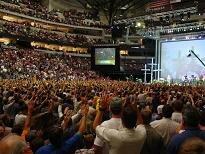
15000 men at a Promise Keepers meeting, praising GodA Christian is a follower of Jesus of Nazareth, referred to as Christ. Christians believe Jesus to be the Son of God, who lived a life befitting that of the creator of the universe, free of sin, who at the end of his earthly life was crucified, and then on the third day, rose from the dead, and later ascended into heaven. These beliefs are held by the vast majority of Christian denominations.


Christians believe that Jesus offers salvation, and that it is only possible because of him. Apart from Jesus Christ, there is no salvation. Ephesians 2:8-9 states that "It is by grace you have been saved, through faith, and that not of yourselves it is the gift of God that no one should boast" (NIV).

Humans cannot save themselves through good works, but only Jesus can. Good works, however, are a result of living according to the Word of God. Christians identify themselves as monotheistic, believing that there is one God. Most sects incorporate God as a perichoresis of three persons: Father (the Source, the Eternal Majesty); the Son (the eternal Logos or Word, incarnate as Jesus of Nazareth); and the Holy Spirit (the Paraclete or advocate).

More...

Thursday, February 08, 2007

Paul the Apostle

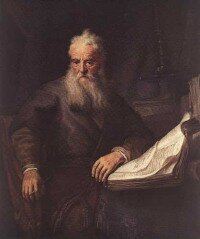
Portrait of St. Paul by RembrandtSaul, also known as Paul, Paulus, and Paul the Apostle, (AD 3—67) is widely considered to be central to the early development and spread of Christianity, particularly westward from Judea. Many Christians view him as an important interpreter of the teachings of Jesus. Paul is described in the New Testament as a Hellenized Jew and Roman citizen from Tarsus (present-day Turkey), and as a persistent persecutor of early Christians, almost all of whom were Jewish, prior to his "Road to Damascus" experience, which brought about his conversion to faith in Jesus as Messiah, not only for Jews, but for all, regardless of ethnic background. Paul made the first great effort, through his Epistles to Gentile Christian communities, to show that the God of Abraham is for all people, rather than for Jews only, though he did not originate the idea, for example see Isaiah 56:6-8 or proselyte or Great Commission, or Simon Peter's vision of the sheet descending from Heaven in Acts 10:9-23a.

Due to his body of work and his undoubted influence on the development of Christianity, some modern scholars have considered Paul to be the founder of Christianity, who modified Jesus' teachings and added important new doctrines. However, this view remains controversial.

More...

Tuesday, January 16, 2007

Mount of Olives

The Mount of OlivesThe Mount of Olives (also Mount Olivet, Hebrew: Har HaZeitim הר הזיתים, sometimes Jebel et-Tur, "Mount of the Summit," or Jebel ez-Zeitun, "Mount of Olives") is a mountain ridge to the east of Jerusalem. It is named from the olive trees with which its sides are clothed. Jesus entered Jerusalem, gave his final teaching, and ascended to heaven from the Mount. It is the site of many important Biblical events.

In the Book of Zechariah the Mount of Olives is identified as the place from which God will begin to redeem the dead at the end of days. For this reason, Jews have always sought to be buried on the mountain, and from Biblical times to the present day the mountain has been used as a cemetery for the Jews of Jerusalem.
The Mount of Olives is first mentioned in connection with David's flight from Jerusalem through the rebellion of Absalom (2 Samuel 15:30), and is only once again mentioned in the Old Testament, in Zechariah 14:4.


More...

Thursday, November 16, 2006

salvation

Two Trinities, Bartolomé Estéban Murillo (1618 - 1682)Salvation refers to deliverance from an undesirable state or condition. In theology, the study of salvation is called soteriology and is a vitally important concept in several religions. Christianity regards salvation as deliverance from the bondage of sin and from condemnation, resulting in eternal life with God.

Christian views of salvation
Salvation is arguably one of the most important Christian spiritual concepts, perhaps second only to the deity of Jesus Christ, the son of God.

Among many Christians, the primary goal of religion is to attain salvation. Others maintain that the primary goal of Christians is to do the will of God, or that the two are equivalent. In many traditions, attaining salvation is synonymous with going to heaven after death, while most also emphasize that salvation represents a changed life while on Earth as well. Many elements of Christian theology explain why salvation is needed and how to attain it.

More...

Wednesday, November 15, 2006

eschatology

Four Horsemen of the Apocalypse, by Albrecht Dürer.Eschatology (eschatos: "final" or "last" + (logos): "word") is a part of theology and philosophy concerned with the final events in the history of the world, (death and judgment, heaven and hell, the end of the world) or the ultimate destiny of human kind, commonly phrased as the end of the world. In many religions, the end of the world is a future event prophesied in sacred texts or folklore. More broadly, eschatology may encompass related concepts such as the Messiah or Messianic Age, the afterlife, and the soul.

As the time of Jesus' own death neared, this is what He said to His disciples to offer them comfort:

1"Do not let your hearts be troubled. Trust in God; trust also in me. 2In my Father's house are many rooms; if it were not so, I would have told you. I am going there to prepare a place for you. 3And if I go and prepare a place for you, I will come back and take you to be with me that you also may be where I am. 4You know the way to the place where I am going."


5Thomas said to him, "Lord, we don't know where you are going, so how can we know the way?" 6Jesus answered, "I am the way and the truth and the life. No one comes to the Father except through me. -John 14:1-6 (NIV)


In verse 6, Jesus is telling not only His disciples but He is telling the world that, He is the way to heaven; that there is no other way to share eternity with God.

Most Western monotheistic religions have doctrines claiming that "chosen" or "worthy" members of the one true faith will be "spared" or "delivered" from the coming judgment and wrath of God. They will be ushered into paradise either before, during, or after it depending upon the end-time scenario to which they hold.

More...
 

Subscribe


LifeNews.com

Desiring God Blog

Youth for Christ International