Showing posts with label Garden of Eden. Show all posts

Friday, December 09, 2011

Paradise Lost

Michael Casts out
all of the Fallen Angels 
 Paradise Lost is an epic poem in blank verse by the 17th-century English poet John Milton. It was originally published in 1667 in ten books, with a total of over ten thousand individual lines of verse. A second edition followed in 1674, redivided into twelve books (in the manner of the division of Virgil's Aeneid) with minor revisions throughout and a note on the versification; the majority of the poem was written while Milton was blind, and was transcribed for him.

The poem concerns the Christian story of the Fall of Man: the temptation of Adam and Eve by the fallen angel Satan and their expulsion from the Garden of Eden. Milton's purpose, stated in Book I, is to "justify the ways of God to men" and elucidate the conflict between God's eternal foresight and free will.

Milton incorporates Paganism, classical Greek references, and Christianity within the poem. It deals with diverse topics from marriage, politics (Milton was politically active during the time of the English Civil War), and monarchy, and grapples with many difficult theological issues, including fate, predestination, the Trinity, and the introduction of sin and death into the world, as well as angels, fallen angels, Satan, and the war in heaven. Milton draws on his knowledge of languages, and diverse sources — primarily Genesis, much of the New Testament, the deuterocanonical Book of Enoch, and other parts of the Old Testament. Milton's epic is generally considered one of the greatest literary works in the English language.

The story was revised into twelve books after initial publication, following the model of the Aeneid of Virgil. The book lengths vary—the longest being Book IX, with 1,189 lines and the shortest, Book VII, having 640. In the second edition, each book was preceded by a summary titled "The Argument". The poem follows the epic tradition of starting in medias res (Latin for in the midst of things), the background story being told in Books V-VI.

More...


Milton's Paradise Lost Book 2 audio
Scenes from Milton's Paradise Lost Part I
Scenes from Milton's Paradise Lost Part II

Friday, November 04, 2011

Cradle of Humanity

The evangelical Protestants of the 19th century, considered the inventors of the term "Cradle of Humanity," made claims that the term originated in Mesopotamia in the 2nd century, and that it was used by early non-Christian Arabs, to refer to a geographic area that falls within a 1,000 mile radius of the spot they believed to be the birthplace of humankind. No documentation of such a historical use has been forthcoming. Nevertheless, the term has been used not only in religious, but also in secular contexts, and may therefore refer to different locations, depending on the views of the user.

Jewish, Christian and Muslim creationists believe that man was created by God in a place called Eden and then placed in a garden located east of Eden. In the Christian Bible, Genesis 2:10-14 indicates the Garden of Eden was supplied by the Tigris and Euphrates rivers. Some early Christians (A.D second century) used the term to refer to a geographic area falling within a 1,000 mile radius of that location as the birthplace of mankind.

Evolutionary View
The consensus among some biologists and paleoanthropologists is that mankind evolved through natural processes, and when journalists and popularizers currently use the term "Cradle of Humanity", it refers to Great Rift Valley sites in Eastern Africa, where the oldest hominid fossils were found in 1974.

There is a growing list of scientists, alive today, who accept the biblical account of Creation.

As the evolutionist apriorism continues, the earliest hominids evolved from apes about 5 million years ago, but modern humans (homo sapien sapiens) didn't emerge until 150,000-200,000 years ago, in eastern Africa. Since 2002, however, several groups of prominent paleontologists have begun to challenge East Africa's position as the evolutionary "cradle of humanity", most notably because of the fossil hominid partial skull found in Chad in July 2002; recent research in connection with earliest hominids outside Africa focuses on the Liujiang hominid of China, the Dmanisi fossils of Georgia and the Mungo Man fossils in Australia.

More...

Saturday, February 13, 2010

Tigris


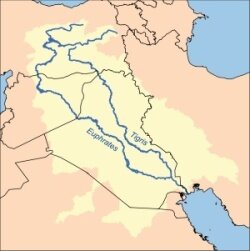
The Tigris is the eastern member of the pair of great rivers that define Mesopotamia (the name "Mesopotamia" is a Greek word meaning "the land between the rivers"), along with the Euphrates, which flows from the mountains of Anatolia through Iraq.

The original Sumerian name was Idigna or Idigina, which can be interpreted as "the swift river"[4] or "the river that goes", contrasted to its neighbor, the Euphrates, whose leisurely pace caused it to deposit more silt and build up a higher bed than the Tigris. This form was borrowed and gave rise to Akkadian Idiqlat. Either through a Persian intermediary or borrowed directly from Akkadian, the word was adopted into Greek as Tigris.

In Pahlavi, tigr means "arrow" (in the same family as Old Persian tigra-, Modern Persian têz "sharp"). However, it does not appear that this was the original name of the river, but that it (like the Semitic forms of the name) was coined as an imitation of the indigenous Sumerian name. The name of the river in English and many other languages — Tigris — is from Ancient Greek, which was in turn derived from the Persian.

It is also possible that the name Tigris, and the variants in Dicle, derives from Kurdish. In Kurdish, tij means "sharp", referring to the Tigris as a sharp and fast river.

Another name for this watercourse, used from the time of the Persian Empire, is Arvand, which has the same meaning. Today, the name Arvand refers to the lower part of the Tigris (ie, Arvand/Shatt al-Arab) in Persian.

In the Hebrew bible, it is called חדקל Chiddeqel

More...

Monday, August 24, 2009

Cradle of Humanity

The evangelical Protestants of the 19th century, considered the inventors of the term "Cradle of Humanity," made claims that the term originated in Mesopotamia [] in the 2nd century, and that it was used by early non-Christian Arabs, to refer to a geographic area that falls within a 1,000 mile radius of the spot they believed to be the birthplace of humankind. No documentation of such a historical use has been forthcoming. Nevertheless, the term has been used not only in religious, but also in secular contexts, and may therefore refer to different locations, depending on the views of the user.

Jewish, Christian and Muslim creationists believe that man was created by God in a place called Eden and then placed in a garden located east of Eden. In the Christian Bible, Genesis 2:10-14 indicates the Garden of Eden was supplied by the Tigris and Euphrates rivers. Some early Christians (A.D second century) used the term to refer to a geographic area falling within a 1,000 mile radius of that location as the birthplace of mankind.

The consensus among some biologists and paleoanthropologists is that mankind evolved through natural processes, and when journalists and popularizers currently use the term "Cradle of Humanity", it refers to Great Rift Valley sites in Eastern Africa, where the oldest hominid fossils were found in 1974.

More...

Saturday, April 12, 2008

Euphrates

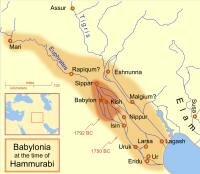
At the time of Hammurabi, Lagash was much closer to the gulf.The Euphrates (the traditional Greek name, Arabic: الفرات; Al-Furat, Hebrew: פְּרָת) is the westernmost of the two great rivers that define Mesopotamia (the other being the Tigris).

Etymology

The name Euphrates may have originated from Old Persian Ufratu, as it were from Avestan *hu-perethuua, meaning "good to cross over" (from hu-, meaning "good", and peretu, meaning "ford"). Alternatively, some suggest that the name Euphrates is possibly of Kurdish origin.

Course of the Euphrates

In Kurdish, fere means "wide", re means "flowing water" and hat is "flowing", giving fererehat, meaning "wide flowing water". The modern Kurdish name, Ferat, is possibly a reduction of the older name. However, the Indo-European etymology of the name is put into doubt by the Sumerian and Akkadian names for the Euphrates are Buranun and Pu-rat-tu, respectively, Buranun being attested in an inscription associated with king Gudea (22nd century BC). It seems thus likely that the Old Persian name arose by popular etymology based on the pre-Iranian name of the river.

More...

Wednesday, April 18, 2007

Garden of Eden

Eden, possibly located in this vecinity where the Tigris and Euphrates terminate into the GulfThe Garden of Eden (from Hebrew Gan Ēden, "גַּן עֵדֶן") is described by the Book of Genesis as being the place where the first man - Adam - and woman - Eve - lived after they were created by God. The past physical existence of this garden forms part of the creation belief of the Abrahamic religions.

The Genesis account (specifically, the Jahwist version of the creation story) supplies the geographical location of Eden in relation to four major rivers. However, because the identification of these rivers has been the subject of much controversy and speculation, a substantial consensus now exists that the knowledge of the location of Eden has been lost.

Suspected locations
There have been a number of claims as to the actual geographic location of the Garden of Eden, though many of these have little or no connection to the text of Genesis. Most put the Garden somewhere in the Middle East near Mesopotamia. Locations as diverse as Ethiopia, Java, Sri Lanka, the Seychelles, Brabant, and Bristol, Florida have all been proposed as locations for the garden. Some Christian theologians believe that the Garden never had a terrestrial existence, but was instead an adjunct to heaven as it became identified with Paradise.

The text asserts that from Eden the river divided into four branches: Hiddekel a.k.a. Tigris, Euphrates, Pishon and Gihon. The identity of the former two are commonly accepted, though the latter two rivers have been the subject of endless argument. But if the Garden of Eden had really been near the sources of the Tigris and the Euphrates, then the original narrators in the land of Canaan would have identified it as located generally in the Taurus Mountains, in Anatolia. Satellite photos reveal two dry riverbeds flowing toward the Persian Gulf near where the Tigris and Euphrates also terminate. While this accounts for four rivers in the vicinity, that area is the mouth of those rivers rather than their source.


More...
 

Subscribe


LifeNews.com

Desiring God Blog

Youth for Christ International