Showing posts with label Paradise Lost. Show all posts

Friday, December 09, 2011

Paradise Lost

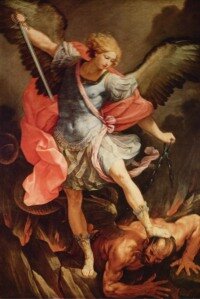
Michael Casts out
all of the Fallen Angels 
 Paradise Lost is an epic poem in blank verse by the 17th-century English poet John Milton. It was originally published in 1667 in ten books, with a total of over ten thousand individual lines of verse. A second edition followed in 1674, redivided into twelve books (in the manner of the division of Virgil's Aeneid) with minor revisions throughout and a note on the versification; the majority of the poem was written while Milton was blind, and was transcribed for him.

The poem concerns the Christian story of the Fall of Man: the temptation of Adam and Eve by the fallen angel Satan and their expulsion from the Garden of Eden. Milton's purpose, stated in Book I, is to "justify the ways of God to men" and elucidate the conflict between God's eternal foresight and free will.

Milton incorporates Paganism, classical Greek references, and Christianity within the poem. It deals with diverse topics from marriage, politics (Milton was politically active during the time of the English Civil War), and monarchy, and grapples with many difficult theological issues, including fate, predestination, the Trinity, and the introduction of sin and death into the world, as well as angels, fallen angels, Satan, and the war in heaven. Milton draws on his knowledge of languages, and diverse sources — primarily Genesis, much of the New Testament, the deuterocanonical Book of Enoch, and other parts of the Old Testament. Milton's epic is generally considered one of the greatest literary works in the English language.

The story was revised into twelve books after initial publication, following the model of the Aeneid of Virgil. The book lengths vary—the longest being Book IX, with 1,189 lines and the shortest, Book VII, having 640. In the second edition, each book was preceded by a summary titled "The Argument". The poem follows the epic tradition of starting in medias res (Latin for in the midst of things), the background story being told in Books V-VI.

More...


Milton's Paradise Lost Book 2 audio
Scenes from Milton's Paradise Lost Part I
Scenes from Milton's Paradise Lost Part II

Saturday, May 15, 2010

Paradise Lost

Paradise Lost is an epic poem in blank verse by the 17th-century English poet John Milton. It was originally published in 1667 in ten books, with a total of over ten thousand individual lines of verse. A second edition followed in 1674, redivided into twelve books (in the manner of the division of Virgil's Aeneid) with minor revisions throughout and a note on the versification; the majority of the poem was written while Milton was blind, and was transcribed for him.

The poem concerns the Christian story of the Fall of Man: the temptation of Adam and Eve by the fallen angel Satan and their expulsion from the Garden of Eden. Milton's purpose, stated in Book I, is to "justify the ways of God to men" and elucidate the conflict between God's eternal foresight and free will.

Milton incorporates Paganism, classical Greek references, and Christianity within the poem. It deals with diverse topics from marriage, politics (Milton was politically active during the time of the English Civil War), and monarchy, and grapples with many difficult theological issues, including fate, predestination, the Trinity, and the introduction of sin and death into the world, as well as angels, fallen angels, Satan, and the war in heaven. Milton draws on his knowledge of languages, and diverse sources — primarily Genesis, much of the New Testament, the deuterocanonical Book of Enoch, and other parts of the Old Testament. Milton's epic is generally considered one of the greatest literary works in the English language.

More...

Monday, April 19, 2010

Michael (archangel)

Michael (Hebrew: Miyka'el, Strong's H317 מיכאל) one of, the chief, or the first archangel who is described as the one who stands in time of conflict for the children of Israel is the archangel mentioned in the Book of Revelation 12:7:
7 And there was war in heaven. Michael and his angels fought against the dragon, and the dragon and his angels fought back. (Revelation 12:7)
in the Hebrew Bible Michael is mentioned by name in the Persian context of the post-Exilic Book of Daniel. There in Daniel does Michael appear—as "one of the chief princes" (Daniel 10:13) who in Daniel's vision comes to the angel Gabriel's aid in his contest with the angel of Persia, and is also described there as the advocate of Israel and "great prince who stands up for the children of your (Daniel's) people" (Daniel 10:21, 12:1). The Talmud tradition rendered his name as meaning "who is like El" (God)? (but literally "El's Likeness")" (compare the late prophet Micah), but according to Rabbi Simeon ben Lakish (AD 230–270), all the specific names for the angels were brought back by the Jews from Babylon, and many modern commentators would agree.

Michael is one of the principal angels in Abrahamic tradition; his name was said to have been the war-cry of the angels in the battle fought in heaven against Satan and his followers

More...


Subscribe


LifeNews.com

Desiring God Blog

Youth for Christ International