Showing posts with label Genesis. Show all posts

Sunday, October 16, 2011

Jacob

(Hebrew: יעקב Ya`aqob "heel holder" or "supplanter" from עָקַב "to supplant, circumvent, take by the heel, follow at the heel, assail insidiously, overreach"), later known as Israel (Hebrew: ישראל Yisra'el Gen 32:28 "God prevails"), is the third biblical Patriarch. His father was Isaac and his grandfather was Abraham. His story is told in the Book of Genesis, at Gen 25:19 which begins, "And these [are] the generations of Isaac, Abraham's son: Abraham begat Isaac...."

Isaac was forty years old when he married Rebekah, sixty years old when Esau and Jacob were born, while Abraham was 160 years old. He and his twin brother, Esau, were markedly different in appearance and behavior. Esau was a ruddy hunter, while Jacob was a gentle man who "dwelled in tents," interpreted by most biblical scholars as a mark of his studiousness in the "tents" of Torah.
And the boys grew: and Esau was a cunning hunter, a man of the field; and Jacob [was] a plain man, dwelling in tents. –Gen 25:27

During Rebekah's pregnancy, "the children struggled together within her" (Genesis 25:22).

According to Rashi
Whenever Rebecca passed a house of study, Jacob would become agitated, indicating his natural inclination for Torah study. If she passed a house of idol worship, however, Esau would become agitated, expressing his own penchant for idolatry. (Rashi, Bereishis 25:22) Seeking to understand this paradox, Rebecca approached Shem, the son of Noah, who had an academy of higher learning and was also a prophet. He revealed that Rebecca would give birth to twins whose character would be completely divergent from each other. Jacob would embrace righteousness; Esav, his evil inclination. (Rashi, Bereishis 25:23)
More...

Tuesday, October 12, 2010

Mount Sinai

11 and be ready for the third day. For on the third day the LORD will come down on Mount Sinai in the sight of all the people. –Exodus 19:11 ESV

Mount Sinai (Hebrew: סיני Ciynay, "thorny") has an Etymology of uncertain derivation , also known as "Gebel Musa" or "Jabal Musa" by the Bedouins, is the name of a mountain in the Sinai Peninsula, or rather a mountainous region in the Arabian peninsula between the two gulfs of the of the Red Sea (the Heroöpolitan and the Ælanite). It is 2,629 m meters high. The mountain known as Sinia is near a protruding lower bluff known as the Ras Sasafeh (Sufsafeh), and rises almost perpendicularly from the plain, the tallest peak on the Sinai peninsula.

The Biblical Mount Sinai is an ambiguously located mountain at which the Hebrew bible states that the Ten Commandments were given to Moses by God. In certain biblical passages these events are described as having transpired at Mount Horeb, but though there is a small body of opinion that Sinai and Horeb were different locations, they are generally considered to have been different names for the same place.

More...

Saturday, September 25, 2010

Jacob

Jacob (Hebrew: יעקב Ya`aqob) (יַעֲקֹב "Holder of the heel"), later known as Israel (יִשְׂרָאֵל "Prince of God") is the third Biblical Patriarch. His father was Isaac and his grandfather was Abraham. His story is told in the Book of Genesis, beginning at Gen 25:19 which describes Jacob's father Isaac, the son of Abraham.

Isaac was forty years old when he married Rebekah, sixty years old when Esau and Jacob were born, and Abraham was 160 years old. He and his twin brother, Esau, were markedly different in appearance and behavior. Esau was a ruddy hunter, while Jacob was a gentle man who "dwelled in tents," interpreted by most biblical scholars as a mark of his studiousness in the "tents" of Torah.

During Rebekah's pregnancy, "the children struggled together within her" (Genesis 25:22).

According to Rashi, whenever Rebekah passed a house of learning, Jacob would struggle to get out; whenever she passed a house of idolatry, Esau would struggle to get out.

Fearing that she was carrying one tenacious child, Rebekah questioned God about the tumult and learned that two children were in her womb, who would become two very different nations.

They would always be in competition, and eventually, the elder would serve the younger. She did not tell her husband Isaac about this prophecy, but remembered it later when she told Jacob to go to his father in place of Esau to receive the paternal blessing.

Esau was born first. Right behind was his brother Jacob, who was grasping onto Esau's heel. Thus he was named Ya`aqob - יעקב, from the Hebrew root עקב, "heel." The commentators explain that Jacob was trying to hold Esau back from being the firstborn and claiming the Abrahamic legacy for himself.

More...

Monday, August 30, 2010

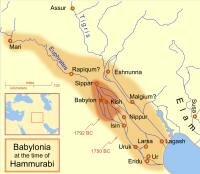
Babylonia

The Great Ziggurat of UR
(January 17, 2004) as viewed
from Royal tombs of UR
Babylonia, named for its capital city, Babylon, was an ancient state in the south part of Mesopotamia (in modern Iraq), combining the territories of Sumer and Akkad. The earliest mention of Babylon can be found in a tablet of the reign of Sargon of Akkad, dating back to the 23rd century BC. Babylonia emerged when Hammurabi created an empire out of the territories of the former Akkadian Empire. Babylonia adopted the written Semitic Akkadian language for official use, and retained the Sumerian language for religious use, which by that time was no longer a spoken language. The Akkadian and Sumerian traditions played a major role in later Babylonian culture, and the region would remain an important cultural center, even under outside rule, throughout the Bronze Age and the Early Iron Age.

Biblical patriarch Abraham and his grandson, Lot, were originally from Ur.
27 This is the account of Terah. Terah became the father of Abram, Nahor and Haran. And Haran became the father of Lot. 28 While his father Terah was still alive, Haran died in Ur of the Chaldeans, in the land of his birth. 29 Abram and Nahor both married. The name of Abram's wife was Sarai, and the name of Nahor's wife was Milcah; she was the daughter of Haran, the father of both Milcah and Iscah. –Genesis 11:27-29
31 Terah took his son Abram, his grandson Lot son of Haran, and his daughter-in-law Sarai, the wife of his son Abram, and together they set out from Ur of the Chaldeans to go to Canaan. But when they came to Haran, they settled there. –Genesis 11:31
Historically, two ethnic groups, the Sumerians and Akkadians, had dominated the region. An area rich in natural resources, and strategically located for trade routes and commerce, it was often under threat from outsiders throughout the region's history.

At around 1900 BC, following the Sumerian revival under Ur-III, Semitic Amorites from west of the Euphrates gained control over most of Mesopotamia. During the first centuries of their rule, Mesopotamia was not unified, and the most powerful city state was Isin. Some Amorites eventually formed a monarchical government in the city-state of Babylon, which would ultimatly take over the Amorite kingdoms and form the first Babylonian empire. The three centuries of their rule is known as the Old Babylonian Period.

More...

Monday, June 21, 2010

Original sin

According to Christian tradition, Original sin is the general and non-personal condition of sinfulness (lack of holiness) into which human beings are born. It is also called hereditary sin or birth sin. Used with the definite article ("the original sin"), it refers to the first sin committed by humans, seen as the seed of future evil effects for the whole human race. Christians usually refer to this first sin as "the Fall".

By analogy the term is used in fields other than religion to indicate a pervading inherent flaw.

The original sin (the Fall)

Classical Biblical view
Adam and Eve's sin, as recounted in the Book of Genesis is sometimes called in Hebrew החטא הקדמון (the original sin), on the basis of the traditional Christian term. But the term used in classical Jewish literature is חטא אדם הראשׁון, (the first sin of man, or of Adam).

The account in Genesis 2-3 implies that Adam and Eve initially lived in a state of intimate communion with God. The narrative reads that God "made various trees grow that were delightful to look at and good for food, with the tree of life in the middle of the garden and the tree of the knowledge of good and bad (Genesis 2:9, ESV)." God then forbid Adam to eat the fruit of the tree of knowledge warning him that he would surely die if he did so. Man was not forbidden to eat from the tree of life initially, but was after breaking the commandment to not eat of the tree of knowledge. God said "The man has now become like one of us, knowing good and evil. He must not be allowed to reach out his hand and take also from the tree of life and eat, and live forever." (Genesis 3:22-23). See "The Tree of Life and "The Tree of Knowledge of Good and Evil" (Genesis 2:15-17). The serpent persuaded Eve to eat from the tree and "she also gave some to her husband, who was with her, and he ate it (Genesis 3:6b, NAB)." After eating the fruit Adam became aware of his nakedness (Genesis 3:1-7). God bestowed a curse upon each of the active participants. First the earth is cursed with thorns. Next the serpent's physical form is altered and God sets up an eternal enmity between Eve and the serpent and all their offspring (Genesis 3:9-15). God then pronounces two curses upon Eve. First, she is to suffer the difficulties of pregnancy. Second, her husband will henceforth rule over her. God then tells Adam that he will now struggle for his sustenance
16 To the woman he said,

"I will surely multiply your pain in childbearing; in pain you shall bring forth children. Your desire shall be for your husband, and he shall rule over you."

17 And to Adam he said, "Because you have listened to the voice of your wife and have eaten of the tree of which I commanded you, 'You shall not eat of it,' cursed is the ground because of you; in pain you shall eat of it all the days of your life; 18 thorns and thistles it shall bring forth for you; and you shall eat the plants of the field. 19 By the sweat of your face you shall eat bread, till you return to the ground, for out of it you were taken; for you are dust, and to dust you shall return."

20 The man called his wife’s name Eve, because she was the mother of all living. 21 And the LORD God made for Adam and for his wife garments of skins and clothed them.
(Genesis 3:16-21 ESV)

More...

Thursday, May 06, 2010

Promised Land

According to the Bible, the Land of Israel (Hebrew: Eretz Yisrael) was promised to the descendants of Hebrew patriarchs Abraham, Isaac, and Jacob by God, making it the Promised land. The concept is frequently used symbolically by Christians, especially in hymnody as a reference to Heaven, or to a new land, such as North America colonized by the Pilgrims. In the Bible, particularly in Genesis, Deuteronomy and Joshua, the Land of Israel was promised as an everlasting possession.

Abraham
'On that day, God made a covenant with Abram, saying: "To your descendants I have given this land, from the river of Egypt as far as the great river the Euphrates. The land of the Kenites, Kenizites, Kadmonites; the Chitties, Perizites, Refaim; the Emorites, Canaanites, Gigashites and Yevusites." ' (Genesis 15:18-21)

More...

Wednesday, April 30, 2008

Edom

Map showing kingdom of Edom (in red) at its largest extent, c. 600 BCE. Areas in dark red show the approximate boundary of classical-age Idumaea Edom (אֱדוֹם), a Hebrew word meaning "red", is a name given to Esau in the Hebrew Bible (see Gen. 25:30), as well as to the nation purportedly descended from him. The nation's name in Assyrian was Udumi; in Greek, Idoumaía; in Latin, Idumæa or Idumea.
The Edomite people were a Semitic-speaking tribal group inhabiting the Negev Desert and the Aravah valley of what is now southern Israel and adjacent Jordan. The region has much reddish sandstone, which may have given rise to the name "Edom". The nation of Edom is known to have existed back to the 8th or 9th Century BCE, and the Bible dates it back several centuries further. Recent archeological evidence may indicate an Edomite nation as long ago as the 11th Century BCE, but the topic is controversial. The nation ceased to exist with the Jewish-Roman Wars.

The Edomites

The Edomites may have been connected with the Shasu and Shutu, nomadic raiders mentioned in Egyptian sources. Indeed, a letter from an Egyptian scribe at a border fortress in the Wadi Tumilat during the reign of Merneptah reports movement of nomadic "shasu-tribes of Edom" to watering holes in Egyptian territory.

In the Bible

The Bible explains the name "Edom" with no mention of red rock. It refers to the Edomites as descendants of Esau, and the Book of Genesis mentions "red" a number of times in describing Esau and explaining his alternate name Edom.

"The first one [Esau] came out reddish [admoni in Hebrew], as hairy as a fur coat. They named him Esau." Years later, "Jacob was once simmering a stew, when Esau came home exhausted from the field. Esau said to Jacob, 'Give me a swallow of that red stuff [ha-adom, ha-adom, i.e., using the word ha-adom twice]! I'm famished!' He was therefore given the name Edom ['Red' or 'Ruddy']."

The Edomites' original country, according to the Tanakh, stretched from the Sinai peninsula as far as Kadesh Barnea. Southward it reached as far as Eilat, which was the seaport of Edom. On the north of Edom was the territory of Moab. The boundary between Moab and Edom was the Wadi Zered. The ancient capital of Edom was Bozrah. According to Genesis, Esau's descendents settled in this land after displacing the Horites. It was also called the land of Seir; Mount Seir appears to have been strongly identified with them and may have been a cultic site.

More...

Saturday, April 12, 2008

Euphrates

At the time of Hammurabi, Lagash was much closer to the gulf.The Euphrates (the traditional Greek name, Arabic: الفرات; Al-Furat, Hebrew: פְּרָת) is the westernmost of the two great rivers that define Mesopotamia (the other being the Tigris).

Etymology

The name Euphrates may have originated from Old Persian Ufratu, as it were from Avestan *hu-perethuua, meaning "good to cross over" (from hu-, meaning "good", and peretu, meaning "ford"). Alternatively, some suggest that the name Euphrates is possibly of Kurdish origin.

Course of the Euphrates

In Kurdish, fere means "wide", re means "flowing water" and hat is "flowing", giving fererehat, meaning "wide flowing water". The modern Kurdish name, Ferat, is possibly a reduction of the older name. However, the Indo-European etymology of the name is put into doubt by the Sumerian and Akkadian names for the Euphrates are Buranun and Pu-rat-tu, respectively, Buranun being attested in an inscription associated with king Gudea (22nd century BC). It seems thus likely that the Old Persian name arose by popular etymology based on the pre-Iranian name of the river.

More...

Wednesday, March 26, 2008

Melchizedek

Statue of Melchizedek. Santa Maria Maggiore, Rome.Melchizedek or Malki-tzédek (מַלְכִּי־צֶדֶק / מַלְכִּי־צָדֶק), sometimes written Malchizedek, Melchisedec, Melchisedech, Melchisedek or Melkisedek, is a figure mentioned by the Hebrew Bible, in the Book of Genesis, where he interacts with Abraham.

Name and titles

Melchizedek's name can be translated (from Hebrew) either as Zedek is my king or as My king is righteous, the former, which treats Zedek as a proper noun, is the translation favoured by most biblical scholars, and refers to a Canaanite deity - Zedek. In Genesis, Melchizedek is also referred to as king of Salem (generally believed to be ancient Jerusalem), and priest of El Elyon. Though traditionally El Elyon is translated as most high God, and interpreted as a reference to Yahweh (by tradition) or El (by some scholars), other scholars believe that it refers to Zedek - regarding El Elyon as referring to a most high god, and using Melchizedek's name as the indicator of who the deity was.

If the majority of scholars are right in taking the name as a reference to Zedek, then it would imply that Zedek was the main deity worshipped at Salem (i.e. Jerusalem) at that time. It is certainly the case that Jerusalem is plausibly referred to as city of Zedek (ir ha-zedek) in the Book of Isaiah, as well as home of Zedek (neweh zedek) in the Book of Jeremiah and as gates of Zedek (sha'are zedek) in the Book of Psalms, though it is also true that in each of these cases zedek is traditionally translated as righteous (as in city of righteousness).

Biblical Narrative

In the Tanakh, Melchizedek brought bread and wine to Abraham (then called Abram) after Abraham's victory over the four kings (led by Chedorlaomer) who had besieged Sodom and Gomorrah and had taken Abraham's nephew Lot prisoner. Melchizedek is also described as blessing Abraham in the name of El Elyon (see name and titles section for identification of El Elyon), and in return for these favours, Abraham gave Melchizedek a tithe, from the spoils gained in the battle.

More...

Friday, March 07, 2008

Flood Geology

The Rocky MountainsFlood geology (also creation geology or diluvial geology) is a creationist perspective on geologic phenomena which assumes the literal truth of the Great Flood described in Genesis (see also Noah's Ark).

Specifically, the Great Flood is claimed to be the origin of most of the Earth's geological features, including sedimentary strata, fossilization, fossil fuels, submarine canyons, salt domes, and frozen mammoths.

Creationists regard Genesis as providing a scientifically accurate record for the geological history of the Earth, but some claim this is not accepted within the science of geology. This segment of the scientific community state that flood geology is pseudoscience.

Flood geology is a part of the broader endeavor of creation science, particularly being associated with proponents of Young Earth creationism. Flood geology adherents support their views with geological field work that they believe gives strong evidence of a universal flood, and they usually profess a literal belief in the Biblical record as their baseline for research.

Mainstream science does not consider the young earth biblical interpretation of a global flood and associated deluge mythology to be a valid scientific theory. Although flood geology was widely supported by early practitioners of geology and geosciences, it was contradicted by many scientific discoveries of the first half of the 19th century and it was abandoned as a serious scientific hypothesis by the middle of the century. It was revived in the early 20th century as part of the growth of the Christian fundamentalist movement in the United States.

More...

Thursday, March 06, 2008

The Serpent

Michelangelo’s depiction of the serpent staff on the Sistine Chapel ceilingSerpent is a word of Latin origin (serpens, serpentis) which is ultimately derived from the Sanskrit term serp, that is normally substituted for "snake" in a specifically mythic or religious context, in order to distinguish such creatures from the field of biology.

Hebrew Bible

In the Hebrew Bible (the Tanakh) of Judaism, the speaking Serpent (nachash) in the Garden of Eden brought forbidden knowledge, but was not identified with Satan in the Book of Genesis. Nor is there any indication there in Genesis that the Serpent was a deity in his own right, aside from the fact that the Pentateuch is not teeming with talking animals.
1"Now the serpent was more cunning than any beast of the field which the Lord God has made," (Genesis 3:1)
Moses lifts up the brass snake, curing the Isrealites from Snake Bites. Hezekiah called the snake Nehushtan though he was cursed for his role in the Garden, this was not the end of the Serpent, who continued to be venerated in the folk religion of Judah and was tolerated by official religion until the in time of king Hezekiah. The Book of Numbers provides an origin for an archaic bronze serpent associated with Moses, with the following narrative:

More...


Subscribe


LifeNews.com

Desiring God Blog

Youth for Christ International