Showing posts with label Babylonia. Show all posts

Wednesday, September 08, 2010

Assyria


Simo Parpola about Assyrians
Assyria in earliest historical times referred to a region on the Upper Tigris river, named for its original capital, the ancient city of Assur. Later, as a nation and Empire, it also came to include roughly the northern half of Mesopotamia (the southern half being Babylonia). The capital is Nineveh.

Assyria proper was located in a mountainous region, extending along the Tigris as far as the high Gordiaean or Carduchian mountain range of Armenia, sometimes called the "Mountains of Ashur".

The Assyrian kings controlled a large kingdom at three different times in history. These are called the Old, Middle, and Neo-Assyrian kingdoms, or periods. The most powerful and best-known nation of these periods is the Neo-Assyrian kingdom, 911-612 BC.

Early history
The most important prehistoric (Neolithic) site in Assyria is at Tell Hassuna, the center of the Hassuna culture.

Of the early history of the kingdom of Assyria, little is positively known. According to some Judeo-Christian traditions, the city of Ashur (also spelled Assur or Aššur) was founded by Ashur (also Asshur) the second son of Shem, who was deified by later generations as the city's patron god.

The upper Tigris river valley seems to have been ruled from Sumer, Akkad, and northern Babylonia in its earliest stages, being part of Sargon of Akkad's empire. Destroyed by barbarians in the Gutian period, it was rebuilt, and ended up being governed as part of the Empire of the 3rd dynasty of Ur.

More...

Monday, August 30, 2010

Babylonia

The Great Ziggurat of UR
(January 17, 2004) as viewed
from Royal tombs of UR
Babylonia, named for its capital city, Babylon, was an ancient state in the south part of Mesopotamia (in modern Iraq), combining the territories of Sumer and Akkad. The earliest mention of Babylon can be found in a tablet of the reign of Sargon of Akkad, dating back to the 23rd century BC. Babylonia emerged when Hammurabi created an empire out of the territories of the former Akkadian Empire. Babylonia adopted the written Semitic Akkadian language for official use, and retained the Sumerian language for religious use, which by that time was no longer a spoken language. The Akkadian and Sumerian traditions played a major role in later Babylonian culture, and the region would remain an important cultural center, even under outside rule, throughout the Bronze Age and the Early Iron Age.

Biblical patriarch Abraham and his grandson, Lot, were originally from Ur.
27 This is the account of Terah. Terah became the father of Abram, Nahor and Haran. And Haran became the father of Lot. 28 While his father Terah was still alive, Haran died in Ur of the Chaldeans, in the land of his birth. 29 Abram and Nahor both married. The name of Abram's wife was Sarai, and the name of Nahor's wife was Milcah; she was the daughter of Haran, the father of both Milcah and Iscah. –Genesis 11:27-29
31 Terah took his son Abram, his grandson Lot son of Haran, and his daughter-in-law Sarai, the wife of his son Abram, and together they set out from Ur of the Chaldeans to go to Canaan. But when they came to Haran, they settled there. –Genesis 11:31
Historically, two ethnic groups, the Sumerians and Akkadians, had dominated the region. An area rich in natural resources, and strategically located for trade routes and commerce, it was often under threat from outsiders throughout the region's history.

At around 1900 BC, following the Sumerian revival under Ur-III, Semitic Amorites from west of the Euphrates gained control over most of Mesopotamia. During the first centuries of their rule, Mesopotamia was not unified, and the most powerful city state was Isin. Some Amorites eventually formed a monarchical government in the city-state of Babylon, which would ultimatly take over the Amorite kingdoms and form the first Babylonian empire. The three centuries of their rule is known as the Old Babylonian Period.

More...

Wednesday, October 07, 2009

Tower of Babel

The Tower of Babel by Pieter Brueghel the Elder (1563)The tower constructed by the builders at Babel (that is, Babylonia - modern day Iraq []) became a symbol of their defiance against God, (Gen. 11:1-6). It was probably modeled after a ziggurat which is a mound of sun-dried bricks and was probably constructed before 4,000 bc.

According to the narrative in Genesis 11 of the Bible, the Tower of Babel was a tower built by a united humanity to reach the heavens.

Because the hearts of men were said to be inherently evil and disobedient, they were striving to make a name for themselves instead of worshipping the God who created them.

Because of this open defiance, God stopped their efforts by confusing languages so that no one could understand each other. As a result, they could no longer communicate and the work was halted. The builders were then scattered to different parts of Earth. This story is used to explain the existence of many different languages and races.

More...

Saturday, May 16, 2009

Babylon

Babylon (in Arabic: بابل; in Syriac: ܒܒܙܠ in Hebrew:בבל) is the Greek variant of Akkadian Babilu (bāb-ilû, meaning "Gateway of the god", translating Sumerian Kadingirra), an ancient city in Mesopotamia (modern Al Hillah, Iraq, see also: Iraq Maps), the ruins of which can be found in present-day Babil Province, about 50 miles (80 km) south of Baghdad. It was the "holy city" of Babylonia from around 2300 BC, and the seat of the Neo-Babylonian empire from 612 BC. In the Bible, the name appears as בבל (Babel).

In the Old Testament, the name appears as בבל Babel or Babylon interpreted by Genesis 11:9 to mean "confusion (by mixing)", from the verb balal:
1) to mix, mingle, confuse, confound
a) (Qal)
1) to mingle, confuse
2) to mix
3) to give provender, feed (animals)
b) (Hithpoel) to mix oneself (among others)
c) (Hiphil) to fade away

The Hanging Gardens of Babylon were one of the Seven Wonders of the Ancient World.

More...

Saturday, April 21, 2007

Babylonia

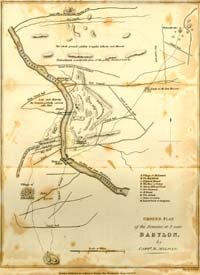
From Travels in Chaldaea, including a journey from Bussorah to Bagdad, Hillah, and Babylon, performed on foot in 1827, published by Henry Colburn and Richard Bentley, London, 1829.Babylonia, named for its capital city, Babylon, was an ancient state in the south part of Mesopotamia (in modern Iraq), combining the territories of Sumer and Akkad. The earliest mention of Babylon can be found in a tablet of the reign of Sargon of Akkad, dating back to the 23rd century BC.

History
Historically, two ethnic groups, the Sumerians and Akkadians, had dominated the region. An area rich in natural resources, and strategically located for trade routes and commerce, it was often under threat from outsiders throughout the region's history.

Old Babylonian period
At around 1900 BC, following the Sumerian revival under Ur-III, Semitic Amorites from west of the Euphrates gained control over most of Mesopotamia. During the first centuries of their rule, Mesopotamia was not unified, and the most powerful city state was Isin. Some Amorites eventually formed a monarchical government in the city-state of Babylon, which would ultimatly take over the Amorite kingdoms and form the first Babylonian empire. The three centuries of their rule is known as the Old Babylonian Period. The Babylonians engaged in regular trade and influence with Western city-states; with Babylonian officials and troops passing to Syria and Canaan. Further, "Amorite" colonists were established in Babylonia for the purposes of trade.

More...


Subscribe


LifeNews.com

Desiring God Blog

Youth for Christ International