Showing posts with label Iraq. Show all posts

Saturday, August 13, 2011

Syria

Syria (Arabic: سوريا ‎or سورية ), officially the Syrian Arab Republic (Arabic: الجمهورية العربية السورية ), is a country in the Middle East, bordering Lebanon to the west, Palestine to the southwest, Jordan to the south, Iraq to the east, and Turkey to the north. The modern state of Syria attained independence from the French mandate of Syria in 1946, but can trace its historical roots to the fourth millennium BC; its capital city, Damascus, was the seat of the Umayyad Empire and a provincial capital of the Mamluk Empire.

Isaiah 17: An Oracle Concerning Damascus

Syria has a population of 19 million, of whom the majority are Arabic-speaking Sunni Muslims, as well as 16% other Muslim groups, including the Alawi, Shiite, and Druze, and 10% Christian.

Since 1963 the country has been governed by the Baath Party; the head of state since 1970 has been a member of the Assad family.

Syria's current President is Bashar al-Assad, son of Hafez al-Assad, who held office from 1970 until his death in 2000.

Historically, Syria has often been taken to include the territories of Lebanon, Israel and the Palestinian Territories, and parts of Jordan, but excluding the Jazira region in the north-east of the modern Syrian state. In this historic sense, the region is also known as Greater Syria or by the Arabic name Bilad al-Sham (بلاد الشام ). Since the Six-Day War in 1967, Israel administers the disputed Golan Heights to the southwest of the country; a dispute with Turkey over the Hatay Province has subsided.

The name Syria comes from the ancient Greek name for the former colonial territories of Assyria such as Canaan and Aram.

At the eastern end of the Mediterranean Sea between Egypt and Arabia to the south and Cilicia to the north, stretching inland to include Mesopotamia, and having an uncertain border to the northeast that Pliny the Elder describes as including from west to east Commagene, Sophene, and Adiabene, "formerly known as Assyria" (N.H. 5.66).

By Pliny's time, however, this larger Syria had been divided into a number of provinces under the Roman Empire (but politically independent from each other): Judaea (or "Judea" and later renamed Palestina in AD 135—the region corresponding to the modern states of Israel and Jordan and the Palestinian territories) in the extreme southwest, Phoenicia corresponding to Lebanon, with Damascena to the inland side of Phoenicia, Coele-Syria (or "Hollow Syria") south of the Eleutheris river, and Mesopotamia.

More...

Sunday, November 28, 2010

Fertile Crescent

The Fertile Crescent is a historical region in the Middle East incorporating Ancient Egypt, the Levant, and Mesopotamia. The term "Fertile Crescent" was coined by University of Chicago archaeologist James Henry Breasted.

Watered by the Nile, Jordan, Euphrates and Tigris rivers and covering some 400-500,000 square kilometers, the region extends from the eastern shore of the Mediterranean Sea around the north of the Syrian Desert and through the Jazirah and Mesopotamia to the Persian Gulf. These areas correspond to the present-day Egypt, Israel, West Bank, Gaza strip, and Lebanon and parts of Jordan, Syria, Iraq, south-eastern Turkey and south-western Iran.

The population of the Nile River Basin is about 70 million, the Jordan River Basin about 20 million, and the Tigris and Euphrates Basins about 30 million, giving the present-day Fertile Crescent a total population of approximately 120 million, or at least a third of the population of the Middle East.

More...

Saturday, August 07, 2010

Mesopotamia

Archaeological sites
of Mesopotamia
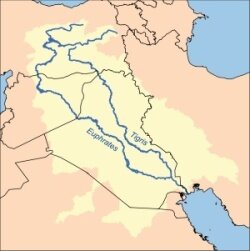
Mesopotamia refers to the region now occupied by modern Iraq, eastern Syria, and southern Turkey. The name comes from the Greek words μέσος "between" and ποταμός "river", referring to the area between the Euphrates and the Tigris (the Arabic term is بين نهرين Bayn Nahrain "between two rivers"). The fertile area watered by these two rivers is known as the "Cradle of Civilization," or "cradle of humanity" and it was here that the first literate societies developed.

The biblical Patriarch Abraham was from Ur in Mesopotamia.
10 Then the servant took ten of his master’s camels and departed, taking all sorts of choice gifts from his master; and he arose and went to Mesopotamia to the city of Nahor. 11 And he made the camels kneel down outside the city by the well of water at the time of evening, the time when women go out to draw water. 12 And he said, "O LORD, God of my master Abraham, please grant me success today and show steadfast love to my master Abraham. 13 Behold, I am standing by the spring of water, and the daughters of the men of the city are coming out to draw water. 14 Let the young woman to whom I shall say, 'Please let down your jar that I may drink,' and who shall say, 'Drink, and I will water your camels'—let her be the one whom you have appointed for your servant Isaac. By this I shall know that you have shown steadfast love to my master."

15 Before he had finished speaking, behold, Rebekah, who was born to Bethuel the son of Milcah, the wife of Nahor, Abraham’s brother, came out with her water jar on her shoulder. 16 The young woman was very attractive in appearance, a maiden whom no man had known. She went down to the spring and filled her jar and came up. 17 Then the servant ran to meet her and said, "Please give me a little water to drink from your jar." 18 She said, "Drink, my lord." And she quickly let down her jar upon her hand and gave him a drink. 19 When she had finished giving him a drink, she said, "I will draw water for your camels also, until they have finished drinking." 20 So she quickly emptied her jar into the trough and ran again to the well to draw water, and she drew for all his camels. 21 The man gazed at her in silence to learn whether the LORD had prospered his journey or not. –Genesis 24:10-21 ESV
There has never been a political entity called Mesopotamia, nor does Mesopotamia have any definite boundaries; the name is simply a convenient one invented by Greek historians to refer to a broad geographical area.

History

Mesopotamia has been home to some of the world's major ancient civilizations, succeeding the major prehistoric cultures such as Ubaid and Jemdet Nasr, including the Sumerian city states, and the Akkadian, Babylonian, and Assyrian Empires.

More...

Thursday, June 24, 2010

Achaemenid Empire

The Achaemenid (uh-kee-muh-nid) Empire (Old Persian: Hakhāmanishiya) was a dynasty in the ancient Persian Empire with high cultural and economical achievements during its highest power [After Achaemenes, legendary ancestor of Cyrus II the Great, founder of the dynasty.] At the height of their power, around 500 BC, the Achaemenid rulers of Persia ruled over territories roughly encompassing today's Iran, Iraq, Armenia, Afghanistan, Turkey, Bulgaria, eastern parts of Greece, Egypt, Syria, much of what is now Pakistan, Jordan, Israel, Palestine, Lebanon, Caucasia, Central Asia, Libya, and northern parts of Arabia. The empire ruled by Persia eventually became the largest empire of the ancient world.

Darius I was the first to speak of Achaemenes, who he claimed was an ancestor of Cyrus the Great, (ca. 576 - 529 BC) and therefore the progenitor of the entire line of Achaemenid rulers. However, some scholars hold that Achaemenes was a fictional character used to legitimize Darius' rule, and that Darius the Great usurped the Persian throne.

More...

Saturday, February 13, 2010

Tigris


The Tigris is the eastern member of the pair of great rivers that define Mesopotamia (the name "Mesopotamia" is a Greek word meaning "the land between the rivers"), along with the Euphrates, which flows from the mountains of Anatolia through Iraq.

The original Sumerian name was Idigna or Idigina, which can be interpreted as "the swift river"[4] or "the river that goes", contrasted to its neighbor, the Euphrates, whose leisurely pace caused it to deposit more silt and build up a higher bed than the Tigris. This form was borrowed and gave rise to Akkadian Idiqlat. Either through a Persian intermediary or borrowed directly from Akkadian, the word was adopted into Greek as Tigris.

In Pahlavi, tigr means "arrow" (in the same family as Old Persian tigra-, Modern Persian têz "sharp"). However, it does not appear that this was the original name of the river, but that it (like the Semitic forms of the name) was coined as an imitation of the indigenous Sumerian name. The name of the river in English and many other languages — Tigris — is from Ancient Greek, which was in turn derived from the Persian.

It is also possible that the name Tigris, and the variants in Dicle, derives from Kurdish. In Kurdish, tij means "sharp", referring to the Tigris as a sharp and fast river.

Another name for this watercourse, used from the time of the Persian Empire, is Arvand, which has the same meaning. Today, the name Arvand refers to the lower part of the Tigris (ie, Arvand/Shatt al-Arab) in Persian.

In the Hebrew bible, it is called חדקל Chiddeqel

More...

Wednesday, October 07, 2009

Tower of Babel

The Tower of Babel by Pieter Brueghel the Elder (1563)The tower constructed by the builders at Babel (that is, Babylonia - modern day Iraq []) became a symbol of their defiance against God, (Gen. 11:1-6). It was probably modeled after a ziggurat which is a mound of sun-dried bricks and was probably constructed before 4,000 bc.

According to the narrative in Genesis 11 of the Bible, the Tower of Babel was a tower built by a united humanity to reach the heavens.

Because the hearts of men were said to be inherently evil and disobedient, they were striving to make a name for themselves instead of worshipping the God who created them.

Because of this open defiance, God stopped their efforts by confusing languages so that no one could understand each other. As a result, they could no longer communicate and the work was halted. The builders were then scattered to different parts of Earth. This story is used to explain the existence of many different languages and races.

More...

Monday, August 24, 2009

Cradle of Humanity

The evangelical Protestants of the 19th century, considered the inventors of the term "Cradle of Humanity," made claims that the term originated in Mesopotamia [] in the 2nd century, and that it was used by early non-Christian Arabs, to refer to a geographic area that falls within a 1,000 mile radius of the spot they believed to be the birthplace of humankind. No documentation of such a historical use has been forthcoming. Nevertheless, the term has been used not only in religious, but also in secular contexts, and may therefore refer to different locations, depending on the views of the user.

Jewish, Christian and Muslim creationists believe that man was created by God in a place called Eden and then placed in a garden located east of Eden. In the Christian Bible, Genesis 2:10-14 indicates the Garden of Eden was supplied by the Tigris and Euphrates rivers. Some early Christians (A.D second century) used the term to refer to a geographic area falling within a 1,000 mile radius of that location as the birthplace of mankind.

The consensus among some biologists and paleoanthropologists is that mankind evolved through natural processes, and when journalists and popularizers currently use the term "Cradle of Humanity", it refers to Great Rift Valley sites in Eastern Africa, where the oldest hominid fossils were found in 1974.

More...

Thursday, April 16, 2009

Mesopotamia

Archaeological sites of MesopotamiaMesopotamia refers to the region now occupied by modern Iraq, eastern Syria, and southern Turkey . The name comes from the Greek words μέσος "between" and ποταμός "river", referring to the area between the Euphrates and the Tigris (the Arabic term is بين نهرين Bayn Nahrain "between two rivers"). The fertile area watered by these two rivers is known as the "Cradle of Civilization," (see also cradle of humanity) and it was here that the first literate societies developed.
10 Then the servant took ten of his master’s camels and departed, taking all sorts of choice gifts from his master; and he arose and went to Mesopotamia to the city of Nahor. 11 And he made the camels kneel down outside the city by the well of water at the time of evening, the time when women go out to draw water. 12 And he said, "O LORD, God of my master Abraham, please grant me success today and show steadfast love to my master Abraham. 13 Behold, I am standing by the spring of water, and the daughters of the men of the city are coming out to draw water. 14 Let the young woman to whom I shall say, 'Please let down your jar that I may drink,' and who shall say, 'Drink, and I will water your camels'—let her be the one whom you have appointed for your servant Isaac. By this I shall know that you have shown steadfast love to my master." Genesis 24:10-14 ESV
There has never been a political entity called Mesopotamia, nor does Mesopotamia have any definite boundaries; the name is simply a convenient one invented by Greek historians to refer to a broad geographical area.

More...

Monday, February 09, 2009

Iraq

virtual map of Iraq and surrounding areaIraq, officially the Republic of Iraq (pronounced Arabic: العراق Al-ʾIrāq), officially the Republic of Iraq (Arabic: جمهورية العراق Jumhūrīyat Al-ʾIrāq, Kurdish: كۆماری عێراق‎, Komara Iraqê), is a country in Western Asia spanning most of the northwestern end of the Zagros mountain range, the eastern part of the Syrian Desert and the northern part of the Arabian Desert. It shares borders with Kuwait and Saudi Arabia to the south, Jordan to the west, Syria to the northwest, Turkey to the north, and Iran to the east. It has a very narrow section of coastline measuring 58 km (35 miles) between Umm Qasr and Al Faw on the Persian Gulf. There are two major flowing rivers: the Tigris and the Euphrates. These provide Iraq with agriculturally capable land and contrast with the desert landscape that covers most of Western Asia.

The capital city, Baghdad (Arabic: بغداد‎ Baġdād), is in the center-east. Iraq's rich history dates back to ancient Mesopotamia. The region between the Tigris and Euphrates rivers is identified as the cradle of civilization and a birthplace of writing. Throughout its long history, Iraq has been the center of the Akkadian, Assyrian, Babylonian, Sassanid and Abbasid Caliphate, and part of the Achaemenid, Macedonian, Parthian, Roman, Rashidun, Umayyad, Mongol, Ottoman and British empires.

Beginning with the invasion in 2003, a multinational coalition of forces, mainly American and British, occupied Iraq. Under the Laws of War and UNSCR 1483, the occupying Coalition Provisional Authority completed the transfer of sovereignty on June 28th, 2004 to the Iraqi Interim Government in accordance with UNSCR 1546, formally ending the "occupation." Elections on January 30th, 2005 created the Iraqi Transitional Government, which drafted the Constitution of Iraq, approved by referendum on October 25th, 2005. Under this new Constitution, elections chose a new Iraqi National Assembly to form the Government of Iraq. Some dispute whether Iraq is de facto sovereign (see Iraqi sovereignty, United States-Iraq relations).

More...

Saturday, March 29, 2008

The Middle East

Political & transportation map of the Middle East today. Turkey, Syria, Lebanon, Israel, Iraq, Iran, Jordan, Egypt, Saudi Arabia. Oman, Yeman, Ethiopia and SudanThe Middle East is a historical and political region of Africa-Eurasia with no clear definition. The term "Middle East" was popularized around 1900 by the British, and has been criticized for its loose definition. The Middle East traditionally includes countries or regions in Southwest Asia and parts of North Africa. The corresponding adjective to Middle East is Middle-Eastern and the derived noun is Middle-Easterner.

Etymology

The term "Middle East" may have originated in the 1850s in the British India Office, and became more widely known when American naval strategist Alfred Thayer Mahan used the term.

The history of the Middle East dates back to ancient times, and throughout its history the Middle East has been a major center of world affairs. The Middle East is also the geographic origin of the the Abrahamic religions - Christianity, Islam, Judaism - comprising approximately one half of the world's religions. The Middle East generally has an arid and hot climate, with several major rivers providing for irrigation to support agriculture in limited areas. Many countries located around the Persian Gulf have large quantities of crude oil. In modern times, the Middle East remains a strategically, economically, politically, culturally, and religiously sensitive region.

More...


Subscribe


LifeNews.com

Desiring God Blog

Youth for Christ International