Showing posts with label Tigris. Show all posts

Saturday, August 07, 2010

Mesopotamia

Archaeological sites
of Mesopotamia
Mesopotamia refers to the region now occupied by modern Iraq, eastern Syria, and southern Turkey. The name comes from the Greek words μέσος "between" and ποταμός "river", referring to the area between the Euphrates and the Tigris (the Arabic term is بين نهرين Bayn Nahrain "between two rivers"). The fertile area watered by these two rivers is known as the "Cradle of Civilization," or "cradle of humanity" and it was here that the first literate societies developed.

The biblical Patriarch Abraham was from Ur in Mesopotamia.
10 Then the servant took ten of his master’s camels and departed, taking all sorts of choice gifts from his master; and he arose and went to Mesopotamia to the city of Nahor. 11 And he made the camels kneel down outside the city by the well of water at the time of evening, the time when women go out to draw water. 12 And he said, "O LORD, God of my master Abraham, please grant me success today and show steadfast love to my master Abraham. 13 Behold, I am standing by the spring of water, and the daughters of the men of the city are coming out to draw water. 14 Let the young woman to whom I shall say, 'Please let down your jar that I may drink,' and who shall say, 'Drink, and I will water your camels'—let her be the one whom you have appointed for your servant Isaac. By this I shall know that you have shown steadfast love to my master."

15 Before he had finished speaking, behold, Rebekah, who was born to Bethuel the son of Milcah, the wife of Nahor, Abraham’s brother, came out with her water jar on her shoulder. 16 The young woman was very attractive in appearance, a maiden whom no man had known. She went down to the spring and filled her jar and came up. 17 Then the servant ran to meet her and said, "Please give me a little water to drink from your jar." 18 She said, "Drink, my lord." And she quickly let down her jar upon her hand and gave him a drink. 19 When she had finished giving him a drink, she said, "I will draw water for your camels also, until they have finished drinking." 20 So she quickly emptied her jar into the trough and ran again to the well to draw water, and she drew for all his camels. 21 The man gazed at her in silence to learn whether the LORD had prospered his journey or not. –Genesis 24:10-21 ESV
There has never been a political entity called Mesopotamia, nor does Mesopotamia have any definite boundaries; the name is simply a convenient one invented by Greek historians to refer to a broad geographical area.

History

Mesopotamia has been home to some of the world's major ancient civilizations, succeeding the major prehistoric cultures such as Ubaid and Jemdet Nasr, including the Sumerian city states, and the Akkadian, Babylonian, and Assyrian Empires.

More...

Saturday, February 13, 2010

Tigris


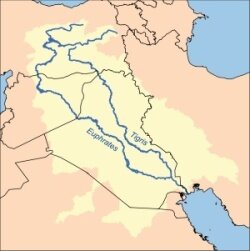
The Tigris is the eastern member of the pair of great rivers that define Mesopotamia (the name "Mesopotamia" is a Greek word meaning "the land between the rivers"), along with the Euphrates, which flows from the mountains of Anatolia through Iraq.

The original Sumerian name was Idigna or Idigina, which can be interpreted as "the swift river"[4] or "the river that goes", contrasted to its neighbor, the Euphrates, whose leisurely pace caused it to deposit more silt and build up a higher bed than the Tigris. This form was borrowed and gave rise to Akkadian Idiqlat. Either through a Persian intermediary or borrowed directly from Akkadian, the word was adopted into Greek as Tigris.

In Pahlavi, tigr means "arrow" (in the same family as Old Persian tigra-, Modern Persian têz "sharp"). However, it does not appear that this was the original name of the river, but that it (like the Semitic forms of the name) was coined as an imitation of the indigenous Sumerian name. The name of the river in English and many other languages — Tigris — is from Ancient Greek, which was in turn derived from the Persian.

It is also possible that the name Tigris, and the variants in Dicle, derives from Kurdish. In Kurdish, tij means "sharp", referring to the Tigris as a sharp and fast river.

Another name for this watercourse, used from the time of the Persian Empire, is Arvand, which has the same meaning. Today, the name Arvand refers to the lower part of the Tigris (ie, Arvand/Shatt al-Arab) in Persian.

In the Hebrew bible, it is called חדקל Chiddeqel

More...

Saturday, April 12, 2008

Euphrates

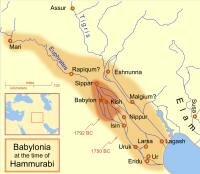
At the time of Hammurabi, Lagash was much closer to the gulf.The Euphrates (the traditional Greek name, Arabic: الفرات; Al-Furat, Hebrew: פְּרָת) is the westernmost of the two great rivers that define Mesopotamia (the other being the Tigris).

Etymology

The name Euphrates may have originated from Old Persian Ufratu, as it were from Avestan *hu-perethuua, meaning "good to cross over" (from hu-, meaning "good", and peretu, meaning "ford"). Alternatively, some suggest that the name Euphrates is possibly of Kurdish origin.

Course of the Euphrates

In Kurdish, fere means "wide", re means "flowing water" and hat is "flowing", giving fererehat, meaning "wide flowing water". The modern Kurdish name, Ferat, is possibly a reduction of the older name. However, the Indo-European etymology of the name is put into doubt by the Sumerian and Akkadian names for the Euphrates are Buranun and Pu-rat-tu, respectively, Buranun being attested in an inscription associated with king Gudea (22nd century BC). It seems thus likely that the Old Persian name arose by popular etymology based on the pre-Iranian name of the river.

More...

Wednesday, January 02, 2008

The Fertile Crescent

This map shows the extent of the Fertile Crescent.The Fertile Crescent is a historical region in the Middle East incorporating Ancient Egypt, the Levant, and Mesopotamia. The term "Fertile Crescent" was coined by University of Chicago archaeologist James Henry Breasted.

Watered by the Nile, Jordan, Euphrates and Tigris rivers and covering some 400-500,000 square kilometers, the region extends from the eastern shore of the Mediterranean Sea around the north of the Syrian Desert and through the Jazirah and Mesopotamia to the Persian Gulf. These areas correspond to the present-day Egypt, Israel, West Bank, Gaza strip, and Lebanon and parts of Jordan, Syria, Iraq, south-eastern Turkey and south-western Iran.

The population of the Nile River Basin is about 70 million, the Jordan River Basin about 20 million, and the Tigris and Euphrates Basins about 30 million, giving the present-day Fertile Crescent a total population of approximately 120 million, or at least a third of the population of the Middle East.

The Fertile Crescent has an impressive record of past human activity. As well as possessing many sites with the skeletal and cultural remains of both pre-modern and early modern humans (e.g. at Kebara Cave in Israel), later Pleistocene hunter-gatherers and Epipalaeolithic semi-sedentary hunter-gatherers (the Natufians), this area is most famous for its sites related to the origins of agriculture. The western zone around the Jordan and upper Euphrates rivers gave rise to the first known Neolithic farming settlements (referred to as Pre-Pottery Neolithic A (PPNA)), which date to around 9,000 BCE (and includes sites such as Jericho). This region, alongside Mesopotamia (which lies to the east of the Fertile Crescent, between the rivers Tigris and Euphrates), also saw the emergence of early complex societies during the succeeding Bronze Age. There is also early evidence from this region for writing, and the formation of state-level societies. This has earned the region the nickname "The Cradle of Humanity."

More...

Monday, October 15, 2007

Sumer

Sumer, Akkad and ElamSumer (or Shumer, Egyptian Sangar, [biblical Shinar], native ki-en-gir, (from Ki = Earth, En = (title) usually translated as Lord, Gir = (cultured) usually translated as Civilised, thus "the land of the civilised lords") was an ancient civilization located in the southern part of Mesopotamia (modern day southeastern Iraq, see also: Iraq Maps) from the time of the earliest records in the mid 4th millennium BC until the rise of Babylonia in the late 3rd millennium BC. The term "Sumerian" applies to all speakers of the Sumerian language. Sumer is considered the first settled society in the world to have manifested all the features needed to qualify fully as a "civilization".

Background

The term "Sumerian" is an exonym first applied by the Akkadians. The Sumerians called themselves "the black-headed people" (sag-gi-ga) and their land "land of the civilized lords" (ki-en-gir). The Akkadian word Shumer possibly represents this name in dialect. The Sumerians were a non-Semitic people and were at one time believed to have been invaders, as a number of linguists believed they could detect a substrate language beneath Sumerian. However, the archaeological record shows clear uninterrupted cultural continuity from the time of the Early Ubaid period (5200-4500 BC C-14, 6090-5429 calBC) settlements in southern Mesopotamia. The Sumerian people who settled here farmed the lands in this region that were made fertile by silt deposited by the Tigris and the Euphrates rivers.

More...

Friday, April 20, 2007

Assyria

Assyrian EmpireAssyria in earliest historical times referred to a region on the Upper Tigris river, named for its original capital, the ancient city of Assur. Later, as a nation and Empire, it also came to include roughly the northern half of Mesopotamia (the southern half being Babylonia). The capital is Nineveh.


Assyria proper was located in a mountainous region, extending along the Tigris as far as the high Gordiaean or Carduchian mountain range of Armenia, sometimes called the "Mountains of Ashur".

The Assyrian kings controlled a large kingdom at three different times in history. These are called the Old, Middle, and Neo-Assyrian kingdoms, or periods. The most powerful and best-known nation of these periods is the Neo-Assyrian kingdom, 911-612 BC.

More...

Wednesday, April 18, 2007

Garden of Eden

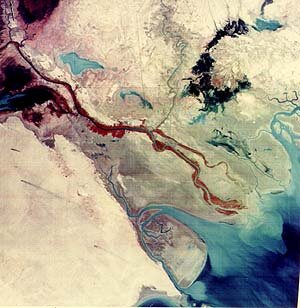
Eden, possibly located in this vecinity where the Tigris and Euphrates terminate into the GulfThe Garden of Eden (from Hebrew Gan Ēden, "גַּן עֵדֶן") is described by the Book of Genesis as being the place where the first man - Adam - and woman - Eve - lived after they were created by God. The past physical existence of this garden forms part of the creation belief of the Abrahamic religions.

The Genesis account (specifically, the Jahwist version of the creation story) supplies the geographical location of Eden in relation to four major rivers. However, because the identification of these rivers has been the subject of much controversy and speculation, a substantial consensus now exists that the knowledge of the location of Eden has been lost.

Suspected locations
There have been a number of claims as to the actual geographic location of the Garden of Eden, though many of these have little or no connection to the text of Genesis. Most put the Garden somewhere in the Middle East near Mesopotamia. Locations as diverse as Ethiopia, Java, Sri Lanka, the Seychelles, Brabant, and Bristol, Florida have all been proposed as locations for the garden. Some Christian theologians believe that the Garden never had a terrestrial existence, but was instead an adjunct to heaven as it became identified with Paradise.

The text asserts that from Eden the river divided into four branches: Hiddekel a.k.a. Tigris, Euphrates, Pishon and Gihon. The identity of the former two are commonly accepted, though the latter two rivers have been the subject of endless argument. But if the Garden of Eden had really been near the sources of the Tigris and the Euphrates, then the original narrators in the land of Canaan would have identified it as located generally in the Taurus Mountains, in Anatolia. Satellite photos reveal two dry riverbeds flowing toward the Persian Gulf near where the Tigris and Euphrates also terminate. While this accounts for four rivers in the vicinity, that area is the mouth of those rivers rather than their source.


More...

Tuesday, April 17, 2007

Ur

Ur seen across the Royal tombs, with the Great Ziggurat in the background, January 17, 2004Ur was an ancient city in southern Mesopotamia, located near the original mouth of the Euphrates and Tigris rivers on the Persian Gulf and close to Eridu. Because of marine regression, the remains are now well inland in present-day Iraq, south of the Euphrates on its right bank , and named Tell el-Mukayyar, near the city of Nasiriyah south of Baghdad.
6Abram believed the LORD, and he credited it to him as righteousness. 7He also said to him, "I am the LORD, who brought you out of Ur of the Chaldeans to give you this land to take possession of it." 8But Abram said, "O Sovereign LORD, how can I know that I will gain possession of it?" -Genesis 15:6-8
The site is marked by the ruins of a ziggurat (right), still largely intact, and by a settlement mound. The ziggurat is a temple of Nanna, the moon deity in Sumerian mythology.

It has has two stages constructed from brick: in the lower stage the bricks are joined together with bitumen, in the upper stage they are joined with mortar. Ur at its height had around 30,000 residents.

More...

Monday, April 16, 2007

Euphrates

Tigris and Euphrates Rivers empties through a delta into the Persian Gulf in southeastern IraqThe Euphrates (the traditional Greek name, Arabic: الفرات; Al-Furat, Hebrew: פְּרָת) is the westernmost of the two great rivers that define Mesopotamia (the other being the Tigris).

Etymology
The name Euphrates may have originated from Old Persian Ufratu, as it were from Avestan *hu-perethuua, meaning "good to cross over" (from hu-, meaning "good", and peretu, meaning "ford"). Alternatively, some suggest that the name Euphrates is possibly of Kurdish origin.

Euphrates in the Bible
The river Euphrates is one of the four rivers that flow from the Garden of Eden according to Genesis 2:13-15. It is the fourth river, after the Pishon, the Gihon, and the Tigris, to form from the river flowing out of the garden. The river also marked one of the boundaries of the land promised by God to Abraham and his descendants. In the Hebrew Bible, it is often referred to simply as "The River" (ha-nahar).

The word Euphrates is a translation for the word "Gush forth" or "break forth". It has always been assumed to mean "river" but this is not explicitly stated. It literally means "breaking forth of liquid". The river Euphrates was named from this root word, "To gush forth".
In the Book of Revelation, it is prophesied that in the "near future the Potamos Euphrates or "breaking forth like water" of the middle east will dry up in preparation for the Battle of Armageddon.

More...

Mesopotamia

Overview map of ancient MesopotamiaMesopotamia refers to the region now occupied by modern Iraq, eastern Syria, and southern Turkey. The name comes from the Greek words μέσος "between" and ποταμός "river", referring to the area between the Euphrates and the Tigris (the Arabic term is بين نهرين Bayn Nahrain "between two rivers"). The fertile area watered by these two rivers is known as the "Cradle of Civilization," (see also cradle of humanity) and it was here that the first literate societies developed.

The biblical Patriarch Abraham was from Ur in Mesopotamia.


Acts 7:22 To this he replied: "Brothers and fathers, listen to me! The God of glory appeared to our father Abraham while he was still in Mesopotamia, before he lived in Haran.


Genesis 11:28-3128 While his father Terah was still alive, Haran died in Ur of the Chaldeans (see Chaldea), in the land of his birth. 29 Abram and Nahor both married. The name of Abram's wife was Sarai, and the name of Nahor's wife was Milcah; she was the daughter of Haran, the father of both Milcah and Iscah. 30 Now Sarai was barren; she had no children. 31 Terah took his son Abram, his grandson Lot son of Haran, and his daughter-in-law Sarai, the wife of his son Abram, and together they set out from Ur of the Chaldeans to go to Canaan. But when they came to Haran, they settled there.


More...

Monday, January 29, 2007

Euphrates

This is a map of the Tigris - Euphrates WatershedThe Euphrates (the traditional Greek name, Arabic: الفرات; Al-Furat, Hebrew: פְּרָת) is the westernmost of the two great rivers that define Mesopotamia (the other being the Tigris).
EtymologyThe name Euphrates may have originated from Old Persian Ufratu, as it were from Avestan *hu-perethuua, meaning "good to cross over" (from hu-, meaning "good", and peretu, meaning "ford"). Alternatively, some suggest that the name Euphrates is possibly of Kurdish origin.

Course of the Euphrates
In Kurdish, fere means "wide", re means "flowing water" and hat is "flowing", giving fererehat, meaning "wide flowing water". The modern Kurdish name, Ferat, is possibly a reduction of the older name. However, the Indo-European etymology of the name is put into doubt by the Sumerian and Akkadian names for the Euphrates are Buranun and Pu-rat-tu, respectively, Buranun being attested in an inscription associated with king Gudea (22nd century BC). It seems thus likely that the Old Persian name arose by popular etymology based on the pre-Iranian name of the river.

More...

Saturday, December 30, 2006

Cush

Aerial view of the pyramids at MeroëCush (כּוּשׁ "Dark,") was the eldest son of Ham, brother of Canaan and the father of Nimrod, mentioned in the "Table of Nations" in the Genesis 10:6 and in I Chronicles 1:8. It is usually considered to be the eponym of the people of Kush. Six Arabian tribes are also sons of Cush.
In Genesis, Cush was the father of the Seba, Havilah, Sabtah, Raamah, and Sabteca. He is also the father of Nimrod.

Another person named Cush in the Bible is a Benjamite (see Tribe of Benjamin) who is mentioned only in Psalm 7 and is believed to be a follower of Saul.

Cush is first mentioned in Genesis 2:12-14,


12(The gold of that land is good; aromatic resin and onyx are also there.) 13The name of the second river is the Gihon; it winds through the entire land of Cush. 14The name of the third river is the Tigris; it runs along the east side of Asshur. And the fourth river is the Euphrates.

More...

Tuesday, December 19, 2006

Jewish history

1759 map of the tribal allotments of IsraelJewish history is the history of the Jewish people, faith (Judaism) and culture. Since Jewish history encompasses nearly six thousand years and hundreds of different populations, any treatment can only be provided in broad strokes. Additional information can be found in the main articles listed below, and in the specific country histories listed in this article.

Ancient Jewish History (through 150 CE)
Ancient Israelites

For the first two periods the history of the Jews is mainly that of the Fertile Crescent. It begins among those peoples which occupied the area lying between the Nile river on the one side and the Tigris and the Euphrates rivers on the other. Surrounded by ancient seats of culture in Egypt and Babylonia, by the deserts of Arabia, and by the highlands of Asia Minor, the land of Canaan (later known as Israel, then at various times Judah, Coele-Syria, Judea, Palestine, the Levant, and finally Israel again) was a meeting place of civilizations. The land was traversed by old-established trade routes and possessed important harbors on the Gulf of Akaba and on the Mediterranean coast, the latter exposing it to the influence of other cultures of the Fertile Crescent.

More...

Wednesday, November 08, 2006

Sumer

Sumer, Akkad and Elam Sumer (or Shumer, Egyptian Sangar, biblical Shinar, native ki-en-gir, (from Ki = Earth, En = (title) usually translated as Lord, Gir = (cultured) usually translated as Civilised, thus "the land of the civilised lords") was an ancient civilization located in the southern part of Mesopotamia (modern day southeastern Iraq) from the time of the earliest records in the mid 4th millennium BC until the rise of Babylonia in the late 3rd millennium BC. The term "Sumerian" applies to all speakers of the Sumerian language. Sumer is considered the first settled society in the world to have manifested all the features needed to qualify fully as a "civilization".

Background
The term "Sumerian" is an exonym first applied by the Akkadians. The Sumerians called themselves "the black-headed people" (sag-gi-ga) and their land "land of the civilized lords" (ki-en-gir). The Akkadian word Shumer possibly represents this name in dialect. The Sumerians were a non-Semitic people and were at one time believed to have been invaders, as a number of linguists believed they could detect a substrate language beneath Sumerian. However, the archaeological record shows clear uninterrupted cultural continuity from the time of the Early Ubaid period (5200-4500 BC C-14, 6090-5429 calBC) settlements in southern Mesopotamia. The Sumerian people who settled here farmed the lands in this region that were made fertile by silt deposited by the Tigris and the Euphrates rivers.

More...

Ur

Ur seen across the Royal tombs, with the Great Ziggurat in the background, January 17, 2004Ur was an ancient city in southern Mesopotamia, located near the original mouth of the Euphrates and Tigris rivers on the Persian Gulf and close to Eridu. Because of marine regression, the remains are now well inland in present-day Iraq, south of the Euphrates on its right bank , and named Tell el-Mukayyar, near the city of Nasiriyah south of Baghdad.

6Abram believed the LORD, and he credited it to him as righteousness. 7He also said to him, "I am the LORD, who brought you out of Ur of the Chaldeans to give you this land to take possession of it." 8But Abram said, "O Sovereign LORD, how can I know that I will gain possession of it?"
-Genesis 15:6-8

The site is marked by the ruins of a ziggurat (right), still largely intact, and by a settlement mound. The ziggurat is a temple of Nanna, the moon deity in Sumerian mythology. It has has two stages constructed from brick: in the lower stage the bricks are joined together with bitumen, in the upper stage they are joined with mortar. Ur at its height had around 30,000 residents.

More...

Saturday, September 02, 2006

Mesopotamia

Overview map of ancient MesopotamiaMesopotamia refers to the region now occupied by modern Iraq, eastern Syria, and southern Turkey. The name comes from the Greek words μέσος "between" and ποταμός "river", referring to the area between the Euphrates and the Tigris (the Arabic term is بين نهرين Bayn Nahrain "between two rivers"). The fertile area watered by these two rivers is known as the "Cradle of Civilization," (see also cradle of humanity) and it was here that the first literate societies developed.

The biblical Patriarch Abraham was from Ur in Mesopotamia.

There has never been a political entity called Mesopotamia, nor does Mesopotamia have any definite boundaries; the name is simply a convenient one invented by Greek historians to refer to a broad geographical area.

More...

Thursday, August 24, 2006

Cradle of Humanity

States believed by some to be the Cradle of Humanity, lands falling within a 1,000-mile radius of the location described in the bible book of Genesis (2:10-14)The evangelical Protestants of the 19th century, considered the inventors of the term "Cradle of Humanity," made claims that the term originated in Mesopotamia in the 2nd century, and that it was used by early non-Christian Arabs, to refer to a geographic area that falls within a 1,000 mile radius of the spot they believed to be the birthplace of humankind. No documentation of such a historical use has been forthcoming. Nevertheless, the term has been used not only in religious, but also in secular contexts, and may therefore refer to different locations, depending on the views of the user.

Creationist View
Jewish, Christian and Muslim creationists believe that man was created by God in a place called Eden and then placed in a garden located east of Eden. In the Christian Bible, Genesis 2:10-14 indicates the Garden of Eden was supplied by the Tigris and Euphrates rivers. Some early Christians (A.D second century) used the term to refer to a geographic area falling within a 1,000 mile radius of that location as the birthplace of mankind.

More...
 

Subscribe


LifeNews.com

Desiring God Blog

Youth for Christ International