Showing posts with label Acts. Show all posts

Sunday, July 05, 2009

Codex Bezae

A portion of the Greek text of the Codex BezaeThe Codex Bezae Cantabrigensis (Gregory-Aland no. D or 05) is an important codex of the New Testament dating from the fifth- or sixth-century. It is written in an uncial hand on vellum and contains, in both Greek and Latin, most of the four Gospels and Acts, with a small fragment of 3 John.

Codex contents
The manuscript presents the gospels in the unusual order Matthew, John, Luke and Mark, of which only Luke is complete; after some missing pages the MS picks up with the Third Epistle of John and contains part of the Acts of the Apostles. Written with one column per page it has 406 leaves, out of perhaps an original 534, and the Greek pages on the left face Latin ones on the right. The first three lines of each book are in red letters, and black and red ink alternate lines towards the end of books. As many as nine correctors have worked on the manuscript between the sixth and twelfth century.

More...

Tuesday, June 23, 2009

Gospel of Luke

St Luke the Evangelist. Artist: Domenico Ghirlandaio. Date: 1486-90The Gospel of Luke is a synoptic Gospel, and the third and longest of the four canonical Gospels of the New Testament, which purport to tell the story of Jesus' life, death, and resurrection. The author was also the author of Acts of the Apostles. Like all gospels, the gospel originally circulated anonymously. Since at least the 2nd century, authorship has been ascribed to Luke, named in Colossians 4:14, a doctor and follower of Paul.

The introductory dedication to Theophilus, 1:1-4 states that since many others have compiled an "orderly narrative of the events" from the original eyewitnesses, that the author has decided to do likewise, after thorough research of everything from the beginning, so that Theophilus may realize the reliability of the teachings in which he has been instructed. The main characteristic of this Gospel, as Farrar (Cambridge Bible, Luke, Introduction) remarks, is expressed in the motto, "Who went about doing good, and healing all that were oppressed of the devil" (Acts 10:38; cf. with Luke 4:18). Luke wrote for the "Hellenistic world".

More...

Thursday, May 08, 2008

Ephesus

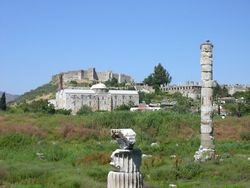
Site of the Temple of Artemis.Ephesus (Greek: Έφεσος see also List of traditional Greek place names, Turkish: Efes) was one of the great cities of the Ionian Greeks in Asia Minor, located in Lydia where the Cayster river flows into the Aegean Sea (in modern day Turkey). It was founded by colonists principally from Athens. The ruins of Ephesus are a major tourist attraction, especially for people traveling to Turkey by cruise ship via the port of Kuşadası.

Ancient Ephesus

Ephesus is believed by many to be the Apasa (or Abasa) mentioned in Hittite sources as the capital of the kingdom of Arzawa. Mycenaean pottery has been found in excavations at the site.

The many-breasted "Lady of Ephesus", identified by Greeks with Artemis, was venerated in the Temple of Artemis, the largest building of the ancient world, according to Pausanias (4.31.8) and one of the Seven Wonders of the World, of which scarcely a trace remains.

Achaichus, (1 Cor. 16:17), was one of the members of the church of Corinth who, with Fortunatus and Stephanas, visited Paul while he was at Ephesus, for the purpose of consulting him on the affairs of the church. These three probably were the bearers of the letter from Corinth to the apostle to which he alludes in 1 Cor. 7:1.

There was a Jew of Ephesus named Alexander who took a prominent part in the uproar raised there by the preaching of Paul (Acts 19:33). The Jews put him forward to plead their cause before the mob. It was probably intended that he should show that he and the other Jews had no sympathy with Paul any more than the Ephesians had.

More...

Saturday, March 15, 2008

Barnabas

Paul and Barnabas at Lystra. 1650 Oil on canvas. Musée d’Art, Saint-Etienne
Barnabas was an early Christian mentioned in the New Testament. His Hellenic Jewish parents called him Joseph, (although the Byzantine text-type calls him Joses, the Aramaic version of Joseph, (Aramaic of Jesus) but when he sold all his goods and gave the money to the apostles in Jerusalem they gave him a new name: Barnabas, which means huios parakleseos (Greek: υιος παρακλήσεως) "son of exhortation," or 'man of encouragement.' see Acts 11:23) and connotes a prophet in the Early Christian sense of the word (see Acts 13:1; 15:32). His feast day is June 11. In many English translations of the Bible, including the New International Version (NIV), King James Version (KJV), and New American Standard Bible (NASB), Barnabas is called an apostle. In Acts 14:14 of these translations, he is listed ahead of Paul, "Barnabas and Paul," instead of "Paul and Barnabas;" both men being described as apostles. Whether Barnabas was an apostle became an important political issue, which was debated in the Middle Ages.

8-10 There was a man in Lystra who couldn't walk. He sat there,
crippled since the day of his birth. He heard Paul talking, and Paul, looking
him in the eye, saw that he was ripe for God's work, ready to believe. So he
said, loud enough for everyone to hear, "Up on your feet!" The man was up in a
flash—jumped up and walked around as if he'd been walking all his life.

11-13 When the crowd saw what Paul had done, they went wild,
calling out in their Lyconian dialect, "The gods have come down! These men are
gods!" They called Barnabas "Zeus" and Paul "Hermes" (since Paul did most of the
speaking). The priest of the local Zeus shrine got up a parade—bulls and banners
and people lined right up to the gates, ready for the ritual of sacrifice.

14-15 When Barnabas and Paul finally realized what was going on,
they stopped them. Waving their arms, they interrupted the parade, calling out,
"What do you think you're doing! We're not gods! We are men just like you, and
we're here to bring you the Message, to persuade you to abandon these silly
god-superstitions and embrace God himself, the living God. We don't make God; he makes us, and all of this—sky, earth, sea, and everything in them. -Acts 14:10-15 (The Message)


More...

Thursday, February 28, 2008

timeline of Christianity

A folio from P46, early 3rd c. New Testament manuscript useful in discerning the early Christian canon.The purpose of this chronology is to give a detailed account of Christianity from the beginning of the current era to the present. Question marks on dates indicate approximate dates.

For "Old Testament" chronology, see History of ancient Israel.

Era of Jesus

The year one is the first year in the Christian calendar (there is no year zero), which is the calendar presently used (in unison with the Gregorian calendar) almost everywhere in the world, because of the current dominance of the Western world. Traditionally, this was held to be the year Jesus was born, however most modern scholars argue for an earlier date and later dates, the most agreed upon being between 6 B.C. and 4 B.C.
  • 6 Herod Archelaus deposed by Augustus Caesar; Samaria, Judea and Idumea annexed as Iudaea Province under direct Roman administration, capital at Caesarea, Publius Sulpicius Quirinius became Legate (Governor) of Syria, conducted Census of Quirinius, opposed by Zealots (JA18, Luke 2:1-3, Acts 5:37)

Friday, February 15, 2008

Open-air preaching

Open-air preaching in China using Dwight L. Moody’s version of the Wordless BookOpen-air preaching or "street preaching" is the act of publicly proclaiming a religious message to crowds of people in open places. It is an ancient method of communicating a religious or social message, and has been used by many cultures and religious traditions but today is usually associated with Christian fundamentalism or evangelicalism.

History of open-air preaching

George Whitefield's outdoor preaching made him a household name in England and the American Colonies.The famous early Methodist preachers John Wesley and George Whitefield preached in the open air, which allowed them to attract crowds larger than most buildings could accommodate.

Biblical examples also include that of the prophet Jonah, who reluctantly obeys the command of God to go to the city of Nineveh and preach "Yet forty days, and Nineveh shall be overthrown!" (Jonah 3:4 KJV) Others include the Sermon on the Mount in Matthew 5-7 and Paul's speech to the Athenians in Acts 17.

More...

Tuesday, January 01, 2008

Acts

Acts 15:22–24 from the seventh-century Codex Laudianus in the Bodleian Library, written in parallel columns of Latin and Greek.The Acts of the Apostles (Greek Praxeis Apostolon) is a book of the Bible, which now stands fifth in the New Testament after the four gospels. This book describes the development of the early church from Christ's Ascension to Paul's sojourn at Rome. It is commonly referred to as simply Acts. The traditional view is that it was written by the Macedonian Christian physician and historian Luke the Evangelist (also the author of the gospel of Luke).

An alternative name for the book is Acts of the Holy Spirit. It describes many of the journeys and actions taken by the apostles, meaning "those who have been sent" by God, to be His witnesses.

This was originally applied exclusively to those who had personally seen and/or lived with Jesus of Nazareth. The book of Acts contains many descriptions of miraculous events (which were given as signs from God to validate the apostles' teachings), which were performed by the Holy Spirit through the apostles. These included miraculous healings, casting out evil spirits, the raising of the dead, and also historical descriptions of everyday life in The Roman Empire and in ancient Jerusalem.

Acts describes the beginning of the Jewish-Christian church on the Day of Pentecost, explains and describes the growth and spread of the Church despite (and because of) official persecution, narrates the inclusion of the gentile Greeks, Romans and other pagans of the Near East into the Church (and explains how this became possible), and focuses on the lives of the apostles, specifically Simon, called "Peter" of Galilee (who followed and lived with Jesus for probably three years) and Saul Paulus of Tarsus (who began as a Pharisee and a persecutor of the Church and was converted later on the Road to Damascus).

More...

Tuesday, November 20, 2007

Andrew

St. Andrew by Camillo Rusconi. Nave of the Basilica of St. John Lateran (Rome).Saint Andrew (Greek: Ανδρέας Andreas, "manly"), called in the Orthodox tradition Protocletos, or the First-called, is a Christian Apostle, brother of Simon Peter.

Biography

According to Christian tradition, Andrew was born at Bethsaida on the Sea of Galilee (John 1:44). Since he was a Jew, Andreas was almost certainly not his given name, but no Hebrew or Aramaic name is recorded for him (see also: Aramaic of Jesus). He had been a disciple of John the Baptist (John 1:37-40) and was one of the first to follow Jesus. He lived at Capernaum (Mark 1:29). In the gospels he is referred to as being present on some important occasions as one of the disciples more closely attached to Jesus (Mark 13:3; John 6:8, 12:22); in Acts there is only a bare mention of him (Acts 1:13).

The Kievan hill where St Andrew is said to have erected the cross is commemorated by the cathedral dedicated in his name. Eusebius quotes Origen as saying Andrew preached in Asia Minor and in Scythia, along the Black Sea as far as the Volga. Hence he became a patron saint of Romania and Russia. Traditionally, he became the first bishop of Byzantium in 38, a position which would later become Patriarch of Constantinople.

He is said to have suffered crucifixion at Patras (Patrae) in Achaea, on a cross of the form called Crux decussata (X-shaped cross) and commonly known as "St. Andrew's cross." or saltire. St Andrew is the patron of Patras. According to tradition his relics were removed from Patras to Constantinople, and thence to St Andrews (see below). Local legends say that the relics were sold to the Romans by the local priests in exchange of the Romans constructing a water reservoir for the city. In recent years, the relics were kept in the Vatican City, but were sent back to Patras by decision of the Pope Paul VI in 1964. The relics, which consist of the small finger and part of the top of the cranium of St Andrew, are since kept in the Church of St Andrew at Patras in a special tomb, and are reverenced in a special ceremony every November 30.

More...

Tuesday, November 06, 2007

Pauline Epistles

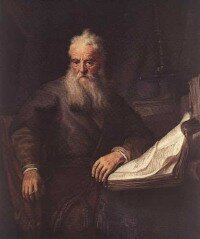
Portrait of St. Paul by RembrandtThe Pauline Epistles are as follows:
  • Romans
  • 1 Corinthians
  • 2 Corinthians
  • Galatians
  • Ephesians
  • Philippians
  • Colossians
  • 1 Thessalonians
  • 2 Thessalonians
  • 1 Timothy
  • 2 Timothy
  • Titus
  • Philemon

The Epistle to the Romans

The Epistle to the Romans is one of the letters of the New Testament canon of the Christian Bible. When it is clear that the Bible is being discussed, it is often referred to as simply "Romans". Romans is one of the seven currently (as of 2004) undisputed letters of Paul and even among the four letters accepted as authentically his (in German scholarship, the Hauptbriefe) by F. C. Baur and the Tübingen School of historical criticism of texts in the 19th century.

History

It was probably written at Corinth or possibly in nearby Cenchrea, transcribed by Tertius. Phoebe (Romans 16:1) of Cenchrea, the Aegean port of Corinth, conveyed it to Rome, and Gaius of Corinth entertained the apostle Paul at the time of his writing it (Romans 16:23; 1 Cor 1:14), and Erastus was chamberlain of the city, that is, of Corinth (2 Tim 4:20).

The precise time at which it was written is not mentioned in the epistle, but it was obviously written when the collection for Jerusalem had been assembled and Paul was about to "go unto Jerusalem to minister unto the saints", that is, at the close of his second visit to Greece, during the winter preceding his last visit to that city (Rom. 15:25; cf. Acts 19:21; 20:2, 3, 16; 1 Cor 16:1–4) early in 58.


More...

Thursday, September 27, 2007

Barnabas

Paul and Barnabas at Lystra. 1650 Oil on canvas. Musée d’Art, Saint-EtienneBarnabas was an early Christian mentioned in the New Testament. His Hellenic Jewish parents called him Joseph, (although the Byzantine text-type calls him Joses, the Aramaic version of Joseph, see also: Aramaic of Jesus) but when he sold all his goods and gave the money to the apostles in Jerusalem, they gave him a new name: Barnabas, which means huios parakleseos (Greek: υιος παρακλήσεως) "son of exhortation," or 'man of encouragement.' see Acts 11:23) and connotes a prophet in the primitive Christian sense of the word (see Acts 13:1; 15:32). His feast day is June 11. In many English translations of the Bible, including the New International Version (NIV), King James Version (KJV), and New American Standard Bible (NASB), Barnabas is called an apostle. In Acts 14:14 of these translations, he is listed ahead of Paul, "Barnabas and Paul," instead of "Paul and Barnabas;" both men being described as apostles. Whether Barnabas was an apostle became an important political issue, which was debated in the Middle Ages.
8-10There was a man in Lystra who couldn't walk. He sat there, crippled since the day of his birth. He heard Paul talking, and Paul, looking him in the eye, saw that he was ripe for God's work, ready to believe. So he said, loud enough for everyone to hear, "Up on your feet!" The man was up in a flash—jumped up and walked around as if he'd been walking all his life.

11-13When the crowd saw what Paul had done, they went wild, calling out in their Lyconian dialect, "The gods have come down! These men are gods!" They called Barnabas "Zeus" and Paul "Hermes" (since Paul did most of the speaking). The priest of the local Zeus shrine got up a parade—bulls and banners and people lined right up to the gates, ready for the ritual of sacrifice.

14-15When Barnabas and Paul finally realized what was going on, they stopped them. Waving their arms, they interrupted the parade, calling out, "What do you think you're doing! We're not gods! We are men just like you, and we're here to bring you the Message, to persuade you to abandon these silly god-superstitions and embrace God himself, the living God. We don't make God; he makes us, and all of this—sky, earth, sea, and everything in them. -Acts 14:10-15 (The Message)

More...

Tuesday, September 18, 2007

lineage of Jesus

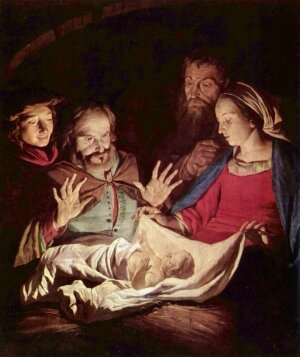
The infant Jesus in Adoration of the Shepherds, Gerard van HonthorstThe lineage of Jesus is recorded in two places in the bible:
1) Matthew 1:1-17, and

2) Luke 3:23-38 (in addition to several other new testament references: Mark 10:47, luke 1:32, Acts 2:29-30, Rev. 5:5, 22:16).

The Matthew 1:1-17 and Luke 3:23-38 accounts differ because, Luke follows Mary's lineage (Jesus' blood mother), through David's son Nathan (Luke's genealogy focused on Jesus' descent from God through the virgin birth. It placed no emphasis on Jesus being the descendant of king David) and the Matthew genealogy follows Joseph's line (Joseph being the legal father of Jesus, see below) through David's son Solomon.

God's promise to David was fulfilled because mary was the biological parent of Jesus.

The virgin birth also addressed the curse God had pronounced upon Jehoiakim. Kingship was an inherited right. By Joseph, Jesus inherited a legal claim to the throne of David. However, he was exempt from the curse of Jehoiakim (Jeremiah 36:1-32, i.e. Joseph's offspring could not claim David's throne because of the curse) because Joseph was not the genetic father of Jesus.

More...

Thursday, September 13, 2007

Tarsus

Location of Tarsus in TurkeyTarsus (Greek Ταρσός) is a city and a large district in Mersin Province, Turkey, 25 km from the city of Mersin and near (40 km) to the city of Adana.

With a history going back 5,000 years Tarsus has long been an important stop for traders to the Orient, a focal point of many civilisations including the Ancient Romans when Tarsus was capital of the province of Cilicia, scene of the romance between Mark Anthony and Cleopatra and birthplace of Saint Paul.


Because of its critical and strategic location, invulnerable from the Tarus Mountains, from the north, and the Mediterranean, on the south, the city was a treasure for many peoples. After the Roman Empire Tarsus wasted away to a small city in the aftermath of hostilities between differing Christian and Muslim empires.


In about 170 BC Tarsus became a free city, leaving it open to Greek culture and Education. By the time of Christ, Tarsus was on a cultural parallel with great cities such as Athens and Alexandria, being a pedagogical center of the world.


Paul Speaks to the Crowd

21

37As the soldiers were about to take Paul into the barracks, he asked the commander, "May I say something to you?"


"Do you speak Greek?" he replied. 38"Aren't you the Egyptian who started a revolt and led four thousand terrorists out into the desert some time ago?"


39Paul answered, "I am a Jew, from Tarsus in Cilicia, a citizen of no ordinary city. Please let me speak to the people."


40Having received the commander's permission, Paul stood on the steps and motioned to the crowd. When they were all silent, he said to them in Aramaic:


22

1"Brothers and fathers, listen now to my defense." 2When they heard him speak to them in Aramaic, they became very quiet. -Paul of Tarsus (Acts 21:37-22:11)


More...

Tuesday, July 17, 2007

righteousness

Righteousness in this article refers to the important theological concept in Judaism and Christianity. In one sense, it is an attribute of God whereby he is said to be holy and righteous. In another sense it refers to the righteousness of man; either his inherent righteousness (or the lack thereof), or his potential right standing before God or as being "judged" or "reckoned" as righteous by God (as the patriarch Abraham was in Genesis).

Man cannot be righteous in the sight of God on his own merits therefore, man must have God's righteousness imputed, or transferred, to him.

According to the prophet Isaiah:


6 All of us have become like one who is unclean, and all our righteous acts are
like filthy rags; we all shrivel up like a leaf, and like the wind our sins
sweep us away. -Isaiah 64:6
And as Paul tells us in his letter to the Philippians:


7-9 The very credentials these people are waving around as something special, I'm
tearing up and throwing out with the trash—along with everything else I used to
take credit for. And why? Because of Christ. Yes, all the things I once thought
were so important are gone from my life. Compared to the high privilege of
knowing Christ Jesus as my Master, firsthand, everything I once thought I had
going for me is insignificant—dog dung. I've dumped it all in the trash so that
I could embrace Christ and be embraced by him. I didn't want some petty,
inferior brand of righteousness that comes from keeping a list of rules when I
could get the robust kind that comes from trusting Christ—God's righteousness.
-Philippians 3:7-9 (The Message)


More...

Wednesday, July 04, 2007

Gospel of Luke

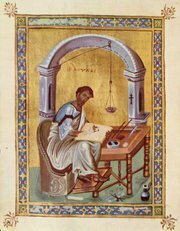
10th century Byzantine illustration of Luke the Evangelist.The Gospel of Luke is a synoptic Gospel, and the third and longest of the four canonical Gospels of the New Testament, which purport to tell the story of Jesus' life, death, and resurrection. The author was also the author of Acts of the Apostles. Like all gospels, the gospel originally circulated anonymously. Since at least the 2nd century, authorship has been ascribed to Luke, named in Colossians 4:14, a doctor and follower of Paul.

The introductory dedication to Theophilus, 1:1-4 states that since many others have compiled an "orderly narrative of the events" from the original eyewitnesses, that the author has decided to do likewise, after thorough research of everything from the beginning, so that Theophilus may realize the reliability of the teachings in which he has been instructed. The main characteristic of this Gospel, as Farrar (Cambridge Bible, Luke, Introduction) remarks, is expressed in the motto, "Who went about doing good, and healing all that were oppressed of the devil" (Acts 10:38; cf. with Luke 4:18). Luke wrote for the "Hellenistic world".


More...

Saturday, June 30, 2007

Sanhedrin Trial of Jesus

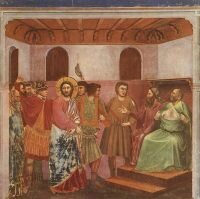
A depiction of the Sanhedrin trial of Jesus, by Giotto The Sanhedrin Trial of Jesus is an event reported by all the Canonical Gospels, in Mark 14:53–65, Matthew 26:57–68, Luke 22:63–71 and John 18:12-24. After the arrest of Jesus, the Canonical Gospels report that Jesus was taken to the Sanhedrin, a legal body composed of the chief Sadduccees, Pharisees, and elders (Kilgallen 255). The precise location and nature of the trial varies between the canonical Gospels, and particularly between the Synoptic Gospels and the Gospel of John.

In the Synoptics, Jesus is taken to the Sanhedrin, with Matthew adding that the Sanhedrin had assembled where Caiaphas was located, possibly implying that the gathering occurred at the home of Caiaphas.

At the time in which the narrative is set, this body was an ad hoc gathering, rather than a fixed court (Brown 146), as in the latter Council of Jamnia, and its gathering in Caiaphas' home is historically plausible, though irregular. Daniel J. Harrington argues that being located in a home makes it more likely that this was a small first preliminary hearing and not a full trial. According to Rabbinic Judaism, the Sanhedrin of the Pharisees, probably a different sanhedrin, was led by Gamaliel from approximately the year 9 to 50. This is believed to be the same Gamaliel who appears in Acts 5:34 and 22:3. Shammai may have also played a role.

More...

Tuesday, June 12, 2007

cessationism

the Healing of the Lame manIn Christian theology, cessationism is the view that the charismatic gifts of the Holy Spirit, such as tongues, prophecy and healing, ceased being practiced early on in Church history.
Cessationists usually believe the miraculous gifts were given only for the foundation of the Church, during the time between the coming of the Holy Spirit on Pentecost, c. AD 33 (see Acts 2) and the fulfillment of God's purposes in history, usually identified as either the completion of the last book of the New Testament or the death of the last Apostle. Its counterpart is continuationism.

Types of cessationist

Cessationists are divided into four main groups:

  1. Concentric Cessationists believe that the miraculous gifts have indeed ceased in the mainstream church and evangelized areas, but appear in unreached areas as an aid to spreading the Gospel (Luther and Calvin, though they were somewhat inconsistent in this position. Daniel B. Wallace is now the most prominent scholar to hold this view).

  2. Classical (or "Weak") cessationists assert that the miraculous gifts such as prophecy, healing and speaking in tongues ceased with the apostles and only served as launching pads for the spreading of the Gospel. However, these cessationists do believe that God still occasionally does miracle-like activities today, such as healings or divine guidance, so long as these "miracles" do not accredit new doctrine or add to the New Testament canon (Warfield, Gaffin). John MacArthur is perhaps the best-known classical cessationist.

  3. Full Cessationists argue that along with no miraculous gifts, there are also no miracles performed by God today. This argument, of course, turns on one's understanding of the term, "miracle."

  4. Consistent Cessationists believe that not only were the miraculous gifts only for the establishment of the first-century church, but the so-called five-fold ministry found in Eph 4 was also a transitional institution (i.e., There are no more apostles, prophets, but also no more pastors, teachers, or evangelists).

More...


Wednesday, June 06, 2007

New Testament

Christ on the Mount of Olives with the angel holding the cup (suffering)That portion of the Bible containing the life and teachings of Christ, including the gospels, the Acts of the Apostles, the Pauline epistles, the General epistles, and the Revelation of John.
The New Testament (Καινή Διαθήκη), sometimes called the Greek Testament or Greek Scriptures, and sometimes also New Covenant (which is the more accurate translation of the original Greek), is the name given to the part of the Christian Bible that was written by various authors c. AD 48–140 and gradually collected into a single volume over the next few centuries. Some minor groups commonly refer to the New Testament as the B'rit Chadashah, Hebrew for New Covenant, or the Apostolic Writings.

The New Testament is twenty-seven separate works: the four narratives of Jesus Christ's ministry, called "Gospels"; a narrative of the Apostles' ministries, which is also a sequel to the third Gospel; twenty-one early letters, commonly called "epistles" in Biblical context, which were written by various authors and consisted mostly of Christian counsel and instruction; and an Apocalyptic prophecy, which is also technically the twenty-second epistle.
More...

Friday, April 27, 2007

F. F. Bruce

Frederick Fyvie BruceFrederick Fyvie Bruce (1910-1990) (more commonly known as F. F. Bruce) was a Bible scholar, and one of the founders of the modern evangelical understanding of the Bible.

He was born in Elgin, Morayshire and was educated at the University of Aberdeen, Cambridge University and the University of Vienna. After teaching Greek for several years first at the University of Edinburgh and then at the University of Leeds he became head of the Department of Biblical History and Literature at the University of Sheffield in 1947. In 1959 he moved to the University of Manchester where he became professor of Biblical Criticism and Exegesis. In his career he wrote some thirty-three books and served as editor of The Evangelical Quarterly and the Palestine Exploration Quarterly. He retired from teaching in 1978.

Bruce was a dedicated member of the Open Plymouth Brethren, though he did not affirm the dispensationalism usually associated with that movement.

Bruce was a distinguished scholar on the life and ministry of the Apostle Paul, and wrote several studies the best known of which is Paul: Apostle of the Free Spirit. He also wrote commentaries on several biblical books including Acts of the Apostles, 1 & 2 Corinthians, and the Epistle to the Hebrews.

His work New Testament Documents: Are They Reliable? is considered a classic in the discipline of apologetics.

More...

Wednesday, April 25, 2007

Christian apologetics

Title page for the 1582 Douai-Rheims New TestamentChristian apologetics is the field of study concerned with the systematic defense of Christianity. The term "apologetic" comes from the Greek word apologia, which means in defense of; therefore a person involved in Christian or Bible Apologetics is a defender of Christianity. Someone who engages in Christian apologetics is called a "Christian apologist". Christian apologetics have taken many forms over the centuries, starting with Paul of Tarsus, including renowned writers such as Augustine of Hippo and Thomas Aquinas, and continuing today with the modern Christian community through authors such as Karl Keating and Jimmy Akin. Apologists have based their defense of Christianity on favoring interpretations of historical evidence, philosophical arguments, scientific investigation, and other avenues.

This Classical Greek term appears in the Koine Greek (i.e. common Greek) of the New Testament. The apostle Paul employed the term "apologia" (a speaking in defense) in his trial speech to Porcius Festus and Agrippa when he said, "I make my defense" (Acts 26:2). In the English language, the word apology, derived from the Greek word "apologia", usually refers to asking for forgiveness for an action that is open to blame. Christian apologetics are meant, however, to argue that Christianity is reasonable and in accordance with the evidence that can be examined, analogous to the use of the term in the Apology of Socrates, written by Plato.


More...

Monday, April 16, 2007

Mesopotamia

Overview map of ancient MesopotamiaMesopotamia refers to the region now occupied by modern Iraq, eastern Syria, and southern Turkey. The name comes from the Greek words μέσος "between" and ποταμός "river", referring to the area between the Euphrates and the Tigris (the Arabic term is بين نهرين Bayn Nahrain "between two rivers"). The fertile area watered by these two rivers is known as the "Cradle of Civilization," (see also cradle of humanity) and it was here that the first literate societies developed.

The biblical Patriarch Abraham was from Ur in Mesopotamia.


Acts 7:22 To this he replied: "Brothers and fathers, listen to me! The God of glory appeared to our father Abraham while he was still in Mesopotamia, before he lived in Haran.


Genesis 11:28-3128 While his father Terah was still alive, Haran died in Ur of the Chaldeans (see Chaldea), in the land of his birth. 29 Abram and Nahor both married. The name of Abram's wife was Sarai, and the name of Nahor's wife was Milcah; she was the daughter of Haran, the father of both Milcah and Iscah. 30 Now Sarai was barren; she had no children. 31 Terah took his son Abram, his grandson Lot son of Haran, and his daughter-in-law Sarai, the wife of his son Abram, and together they set out from Ur of the Chaldeans to go to Canaan. But when they came to Haran, they settled there.


More...
 

Subscribe


LifeNews.com

Desiring God Blog

Youth for Christ International