Showing posts with label Pauline Epistles. Show all posts

Saturday, January 30, 2010

The Letters of Paul


The Pauline epistles are the thirteen or fourteen letters in the New Testament of the Christian Bible traditionally believed to have been written by the apostle Paul. Among them are some of the earliest extant (still existing) Christian documents. They provide an insight into the beliefs and controversies of formative Christianity and, as part of the biblical canon of the New Testament, they have also been, and continue to be, hugely influential in Christian theology and Christian ethics.

The Letters of Paul are as follows:
  • Romans
  • 1 Corinthians
  • 2 Corinthians
  • Galatians
  • Ephesians
  • Philippians
  • Colossians
  • 1 Thessalonians
  • 2 Thessalonians
  • 1 Timothy
  • 2 Timothy
  • Titus
  • Philemon


More...

Wednesday, March 12, 2008

Epistle to the Romans

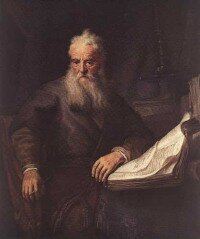
Portrait of St. Paul by Rembrandt The Epistle of St. Paul the Apostle to the Romans is one of the letters of the New Testament canon of the Christian Bible. Often referred to simply as Romans, it is one of the seven currently undisputed letters of Paul. It is even counted among the four letters accepted as authentic (known in German scholarship as Hauptbriefe) by F. C. Baur and the Tübingen School of historical criticism of texts in the 19th century.

The book, according to Joseph Fitzmyer, "overwhelms the reader by the density and sublimity of the topic with which it deals, the gospel of the justification and salvation of Jew and Greek alike by the grace of God through faith in Jesus Christ, revealing the uprightness and love of God the father." N.T. Wright notes that Romans is "neither a systematic theology nor a summary of Paul's lifework, but it is by common consent his masterpiece. It dwarfs most of his other writings, an Alpine peak towering over hills and villages. Not all onlookers have viewed it in the same light or from the same angle, and their snapshots and paintings of it are sometimes remarkably unalike. Not all climbers have taken the same route up its sheer sides, and there is frequent disagreement on the best approach. What nobody doubts is that we are here dealing with a work of massive substance, presenting a formidable intellectual challenge while offering a breathtaking theological and spiritual vision".

More...

Tuesday, February 19, 2008

Thessalonica

Bird’s Eye View of ThessalonicaThessalonica or Thessaloniki (Greek: Θεσσαλονίκη), is Greece's second-largest city and the capital of the Greek region of Macedonia.

Thessalonica had a Jewish colony, established during the first century, and was an early centre of Christianity. On his second missionary journey, Paul of Tarsus preached in the city's synagogue, the chief synagogue of the Jews in that part of Thessaloniki, and laid the foundations of a church. Opposition against him from the Jews drove him from the city, and he fled to Veroia. Paul wrote two of his epistles to the Christian community at Thessalonica, the First Epistle to the Thessalonians and the Second Epistle to the Thessalonians.

Paul's teaching about the end of the world is expressed most clearly in his letters to the Christians at Thessalonica. Heavily persecuted, it appears that they had written asking him first about those who had died already, and, secondly, when they should expect the end. Paul regarded the age as passing and, in such difficult times, he therefore encouraged marriage as a means of happiness. He assures them that the dead will rise first and be followed by those left alive (1 Thessalonians 4:16).

16For the Lord himself will come down from heaven, with a loud command, with the voice of the archangel and with the trumpet call of God, and the dead in Christ will rise first.

This suggests an imminence of the end but he is unspecific about times and seasons, and encourages his hearers to expect a delay. The form of the end will be a battle between Jesus and the Man of Lawlessness (3ff) whose conclusion is the triumph of Christ.

More...
Tuesday, November 06, 2007

Pauline Epistles

Portrait of St. Paul by RembrandtThe Pauline Epistles are as follows:
  • Romans
  • 1 Corinthians
  • 2 Corinthians
  • Galatians
  • Ephesians
  • Philippians
  • Colossians
  • 1 Thessalonians
  • 2 Thessalonians
  • 1 Timothy
  • 2 Timothy
  • Titus
  • Philemon

The Epistle to the Romans

The Epistle to the Romans is one of the letters of the New Testament canon of the Christian Bible. When it is clear that the Bible is being discussed, it is often referred to as simply "Romans". Romans is one of the seven currently (as of 2004) undisputed letters of Paul and even among the four letters accepted as authentically his (in German scholarship, the Hauptbriefe) by F. C. Baur and the Tübingen School of historical criticism of texts in the 19th century.

History

It was probably written at Corinth or possibly in nearby Cenchrea, transcribed by Tertius. Phoebe (Romans 16:1) of Cenchrea, the Aegean port of Corinth, conveyed it to Rome, and Gaius of Corinth entertained the apostle Paul at the time of his writing it (Romans 16:23; 1 Cor 1:14), and Erastus was chamberlain of the city, that is, of Corinth (2 Tim 4:20).

The precise time at which it was written is not mentioned in the epistle, but it was obviously written when the collection for Jerusalem had been assembled and Paul was about to "go unto Jerusalem to minister unto the saints", that is, at the close of his second visit to Greece, during the winter preceding his last visit to that city (Rom. 15:25; cf. Acts 19:21; 20:2, 3, 16; 1 Cor 16:1–4) early in 58.


More...


Subscribe


LifeNews.com

Desiring God Blog

Youth for Christ International