Showing posts with label Andrew. Show all posts

Wednesday, October 05, 2011

Andrew

(Greek: Andreas, Ανδρέας "manly"), called in the Orthodox tradition Protocletos, or the First-called, is a Christian Apostle, brother of Simon Peter.
One of the two who heard John speak and followed Jesus was Andrew, Simon Peter’s brother. John:1:40 ESV

Biography
According to Christian tradition, Andrew was born at Bethsaida (Greek: Βηθσαϊδά Bēthsaïda "house or place of hunting or fishing" of Aramaic origin בַּיִת צַיָּד bayith "house" tsayad "hunter"), a small fishing village on the west shore of Lake Gennesaret Sea of Galilee, home of Andrew, Peter, Philip and John (John 1:44). Since he was a Jew, Andreas was almost certainly not his given name, but no Hebrew or Aramaic name is recorded for him. He had been a disciple of John the Baptist (John 1:37-40) and was one of the first to follow Jesus. He lived at Capernaum (Mark 1:29). In the gospels he is referred to as being present on some important occasions as one of the disciples more closely attached to Jesus (Mark 13:3; John 6:8, 12:22). In the book of Matthew, Jesus said, to Andrew and his brother Simon, "Follow me, and I will make you fishers of men." (Greek: ἁλιεύς ἄνθρωπος halieus "a fisherman, fisher" anthrōpos "a human being, whether male or female") in Acts there is only a bare mention of him (Acts 1:13).
More...

John Piper Apostles and Church Growth

Saturday, March 01, 2008

The Twelve Apostles

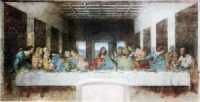
The Last Supper fresco in Milan (1498)  by Leonardo da VinciThe Twelve Apostles (in Koine Greek "απόστολος" apostolos, Liddell & Scott, Strong's G652, a delegate, messenger, one sent forth with orders) were men that according to the Synoptic Gospels and Christian tradition (see also Oral Tradition), were chosen from among the disciples of Jesus for a mission (see also: Seventy Disciples). According to the Bauer lexicon, Walter Bauer's Greek-English Lexicon of the New Testament: "...Judaism had an office known as apostle (שליח)".

The Gospel of Mark states that Jesus initially sent out these twelve in pairs (Mark 6:7-13, cf. Matthew 10:5-42, Luke 9:1-6), to towns in Galilee [map].

Literal readings of the text state that their initial instructions were to heal the sick and drive out demons, but some scholars read this more metaphorically as instructions to heal the spiritually sick and thus to drive away wicked behaviour. They are also instructed to only take their staffs, and that if any town rejects them they ought to shake the dust off their feet as they leave, a gesture which some scholars think was meant as a contemptuous threat (Miller 26). Their carrying of just a staff is sometimes given as the reason for the use by Christian Bishops of a staff of office, in those denominations that believe they maintain an Apostolic Succession.

Later in the Gospel narratives the Twelve Apostles are described as having been commissioned to preach the Gospel to the world, regardless of whether Jew or Gentile. Although the Apostles are portrayed as having been Galilean Jews, and 10 of their names are Aramaic, the other 4 names are Greek, suggesting a more metropolitan background.

More...

Tuesday, November 20, 2007

Andrew

St. Andrew by Camillo Rusconi. Nave of the Basilica of St. John Lateran (Rome).Saint Andrew (Greek: Ανδρέας Andreas, "manly"), called in the Orthodox tradition Protocletos, or the First-called, is a Christian Apostle, brother of Simon Peter.

Biography

According to Christian tradition, Andrew was born at Bethsaida on the Sea of Galilee (John 1:44). Since he was a Jew, Andreas was almost certainly not his given name, but no Hebrew or Aramaic name is recorded for him (see also: Aramaic of Jesus). He had been a disciple of John the Baptist (John 1:37-40) and was one of the first to follow Jesus. He lived at Capernaum (Mark 1:29). In the gospels he is referred to as being present on some important occasions as one of the disciples more closely attached to Jesus (Mark 13:3; John 6:8, 12:22); in Acts there is only a bare mention of him (Acts 1:13).

The Kievan hill where St Andrew is said to have erected the cross is commemorated by the cathedral dedicated in his name. Eusebius quotes Origen as saying Andrew preached in Asia Minor and in Scythia, along the Black Sea as far as the Volga. Hence he became a patron saint of Romania and Russia. Traditionally, he became the first bishop of Byzantium in 38, a position which would later become Patriarch of Constantinople.

He is said to have suffered crucifixion at Patras (Patrae) in Achaea, on a cross of the form called Crux decussata (X-shaped cross) and commonly known as "St. Andrew's cross." or saltire. St Andrew is the patron of Patras. According to tradition his relics were removed from Patras to Constantinople, and thence to St Andrews (see below). Local legends say that the relics were sold to the Romans by the local priests in exchange of the Romans constructing a water reservoir for the city. In recent years, the relics were kept in the Vatican City, but were sent back to Patras by decision of the Pope Paul VI in 1964. The relics, which consist of the small finger and part of the top of the cranium of St Andrew, are since kept in the Church of St Andrew at Patras in a special tomb, and are reverenced in a special ceremony every November 30.

More...


Subscribe


LifeNews.com

Desiring God Blog

Youth for Christ International