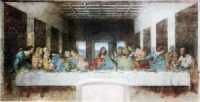
The Twelve Apostles (in
Koine Greek "απόστολος" apostolos, Liddell & Scott, Strong's G652, a delegate, messenger, one sent forth with orders) were men that according to the Synoptic Gospels and Christian tradition (see also
Oral Tradition), were chosen from among the disciples of Jesus for a mission (see also: Seventy Disciples). According to the Bauer lexicon, Walter Bauer's Greek-English Lexicon of the New Testament: "...Judaism had an office known as apostle (שליח)".
The Gospel of Mark states that Jesus initially sent out these twelve in pairs (Mark 6:7-13, cf. Matthew 10:5-42, Luke 9:1-6), to towns in Galilee [map].
Literal readings of the text state that their initial instructions were to heal the sick and drive out demons, but some scholars read this more metaphorically as instructions to heal the spiritually sick and thus to drive away wicked behaviour. They are also instructed to only take their staffs, and that if any town rejects them they ought to shake the dust off their feet as they leave, a gesture which some scholars think was meant as a contemptuous threat (Miller 26). Their carrying of just a staff is sometimes given as the reason for the use by Christian Bishops of a staff of office, in those denominations that believe they maintain an Apostolic Succession.
Later in the Gospel narratives the Twelve Apostles are described as having been commissioned to preach the Gospel to the world, regardless of whether Jew or Gentile. Although the Apostles are portrayed as having been Galilean Jews, and 10 of their names are Aramaic, the other 4 names are Greek, suggesting a more metropolitan background.
More...