Showing posts with label Judas Iscariot. Show all posts

Sunday, October 04, 2009

Judas Iscariot

Taking of Christ. Date: c. 1598. Artist: CaravaggioJudas Iscariot (died April AD 29–33) was, according to the New Testament, one of the twelve original apostles of Jesus, and the one who is said to have betrayed him.

Biblical narrative
Mark states that the chief priests were looking for a "sly" way to arrest Jesus. They determine not to do so during the feast because they were afraid that the people would riot. It is after the feast that they do end up arresting him.

According to the account given in the gospels, he carried the disciples' money box and betrayed Jesus for a bribe of "thirty pieces of silver" by identifying him with a kiss—the "kiss of Judas"— to arresting soldiers of the High Priest Caiaphas, who then turned Jesus over to Pontius Pilate's soldiers. These "pieces of silver" were most likely intended to be understood as silver Tyrian shekels (see also Biblical and Talmudic units of measurement).

Judas Iscariot, son of Simon, should not be confused with Jude Thomas (more commonly known as Saint Thomas the Apostle), or with Saint Jude who was also one of the twelve disciples and a brother of James the Less.

More...

Tuesday, August 05, 2008

Judas Iscariot

udas Iscariot 1891 by Nikolaj Nikolajewitsch Ge, Deutsch: Das Gewissen, Judas, English: Conscious, Judas, Русский: Совесть, ИудаJudas Iscariot (died April AD 29–33) was, according to the New Testament, one of the twelve original apostles of Jesus, and the one who is said to have betrayed him.

Biblical narrative

Mark also states that the chief priests were looking for a "sly" way to arrest Jesus. They determine not to do so during the feast because they were afraid that the people would riot. It is after the feast that they do end up arresting him.

According to the account given in the gospels, he carried the disciples' money box and betrayed Jesus for a bribe of "thirty pieces of silver" by identifying him with a kiss—the "kiss of Judas"— to arresting soldiers of the High Priest Caiphas, who then turned Jesus over to Pontius Pilate's soldiers. These "pieces of silver" were most likely intended to be understood as silver Tyrian shekels.

Judas Iscariot, son of Simon, should not be confused with Jude Thomas (more commonly known as Saint Thomas the Apostle), or with Saint Jude who was also one of the twelve disciples and a brother of James the Less.

More...
Saturday, March 01, 2008

The Twelve Apostles

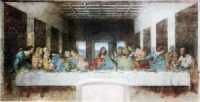
The Last Supper fresco in Milan (1498)  by Leonardo da VinciThe Twelve Apostles (in Koine Greek "απόστολος" apostolos, Liddell & Scott, Strong's G652, a delegate, messenger, one sent forth with orders) were men that according to the Synoptic Gospels and Christian tradition (see also Oral Tradition), were chosen from among the disciples of Jesus for a mission (see also: Seventy Disciples). According to the Bauer lexicon, Walter Bauer's Greek-English Lexicon of the New Testament: "...Judaism had an office known as apostle (שליח)".

The Gospel of Mark states that Jesus initially sent out these twelve in pairs (Mark 6:7-13, cf. Matthew 10:5-42, Luke 9:1-6), to towns in Galilee [map].

Literal readings of the text state that their initial instructions were to heal the sick and drive out demons, but some scholars read this more metaphorically as instructions to heal the spiritually sick and thus to drive away wicked behaviour. They are also instructed to only take their staffs, and that if any town rejects them they ought to shake the dust off their feet as they leave, a gesture which some scholars think was meant as a contemptuous threat (Miller 26). Their carrying of just a staff is sometimes given as the reason for the use by Christian Bishops of a staff of office, in those denominations that believe they maintain an Apostolic Succession.

Later in the Gospel narratives the Twelve Apostles are described as having been commissioned to preach the Gospel to the world, regardless of whether Jew or Gentile. Although the Apostles are portrayed as having been Galilean Jews, and 10 of their names are Aramaic, the other 4 names are Greek, suggesting a more metropolitan background.

More...

Friday, October 05, 2007

Gethsemane

The Garden of Gethsemane. The Church of All Nations is visible in the background. Gethsemane (also spelled Gethsemani) was the garden where, according to the New Testament and Christian traditions, Jesus watched and prayed the night before he was crucified and suffered for the sins of the world (see Atonement). According to Luke 22:43–44, Jesus' anguish in Gethsemane was so deep that "his sweat was as it were great drops of blood falling down to the ground." Gethsemane was also where Christ was betrayed by the disciple Judas Iscariot.

The garden identified as Gethsemane is located at the foot of the Mount of Olives, now within the city of Jerusalem. Located by the garden is the Church of All Nations, also known as the Church of the Agony.

The ancient church was destroyed by the Sassanids in 614. The church rebuilt on the site by the Crusaders was finally razed, probably in 1219.

The name Gethsemane is given in the Greek of the Gospels (Matthew 26:36 and Mark 14:32) as Γεθσημανι (Gethsêmani). This represents the Aramaic (see also: Aramaic of Jesus) 'Gath-Šmânê', meaning 'the oil press' or 'oil vat' (referring to olive oil). It would appear from this that there were a number of olive trees planted around the area at the time.

More...

Friday, September 21, 2007

New Testament view on the life of Jesus

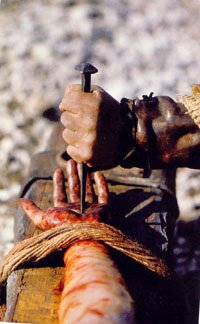
Jesus Christ being nailed to the cross The four canonical gospels of the New Testament are the main sources of information for the traditional Christian narrative of Jesus' life.

The Gospels give two accounts of Jesus' genealogy: one in the male line through his legal father Joseph of Nazareth (Matt 1:2–16 and one through his mother, Mary, while referencing his supposed father; Luke 3:23–38). Both accounts trace his line back to King David and from there to Abraham. These lists are identical between Abraham and David, but they differ between David and Joseph. Matthew starts with Solomon and proceeds through the kings of Judah to the last king, Jeconiah. After Jeconiah the line of kings terminated when Babylon conquered Judah. Thus, Matthew shows that Jesus is the legal heir to the throne of Israel. Luke's genealogy is longer than Matthew's; it goes back to Adam and provides more names between David and Jesus, thus giving us direct descendants from Adam to Jesus through Mary.

Joseph of Nazareth appears only in descriptions of Jesus' childhood. With Jesus commending Mary into the care of the beloved disciple during his crucifixion (John 19:25–27), it is likely that he had died by the time of Jesus' ministry. Both Matthew 13:55–56 and Mark 6:3 tell of Jesus' relatives. Mark 6:3 reports that those hearing Jesus asked, "Isn't this the carpenter? Isn't this Mary's son and the brother of James, Joseph, Judas and Simon? Aren't his sisters here with us?" The apostle Paul, in his letter to the Galatians, mentions at 1:19 that "I saw none of the other apostles—only James, the Lord's brother." The first-century Jewish historian Flavius Josephus also describes James the Just as "the brother of Jesus, who was called Christ" (translation of William Whiston), though this passage has been suggested as an interpolation (see Josephus on Jesus). Additionally, the Christian historian Eusebius (who wrote in the 4th century but quoted earlier sources that are now lost) refers to James the Just as Jesus' brother (see Desposyni). However, Epiphanius argued that they were "Joseph's children by his (unrecorded) first wife", while Jerome argued that they were "Jesus' cousins". The Greek word adelphos in these verses is often translated as brother in many Bible translations. However, the word can refer to any familial relation, and Roman Catholic and Eastern Orthodox traditions, along with certain other Christians, cite later revelations concerning the perpetual virginity of Mary, contend the correct translation of adelphos is kinsman or cousin.

More...

Wednesday, November 22, 2006

Judas Iscariot

Judas returns the silver coins to the priestsJudas Iscariot (died April AD 29–33) was, according to the New Testament, one of the twelve original apostles of Jesus, and the one who is said to have betrayed him.

Traditional Christian views

Biblical narrative
Mark also states that the chief priests were looking for a "sly" way to arrest Jesus. They determine not to do so during the feast because they were afraid that the people would riot. It is after the feast that they do end up arresting him.

According to the account given in the gospels, he carried the disciples' money box and betrayed Jesus for a bribe of "thirty pieces of silver" by identifying him with a kiss—the "kiss of Judas"— to arresting soldiers of the High Priest Caiphas, who then turned Jesus over to Pontius Pilate's soldiers. These "pieces of silver" were most likely intended to be understood as silver Tyrian shekels.


More...
 

Subscribe


LifeNews.com

Desiring God Blog

Youth for Christ International