Showing posts with label The Twelve Apostles. Show all posts

Sunday, November 27, 2011

Bartholomew

Often often identified with the Nathanael, Bartholomew was born in Cana of Galilee (John 21:2).
45 Philip found Nathanael and said to him, "We have found him of whom Moses in the Law and also the prophets wrote, Jesus of Nazareth, the son of Joseph." Nathanael said to him, "Can anything good come out of Nazareth" Philip said to him, "Come and see."
—John 1:45-46
"Bartholomew" (Greek: Βαρθολομαῖος Bartholomaios "son of Tolmai" or "from Ptolemais" (of Aramaic origin: בַּר bar (Aramaic) son + תַּלְמַי Talmai = "furrowed") from תֶּלֶם telem = "furrow," from an unused root word meaining "to accumulate," often identified with the Nathanael (Greek Ναθαναήλ Nathanaēl of Hebrew origin נְתַנְאֵל Nĕthane'l "given of God") of John 1:45-1:51.

He was listed as one of The Twelve Apostles (Matthew 10:2-4; Acts 1:13).

He was honest
47 Jesus saw Nathanael coming toward him and said of him, "Behold, an Israelite indeed, in whom there is no deceit!"
—John 1:47
and he was faithful (John 1:49).
Jesus told him "Truly, truly, I say to you, you will see heaven opened, and the angels of God ascending and descending on the Son of Man."
—John 1:50:51
He was a witness of the miracle catch of fish and ate with Jesus after his resurrection.
More...

Greg Laurie
12 Men Who Shook the World
Where is God?
(The Problem of Evil) by John Piper – Parts 1-6


Friday, April 08, 2011

History of Christianity

The history of Christianity concerns the history of the Christian religion and the Church, from Jesus and his Twelve Apostles to contemporary times. Christianity is the monotheistic religion which considers itself based on the revelation of Jesus Christ (cf. Galatians 1:12 see below). "The Church" is understood theologically as the institution founded by Jesus for the salvation of mankind.

Christianity began in the 1st century AD as a Jewish sect but quickly spread throughout the Greco-Roman world.
The word revelation never occurs again in the book that has come to bear that name. Every other time the book refers to itself, it is as a prophecy (v. 3; compare 22:7, 10, 18) or a "book of prophecy" (22:19). Revelation should therefore be understood in much the same sense as in 1 Corinthians 14:6, 26, where Paul lists "a revelation" among the things prophets in early Christian congregations received from God in the Spirit--along with knowledge, prophecy, teaching (v. 6), a psalm, a teaching, a tongue, an interpretation (v. 26).

Paul uses the phrase "revelation of Jesus Christ" in Galatians 1:12 (NRSV) to refer to the divine message he had received, and by virtue of which he became apostle to the Gentiles. Both in Galatians and here in Revelation the phrase "revelation of Jesus Christ" tells us primarily where the revelation comes from, not what it is about. It is a revelation given by Jesus Christ from heaven, now that God has raised him from the dead. Much of it, of course, will also be about Jesus, but above all the title is saying that the book is from Jesus. ©InterVarsity Press 
12 For I did not receive it from any man, nor was I taught it, but I received it through a revelation of Jesus Christ. (Galatians 1:12 ESV)

More...

Tuesday, July 20, 2010

The Twelve Apostles

The Twelve Apostles (in Koine Greek "απόστολος" apostolos: "messenger from God, LXX 3 Ki.14.6; esp. of the Apostles, Ev.Matt.10.2, al." (Henry George Liddell, Robert Scott), G652: "a delegate, messenger, one sent forth with orders a) specifically applied to the twelve apostles of Christ) in a broader sense applied to other eminent Christian teachers" (Strong's Concordance) were men that according to the Synoptic Gospels and Christian tradition, were chosen from among the disciples of Jesus for a mission (see also: Seventy Disciples). According to the Bauer lexicon, Walter Bauer's Greek-English Lexicon of the New Testament: " Judaism had an office known as apostle (שליח)".

The Gospel of Mark states that Jesus initially sent out these twelve in pairs (Mark 6:7-13, cf. Matthew 10:5-42, Luke 9:1-6), to towns in Galilee.

Literal readings of the text state that their initial instructions were to heal the sick and drive out demons, but some scholars read this more metaphorically as instructions to heal the spiritually sick and thus to drive away wicked behavior.

More...

Thursday, August 27, 2009

The Twelve Apostles

The Twelve ApostlesThe Twelve Apostles (in Koine Greek "απόστολος" apostolos: "messenger from God, LXX 3 Ki.14.6; esp. of the Apostles, Ev.Matt.10.2, al." (Henry George Liddell, Robert Scott), G652: "a delegate, messenger, one sent forth with orders a) specifically applied to the twelve apostles of Christ) in a broader sense applied to other eminent Christian teachers" (Strong's Concordance) were men that according to the Synoptic Gospels and Christian tradition (see also Oral Tradition), were chosen from among the disciples of Jesus for a mission (see also: Seventy Disciples). According to the Bauer lexicon, Walter Bauer's Greek-English Lexicon of the New Testament: "...Judaism had an office known as apostle (שליח)".

The Gospel of Mark states that Jesus initially sent out these twelve in pairs (Mark 6:7-13, cf. Matthew 10:5-42, Luke 9:1-6), to towns in Galilee [].

Literal readings of the text state that their initial instructions were to heal the sick and drive out demons, but some scholars read this more metaphorically as instructions to heal the spiritually sick and thus to drive away wicked behaviour.

They are also instructed to only take their staffs, and that if any town rejects them they ought to shake the dust off their feet as they leave, a gesture which some scholars think was meant as a contemptuous threat (Miller 26). Their carrying of just a staff is sometimes given as the reason for the use by Christian Bishops of a staff of office, in those denominations that believe they maintain an Apostolic Succession.

More...

Monday, September 15, 2008

The Twelve Apostles

The Twelve ApostlesThe Twelve Apostles (in Koine Greek "απόστολος" apostolos: "messenger from God, LXX 3 Ki.14.6; esp. of the Apostles, Ev.Matt.10.2, al." (Henry George Liddell, Robert Scott), G652: "a delegate, messenger, one sent forth with orders a) specifically applied to the twelve apostles of Christ b) in a broader sense applied to other eminent Christian teachers" (Strong's Concordance) were men that according to the Synoptic Gospels and Christian tradition (see also Oral Tradition), were chosen from among the disciples of Jesus for a mission (see also: Seventy Disciples). According to the Bauer lexicon, Walter Bauer's Greek-English Lexicon of the New Testament: "...Judaism had an office known as apostle (שליח)".

The Gospel of Mark states that Jesus initially sent out these twelve in pairs (Mark 6:7-13, cf. Matthew 10:5-42, Luke 9:1-6), to towns in Galilee [map].

Literal readings of the text state that their initial instructions were to heal the sick and drive out demons, but some scholars read this more metaphorically as instructions to heal the spiritually sick and thus to drive away wicked behaviour.

More...

Wednesday, March 19, 2008

John the Apostle

St John the Evangelist, imagined by Jacopo Pontormo, ca 1525 (Santa Felicita, Florence)John the Apostle (יוחנן "The LORD is merciful", Greek Ευαγγελιστής Ιωάννης), was one of The Twelve Apostles of Jesus. Christian tradition proclaims he is the same person who wrote:
  • the Gospel of John and first epistle of John (the author of these is also referred to as John the Evangelist, John the Theologian or John the Divine)
  • the second and third Epistle of John (the author of these is sometimes distinguished under the name of John the Presbyter).
  • the Book of Revelation (the author is sometimes referred to as John of Patmos or John the Revelator).

In the Bible

John the Apostle was the son of Zebedee, and the brother of James. One tradition gives his mother's name as Salome.

John and James were originally fishermen and fished with their father in the Lake of Genesareth (the Sea of Galilee).

He was first a disciple of John the Baptist and later one of The Twelve Apostles of Jesus. He is revered as a saint by most of Christianity. The Roman Catholic Church commemorates him on December 27. He is also remembered in the liturgy on January 3. The Eastern Orthodox Church commemorates him on September 26, and also remembers him on May 8, on which date Christians used to draw forth from his grave fine ashes which were believed to be effective for healing the sick.

More...

Tuesday, March 18, 2008

history of Christianity

The Sermon On the Mount by Carl Heinrich Bloch, Danish painter, d. 1890.The history of Christianity concerns the history of the Christian religion and the Church, from Jesus and His Twelve Apostles to contemporary times. Christianity is the monotheistic religion which considers itself based on the revelation of Jesus Christ. "The Church" is understood theologically as the institution founded by Jesus for the salvation of mankind.

Christianity began in the 1st century AD as a Jewish sect but quickly spread throughout the Greco-Roman world.

Rapid early spread of Christianity

Although it was originally persecuted under the Roman empire, it would ultimately become the state religion. In the Middle Ages it spread beyond the old borders of the Empire into Northern Europe and Russia. During the Age of Exploration, Christianity expanded throughout the world; it is the world's largest religion.

Throughout its history, the religion weathered schisms and theological disputes that have resulted in the development of three main branches: Catholicism, Eastern Christianity (Eastern Orthodoxy), and Protestantism.

More...

Saturday, March 01, 2008

The Twelve Apostles

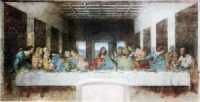
The Last Supper fresco in Milan (1498)  by Leonardo da VinciThe Twelve Apostles (in Koine Greek "απόστολος" apostolos, Liddell & Scott, Strong's G652, a delegate, messenger, one sent forth with orders) were men that according to the Synoptic Gospels and Christian tradition (see also Oral Tradition), were chosen from among the disciples of Jesus for a mission (see also: Seventy Disciples). According to the Bauer lexicon, Walter Bauer's Greek-English Lexicon of the New Testament: "...Judaism had an office known as apostle (שליח)".

The Gospel of Mark states that Jesus initially sent out these twelve in pairs (Mark 6:7-13, cf. Matthew 10:5-42, Luke 9:1-6), to towns in Galilee [map].

Literal readings of the text state that their initial instructions were to heal the sick and drive out demons, but some scholars read this more metaphorically as instructions to heal the spiritually sick and thus to drive away wicked behaviour. They are also instructed to only take their staffs, and that if any town rejects them they ought to shake the dust off their feet as they leave, a gesture which some scholars think was meant as a contemptuous threat (Miller 26). Their carrying of just a staff is sometimes given as the reason for the use by Christian Bishops of a staff of office, in those denominations that believe they maintain an Apostolic Succession.

Later in the Gospel narratives the Twelve Apostles are described as having been commissioned to preach the Gospel to the world, regardless of whether Jew or Gentile. Although the Apostles are portrayed as having been Galilean Jews, and 10 of their names are Aramaic, the other 4 names are Greek, suggesting a more metropolitan background.

More...


Subscribe


LifeNews.com

Desiring God Blog

Youth for Christ International