Showing posts with label Mesopotamia. Show all posts

Sunday, December 04, 2011

Mesopotamia

Mesopotamia refers to the region
now occupied by modern Iraq, eastern
Syria, and southern Turkey
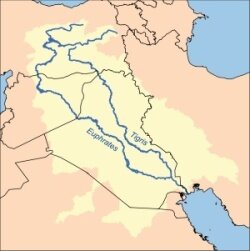
Mesopotamia (Hebrew: ארם נהרים 'Aram Naharayim "Aram of the two rivers" from אָרַם 'Aram "exalted" and נָהָר nahar "stream, river" or "to flow, flow together" see Isaiah 2:2)  refers to the region now occupied by modern Iraq, eastern Syria, and southern Turkey . The name comes from the Greek words μέσος "between" and ποταμός "river", referring to the area between the Euphrates and the Tigris (the Arabic term is بين نهرين Bayn Nahrain "between two rivers"). The fertile area watered by these two rivers is known as the "Cradle of Civilization," or "cradle of humanity" and it was here that the first literate societies developed.

The biblical Patriarch Abraham was from Ur in Mesopotamia.
10 Then the servant took ten of his master’s camels and departed, taking all sorts of choice gifts from his master; and he arose and went to Mesopotamia to the city of Nahor. 11 And he made the camels kneel down outside the city by the well of water at the time of evening, the time when women go out to draw water. 12 And he said, "O LORD, God of my master Abraham, please grant me success today and show steadfast love to my master Abraham. 13 Behold, I am standing by the spring of water, and the daughters of the men of the city are coming out to draw water. 14 Let the young woman to whom I shall say, 'Please let down your jar that I may drink,' and who shall say, 'Drink, and I will water your camels'—let her be the one whom you have appointed for your servant Isaac. By this I shall know that you have shown steadfast love to my master."

15 Before he had finished speaking, behold, Rebekah, who was born to Bethuel the son of Milcah, the wife of Nahor, Abraham’s brother, came out with her water jar on her shoulder. 16 The young woman was very attractive in appearance, a maiden whom no man had known. She went down to the spring and filled her jar and came up. 17 Then the servant ran to meet her and said, "Please give me a little water to drink from your jar." 18 She said, "Drink, my lord." And she quickly let down her jar upon her hand and gave him a drink. 19 When she had finished giving him a drink, she said, "I will draw water for your camels also, until they have finished drinking." 20 So she quickly emptied her jar into the trough and ran again to the well to draw water, and she drew for all his camels. 21 The man gazed at her in silence to learn whether the LORD had prospered his journey or not.
—Genesis 24:10-21 ESV

More...


Civilisations — Mesopotamia Parts 1-6

Friday, November 04, 2011

Cradle of Humanity

The evangelical Protestants of the 19th century, considered the inventors of the term "Cradle of Humanity," made claims that the term originated in Mesopotamia in the 2nd century, and that it was used by early non-Christian Arabs, to refer to a geographic area that falls within a 1,000 mile radius of the spot they believed to be the birthplace of humankind. No documentation of such a historical use has been forthcoming. Nevertheless, the term has been used not only in religious, but also in secular contexts, and may therefore refer to different locations, depending on the views of the user.

Jewish, Christian and Muslim creationists believe that man was created by God in a place called Eden and then placed in a garden located east of Eden. In the Christian Bible, Genesis 2:10-14 indicates the Garden of Eden was supplied by the Tigris and Euphrates rivers. Some early Christians (A.D second century) used the term to refer to a geographic area falling within a 1,000 mile radius of that location as the birthplace of mankind.

Evolutionary View
The consensus among some biologists and paleoanthropologists is that mankind evolved through natural processes, and when journalists and popularizers currently use the term "Cradle of Humanity", it refers to Great Rift Valley sites in Eastern Africa, where the oldest hominid fossils were found in 1974.

There is a growing list of scientists, alive today, who accept the biblical account of Creation.

As the evolutionist apriorism continues, the earliest hominids evolved from apes about 5 million years ago, but modern humans (homo sapien sapiens) didn't emerge until 150,000-200,000 years ago, in eastern Africa. Since 2002, however, several groups of prominent paleontologists have begun to challenge East Africa's position as the evolutionary "cradle of humanity", most notably because of the fossil hominid partial skull found in Chad in July 2002; recent research in connection with earliest hominids outside Africa focuses on the Liujiang hominid of China, the Dmanisi fossils of Georgia and the Mungo Man fossils in Australia.

More...

Wednesday, November 02, 2011

Hammurabi

(Akkadian, meaning "the kinsman is a healer," ca. 1810 BC – 1750 BC), was the sixth king of Babylon. He became the first king of the Babylonian Empire, extending Babylon's control over Mesopotamia by winning a series of wars against neighboring kingdoms.

Hammurabi is known for the set of laws called Hammurabi's Code, one of the first written codes of law in recorded history. Owing to his reputation in modern times as an ancient law-giver, Hammurabi's portrait is in many government buildings throughout the world. Although his empire controlled all of Mesopotamia by the time of his death, his successors were unable to maintain his empire.

Hammurabi was one of the first dynasty kings of the city-state of Babylon, and inherited the throne from his father, Sin-muballit, in 1792 BC.

Babylon was one of the many ancient city-states that dotted the Mesopotamian plain and waged war on each other for control of fertile agricultural land. Though many cultures co-existed in Mesopotamia, Babylonian culture gained a degree of prominence among the literate classes throughout the Middle East The kings who came before Hammurabi had begun to consolidate rule of central Mesopotamia under Babylonian hegemony and, by the time of his reign, had conquered the city-states of Borsippa, Kish, and Sippar. Thus Hammurabi ascended to the throne as the king of a minor kingdom in the midst of a complex geopolitical situation, surrounded by the more powerful kingdoms of Shamshi-Adad, Larsa, Eshnunna, and Elam.

The first few decades of Hammurabi's reign were relatively peaceful, although the death of Shamshi-Adad I led to the fragmentation of his northern Semitic empire, and Babylon became comparatively stronger as a result. Hammurabi used this time to undertake a series of public works, including heightening the city walls for defensive purposes, and expanding the temples.

In 1766 BC, the powerful kingdom of Elam, which straddled important trade routes across the Zagros Mountains, invaded the Mesopotamian plain. With allies among the plain states, Elam attacked and destroyed the empire of Eshnunna, destroying a number of cities and imposing its rule on portions of the plain for the first time. In order to consolidate its position, Elam tried to start a war between Hammurabi's Babylonian kingdom and the kingdom of Larsa. Hammurabi and the king of Larsa made an alliance when they discovered this duplicity and were able to crush the Elamites, although Larsa did not contribute greatly to the military effort. Angered by Larsa's failure to come to his aid, Hammurabi turned on that southern power, thus gaining control of the entirety of the lower Mesopotamian plain by 1699 BC.

More...

Wednesday, November 10, 2010

Sumer

Sumer (or Shumer, Egyptian Sangar, [biblical Shinar], native ki-en-gir, (native ki-en-gir, (from Ki = "Earth," En = "title" usually translated as Lord, Gir = "cultured" usually translated as "Civilized," thus "the land of the civilised lords") was an ancient civilization located in the southern part of Mesopotamia (modern day southeastern Iraq) from the time of the earliest records in the mid 4th millennium BC until the rise of Babylonia in the late 3rd millennium BC. The term "Sumerian" applies to all speakers of the Sumerian language. Sumer is considered the first settled society in the world to have manifested all the features needed to qualify fully as a "civilization."

1 Now the whole earth had one language and the same words. 2 And as people migrated from the east, they found a plain in the land of Shinar and settled there. 3 And they said to one another, "Come, let us make bricks, and burn them thoroughly." And they had brick for stone, and bitumen for mortar. 4 Then they said, "Come, let us build ourselves a city and a tower with its top in the heavens, and let us make a name for ourselves, lest we be dispersed over the face of the whole earth." 5 And the LORD came down to see the city and the tower, which the children of man had built. 6 And the LORD said, "Behold, they are one people, and they have all one language, and this is only the beginning of what they will do. And nothing that they propose to do will now be impossible for them. 7 Come, let us go down and there confuse their language, so that they may not understand one another's speech." 8 So the LORD dispersed them from there over the face of all the earth, and they left off building the city. 9 Therefore its name was called Babel, because there the LORD confused the language of all the earth. And from there the LORD dispersed them over the face of all the earth.
–Genesis 11:1-12 ESV
In an interview, controversial Azeri-born American author Zecharia Sitchin discusses the Annunaki and the origins of the human race on earth, which he calls:
"Best corroborating evidence for the voracity of the bible"

What do you think?

More...

Wednesday, September 08, 2010

Assyria


Simo Parpola about Assyrians
Assyria in earliest historical times referred to a region on the Upper Tigris river, named for its original capital, the ancient city of Assur. Later, as a nation and Empire, it also came to include roughly the northern half of Mesopotamia (the southern half being Babylonia). The capital is Nineveh.

Assyria proper was located in a mountainous region, extending along the Tigris as far as the high Gordiaean or Carduchian mountain range of Armenia, sometimes called the "Mountains of Ashur".

The Assyrian kings controlled a large kingdom at three different times in history. These are called the Old, Middle, and Neo-Assyrian kingdoms, or periods. The most powerful and best-known nation of these periods is the Neo-Assyrian kingdom, 911-612 BC.

Early history
The most important prehistoric (Neolithic) site in Assyria is at Tell Hassuna, the center of the Hassuna culture.

Of the early history of the kingdom of Assyria, little is positively known. According to some Judeo-Christian traditions, the city of Ashur (also spelled Assur or Aššur) was founded by Ashur (also Asshur) the second son of Shem, who was deified by later generations as the city's patron god.

The upper Tigris river valley seems to have been ruled from Sumer, Akkad, and northern Babylonia in its earliest stages, being part of Sargon of Akkad's empire. Destroyed by barbarians in the Gutian period, it was rebuilt, and ended up being governed as part of the Empire of the 3rd dynasty of Ur.

More...

Saturday, August 07, 2010

Mesopotamia

Archaeological sites
of Mesopotamia
Mesopotamia refers to the region now occupied by modern Iraq, eastern Syria, and southern Turkey. The name comes from the Greek words μέσος "between" and ποταμός "river", referring to the area between the Euphrates and the Tigris (the Arabic term is بين نهرين Bayn Nahrain "between two rivers"). The fertile area watered by these two rivers is known as the "Cradle of Civilization," or "cradle of humanity" and it was here that the first literate societies developed.

The biblical Patriarch Abraham was from Ur in Mesopotamia.
10 Then the servant took ten of his master’s camels and departed, taking all sorts of choice gifts from his master; and he arose and went to Mesopotamia to the city of Nahor. 11 And he made the camels kneel down outside the city by the well of water at the time of evening, the time when women go out to draw water. 12 And he said, "O LORD, God of my master Abraham, please grant me success today and show steadfast love to my master Abraham. 13 Behold, I am standing by the spring of water, and the daughters of the men of the city are coming out to draw water. 14 Let the young woman to whom I shall say, 'Please let down your jar that I may drink,' and who shall say, 'Drink, and I will water your camels'—let her be the one whom you have appointed for your servant Isaac. By this I shall know that you have shown steadfast love to my master."

15 Before he had finished speaking, behold, Rebekah, who was born to Bethuel the son of Milcah, the wife of Nahor, Abraham’s brother, came out with her water jar on her shoulder. 16 The young woman was very attractive in appearance, a maiden whom no man had known. She went down to the spring and filled her jar and came up. 17 Then the servant ran to meet her and said, "Please give me a little water to drink from your jar." 18 She said, "Drink, my lord." And she quickly let down her jar upon her hand and gave him a drink. 19 When she had finished giving him a drink, she said, "I will draw water for your camels also, until they have finished drinking." 20 So she quickly emptied her jar into the trough and ran again to the well to draw water, and she drew for all his camels. 21 The man gazed at her in silence to learn whether the LORD had prospered his journey or not. –Genesis 24:10-21 ESV
There has never been a political entity called Mesopotamia, nor does Mesopotamia have any definite boundaries; the name is simply a convenient one invented by Greek historians to refer to a broad geographical area.

History

Mesopotamia has been home to some of the world's major ancient civilizations, succeeding the major prehistoric cultures such as Ubaid and Jemdet Nasr, including the Sumerian city states, and the Akkadian, Babylonian, and Assyrian Empires.

More...

Thursday, February 25, 2010

Babylon

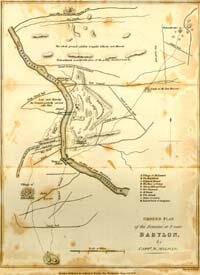
Babylon (in Arabic: بابل; in Syriac: ܒܒܙܠ in Hebrew: בבל) is the Greek variant of Akkadian Babilu (bāb-ilû, meaning "Gateway of the god", translating Sumerian Kadingirra), an ancient city in Mesopotamia (modern Al Hillah, Iraq, see also: Iraq Maps), the ruins of which can be found in present-day Babil Province, about 50 miles (80 km) south of Baghdad. It was the "holy city" of Babylonia from around 2300 BC, and the seat of the Neo-Babylonian empire from 612 BC. In the Bible, the name appears as בבל (Babel - Genesis 10:10, 11:1, 11:9).

In the Old Testament, the name appears as בבל (Babel), interpreted by Genesis 11:9 to mean "confusion", its Etymology from the verb balal, "to confuse".

The Hanging Gardens of Babylon were one of the Seven Wonders of the Ancient World.

More...

Saturday, February 20, 2010

Akkadian Empire

The Akkadian Empire was an empire centered in the city of Akkad (Sumerian: Agade Hittite KUR A.GA.DÈKI "land of Akkad"; Biblical Accad) and its surrounding region Akkadian URU Akkad KI in central Mesopotamia.

The city of Akkad was situated on the west bank of the Euphrates, between Sippar and Kish (in Iraq, about 50 km (31 mi) southwest of the center of Baghdad). Despite an extensive search, the precise site has never been found. It reached the height of its power between the 24th and 22nd centuries BC, following the conquests of king Sargon of Akkad.

Because of the policies of the Akkadian Empire toward linguistic assimilation, Akkad also gave its name to the predominant Semitic dialect: the Akkadian language, reflecting use of akkadû ("in the language of Akkad") in the Old Babylonian period to denote the Semitic version of a Sumerian text.

More...

Saturday, February 13, 2010

Tigris


The Tigris is the eastern member of the pair of great rivers that define Mesopotamia (the name "Mesopotamia" is a Greek word meaning "the land between the rivers"), along with the Euphrates, which flows from the mountains of Anatolia through Iraq.

The original Sumerian name was Idigna or Idigina, which can be interpreted as "the swift river"[4] or "the river that goes", contrasted to its neighbor, the Euphrates, whose leisurely pace caused it to deposit more silt and build up a higher bed than the Tigris. This form was borrowed and gave rise to Akkadian Idiqlat. Either through a Persian intermediary or borrowed directly from Akkadian, the word was adopted into Greek as Tigris.

In Pahlavi, tigr means "arrow" (in the same family as Old Persian tigra-, Modern Persian têz "sharp"). However, it does not appear that this was the original name of the river, but that it (like the Semitic forms of the name) was coined as an imitation of the indigenous Sumerian name. The name of the river in English and many other languages — Tigris — is from Ancient Greek, which was in turn derived from the Persian.

It is also possible that the name Tigris, and the variants in Dicle, derives from Kurdish. In Kurdish, tij means "sharp", referring to the Tigris as a sharp and fast river.

Another name for this watercourse, used from the time of the Persian Empire, is Arvand, which has the same meaning. Today, the name Arvand refers to the lower part of the Tigris (ie, Arvand/Shatt al-Arab) in Persian.

In the Hebrew bible, it is called חדקל Chiddeqel

More...

Thursday, April 16, 2009

Mesopotamia

Archaeological sites of MesopotamiaMesopotamia refers to the region now occupied by modern Iraq, eastern Syria, and southern Turkey . The name comes from the Greek words μέσος "between" and ποταμός "river", referring to the area between the Euphrates and the Tigris (the Arabic term is بين نهرين Bayn Nahrain "between two rivers"). The fertile area watered by these two rivers is known as the "Cradle of Civilization," (see also cradle of humanity) and it was here that the first literate societies developed.
10 Then the servant took ten of his master’s camels and departed, taking all sorts of choice gifts from his master; and he arose and went to Mesopotamia to the city of Nahor. 11 And he made the camels kneel down outside the city by the well of water at the time of evening, the time when women go out to draw water. 12 And he said, "O LORD, God of my master Abraham, please grant me success today and show steadfast love to my master Abraham. 13 Behold, I am standing by the spring of water, and the daughters of the men of the city are coming out to draw water. 14 Let the young woman to whom I shall say, 'Please let down your jar that I may drink,' and who shall say, 'Drink, and I will water your camels'—let her be the one whom you have appointed for your servant Isaac. By this I shall know that you have shown steadfast love to my master." Genesis 24:10-14 ESV
There has never been a political entity called Mesopotamia, nor does Mesopotamia have any definite boundaries; the name is simply a convenient one invented by Greek historians to refer to a broad geographical area.

More...

Monday, April 16, 2007

Mesopotamia

Overview map of ancient MesopotamiaMesopotamia refers to the region now occupied by modern Iraq, eastern Syria, and southern Turkey. The name comes from the Greek words μέσος "between" and ποταμός "river", referring to the area between the Euphrates and the Tigris (the Arabic term is بين نهرين Bayn Nahrain "between two rivers"). The fertile area watered by these two rivers is known as the "Cradle of Civilization," (see also cradle of humanity) and it was here that the first literate societies developed.

The biblical Patriarch Abraham was from Ur in Mesopotamia.


Acts 7:22 To this he replied: "Brothers and fathers, listen to me! The God of glory appeared to our father Abraham while he was still in Mesopotamia, before he lived in Haran.


Genesis 11:28-3128 While his father Terah was still alive, Haran died in Ur of the Chaldeans (see Chaldea), in the land of his birth. 29 Abram and Nahor both married. The name of Abram's wife was Sarai, and the name of Nahor's wife was Milcah; she was the daughter of Haran, the father of both Milcah and Iscah. 30 Now Sarai was barren; she had no children. 31 Terah took his son Abram, his grandson Lot son of Haran, and his daughter-in-law Sarai, the wife of his son Abram, and together they set out from Ur of the Chaldeans to go to Canaan. But when they came to Haran, they settled there.


More...
 

Subscribe


LifeNews.com

Desiring God Blog

Youth for Christ International