Showing posts with label Turkey. Show all posts

Saturday, August 13, 2011

Syria

Syria (Arabic: سوريا ‎or سورية ), officially the Syrian Arab Republic (Arabic: الجمهورية العربية السورية ), is a country in the Middle East, bordering Lebanon to the west, Palestine to the southwest, Jordan to the south, Iraq to the east, and Turkey to the north. The modern state of Syria attained independence from the French mandate of Syria in 1946, but can trace its historical roots to the fourth millennium BC; its capital city, Damascus, was the seat of the Umayyad Empire and a provincial capital of the Mamluk Empire.

Isaiah 17: An Oracle Concerning Damascus

Syria has a population of 19 million, of whom the majority are Arabic-speaking Sunni Muslims, as well as 16% other Muslim groups, including the Alawi, Shiite, and Druze, and 10% Christian.

Since 1963 the country has been governed by the Baath Party; the head of state since 1970 has been a member of the Assad family.

Syria's current President is Bashar al-Assad, son of Hafez al-Assad, who held office from 1970 until his death in 2000.

Historically, Syria has often been taken to include the territories of Lebanon, Israel and the Palestinian Territories, and parts of Jordan, but excluding the Jazira region in the north-east of the modern Syrian state. In this historic sense, the region is also known as Greater Syria or by the Arabic name Bilad al-Sham (بلاد الشام ). Since the Six-Day War in 1967, Israel administers the disputed Golan Heights to the southwest of the country; a dispute with Turkey over the Hatay Province has subsided.

The name Syria comes from the ancient Greek name for the former colonial territories of Assyria such as Canaan and Aram.

At the eastern end of the Mediterranean Sea between Egypt and Arabia to the south and Cilicia to the north, stretching inland to include Mesopotamia, and having an uncertain border to the northeast that Pliny the Elder describes as including from west to east Commagene, Sophene, and Adiabene, "formerly known as Assyria" (N.H. 5.66).

By Pliny's time, however, this larger Syria had been divided into a number of provinces under the Roman Empire (but politically independent from each other): Judaea (or "Judea" and later renamed Palestina in AD 135—the region corresponding to the modern states of Israel and Jordan and the Palestinian territories) in the extreme southwest, Phoenicia corresponding to Lebanon, with Damascena to the inland side of Phoenicia, Coele-Syria (or "Hollow Syria") south of the Eleutheris river, and Mesopotamia.

More...

Saturday, August 07, 2010

Mesopotamia

Archaeological sites
of Mesopotamia
Mesopotamia refers to the region now occupied by modern Iraq, eastern Syria, and southern Turkey. The name comes from the Greek words μέσος "between" and ποταμός "river", referring to the area between the Euphrates and the Tigris (the Arabic term is بين نهرين Bayn Nahrain "between two rivers"). The fertile area watered by these two rivers is known as the "Cradle of Civilization," or "cradle of humanity" and it was here that the first literate societies developed.

The biblical Patriarch Abraham was from Ur in Mesopotamia.
10 Then the servant took ten of his master’s camels and departed, taking all sorts of choice gifts from his master; and he arose and went to Mesopotamia to the city of Nahor. 11 And he made the camels kneel down outside the city by the well of water at the time of evening, the time when women go out to draw water. 12 And he said, "O LORD, God of my master Abraham, please grant me success today and show steadfast love to my master Abraham. 13 Behold, I am standing by the spring of water, and the daughters of the men of the city are coming out to draw water. 14 Let the young woman to whom I shall say, 'Please let down your jar that I may drink,' and who shall say, 'Drink, and I will water your camels'—let her be the one whom you have appointed for your servant Isaac. By this I shall know that you have shown steadfast love to my master."

15 Before he had finished speaking, behold, Rebekah, who was born to Bethuel the son of Milcah, the wife of Nahor, Abraham’s brother, came out with her water jar on her shoulder. 16 The young woman was very attractive in appearance, a maiden whom no man had known. She went down to the spring and filled her jar and came up. 17 Then the servant ran to meet her and said, "Please give me a little water to drink from your jar." 18 She said, "Drink, my lord." And she quickly let down her jar upon her hand and gave him a drink. 19 When she had finished giving him a drink, she said, "I will draw water for your camels also, until they have finished drinking." 20 So she quickly emptied her jar into the trough and ran again to the well to draw water, and she drew for all his camels. 21 The man gazed at her in silence to learn whether the LORD had prospered his journey or not. –Genesis 24:10-21 ESV
There has never been a political entity called Mesopotamia, nor does Mesopotamia have any definite boundaries; the name is simply a convenient one invented by Greek historians to refer to a broad geographical area.

History

Mesopotamia has been home to some of the world's major ancient civilizations, succeeding the major prehistoric cultures such as Ubaid and Jemdet Nasr, including the Sumerian city states, and the Akkadian, Babylonian, and Assyrian Empires.

More...

Thursday, June 24, 2010

Achaemenid Empire

The Achaemenid (uh-kee-muh-nid) Empire (Old Persian: Hakhāmanishiya) was a dynasty in the ancient Persian Empire with high cultural and economical achievements during its highest power [After Achaemenes, legendary ancestor of Cyrus II the Great, founder of the dynasty.] At the height of their power, around 500 BC, the Achaemenid rulers of Persia ruled over territories roughly encompassing today's Iran, Iraq, Armenia, Afghanistan, Turkey, Bulgaria, eastern parts of Greece, Egypt, Syria, much of what is now Pakistan, Jordan, Israel, Palestine, Lebanon, Caucasia, Central Asia, Libya, and northern parts of Arabia. The empire ruled by Persia eventually became the largest empire of the ancient world.

Darius I was the first to speak of Achaemenes, who he claimed was an ancestor of Cyrus the Great, (ca. 576 - 529 BC) and therefore the progenitor of the entire line of Achaemenid rulers. However, some scholars hold that Achaemenes was a fictional character used to legitimize Darius' rule, and that Darius the Great usurped the Persian throne.

More...

Sunday, June 06, 2010

Mount Ararat

Mount Ararat is the tallest peak in modern Turkey. This snow-capped, dormant volcanic cone is located in the Ağrı Province, near the northeast corner of Turkey, 16 km west of the Iranian and 32 km south of the Armenian borders.

During the time of Noah, this mountain was completely covered with water:
17 The flood continued forty days on the earth. The waters increased and bore up the ark, and it rose high above the earth. 18 The waters prevailed and increased greatly on the earth, and the ark floated on the face of the waters. 19 And the waters prevailed so mightily on the earth that all the high mountains under the whole heaven were covered. 20 The waters prevailed above the mountains, covering them fifteen cubits deep. (Genesis 7:17-20 ESV)
During the time of Sennacherib, was the son of Sargon II, whom he succeeded on the throne of Assyria (705 BC–681 BC), Adrammelech and Sharezer, his sons, struck him down with the sword and escaped into the land of Ararat. (cf. 2 Kings 19:36-37. The same story is mentioned in Isaiah 37:38).

More...

Thursday, February 11, 2010

Ottoman Empire

The Ottoman Empire (Ottoman Turkish: دولت عليه عثمانيه Devlet-i Âliye-i Osmâniyye; literally, "The Sublime Ottoman State"), also sometimes known in the West as the Turkish Empire, existed from 1299 to 1923. At the height of its power in the 16th and 17th centuries, its territory included Anatolia, the Middle East, parts of North Africa, and much of south-eastern Europe to the Caucasus. It comprised an area of about 5.6 million km² (though if adjoining territories where the empire's suzerainty was recognised, dominated mainly by nomadic tribes, are included it controlled a much larger area). The empire interacted with both Eastern and Western cultures throughout its 624-year history.

In the 16th and 17th centuries, the Ottoman Empire was among the world's most powerful political entities, with the powers of eastern Europe constantly threatened by its steady advance through the Balkans, the Kingdom of Hungary and the southern part of the Polish-Lithuanian Commonwealth. Its navy was also a powerful force in the Mediterranean. On several occasions, the Ottoman army invaded central Europe, laying siege to Vienna in 1529 and again in 1683 in an attempt to conquer the Habsburg domain, and was finally repulsed only by great coalitions of European powers at sea and on land. It was the only non-European power to seriously challenge the growing influence of the West between the 15th and 20th centuries, eventually becoming an integral part of European balance of power politics, hence blurring the distinctions.

The dissolution of the empire was a direct consequence of World War I, when the Allied Powers defeated the Central Powers in Europe as well as the Ottoman forces in the Middle Eastern theatre. At the end of the war, the Ottoman government collapsed and Ottoman territory was divided among the victorious powers. Subsequent years saw the creation of new states from the remnants of the Ottoman Empire, the Republic of Turkey among them. The new republic declared most of the former ruling elite, including the Ottoman Dynasty, persona non grata. In 1974, after 50 years, the Grand National Assembly of Turkey granted the right to re-acquire Turkish citizenship to the descendants of the former ruling dynasty, (Ertuğrul Osman V, head of the House of Ottoman, repatriated in 2004).

More...

Wednesday, May 21, 2008

Constantinople

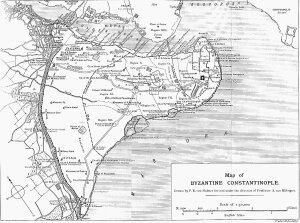
Map of ConstantinopleConstantinople was the name of the modern city of İstanbul, Turkey over the centuries that it served as the second capital of the unified Roman Empire, and after its division into East and West, of the Eastern Roman Empire, also known as the Byzantine Empire (from the city's ancient Greek name, Byzantium).

Constantinople was located strategically between the Golden Horn and the Sea of Marmara at the point where Europe met Asia, and was highly significant as the successor to ancient Rome and the largest and wealthiest city in Europe throughout the Middle Ages, known as the "Queen of Cities".

Names

The city had many names throughout history. Depending on the background of people, and their language and ethnicity, it often had several different names at any given time; among the most common were Byzantium, New Rome, Constantinople and Stamboul were some.

The name of Constantinople is an honorific eponym referencing its founder, the Roman emperor Constantine the Great.

More...

Saturday, March 29, 2008

The Middle East

Political & transportation map of the Middle East today. Turkey, Syria, Lebanon, Israel, Iraq, Iran, Jordan, Egypt, Saudi Arabia. Oman, Yeman, Ethiopia and SudanThe Middle East is a historical and political region of Africa-Eurasia with no clear definition. The term "Middle East" was popularized around 1900 by the British, and has been criticized for its loose definition. The Middle East traditionally includes countries or regions in Southwest Asia and parts of North Africa. The corresponding adjective to Middle East is Middle-Eastern and the derived noun is Middle-Easterner.

Etymology

The term "Middle East" may have originated in the 1850s in the British India Office, and became more widely known when American naval strategist Alfred Thayer Mahan used the term.

The history of the Middle East dates back to ancient times, and throughout its history the Middle East has been a major center of world affairs. The Middle East is also the geographic origin of the the Abrahamic religions - Christianity, Islam, Judaism - comprising approximately one half of the world's religions. The Middle East generally has an arid and hot climate, with several major rivers providing for irrigation to support agriculture in limited areas. Many countries located around the Persian Gulf have large quantities of crude oil. In modern times, the Middle East remains a strategically, economically, politically, culturally, and religiously sensitive region.

More...


Subscribe


LifeNews.com

Desiring God Blog

Youth for Christ International