Showing posts with label Promised Land. Show all posts

Thursday, May 06, 2010

Promised Land

According to the Bible, the Land of Israel (Hebrew: Eretz Yisrael) was promised to the descendants of Hebrew patriarchs Abraham, Isaac, and Jacob by God, making it the Promised land. The concept is frequently used symbolically by Christians, especially in hymnody as a reference to Heaven, or to a new land, such as North America colonized by the Pilgrims. In the Bible, particularly in Genesis, Deuteronomy and Joshua, the Land of Israel was promised as an everlasting possession.

Abraham
'On that day, God made a covenant with Abram, saying: "To your descendants I have given this land, from the river of Egypt as far as the great river the Euphrates. The land of the Kenites, Kenizites, Kadmonites; the Chitties, Perizites, Refaim; the Emorites, Canaanites, Gigashites and Yevusites." ' (Genesis 15:18-21)

More...

Friday, May 22, 2009

Promised Land

The Kingdom of David and Solomon. Solomon ruled over all the kingdoms west of the Euphrates River from Tiphsah to Gaza; he was at peace with all his neighbors (I Kings, 4:24)According to the Bible, the Land of Israel (Hebrew: Eretz Yisrael) was promised to the descendants of Hebrew patriarchs Abraham, Isaac, and Jacob by God, making it the Promised land. The concept is frequently used symbolically by Christians, especially in hymnody as a reference to Heaven, or to a new land, such as North America colonized by the Pilgrims. In the Bible, particularly in Genesis, Deuteronomy and Joshua, the Land of Israel was promised as an everlasting possession.

Abraham
'On that day, God made a covenant with Abram, saying: "To your descendants I have given this land, from the river of Egypt as far as the great river the Euphrates. The land of the Kenites, Kenizites, Kadmonites; the Chitties, Perizites, Refaim; the Emorites, Canaanites, Gigashites and Yevusites." '
(Genesis 15:18-21)
More...

Friday, August 31, 2007

Mount Hermon

Mount Hermon, viewed from Mount Bental Mount Hermon (33°24′N 35°51′E; Hebrew: הר חרמון, Har Hermon; Arabic: جبل الشيخ‎, Jabal el-Shaiykh, Djabl a-Shekh, "mountain of the chief" and "snowy mountain") is a mountain in the Anti-Lebanon mountain range. Its highest point is 2,814 m (9,230 feet) above sea level, and is on the border between Syria and Lebanon.

Though the summit remained under Syrian control, the southern and western slopes of Mount Hermon came under the control of Israel as part of the Golan Heights as a result of the Israeli victory in the 1967 Six-Day War, and were unilaterally annexed by Israel in 1980. the nation" in Israel because its altitude makes it Israel's primary strategic early warning system.


Biblical History

Mount Hermon was called Senir by the Amorites and Sirion by the Sidonians (Deuteronomy 3:9; Psalms 29:6; 1 Chronicles 5:23; Song of Solomon 4:8; Ezekiel 27:5). The mountain served as the northern boundary of the Promised Land (Deuteronomy 3:8) and also was the northern limit of the Conquest (Joshua 11:17; 12:1; 13:5).
More...

Tuesday, August 28, 2007

Mount Nebo

The Dead Sea is viewable in the distance from atop Mount Nebo. The promised land is just beyond the Jordan River and the Dead SeaMount Nebo (Arabic: جبل نيبو; transliterated: Jabal Nībū) is an elevated ridge that is approximately 817 metres (2680 feet) above sea level, in what is now western Jordan. The view from the summit provides a panorama of the Holy Land, and to the north, a more limited one of the valley of the River Jordan. The West Bank city of Jericho is usually visible from the summit, as is Jerusalem on a very clear day.

Judaism and Christianity
According to the final chapter of Deuteronomy, Mount Nebo is where the Hebrew prophet Moses was given a view of the promised land that God was giving to the Hebrews.

More...

Wednesday, June 27, 2007

Jacob's Ladder

The angels climb Jacob‘s Ladder on the west front of Bath AbbeyJacob's Ladder refers to a ladder to heaven described in the Genesis 28:11-19 which the biblical patriarch Jacob envisioned during his flight from his brother Esau:

10 Jacob left Beersheba and set out for Haran. 11 When he reached a certain place, he stopped for the night because the sun had set. Taking one of the stones there, he put it under his head and lay down to sleep. 12 He had a dream in which he saw a stairway resting on the earth, with its top reaching to heaven, and the angels of God were ascending and descending on it. 13 There above it stood the LORD, and he said: "I am the LORD, the God of your father Abraham and the God of Isaac. I will give you and your descendants the land on which you are lying. 14 Your descendants will be like the dust of the earth, and you will spread out to the west and to the east, to the north and to the south. All peoples on earth will be blessed through you and your offspring. 15 I am with you and will watch over you wherever you go, and I will bring you back to this land. I will not leave you until I have done what I have promised you."

16 When Jacob awoke from his sleep, he thought, "Surely the LORD is in this place, and I was not aware of it." 17 He was afraid and said, "How awesome is this place! This is none other than the house of God; this is the gate of heaven."

18 Early the next morning Jacob took the stone he had placed under his head and set it up as a pillar and poured oil on top of it. 19 He called that place Bethel, though the city used to be called Luz.

20 Then Jacob made a vow, saying, "If God will be with me and will watch over me on this journey I am taking and will give me food to eat and clothes to wear 21 so that I return safely to my father's house, then the LORD will be my God 22 and this stone that I have set up as a pillar will be God's house, and of all that you give me I will give you a tenth." (Gen. 28: 10-22)

More...

Saturday, May 19, 2007

Israel

Map of IsraelThe name "Israel" is rooted in the Hebrew bible, the Tanakh, where Jacob is renamed Israel after wrestling with a mysterious adversary ("a man", and later "God" according to Gen. 32:24-30; or "the angel", according to Hosea 12:4). Israel means "he who has wrestled with God." The Jews, the nation fathered by Jacob, were then called "the children of Israel" or the "Israelites."

History
The earliest known mention of the name 'Israel', probably referring to a group of people rather than to a place, is the Egyptian Merneptah Stele dated to about 1210 BCE. For over 3,000 years, Jews have held the Land of Israel to be their homeland, both as a Holy Land and as a Promised Land. The Land of Israel holds a special place in Jewish religious obligations, encompassing Judaism's most important sites — including the remains of the First and Second Temples (see temple), as well as the rites concerning those temples. Starting around 1200 BCE, a series of Jewish kingdoms and states existed intermittently in the region for over a millennium.


Under Babylonian, Persians, Greek, Roman, Byzantine, and (briefly) Sassanian rule, Jewish presence in the province dwindled due to mass expulsions.


In particular, the failure of the Bar Kochba Revolt against The Roman Empire resulted in the large-scale expulsion of Jews.


More...

Tuesday, May 15, 2007

Promised Land

The Kingdom of David and Solomon. Solomon ruled over all the kingdoms west of the Euphrates River from Tiphsah to Gaza; he was at peace with all his neighbors (I Kings, 4:24)According to the Bible, the Land of Israel (Hebrew: Eretz Yisrael) was promised to the descendants of Hebrew patriarchs Abraham, Isaac, and Jacob by God, making it the Promised land. The concept is frequently used symbolically by Christians, especially in hymnody as a reference to Heaven, or to a new land, such as North America colonized by the Pilgrims. In the Bible, particularly in Genesis, Deuteronomy and Joshua, the Land of Israel was promised as an everlasting possession.

Abraham
'On that day, God made a covenant with Abram, saying: "To your descendants I have given this land, from the river of Egypt as far as the great river the Euphrates. The land of the Kenites, Kenizites, Kadmonites; the Chitties, Perizites, Refaim; the Emorites, Canaanites, Gigashites and Yevusites." ' (Genesis 15:18-21)

Isaac
"To you and your descendants I give this land." (Genesis 26:3)

Jacob
"The ground upon which you are lying I give to you and your descendants." (Genesis 28:13)

Moses
"I made a pact with them to give them the land of Canaan.” (Exodus 6:4)
'Now Moses went up from the plains of Moab to Mount Nebo, to the top of Pisgah, which is opposite Jericho. And the LORD showed him all the land, Gilead as far as Dan, and all Naphtali and the land of Ephraim and Manasseh, and all the land of Judah as far as the western sea [Mediterranean Sea], and the Negev and the plain in the valley of Jericho, the city of palm trees, as far as Zoar. Then the LORD said to him, "This is the land which I swore to Abraham, Isaac, and Jacob, saying, 'I will give it to your descendants'; I have let you see {it} with your eyes, but you shall not go over there." '(Deuteronomy 34:1-4)

More...

Monday, April 16, 2007

Euphrates

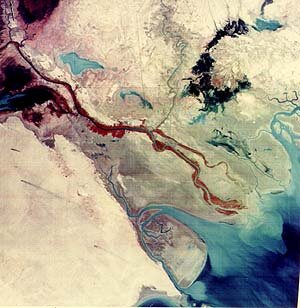
Tigris and Euphrates Rivers empties through a delta into the Persian Gulf in southeastern IraqThe Euphrates (the traditional Greek name, Arabic: الفرات; Al-Furat, Hebrew: פְּרָת) is the westernmost of the two great rivers that define Mesopotamia (the other being the Tigris).

Etymology
The name Euphrates may have originated from Old Persian Ufratu, as it were from Avestan *hu-perethuua, meaning "good to cross over" (from hu-, meaning "good", and peretu, meaning "ford"). Alternatively, some suggest that the name Euphrates is possibly of Kurdish origin.

Euphrates in the Bible
The river Euphrates is one of the four rivers that flow from the Garden of Eden according to Genesis 2:13-15. It is the fourth river, after the Pishon, the Gihon, and the Tigris, to form from the river flowing out of the garden. The river also marked one of the boundaries of the land promised by God to Abraham and his descendants. In the Hebrew Bible, it is often referred to simply as "The River" (ha-nahar).

The word Euphrates is a translation for the word "Gush forth" or "break forth". It has always been assumed to mean "river" but this is not explicitly stated. It literally means "breaking forth of liquid". The river Euphrates was named from this root word, "To gush forth".
In the Book of Revelation, it is prophesied that in the "near future the Potamos Euphrates or "breaking forth like water" of the middle east will dry up in preparation for the Battle of Armageddon.

More...

Saturday, April 14, 2007

covenant

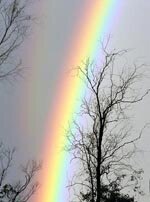
Rainbow by bluemist57, Adelaide, Australia Covenant, meaning a solemn contract, is the customary word used to translate the Hebrew word berith (ברית) as it is used in the Hebrew Bible

God's promise to Israel in both the Old Testament and the New Testament that He would redeem the nation of Israel, give Israel the land of Zion, and "appear in his glory" and "come out of Zion" when "all Israel shall be saved" (cf. Psalm 102:15-18, Romans 11:25-27).
While the word is used to identify treaties or similar contracts between rulers or individuals, the primary covenants mentioned in the Bible are the one between God and the Israelites (Old Testament) and the one between God and the Christian Church (New Testament).

This covenant was the basis for the Torah, and the claimed status of the Israelites as God's "chosen people." According to the terms of the covenant, Israelites understand that God had promised to undertake certain things on behalf of the people of Israel, and that the Israelites owed God obedience and worship in return.


More...

Friday, November 24, 2006

Covenant

Rainbow by bluemist57, Adelaide, AustraliaCovenant, meaning a solemn contract, is the customary word used to translate the Hebrew word berith (ברית) as it is used in the Hebrew Bible.

God's promise to Israel in both the Old Testament and the New Testament that He would redeem the nation of Israel, give Israel the land of Zion, and "appear in his glory" and "come out of Zion" when "all Israel shall be saved" (cf. Psalm
102:15-18, Romans 11:25-27).


While the word is used to identify treaties or similar contracts between rulers or individuals, the primary covenants mentioned in the Bible are the one between God and the Israelites (Old Testament) and the one between God and the Christian Church (New Testament).

This covenant was the basis for the Torah, and the claimed status of the Israelites as God's "chosen people." According to the terms of the covenant, Israelites understand that God had promised to undertake certain things on behalf of the people of Israel, and that the Israelites owed God obedience and worship in return.

More...

Saturday, September 30, 2006

covenant

Rainbow by bluemist57, Adelaide, Australia
Covenant, meaning a solemn contract, is the customary word used to translate the Hebrew word berith (ברית) as it is used in the Hebrew Bible


God's promise to Israel in both the Old Testament and the New Testament that He would redeem the nation of Israel, give Israel the land of Zion, and "appear in his glory" and "come out of Zion" when "all Israel shall be saved" (cf. Psalm 102:15-18, Romans 11:25-27).

While the word is used to identify treaties or similar contracts between rulers or individuals, the primary covenants mentioned in the Bible are the one between God and the Israelites (Old Testament) and the one between God and the Christian Church (New Testament). This covenant was the basis for the Torah, and the claimed status of the Israelites as God's "chosen people." According to the terms of the covenant, Israelites understand that God had promised to undertake certain things on behalf of the people of Israel, and that the Israelites owed God obedience and worship in return.

More...


Monday, September 18, 2006

The Holy Land

Valley of the Dead Sea, a desertic area that was the main scenary of the Biblical revelations.The expression "The Holy Land" (Hebrew ארץ הקודש) generally refers to the Land of Israel, otherwise known as the region of Palestine (sometimes including parts of Jordan, Syria and Egypt). It concerns the areas that hold significant religious importance to any or all three monotheistic Abrahamic religions: Judaism, Christianity and Islam.

The Holy Land is the territory where the Biblical stories took place, those described by the Tanakh or those by the New Testament. The concept had its evolution in the same Scriptures. For some Biblical authors the territory was marked by the concept of Promised Land, but for others it refers to those events in any place related to the People of Israel.

More...

Tuesday, September 05, 2006

Mount Nebo

The Dead Sea is viewable in the distance from atop Mount Nebo. The promised land is just beyond the Jordan River and the Dead SeaMount Nebo (Arabic: جبل نيبو) is an elevated ridge that is approximately 817 metres (2680 feet) above sea level, in what is now western Jordan. The view from the summit provides a panorama of the Holy Land, and to the north, a more limited one of the valley of the River Jordan. The West Bank city of Jericho is usually visible from the summit, as is Jerusalem on a very clear day.

Judaism and Christianity
According to the final chapter of Deuteronomy, Mount Nebo is where the Hebrew prophet Moses was given a view of the promised land that God was giving to the Hebrews.

More...
 

Subscribe


LifeNews.com

Desiring God Blog

Youth for Christ International