Showing posts with label history of ancient Israel. Show all posts

Sunday, August 14, 2011

History of Ancient Israel


The Merneptah Stele
The history of Ancient Israel and Judah is known to us from classical sources including Judaism's Tanakh or Hebrew Bible (known to Christianity as the Old Testament), the Talmud, the Ethiopian Kebra Nagast, the writings of Nicolaus of Damascus, Artapanas, Philo of Alexandria and Flavius Josephus supplemented by ancient sources uncovered by biblical archaeology including Egyptian, Moabite, Assyrian, Babylonian as well as Israelite and Judean inscriptions.

It was also subject to domination by adjacent empires, beginning with Egypt in the late 3rd millennium BCE.

Traditions regarding the early history found in later works such as the Kebra Nagast and commentaries of Rashi, Philo of Alexandria, and numerous others, (besides of course, the Tanakh) refer to the early inhabitants as the sons of Shem and also speak of an invasion by the people known as Canaanites (see also Canaan) descended from Ham.

The Book of Jubilees states that the land was originally allotted to Shem and Arphaxad (ancestor of the Hebrews) when it was still vacant, but was wrongfully occupied by Canaan and his son Sidon. Jubilees makes this, then, the true justification for the later war to drive out the Canaanites.

The Kebra Nagast, however, speaks of the Canaanites (see Canaan) invading existing cities of Shem and Ibn Ezra, similarly notes that they had seized land from earlier inhabitants. Rashi mentions that the Canaanites were seizing land from the sons of Shem in the days of Abraham.

True History of the Founding of Israel
As pointed out in a May, 2011 article by Palestinian Media Watch, the common incantation that Zionists stole Palestinian land is a false claim.

Abstract:

"The Zionist gangs stole Palestine ... and established the state of Israel" - this quote, from an official PA 12th Grade schoolbook, is an accurate depiction of how the PA educates its population to view the establishment of the State of Israel. Presenting the creation of the state as an act of theft and its continued existence as a historical injustice serves as the basis for the PA's non-recognition of Israel's right to exist. In order to create an ideological basis for this, the PA denies there was an ancient Jewish history in the Land of Israel and also distorts modern history, presenting Zionism as a demonic Nazi-like phenomenon. In order to explain what made Jews come to Israel, since they claim there was no historical connection to draw them, Zionism is presented as a colonialist movement created by the West to further its interests.

First, the countries of Europe wanted to rid themselves of the Jews and needed a place for them. They also wanted a foreign body in the heart of the Arab world to serve Europe's colonialist aims. For these reasons, they sent the Jews to "steal Palestine." Israel is further demonized through images and descriptions, such as "the foster child of the Nazis," "an organized terror state," "the cruelest enemy," etc. Accordingly, the idea of the State of Israel ceasing to exist is presented as the achievement of justice.

Today, following the establishment of a Fatah and Hamas unity government, many countries are demanding that Hamas recognize Israel's right to exist as a condition for the world's recognition of their new government. Ironically, this very condition is violated daily by the Palestinian Authority under Mahmoud Abbas.

The report:

1. "The Zionist gangs stole Palestine"
2. Not recognizing Israel's right to exist
3. Establishment of the State of Israel presented as "colonialist" plan
4. Demonic images and descriptions of the State of Israel
5. Justice will be achieved when Israel ceases to exist

The Rest of the Report

Daniel Pipes also answers the veracity of the "Zionists stole Palestinian land" claim in his article, "Not Stealing Palestine but Purchasing Israel," saying:

"No, it is not. Ironically, the building of Israel represents about the most peaceable in-migration and state creation in history. To understand why requires seeing Zionism in context. Simply put, conquest is the historic norm; governments everywhere were established through invasion, nearly all states came into being at someone else's expense. No one is permanently in charge, everyone's roots trace back to somewhere else.

Germanic tribes, Central Asian hordes, Russian tsars, and Spanish and Portuguese conquistadors remade the map. Modern Greeks have only a tenuous connection to the Greeks of antiquity. Who can count the number of times Belgium was overrun? The United States came into existence by defeating Native Americans. Kings marauded in Africa, Aryans invaded India. In Japan, Yamato-speakers eliminated all but tiny groups such as the Ainu.

The Middle East, due to its centrality and geography, has experienced more than its share of invasions, including the Greek, Roman, Arabian, Crusader, Seljuk, Timurid, Mongolian, and modern European. Within the region, dynastic froth caused the same territory – Egypt for example – to be conquered and re-conquered.

More...

Sunday, May 31, 2009

history of Ancient Israel

1759 map of the tribal allotments of IsraelThe history of Ancient Israel and Judah is known to us from classical sources including Judaism's Tanakh or Hebrew Bible (known to Christianity as the Old Testament), the Talmud, the Ethiopian Kebra Nagast, the writings of Nicolaus of Damascus, Artapanas, Philo of Alexandria and Flavius Josephus supplemented by ancient sources uncovered by biblical archaeology including Egyptian, Moabite, Assyrian, Babylonian as well as Israelite and Judean inscriptions.

It was also subject to domination by adjacent empires, beginning with Egypt in the late 3rd millennium BCE.

Traditions regarding the early history found in later works such as the Kebra Nagast and commentaries of Rashi, Philo of Alexandria, and numerous others, (besides of course, the Tanakh) refer to the early inhabitants as the sons of Shem and also speak of an invasion by the people known as Canaanites (see Canaan) descended from Ham.

More...

Thursday, April 03, 2008

history of Ancient Israel

1759 map of the tribal allotments of IsraelThe history of Ancient Israel and Judah is known to us from classical sources including Judaism's Tanakh or Hebrew Bible (known to Christianity as the Old Testament), the Talmud, the Ethiopian Kebra Nagast, the writings of Nicolaus of Damascus, Artapanas, Philo of Alexandria and Flavius Josephus supplemented by ancient sources uncovered by biblical archaeology including Egyptian, Moabite, Assyrian, Babylonian as well as Israelite and Judean inscriptions.

It was also subject to domination by adjacent empires, beginning with Egypt in the late 3rd millennium BCE.

In his book What did the Biblical Writers Know and When did they know it? William Dever suggests that rather than there being just one history there are in fact multiple histories and that we can distinguish nine types of history of Israel and Judah as follows.

  1. Theological history – the relationship between the God(s) and their believers.
  2. Political history – usually the account of “Great Men”, is generally episodic, chauvinistic and propagandist
  3. Narrative history – a running chronology of events, purporting to be factual but always very highly selective
  4. Socio-cultural history – a history of institutions, including their social underpinnings in family, clan, tribe and social class and the state
  5. Intellectual history – the literary history of ideas and their development, context and evolution as expressed through texts and documents
  6. Cultural history – is based upon a larger context of overall cultural evolution, demography, socio-economic and political structure and ethnicit
  7. Technological history – a history of the techniques by which humans adapt to, exploit and make use of the resources of their environment
  8. Natural history – is a geographic history of how humans discover and adapt to the ecological understandings of their natural environment
  9. Material history – as shown in the study of artifacts as correlates of human changes in behaviour.


More...

Friday, December 14, 2007

Kingdom of Judah

Map of the southern Levant, c.830s BCE.The Kingdom of Judah (Hebrew מַלְכוּת יְהוּדָה) in the times of the Hebrew Bible, was the nation formed from the territories of the tribes of Judah, Simeon, and Benjamin after the Kingdom of Israel was divided, and was named after Judah, son of Jacob (Israel, see sons of Jacob). The name Judah itself means "Praise of God." (see: Kings of Judah).

Judah is often referred to as the Southern Kingdom to distinguish it from the Northern Kingdom (being the Kingdom of Israel) after the division of the Kingdom. Its capital was Jerusalem. See History of ancient Israel.

When the disruption took place at Shechem, at first only the tribe of Judah followed the house of David. But very soon after the tribe of Benjamin joined the tribe of Judah, and Jerusalem became the capital of the new kingdom (Joshua 18:28), which was called the kingdom of Judah.

For the first sixty years the kings of Judah aimed at re-establishing their authority over the kingdom of the other ten tribes, so that there was a state of perpetual war between them. For the following eighty years there was no open war between them. For the most part they were in friendly alliance, co-operating against their common enemies, especially against Damascus. After the destrution of Israel, Judah continued to exist for about a century and a half until its final overthrow in (586 BC) by Nebuzar-adan, who was captain of Nebuchadnezzar's body-guard (2 Kings 25:8-21), an event which also saw the destruction of the First Temple.

More...

Monday, July 09, 2007

Jericho

The Taking of Jericho, by Jean Fouquet Jericho (Arabic أريحا , Hebrew יְרִיחוֹ ) - Holy echo is a town in the West Bank, Palestine near the Jordan River. Jericho has a population of approximately 19,000. It is believed by some to be the oldest continuously occupied settlement in the world. The current mayor of Jericho is Hassan Saleh.

Recent history
The present city was captured by Israel after the Six-Day War in 1967. It was the first city handed over to Palestinian Authority control in 1994, in accordance with the Oslo accords. After a period of Israeli readministration, it was returned to the Palestinian Authority on 16 March 2005.

Jericho prison incident
On March 14, 2006, the Israel Defense Forces took captive six inmates from a Jericho prison following a 10-hour siege. The IDF said the reason for taking the prisoners, who were wanted for participation in the assassination of Israeli tourism minister Rehavam Zeevi, was to keep them from being released. Both sides of the siege were armed and at least two people were killed and 35 wounded in the incident.

Synagogue
An ancient synagogue was discovered in Jericho in 1936. It has been controlled by Israel since the Six Day War, but after the Oslo Accords and especially the Al Aqsa Intifada it has been a source of conflict.

More...

Saturday, June 09, 2007

timeline of Christianity

A folio from P46, early 3rd c. New Testament manuscript useful in discerning the early Christian canon
The purpose of this chronology is to give a detailed account of Christianity from the beginning of the current era to the present. Question marks on dates indicate approximate dates. For "Old Testament" chronology, see History of ancient Israel.

Era of Jesus
The year one is the first year in the Christian calendar (there is no year zero), which is the calendar presently used (in unison with the Gregorian calendar) almost everywhere in the world, because of the current dominance of the Western world. Traditionally, this was held to be the year Jesus was born, however most modern scholars argue for an earlier date and later dates, the most agreed upon being between 6 B.C. and 4 B.C.

More...

Tuesday, March 06, 2007

history of ancient Israel

Map of the southern Levant, c.830 BCE.Early History The Semitic culture followed on from the Ghassulians. People became urbanized and lived in city-states, one of which was Jericho. The area's location at the center of routes linking three continents made it the meeting place for religious and cultural influences from Egypt, Syria, Mesopotamia, and Asia Minor.

It was also the natural battleground for the great powers of the region.

It was also subject to domination by adjacent empires, beginning with Egypt in the late 3rd millennium BCE. Traditions regarding the early history found in later works such as the Kebra Nagast and commentaries of Rashi, Philo of Alexandria, and numerous others, (besides of course, the Tanakh) refer to the early inhabitants as the sons of Shem and also speak of an invasion by the people known as Canaanites (see Canaan) descended from Ham.

More...

Saturday, March 03, 2007

Joshua

Moses names Joshua his successorJoshua or Yehoshúa (יְהוֹשֻׁעַ "The LORD of/is help/court") is a Biblical character, much of whose life is described in the Book of Joshua. The lack of a vav after the shin would normally indicate a pronunciation of Yehoshēa`, and in three places he is actually called Hoshēa. In Greek he is called Ιησούς (Iēsoûs) του Ναυή, the same as the name of Jesus of Nazareth and others bearing the Hebrew name Yēshua`. He is a historical figure, and would have lived sometime between the 18th century BC and the late 13th century BC.

Joshua was the son of Nun, of the tribe of Ephraim and the successor to Moses as the leader of Israel. See also History of ancient Israel and Judah. He is called Jehoshua in Num. 13:16 (A.V.), and Jesus in Acts 7:45 and Heb. 4:8 (R.V., Joshua).


He was born in Egypt, and was probably of the age of Caleb, with whom he is generally associated. He shared in all the events of the Exodus, and held the place of commander of the host of the Israelites at their great battle against the Amalekites in Rephidim (Ex. 17:8-16).


He became Moses' minister, and accompanied him part of the way when he ascended Mount Sinai to receive the (Exodus 32:17). He was also one of the twelve spies who were sent on by Moses to explore the land of Canaan (Num. 13:16, 17), and only he and Caleb gave an encouraging report.


More...

Monday, January 08, 2007

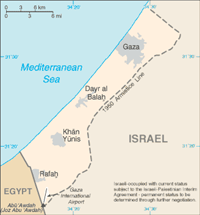
Gaza


Gaza is the largest city within the Gaza Strip, part of the Palestinian Territories. The city, which has a population of approximately 400,000, is frequently termed "Gaza City" in order to distinguish it from the larger Gaza Strip.
History
40 So Joshua subdued the whole region, including the hill country, the Negev, the western foothills and the mountain slopes, together with all their kings. He left no survivors. He totally destroyed all who breathed, just as the LORD, the God of Israel, had commanded. 41 Joshua subdued them from Kadesh Barnea to Gaza and from the whole region of Goshen to Gibeon. 42 All these kings and their lands Joshua conquered in one campaign, because the LORD, the God of Israel, fought for Israel. -Joshua 10:40-42


Strategically located on the Mediterranean coastal route, ancient Gaza was a prosperous trade center and a stop on the caravan route between Egypt and Syria. The city was occupied by Egypt around the 15th century BCE.


More...


Wednesday, December 20, 2006

Tyre

Map of Lebanon from the CIA Factbook. Tyre is near the <br />southern border

Tyre (Hebrew צור Tzor, Greek Τύρος Týros) is a city in the South Governorate of Lebanon. With 117,100 inhabitants (it is reported only 10% of the population is left because of the Israel-Lebanon conflict), Tyre juts out from the coast of the Mediterranean Sea, about 23 miles north of Acre, and 20 miles south of Sidon. The name of the city means "rock".

Tyre is an ancient Phoenician city. Today it is the fourth largest city in Lebanon and houses one of the nation's major ports. Tyre is a popular destination for tourists.

The city has many ancient sites, including its Roman Hippodrome which was reportedly used for the film Ben-Hur, and was added to UNESCO's World Heritage list in 1979 (Resolution 459).

History
Tyre is near the southern border."The location of the city of Tyre is not in doubt, for it exists to this day on the same spot and is known as Sur." (Katzenstein, H.J., The History of Tyre, 1973, p9) Tyre originally consisted of two distinct urban centers, one on an island and the other on the adjacent coast (approximately 30 stadia apart or 3.5 miles according to Strabo in his Geography xvi, 2), before Alexander the Great connected the island to the coast during his siege of the city. One was a heavily fortified island city amidst the sea and the latter, originally called Ushu (later, Palaetyrus, by the Greeks) was actually more like a line of suburbs than any one city and was used primarily as a source of water and timber for the main island city. Flavius Josephus even records them fighting against each other, although most of the time they supported one another due to the island city’s wealth from maritime trade and the mainland area’s source of timber, water and burial grounds.

More...

Tuesday, December 19, 2006

Jewish history

1759 map of the tribal allotments of IsraelJewish history is the history of the Jewish people, faith (Judaism) and culture. Since Jewish history encompasses nearly six thousand years and hundreds of different populations, any treatment can only be provided in broad strokes. Additional information can be found in the main articles listed below, and in the specific country histories listed in this article.

Ancient Jewish History (through 150 CE)
Ancient Israelites

For the first two periods the history of the Jews is mainly that of the Fertile Crescent. It begins among those peoples which occupied the area lying between the Nile river on the one side and the Tigris and the Euphrates rivers on the other. Surrounded by ancient seats of culture in Egypt and Babylonia, by the deserts of Arabia, and by the highlands of Asia Minor, the land of Canaan (later known as Israel, then at various times Judah, Coele-Syria, Judea, Palestine, the Levant, and finally Israel again) was a meeting place of civilizations. The land was traversed by old-established trade routes and possessed important harbors on the Gulf of Akaba and on the Mediterranean coast, the latter exposing it to the influence of other cultures of the Fertile Crescent.

More...

Tuesday, October 10, 2006

history of Ancient Israel

A stone (2.43x1 m) with Hebrew inscription “To the Trumpeting Place“ excavated by B. Mazar at the southern foot of the Temple Mount is believed to be a part of the Second Temple.The Semitic culture followed on from the Ghassulians. People became urbanized and lived in city-states, one of which was Jericho. The area's location at the center of routes linking three continents made it the meeting place for religious and cultural influences from Egypt, Syria, Mesopotamia, and Asia Minor.

It was also the natural battleground for the great powers of the region. It was also subject to domination by adjacent empires, beginning with Egypt in the late 3rd millennium BCE.

More...

Thursday, August 24, 2006

history of Ancient Israel

1759 map of the tribal allotments of Israel  Early History
The Semitic culture followed on from the Ghassulians. People became urbanized and lived in city-states, one of which was Jericho. The area's location at the center of routes linking three continents made it the meeting place for religious and cultural influences from Egypt, Syria, Mesopotamia, and Asia Minor. It was also the natural battleground for the great powers of the region. It was also subject to domination by adjacent empires, beginning with Egypt in the late 3rd millennium BCE.

Traditions regarding the early history found in later works such as the Kebra Nagast and commentaries of Rashi, Philo, and numerous others, (besides of course, the Tanakh) refer to the early inhabitants as the sons of Shem and also speak of an invasion by the people known as Canaanites descended from Ham.

More...

Friday, July 14, 2006

History of Ancient Israel

The Wailing WallThe Semitic culture followed on from the Ghassulians. People became urbanized and lived in city-states, one of which was Jericho. The area's location at the center of routes linking three continents made it the meeting place for religious and cultural influences from Egypt, Syria, Mesopotamia, and Asia Minor. It was also the natural battleground for the great powers of the region and subject to domination by adjacent empires, beginning with Egypt in the late 3rd millennium BCE.

Traditions regarding the early history found in later works such as the Kebra Nagast and commentaries of Rashi, Philo, and numerous others, (besides of course, the Tanakh) refer to the early inhabitants as the sons of Shem and also speak of an invasion by the people known as Canaanites (see Canaan) descended from Ham.

More...
 

Subscribe


LifeNews.com

Desiring God Blog

Youth for Christ International