Showing posts with label Christmas. Show all posts

Saturday, December 24, 2011

Christmas

Triptych with the
Adoration of the Magi
"O Holy Night"
By David Phelps
Christmas (literally, the Mass of Christ) is a traditional holiday commonly observed on 25 December. In most Eastern Orthodox Churches, even where the civil calendar used is the Gregorian, the event is observed according to the Julian calendar, which coincides with the predominant reckoning of 7 January. It is celebrated by most Christians to mark the birth of Jesus, which is believed to have occurred in Bethlehem in the Roman Province of Judea between 6 BC and AD 6. Christ's birth, or nativity, was said by his followers to fulfill the prophecies of Judaism that a messiah would come, from the house of David, to redeem the world from sin. Efforts to decide upon a date on which to celebrate his birth began some centuries later.
The word Christmas is a contraction of Christ's Mass, derived from the Old English Cristes Maesse, the Mass of Christ, first found in 1038, and Cristes-messe, in 1131. In Dutch it is Kerstmis, in Latin Dies Natalis, whence comes the French Noël, and Italian Il natale; in German Weihnachtsfest.

It is sometimes abbreviated Xmas, probably because X resembles the Greek letter Χ (chi) which has often historically been used as an abbreviation for Christ (Χριστός Christos in Greek).

The Nativity of Jesus refers to the Christian belief that the Messiah was born to the Virgin Mary. The story of Christmas is based on the biblical accounts given in the Gospel of Matthew, namely Matthew 1:18-2:12 and the Gospel of Luke, specifically Luke 1:26-2:40. According to these accounts, Jesus was born to Mary, assisted by her husband Joseph, in the city of Bethlehem. According to popular tradition, the birth took place in a "stable", surrounded by farm animals, though neither the “stable” nor the animals are mentioned in the Biblical accounts. However, a "manger" is mentioned in Luke 2:7 where it states "She wrapped him in cloths and placed him in a manger, because there was no room for them in the inn." Shepherds from the fields surrounding Bethlehem were told of the birth by an angel, and were the first to see the child. Christians believe that the birth of Jesus fulfilled many prophecies made hundreds of years before His birth.
More...


Sunday, December 18, 2011

Jesus of Nazareth

Flagellation of Christ,
Artist: CARAVAGGIO,
Date: c. 1607
Born in Bethlehem and active in Nazareth; His life and sermons form the basis for Christianity (circa 4 bc - ad 29).
The Gospels were all composed during the latter part of the first century, and there is distinct historical evidence to show that they were used and accepted as authentic before the end of the second century.

The principal sources of information regarding Jesus' life and teachings are the four canonical gospels though some scholars argue that other texts (such as the Gospel of Thomas) are as relevant as the canonical gospels to the historical Jesus. Most critical scholars in the fields of history and biblical studies believe that ancient texts on Jesus' life are at least partially accurate, agreeing that Jesus was a Galilean Jew who was regarded as a teacher and healer. They also generally accept that he was baptized by John the Baptist, and was crucified in Jerusalem on orders of the Roman Prefect of Judaea Pontius Pilate, on the charge of sedition against the Roman Empire.


Jesus De Nazareth
Edmar Castaneda Live At Jazz Standard

Christian views of Jesus (see also Christology) center on the belief that Jesus is divine, is the Messiah whose coming was prophesied in the Old Testament (e.g. Deut. 18:15;Judges 13:5;Amos 2:11;Lam. 4:7;Isaiah:53;Isaiah 7:14, etc.), and that he was resurrected after his crucifixion. Christians predominantly believe that Jesus is the "Son of God" (generally meaning that he is the son of God, the second person in the Trinity), who came to provide salvation and reconciliation with God by his death for their sins.

Other Christian beliefs include Jesus' virgin birth, performance of miracles, ascension into Heaven, and future Second Coming. While the doctrine of the Trinity is widely accepted by Christians, a small minority instead hold various nontrinitarian beliefs concerning the divinity of Jesus.

More...

Thursday, December 25, 2008

Christmas

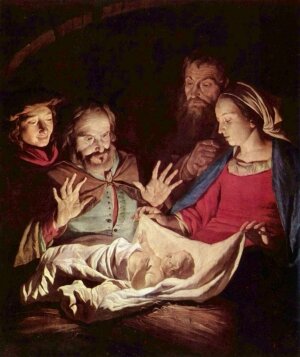
The infant Jesus in Adoration of the Shepherds, Gerard van HonthorstChristmas (literally, the Mass of Christ) is a traditional holiday commonly observed on 25 December. In most Eastern Orthodox Churches, even where the civil calendar used is the Gregorian, the event is observed according to the Julian calendar, which coincides with the predominant reckoning of 7 January. It is celebrated by most Christians to mark the birth of Jesus, which is believed to have occurred in Bethlehem in the Roman Province of Judea between 6 BC and AD 6. Christ's birth, or nativity, was said by his followers to fulfill the prophecies of Judaism that a messiah would come, from the house of David, to redeem the world from sin. Efforts to decide upon a date on which to celebrate his birth began some centuries later.

The word Christmas is a contraction of Christ's Mass, derived from the Old English Cristes mæsse. It is sometimes abbreviated Xmas, probably because X resembles the Greek letter Χ (chi) which has often historically been used as an abbreviation for Christ (Χριστός in Greek).

The Nativity of Jesus refers to the Christian belief that the Messiah was born to the Virgin Mary. The story of Christmas is based on the biblical accounts given in the Gospel of Matthew, namely Matthew 1:18-2:12 and the Gospel of Luke, specifically Luke 1:26-2:40. According to these accounts, Jesus was born to Mary, assisted by her husband Joseph, in the city of Bethlehem. According to popular tradition, the birth took place in a "stable", surrounded by farm animals, though neither the “stable” nor the animals are mentioned in the Biblical accounts.


More...

Monday, December 24, 2007

Christmas

Wise Men visiting Jesus after his birthChristmas (literally, the Mass of Christ) is a traditional holiday commonly observed on 25 December. In most Eastern Orthodox Churches, even where the civil calendar used is the Gregorian, the event is observed according to the Julian calendar, which coincides with the predominant reckoning of 7 January. It is celebrated by most Christians to mark the birth of Jesus, which is believed to have occurred in Bethlehem in the Roman Province of Judea between 6 BC and AD 6. Christ's birth, or nativity, was said by his followers to fulfill the prophecies of Judaism that a messiah would come, from the house of David, to redeem the world from sin. Efforts to decide upon a date on which to celebrate his birth began some centuries later.

The word Christmas is a contraction of Christ's Mass, derived from the Old English Cristes mæsse.

It is sometimes abbreviated Xmas, probably because X resembles the Greek letter Χ (chi) which has often historically been used as an abbreviation for Christ (Χριστός in Greek).

The Nativity

The Nativity of Jesus refers to the Christian belief that the Messiah was born to the Virgin Mary. The story of Christmas is based on the biblical accounts given in the Gospel of Matthew, namely Matthew 1:18-Matthew 2:12 and the Gospel of Luke, specifically Luke 1:26-Luke 2:40. According to these accounts, Jesus was born to Mary, assisted by her husband Joseph, in the city of Bethlehem. According to popular tradition, the birth took place in a "stable", surrounded by farm animals, though neither the “stable” nor the animals are mentioned in the Biblical accounts. However, a "manger" is mentioned in Luke 2:7 where it states "She wrapped him in cloths and placed him in a manger, because there was no room for them in the inn." Shepherds from the fields surrounding Bethlehem were told of the birth by an angel, and were the first to see the child. Christians believe that the birth of Jesus fulfilled many prophecies made hundreds of years before his birth.

More...

Sunday, December 24, 2006

Christmas

Wise Men visiting Jesus on Twelfth<br />Night after his birth on ChristmasChristmas (literally, the Mass of Christ) is a traditional holiday commonly observed on 25 December. In most Eastern Orthodox Churches, even where the civil calendar used is the Gregorian, the event is observed according to the Julian calendar, which coincides with the predominant reckoning of 7 January. It is celebrated by most Christians to mark the birth of Jesus, which is believed to have occurred in Bethlehem in the Roman Province of Judea between 6 BC and AD 6. Christ's birth, or nativity, was said by his followers to fulfill the prophecies of Judaism that a messiah would come, from the house of David, to redeem the world from sin. Efforts to decide upon a date on which to celebrate his birth began some centuries later.


The word Christmas is a contraction of Christ's Mass, derived from the Old English Cristes mæsse.


It is sometimes abbreviated Xmas, probably because X resembles the Greek letter Χ (chi) which has often historically been used as an abbreviation for Christ (Χριστός in Greek).

More...
 

Subscribe


LifeNews.com

Desiring God Blog

Youth for Christ International