Showing posts with label Passover. Show all posts

Saturday, April 23, 2011

Pesach


Photo of Passover Seder Plate showing (clockwise, beginning from top):maror (romaine lettuce), z'roa (roasted shankbone),
charoset, maror (chrein), karpas (celery sticks), beitzah (roasted egg).
Pesach (Passover, Hebrew: פֶּסַח; transliterated also as pecach, Pesah) "passover" which can refer to:
  1. sacrifice of passover,
  2. animal victim of the passover,
  3. festival of the passover,
which is from the Hebrew Root Word פָּסַח pacach "to pass over, spring over" is a Jewish holiday beginning on the 15th day of Nisan, which falls in the early spring and commemorates the Exodus and freedom of the Israelites from ancient Egypt. Passover marks the "birth" of the Jewish nation, as the Jews were freed from being slaves of Pharaoh and allowed to become servants of God instead.

In most languages of Christian societies, other than English, German and some Slavic languages, the holiday's name is derived from Pesach, the Hebrew name of Passover, a Jewish holiday to which the Christian Easter is intimately linked.

Together with Sukkot (or Succoth) and Shavuot, Passover is one of the three pilgrim festivals (Shalosh Regalim) during which the entire Jewish populace made a pilgrimage to Jerusalem in the days of the Holy Temple.

In Israel, Passover is a 7-day holiday, with the first and last days celebrated as a full festival (involving abstention from work, special prayer services and holiday meals). Outside Israel, the holiday is celebrated for 8 days, with the first two days and last two days celebrated as full festivals. The intervening days are known as Chol HaMoed (festival weekdays).
Passover in 2011 will start on sunset of Monday, the 18th of April and will continue for 7 days until Wednesday, the 26th of April.
The primary symbol of Passover is the matzo, a flat, unleavened bread which recalls the bread that the Israelites ate after their hasty departure from Egypt. According to Halakha, this bread is made from a dough of flour and water only, which has not been allowed to rise for more than 18–22 minutes. Many Jews observe the positive Torah commandment of eating matzo on the first night, as well as the Torah prohibition against eating or owning any leavened products — such as bread, cake, cookies, or pasta (anything whose dough has been mixed with a leavening agent or which has been left to rise more than 18–22 minutes) — for the duration of the holiday.

More...

Tuesday, April 07, 2009

Passover

Passover (Hebrew: פסח transliterated as Pesach or Pesah), also called חג המצות (Chag HaMatzot - Festival of Matzot) is a Jewish holiday beginning on the 15th day of Nisan, which falls in the early spring and commemorates the Exodus and freedom of the Israelites from ancient Egypt. Passover marks the "birth" of the Jewish nation, as the Jews were freed from being slaves of Pharaoh and allowed to become servants of God instead.

In most languages of Christian societies, other than English, German and some Slavic languages, the holiday's name is derived from Pesach, the Hebrew name of Passover, a Jewish holiday to which the Christian Easter is intimately linked.

Together with Sukkot and Shavuot, Passover is one of the three pilgrim festivals (Shalosh Regalim) during which the entire Jewish populace made a pilgrimage to Jerusalem in the days of the Holy Temple.

In Israel, Passover is a 7-day holiday, with the first and last days celebrated as a full festival (involving abstention from work, special prayer services and holiday meals). Outside Israel, the holiday is celebrated for 8 days, with the first two days and last two days celebrated as full festivals. The intervening days are known as Chol HaMoed (festival weekdays).

More...

Thursday, March 20, 2008

The Last Supper

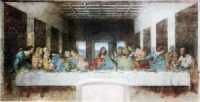
The Last Supper fresco in Milan (1498)  by Leonardo da Vinci.In the Christian faith, the Last Supper was the last meal Jesus shared with his apostles before his death. The Last Supper has been the subject of many different paintings, perhaps the most famous by Leonardo da Vinci. Christians celebrate the related events quasi-annually (annually on a Lunar Calendar) as Maundy Thursday.

In the New Testament

Chronology

The meal is discussed at length in the Gospel of Luke, chapter 22 of the Bible. It was the seder for the Passover, and it was in the morning of the same day the Paschal lamb, for the meal, had been sacrificed (see also: Korban).

However, under the Jewish method of reckoning time, the day was considered to begin straight after dusk, and so the Passover feast would be regarded as ocurring on the day after the lamb was sacrificed. This implies that either the synoptic gospels are not written with an awareness of the Jewish method of time reckoning (Kilgallen 264), or that they used the literary technique of telescoping events that actually happened on different days into just happening on single ones (Brown et al. 625).

More...

Tuesday, March 11, 2008

Korban

The lamb is one of the animals that was used as a sacrificial animal prior to 70 CE.Korban (קרבן) (plural: Korbanot קרבנות) is a Jewish practice of sacrificing an animal or of making an offering at the Temple. It is known as a Korban in Hebrew because its Hebrew root K [a] R [o] V (קרב) means to "[come] Close (or Draw Near) [to God]", which the English words "sacrifice" or "offering" do not fully convey. There were many different types of korbanot. Once performed as part of the religious ritual in the Temple in Jerusalem in Ancient Israel, the practice was stopped in 70 CE, after the destruction of the Second Temple

A Korban was usually an animal sacrifice, such as a lamb or a bull that was ritually slaughtered, and (usually) cooked and eaten by the offerer, with parts given to the Kohanim (priests) and parts burned on an altar. Korbanot could also consist of turtle-doves or pigeons, grain, incense, fruit, and a variety of other offerings.

The Hebrew Bible narrates that the God of Israel commanded the Children of Israel to offer korbanot up on various altars, and describes the ritual's practice in the ancient Tabernacle, on high places, and in the Temple in Jerusalem during the history of ancient Israel and Judah until the Second Temple was destroyed in 70 CE. Korbanot and the nature of their practice continue to have relevance to Jewish theology, ritual, and law, particularly in Orthodox Judaism.

More...

Sunday, April 01, 2007

Passover

The Last Supper fresco in Milan (1498)  by Leonardo da VinciPassover (Hebrew: פסח; transliterated as Pesach or Pesah), also called חג המצות (Chag HaMatzot - Festival of Matzot) is a Jewish holiday beginning on the 15th day of Nisan, which falls in the early spring and commemorates the Exodus and freedom of the Israelites from ancient Egypt. Passover marks the "birth" of the Jewish nation, as the Jews were freed from being slaves of Pharaoh and allowed to become servants of God instead.

In most languages of Christian societies, other than English, German and some Slavic languages, the holiday's name is derived from Pesach, the Hebrew name of Passover, a Jewish holiday to which the Christian Easter is intimately linked.

Together with Sukkot and Shavuot, Passover is one of the three pilgrim festivals (Shalosh Regalim) during which the entire Jewish populace made a pilgrimage to Jerusalem in the days of the Holy Temple.

In Israel, Passover is a 7-day holiday, with the first and last days celebrated as a full festival (involving abstention from work, special prayer services and holiday meals). Outside Israel, the holiday is celebrated for 8 days, with the first two days and last two days celebrated as full festivals. The intervening days are known as Chol HaMoed (festival weekdays).

more...


Subscribe


LifeNews.com

Desiring God Blog

Youth for Christ International