Showing posts with label theology. Show all posts

Sunday, August 07, 2011

Dr. Wayne Grudem Alliance Defense Fund - Q&A with Dr. Wayne Grudem "Politics according to the Bible" and "Why Theology is Important" 1-3

Dr. Wayne Grudem, Research Professor of Theology and Biblical Studies at Phoenix Seminary, speaks on Politics according to the Bible and Why Theology is Important.

"Politics according to the Bible"


Dr. Grudem is a co-founder and past president of the Council on Biblical Manhood and Womanhood.[1]

Grudem also edited (with John Piper) Recovering Biblical Manhood and Womanhood (which was named “Book of the Year” by Christianity Today in 1992). Zondervan released his new book, Politics According to the Bible on September 23, 2010.[2]  He has served as President of the Evangelical Theological Society (1999), and as a member of the Translation Oversight Committee for the English Standard Version of the Bible. He also served as the General Editor for the ESV Study Bible.[3]


See Also:
"Why Theology is Important"
Part 1

Part 2

Part 3

Tuesday, February 01, 2011

The Gospels

Books in the new testament referred to as the Gospels:

In Christianity, a gospel (from Old English, "good news") is generally one of four canonical books of the New Testament that describe the miraculous birth, life, ministry, crucifixion, and resurrection of Jesus. These books are the Gospels according to Matthew, Mark, Luke and John, written between 65 and 100 AD.

Many modern scholars argue that the sequence in which the Gospel accounts have traditionally been printed in the Bible is not the order of their composition, and that the first canonical gospel to have been written is Mark (c 65-70), which in turn was used as a source for the gospels of Matthew and Luke. Matthew and Luke may have also used the hypothetical Q Document. These first three gospels are called the synoptic gospels because they share a similar view. The last gospel, the gospel of John, presents a very different picture of Jesus and his ministry from the synoptics.

The vast majority of biblical scholars believe the canonical gospels were originally written in Greek, although some believe the gospel of Matthew was originally written in Aramaic or Hebrew and later translated to Greek. However, Eusebius wrote that Matthew composed the Gospel According to the Hebrews and his Church Catalog suggests that it was the only Jewish Gospel. Yet, some have accused Eusebius of falsification.

Originally, the "gospel" meant the proclamation of God's saving activity in Jesus of Nazareth, or the agape (love) message proclaimed by Jesus of Nazareth. This is the original New Testament usage (for example Mark 1:14-15 or 1 Corinthians 15:1-9; see also Strong's G2098). The word is still used in this sense. Ancient, non-canonical works that purport to quote Jesus (e.g., Gospel of Thomas) are also called gospels, and the term refers, in general, to works of a genre of Early Christian literature (cf. Peter Stuhlmacher, ed., Das Evangelium und die Evangelien, Tübingen 1983, also in English: The Gospel and the Gospels).

More

Thursday, February 04, 2010

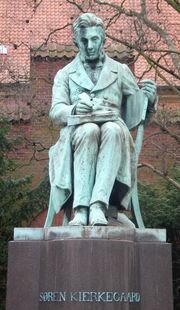
Søren Kierkegaard

Søren Aabye Kierkegaard (5 May 1813 – 11 November 1855) was a prolific 19th century Danish philosopher and theologian. Kierkegaard strongly criticized both the Hegelianism of his time, and what he saw as the empty formalities of the Danish church. Much of his work deals with religious problems such as the nature of faith, the institution of the Christian Church, Christian ethics and theology, and the emotions and feelings of individuals when faced with life choices. His early work was written under various pseudonyms who present their own distinctive viewpoints in a complex dialogue. Kierkegaard left the task of discovering the meaning of the works to the reader, because "the task must be made difficult, for only the difficult inspires the noble-hearted". Subsequently, many have interpreted Kierkegaard as an existentialist, neo-orthodoxist, postmodernist, humanist, individualist, etc. Crossing the boundaries of philosophy, theology, psychology, and literature, Kierkegaard came to be regarded as a highly significant and influential figure in contemporary thought.

Søren Kierkegaard was born to an affluent family in Copenhagen, the capital of Denmark. His mother, Ane Sørensdatter Lund Kierkegaard, had served as a maid in the household before marrying Søren's father. She was an unassuming figure: quiet, plain, and not formally educated. She is not directly referred to in Kierkegaard's books, although she too affected his later writings. His mother died on July 31, 1834, age 66.

His father, Michael Pedersen Kierkegaard, was a melancholic, anxious, deeply pious, and fiercely intelligent man. Convinced that he had earned God's wrath, he believed that none of his children would live past the age attained by Jesus Christ, that of 33. He believed his personal sins, such as cursing the name of God in his youth and possibly impregnating Ane out of wedlock, necessitated this punishment. Though many of his seven children died young, his prediction was disproved when two of them surpassed this age: Søren and Peter Christian Kierkegaard, a Lutheran bishop several years Søren's senior. This early introduction to the notion of sin and its connection from father and son laid the foundation for much of Kierkegaard's work (particularly Fear and Trembling). Despite his father's occasional religious melancholy, Kierkegaard and his father shared a close bond. Kierkegaard learned to explore the realm of his imagination through a series of exercises and games they played together.

Kierkegaard's father died on August 9, 1838 at the age of 82. Before his death, he asked Søren to become a pastor. Søren was deeply influenced by his father's religious experience and life and felt obligated to fulfill his wish. Two days later, on August 11, Kierkegaard wrote:
"My father died on Wednesday. I had so very much wished that he might live a few years longer, and I look upon his death as the last sacrifice which he made to his love for me; .. he died for me in order that, if possible, I might still turn into something. Of all that I have inherited from him, the recollection of him, his transfigured portrait .. is dearest to me, and I will be careful to preserve [his memory] safely hidden from the world."


More...


Subscribe


LifeNews.com

Desiring God Blog

Youth for Christ International