Showing posts with label 20th century German philosophy. Show all posts

Sunday, September 18, 2011

Leo Tolstoy

Count Lev Nikolayevich Tolstoy (Lyof, Lyoff) (September 9 [O.S. August 28] 1828 – November 20 [O.S. November 7] 1910) (Russian: Лев Никола́евич Толсто́й) commonly referred to in English as Leo Tolstoy, was a Russian writer – novelist, essayist, dramatist and philosopher – as well as pacifist Christian anarchist and educational reformer. He is perhaps the most influential member of the aristocratic Tolstoy family.

As a fiction writer Tolstoy is widely regarded as one of the greatest of all novelists, particularly noted for his masterpieces War and Peace and Anna Karenina. In their scope, breadth and realistic depiction of 19th-century Russian life, the two books stand at the peak of realist fiction. As a moral philosopher Tolstoy was notable for his ideas on nonviolent resistance through works such as The Kingdom of God is Within You, which in turn influenced such twentieth-century figures as Mahatma Gandhi and Martin Luther King, Jr.

Leo was born on his father's estate of Yasnaya Polyana, in the Tula guberniya of Central Russia. The Tolstoys are a well-known family of old Russian nobility, the writer's mother was born a Princess Volkonsky, while his grandmothers came from the Troubetzkoy and Gorchakov princely families. Tolstoy was connected to the grandest families of Russian aristocracy; Alexander Pushkin was his fourth cousin. His birth as a member of the highest Russian nobility marks off Tolstoy very distinctly from the other writers of his generation. He always remained a class-conscious nobleman who cherished his impeccable French pronunciation and kept aloof from the intelligentsia.

More...

Leo Tolstoy "The Last Years"

Monday, February 14, 2011

Paul Tillich


Albert Einstein (left, standing behind girl) and Paul Tillich (right, standing in front wearing glasses) at a conference in Davos, Switzerland on March 18, 1928. (Courtesy of Image Archive ETH-Bibliothek, Zurich).
Paul Johannes Tillich (August 20, 1886 – October 22, 1965) was a German-American theologian and Christian existentialist philosopher. Tillich was one of the most influential Protestant theologians of the twentieth century.

Biography
Paul Tillich was born on August 20, 1886, in the province of Brandenburg in eastern Germany in the small village of Starzeddel. Tillich's Prussian father was a Lutheran pastor and his mother was from the Rhineland and more liberal, influenced heavily by Calvinist thinking. At an early age Tillich held an appreciation for nature and the countryside into which he had been born. Among the general populace, he is best known for his works The Courage to Be (1952) and Dynamics of Faith (1957), which introduced issues of theology and modern culture to a general readership. Theologically, he is best known for his major three-volume work Systematic Theology (1951–63), in which he developed his "method of correlation": an approach of exploring the symbols of Christian revelation as answers to the problems of human existence raised by contemporary existential philosophical analysis.

Paul Tillich’s life has been chronicled in a biography, a partially biographical book (Hopper, 1968), an autobiographical sketch (in On the Boundary), and two autobiographical essays (in Kegley and My Search for Absolutes).

More...

Tuesday, December 14, 2010

Johannes Brahms

Johann Strauss II and Johannes Brahms
Johannes Brahms (pronounced [joːˈhanəs ˈbʁaːms]) (May 7, 1833 – April 3, 1897) was a German composer of the Romantic period. Born in Hamburg, he eventually settled in Vienna, Austria.

His first and most devoted supporter, Robert Schumann (1810-56), called him "another John the Baptist, whose revelations will puzzle many of the Pharisees, and every one else, for centuries."

Brahms's father, Johann Jakob Brahms, came to Hamburg from Schleswig-Holstein, seeking a career as a town musician. He was proficient on several instruments, but found employment mostly playing the horn and double bass. He married Johanna Henrika Christiane Nissen, a seamstress, who was seventeen years older than he was. Initially, they lived near the city docks, in the Gängeviertel quarter of Hamburg, for six months before moving to a small house on the Dammtorwall, located on the northern perimeter of Hamburg in the Inner Alster.

Johann Jakob gave his son his first musical training. He studied piano from the age of seven with Otto Friedrich Willibald Cossel. Brahms showed early promise (his younger brother Fritz also became a pianist) and helped to supplement the rather meager family income by playing the piano in restaurants and theaters, as well as by teaching. It is a long-told tale that Brahms was forced in his early teens to play the piano in bars that doubled as brothels; recently Brahms scholar Kurt Hoffman has suggested that this legend is false. Since Brahms himself clearly originated the story, however, some have questioned Hoffman's theory.


More...


 Johannes Brahms, Hungarian Dance No. 5

Wednesday, October 06, 2010

Secular humanism

Secular humanism is a humanist philosophy that upholds reason, ethics, and justice and specifically rejects rituals and ceremonies as a means to affirm a life stance. The term was coined in the 20th century to make a clear distinction from "religious humanism". A perhaps less confrontational synonym is scientific humanism, which the biologist Edward O. Wilson claimed to be "the only worldview compatible with science's growing knowledge of the real world and the laws of nature.

When humanists use the phrase secular humanism it is typically to emphasize differences relative to religion or religious humanism. There are a number of ways in which secular and religious humanism can differ:
  • Religious humanists may value rituals and ceremonies as means of affirming their life stance. Secular humanists are typically not interested in using rituals and ceremonies.
  • Some religious humanists may seek profound "religious" experiences, such as those that others would associate with the presence of God, despite interpreting these experiences differently. Secular humanists would generally not pursue such experiences.
  • Some varieties of nontheistic religious humanism may conceive of the word divine as more than metaphoric even in the absence of a belief in a traditional God; they may believe in ideals that transcend physical reality; or they may conceive of some experiences as "numinous" or uniquely religious. Secular humanism regards all such terms as, at best, metaphors for truths rooted in the material world.
  • Some varieties of religious humanism, such as Christian humanism include belief in God, traditionally defined. Secular humanism is skeptical about God and the supernatural and believes that these are not useful concepts for addressing human problems.
While some humanists embrace calling themselves secular humanists, others prefer the term Humanist, capitalized and without any qualifying adjective. The terms secular humanism and Humanism overlap, but have different connotations. The term secular humanism emphasizes a non-religious focus, whereas the term Humanism de-emphasizes this and may even encompass some non-theistic varieties of religious humanism. The term Humanism also emphasizes considering one's humanism to be a life stance. Secular humanism advocates secularism but is a broader concept. Secularism has a number of usages but generally emphasize limits on the role of religious or supernatural considerations in the affairs of society or government. Secular humanism adds to these positions a comprehensive perspective on life, including affirmation of human dignity and the importance of ethics.

More...
 ...includes Julie Andrews singing "something good" and "your crowning glory"

Saturday, September 12, 2009

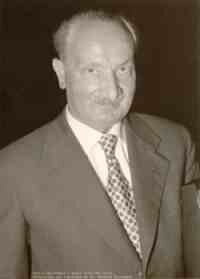
Martin Heidegger

Martin Heidegger 1950’s, © Dr. Hermann HeideggerMartin Heidegger (September 26, 1889 – May 26, 1976) was an influential German philosopher. His best known book, Being and Time (German: Sein und Zeit, 1927), is generally considered to be one of the key philosophical works of the 20th century.

Heidegger claimed that Western philosophy has, since Plato, misunderstood what it means for something to be, tending to approach this question in terms of a being, rather than asking about being itself. In other words, Heidegger believed all investigations of being have historically focused on particular entities and their properties, or have treated being itself as an entity, or substance, with properties. A more authentic analytic of being would, for Heidegger, investigate "that on the basis of which beings are already understood," or that which underlies all particular entities and allows them to show up as entities in the first place.

But since philosophers and scientists have overlooked the more basic, pre-theoretical ways of being from which their theories derive, and since they have incorrectly applied those theories universally, they have confused our understanding of being and human existence. To avoid these deep-rooted misconceptions, Heidegger believed philosophical inquiry must be conducted in a new way, through a process of retracing the steps of the history of philosophy.

More...
 

Subscribe


LifeNews.com

Desiring God Blog

Youth for Christ International