Showing posts with label Being and Time. Show all posts

Saturday, September 12, 2009

Martin Heidegger

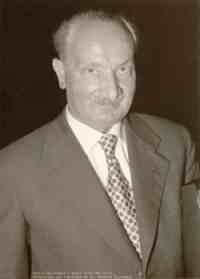
Martin Heidegger 1950’s, © Dr. Hermann HeideggerMartin Heidegger (September 26, 1889 – May 26, 1976) was an influential German philosopher. His best known book, Being and Time (German: Sein und Zeit, 1927), is generally considered to be one of the key philosophical works of the 20th century.

Heidegger claimed that Western philosophy has, since Plato, misunderstood what it means for something to be, tending to approach this question in terms of a being, rather than asking about being itself. In other words, Heidegger believed all investigations of being have historically focused on particular entities and their properties, or have treated being itself as an entity, or substance, with properties. A more authentic analytic of being would, for Heidegger, investigate "that on the basis of which beings are already understood," or that which underlies all particular entities and allows them to show up as entities in the first place.

But since philosophers and scientists have overlooked the more basic, pre-theoretical ways of being from which their theories derive, and since they have incorrectly applied those theories universally, they have confused our understanding of being and human existence. To avoid these deep-rooted misconceptions, Heidegger believed philosophical inquiry must be conducted in a new way, through a process of retracing the steps of the history of philosophy.

More...

Sunday, May 17, 2009

Being and Time

Being and Time (German: Sein und Zeit, 1927) is a book by German philosopher Martin Heidegger. Although written quickly, and despite the fact that Heidegger never completed the project outlined in the introduction, it remains his most important work and has profoundly influenced 20th-century philosophy, particularly existentialism, hermeneutics and deconstruction.

Being and Time was originally intended to consist of two major parts, each part consisting of three divisions. Heidegger was forced to prepare the book for publication when he had completed only the first two divisions of part one. The remaining divisions planned for Being and Time (particularly the divisions on time and being, Immanuel Kant, and Aristotle) were never published, although in many respects they are addressed in one form or another in Heidegger's other works. In terms of structure, Being and Time remains as it was when it first appeared in print; it consists of the lengthy and important two-part introduction, followed by Division One, the "Preparatory Fundamental Analysis of Dasein," and Division Two, "Dasein and Temporality."

More...
 

Subscribe


LifeNews.com

Desiring God Blog

Youth for Christ International