Showing posts with label Stanley Hauerwas. Show all posts

Thursday, May 07, 2009

Narrative theology

Wisembach, Commune des Vosges, Copyright © Christian AmetNarrative theology was a late 20th century theological development which supported the idea that the Church's use of the Bible should focus on a narrative presentation of the faith, rather than on the development of a systematic theology. The Christian faith is thus also to be interpreted by the Christian community, and not by outside scholars or explorers.

Partly a reaction to the modern, individualist and romantic trends of theological liberalism, important post liberal thinkers included George Lindbeck, Hans Wilhelm Frei, and Stanley Hauerwas.

Frequently referred to as postliberal theology, narrative theology was inspired by a group of theologians at Yale Divinity School, many influenced theologically by Karl Barth, Thomas Aquinas and to some extent, the nouvelle théologie of French Catholics such as Henri de Lubac. The clear philosophical influence, however, was Ludwig Wittgenstein's philosophy of language, the moral philosophy of Alasdair MacIntyre, and the sociological insights of Clifford Geertz and Peter Berger on the nature of communities.
More...
Wednesday, February 27, 2008

Protestant Reformation

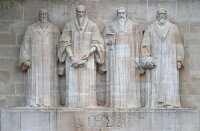
The Reformation Wall in Geneva. From left: William Farel, John Calvin, Theodore Beza, and John Knox The Protestant Reformation was a movement that emerged in the 16th century as a series of attempts to reform the Roman Catholic Church in Western Europe. The main front of the reformation was started by Martin Luther and his 95 Theses. The reformation ended in division and the establishment of new institutions, most importantly Lutheranism, the Reformed churches, and Anabaptists, a radical branch whose name means "those who baptize again".

It also led to the Counter-Reformation within the Roman Catholic Church, which theological draft and background were drawn up with the Council of Trent (1548–1563), when Rome struck back against the fundamental ideas defended by the Reformers, like Luther. The rift between Catholics and Protestants would lead to the break up of large European empires into the modern nation-state system.

Unrest in the Western Church and Empire culminating in the Avignon Papacy (1308–1378), and the papal schism (1378–1416), excited wars between princes, uprisings among the peasants, and widespread concern over corruption in the monastic system. A new nationalism also challenged the relatively internationalist medieval world.

One of the most disruptive and radical of the new perspectives came first from John Wycliffe at Oxford University, then from John Huss at the University of Prague. The Roman Catholic Church officially concluded this debate at the Council of Constance (1414–1418). The conclave condemned Jan Hus, who was executed (he had come under a promise of safe-conduct) and posthumously burned Wycliffe as a heretic.

More...


Subscribe


LifeNews.com

Desiring God Blog

Youth for Christ International