Showing posts with label Isaac Newton. Show all posts

Wednesday, December 08, 2010

Founders of modern science

Science (from the Latin scientia, 'knowledge') is a system of acquiring knowledge based on the scientific method, as well as the organized body of knowledge gained through such research. Science as defined here is sometimes termed pure science to differentiate it from applied science, which is the application of scientific research to specific human needs.

The renewal of learning in Europe, that began with 12th century Scholasticism, came to an end about the time of the Black Death, and the initial period of the subsequent Italian Renaissance is sometimes seen as a lull in scientific activity. The Northern Renaissance, on the other hand, showed a decisive shift in focus from Aristoteleian natural philosophy to chemistry and the biological sciences (botany, anatomy, and medicine). Thus modern science in Europe was resumed in a period of great upheaval: the Protestant Reformation and Catholic Counter-Reformation; the discovery of the Americas by Christopher Columbus; the Fall of Constantinople; but also the re-discovery of Aristotle during the Scholastic period presaged large social and political changes (see the Renaissance).

Thus, a suitable environment was created in which it became possible to question scientific doctrine, in much the same way that Martin Luther and John Calvin questioned religious doctrine. The works of Claudius Ptolemaeus (astronomy) and Galen (medicine) were found not always to match everyday observations. Work by Vesalius on human cadavers found problems with the Galenic view of anatomy.

The willingness to question previously held truths and search for new answers resulted in a period of major scientific advancements, now known as the Scientific Revolution. The Scientific Revolution is traditionally held by most historians to have begun in 1543, when De Revolutionibus, by the astronomer Nicolaus Copernicus, was first printed. The thesis of this book was that the Earth moved around the Sun. The period culminated with the publication of the PhilosophiƦ Naturalis Principia Mathematica in 1687 by Isaac Newton.

More...


 Galileo and the Church, Part 1 of 4
Wednesday, August 08, 2007

Isaac Newton

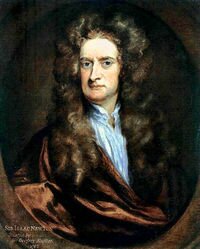
Newton in 1702. Portrait by Godfrey KnellerSir Isaac Newton, (4 January 1643 – 31 March 1727) [ OS: 25 December 1642 – 20 March 1727] was an English physicist, mathematician, astronomer, natural philosopher, and alchemist, regarded by many as the greatest figure in the history of science. His treatise Philosophiae Naturalis Principia Mathematica, published in 1687, described universal gravitation and the three laws of motion, laying the groundwork for classical mechanics. By deriving Kepler's laws of planetary motion from this system, he was the first to show that the motion of objects on Earth and of celestial bodies are governed by the same set of natural laws. The unifying and predictive power of his laws was central to the scientific revolution, the advancement of heliocentrism, and the broader acceptance of the notion that rational investigation can reveal the inner workings of nature.

In mechanics, Newton also markedly enunciated the principles of conservation of momentum and angular momentum. In optics, he invented the reflecting telescope and developed a theory of colour based on the observation that a prism decomposes white light into a visible spectrum. Newton notably argued that light is composed of particles. He also formulated an empirical law of cooling, studied the speed of sound, and proposed a theory of the origin of stars. In mathematics, Newton shares the credit with Gottfried Leibniz for the development of calculus. He also demonstrated the generalized binomial theorem, developed the so-called "Newton's method" for approximating the zeroes of a function, and contributed to the study of power series.


French mathematician Joseph-Louis Lagrange often said that Newton was the greatest genius who ever lived, and once added that he was also "the most fortunate, for we cannot find more than once a system of the world to establish." English poet Alexander Pope was moved by Newton's accomplishments to write the famous epitaph:


“ Nature and nature's laws lay hid in night; God said "Let Newton be" and
all was light. ”


More...
 

Subscribe


LifeNews.com

Desiring God Blog

Youth for Christ International